
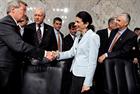
Senators Snowe and Baucus shake on the Americans Healthy Futures Bill
Today the last of the five healthcare reform bills in the US Congress was passed from committee to the floor of one of the two chambers. The Senate will have two bills endorsed by committees to consider and there will be three committee endorsed bills in the House of Representatives. Of course each of these bills will have a certain amount of powerful institutional endorsement and each will have been written so that there is something to be negotiated away. I have used this blog to promote my own ideas of a healthcare reform plan.
So, for no particular reason, instead of going over these five bills I am reprinting my plan in today’s blog post. If you like it talk to someone about it send a copy to the Congress, print it out and mail it to a friend in a relevant industry. We could still see a plan like this plan become the law of the land.
A Dozen Policy Points on Healthcare:
1.Medicare and S-CHIP programs should be mostly preserved. Medicaid should be reformed but not abolished.
2. Americans should each be allowed to join three or fewer family associations and pay in one percent of their taxable income tax with the amount of the family association deductible from the amount of each Americans tax liability. Donations to each and all of these funds should be able entitled to FDIC protection in a special class of funds and authorized to buy health insurance, get loans and make investments in a structure of options designed by the government to address the Healthcare situation. One investment which would qualify for some Federal support would be a Community Clinic.

My nieces and nephews at my maternal grandparents home
3. A National Wellness Agency should be established. One mil of all FICA revenues and small fee of say $1.00 collected from everyone entering the United States would be devoted exclusively to this NWA. The NWA would have various chartering regimes for Community Clinics being especially generous to those already existing in getting Agency approval.
4. The NWA would have a subagency devoted to collecting, inspecting and dating unused medicines from institutions and deceased persons and would distribute them to Community Clinics.
5. Every physician who received federal financial aid would be required to spend one day for every thousand dollars of Federal loans and five days for every thousand dollars of Federal grants working for an approved Community Clinic after basic medical school graduation and before any extended residency or specialty training. The National Wellness Agency would oversee this program.
6. The National Wellness Agency would receive a dedicated tax of one mil of every health and life insurance premium collected in the United States. This money would largely (but not exclusively) pay for a coordination program linking Community Clinics to school nurses, fitness centers, foodbanks, shelters, eldercare and daycare facilitites as well as other community institutions.
7. The Community Clinics would have hours reserved for only those invested in the clinic or owning cheap Community Clinic Insurance which would be available to all including fugitive felons and illegal aliens on confidential basis. The Community Clinics would also charge a visit fee of five dollars and a file fee of twenty dollars per year to any one able to pay and not insured. Half of one percent of the revenues of each clinic would be paid to the National Wellness Agency. Insurance would be about ten dollars per household per month and would cover clinic fees if current.
8. The National Wellness Agency would also receive a small dedicated of perhaps one percent on all imported alcohol, tobacco, firearms and high performance recreational vehicles. These funds would be largely dedicated to the Volunteer Support Program. Meals and seminars would be provided where possible for Health and Medical Professionals volunteering at Community Clinics. The Clinics would keep track of hours and the volunteers would receive a check at the end of each year for the federal minimum wage or one fifth of their normal hourly rate of pay — whichever was less.
9. The National Wellness Agency would offer a lottery for tests, specialists and referrals for all those holding Community Clinic Insurance. The NWA would also interface with research institutions, charity hospitals and other players. These agencies would also be required to dedicate at least one percent of the value of Federal funds received to the network of deserving cases.
10. The National Wellness Agency would train community workers in churches, clubs and sports leagues and sponsor nutrition, hygiene and other programs. This activity would be paid for in large part by a one mil tax on the wholesale and a one percent tax on the retail of all prescribed pharmaceuticals. These community workers would be trained to transport persons needing care to the Community Clinics. Clinics would work with other nonprofit organizations of all types to create medical transport with donated vehicles and other assets.
11. Emergency Rooms and Ambulances would be required to give some triage preference to those coming from Community Clinics over those coming from the open street.
12. Corporations which sponsored a Community Clinic would receive a Wellness Program Support Package from the NWA tied to their level of support.
That is about half the operative language which I have devoted to this program. The other half of the language is just coming up below (to use an odd turn of phrase). The rest is about risk, torts, conflict and problems not with health but with the system itself.
So while I presumed to use a dozen principles to change everything in terms of laying out the new scheme I will allow myself twelve principles just for dealing with legal conflicts which arise. I propose a DOZEN LEGAL PRINCIPLES FOR THE NEW REGIME:
1. All malpractice policies and automobile liability policies and any other policies which insure against tort liability must cover any activity generally or usually covered when it is performed by a Community Clinic or the National Wellness Agency or in collaboration with them.
2. All users of the Community Clinics will sign a liability waiver when using the program and will be limited to the maximum level of benefits on a set program of awards and benefits unless a plaintiff can show intentional tort or criminal malfeasance.
3. Workers Compensation Programs which assist in administering this liability program will qualify for discounts and special services as investors in the clinic system.
4. The National Wellness Agency shall have standing to defend any claim against a licensed Community Clinic.
5. All law students receiving federal grants and loans will be required to contribute one day for every thousand dollars in loans and five days for every thousand dollars in grants after the end of their second year and before beginning a regular practice to the National Wellness Agency. These students will assist in malpractice defense. They shall also assist the NWA in suing those who create a narrowly defined new federal Threat to Public Health. A sizable portion of the funds collected in each of these cases shall go into two dedicated funds. One shall be used to compensate those injured and the other to assist in all aspects of liability management including defense of malpractice.
6. All liability insurers for companies where the NWA maintains a wellness support program must contribute half of one percent of all premiums collected to the total liability management fund of the National Wellness Agency.
7. The National Wellness Agency shall assist in the development of safety standards and seminars for all Community Clinics.
8. Emergency Rooms and Ambulances shall have National Wellness Agency liaison subagency that interacts them in providing quick emergency support to clinics and using clinics to better mange crises.
9. The NWA will have as part of its mission to increase the effectiveness of its partners in providing safe low level health services as school nurses, fitness trainers and others who enhance health outside of sickcare.
10. The US military will have protocols for crisis management support with the NWA and clinics so that hospitals and other providers will not be as quickly overwhelmed by crises which arise in cities and regions. This will be secondary to their purely military missions but still mandated.
11. Hospitals shall be required to acknowledge and not undermine the work of those providing a less defensive standard of care in the Community Clinics than is to be the standard in hospitals and other institutions.
12. All medical records of community clinics are to be capable of transmission to all other clinics through the NWA to minimize errors and risk.

San Francisco Mayor Newsom in an unrelated appearance with Former Pres. Clinton
Recently on television news, I think it was on CBS Sunday Morning, I saw a special report on Mayor Newsome and the City of San Francisco and their program called Healthy San Francisco. I really felt when I watched the show that this program would be a tremendous assistance to them in trying to make their system work. It would be a real boost if it could be made to interface well with what is good in their system.They would give this national structure the right shape and flavor for San Francisco. I am sure that the members of the Senate Finance Committee also feel that their bill would assist the best programs and initiatives in states and communities but I am skeptical about the likelihood that this will happen.


 Franksummers3ba's Blog