Category Archives: Abbeville

Emerging Views: Chapter Eleven The Movie at the Dixie as it Was

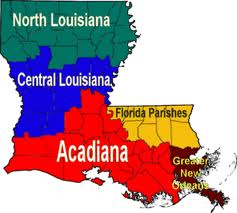
This posting of this chapter raises a few issues for me. Not the least of these issues is that Chapters Thirteen and Fourteen are still not ready to be posted and chapter fourteen will be ready before Chapter Thirteen. So my little serialization system is about to experience some more strain than it already has. Secondly it is time to post a few more bits of accompanying information for those who are not  reading this right now but may in one of the unpredictable future upswings in readership which this blog occasionally enjoys. Below is a map to more or less remind or inform people of what the Acaidana region is.


More or less what Acadian means to those who do not know...

More or less what Acadiana means to those who do not know…

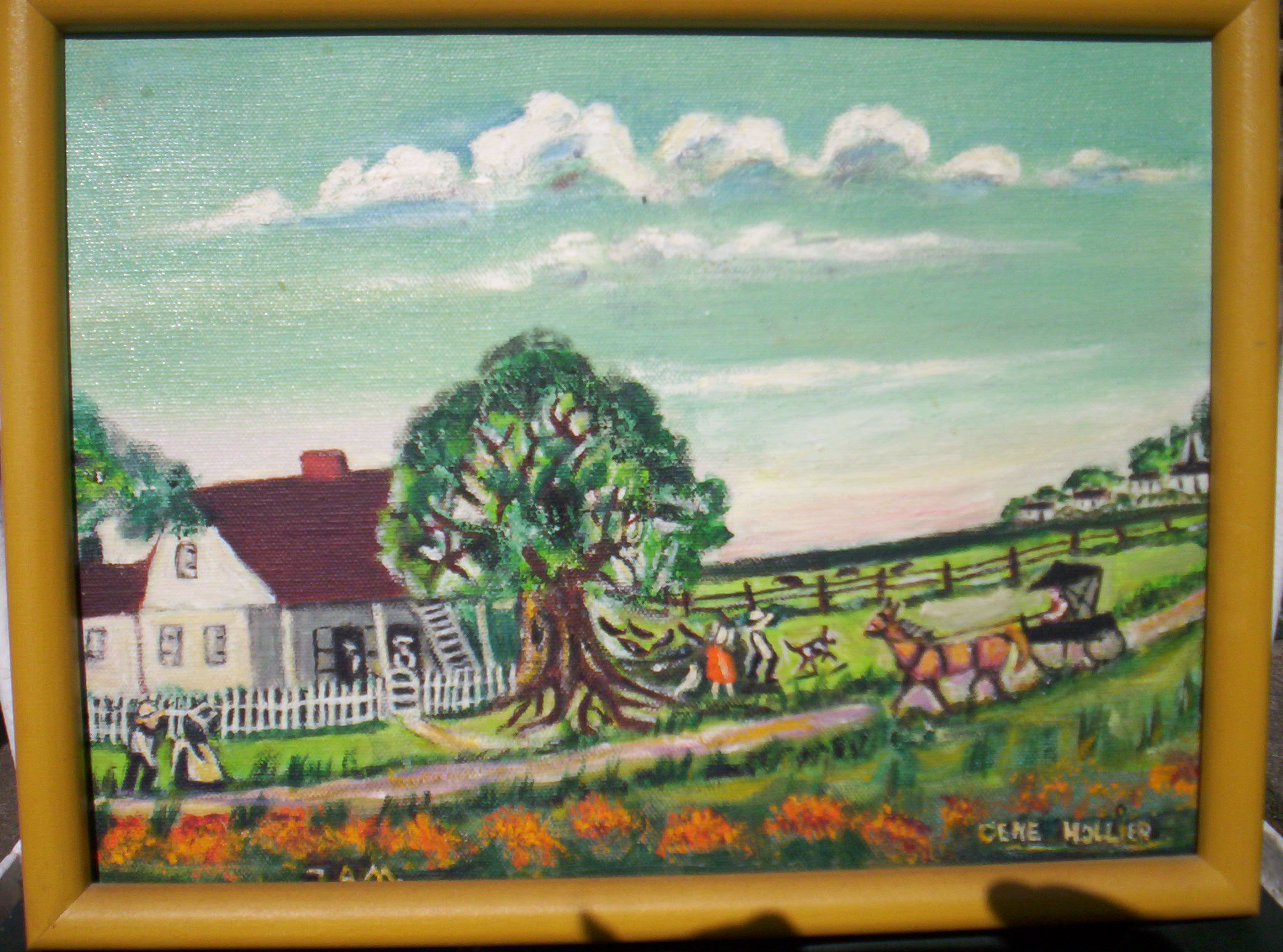
But this post brings up more than this  map relates to — at least directly. Here below is one of my grandmother’s pictures of a period before the film premiere and painted long after the film premiere. But it does address issues of cultural relevance and give a little more context to the discussion.


My great grandmother painted glimpses of Cajun life -- this is one of those.

My great grandmother painted glimpses of Cajun life — this is one of those.

So we come to a chapter that shows how the local community responded to the premiere of Louisiana Story. I hope that it is informative and entertaining to at least some reader and a bit more to an even smaller set of people.

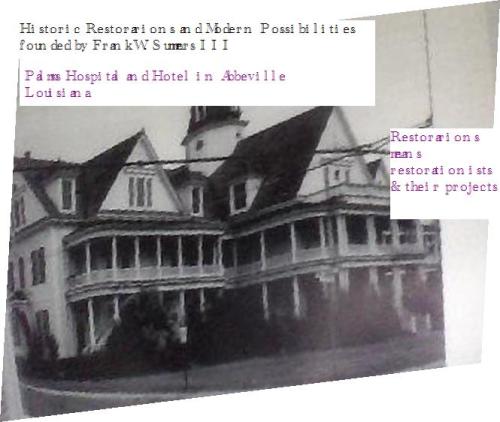
This is a glimpse of how the black and white film was presented to the world. The local papers ran black and white promotional and reporting spreads.

This is a glimpse of how the black and white film was presented to the world. The local papers ran black and white promotional and reporting spreads.


Here is a pdf version of the text: EmergingViewsChapterElevenTheMovieattheDixieasitWas (1)

Here is the text itself:

Chapter Eleven:

The Movie at the Dixie as it Was


The previous chapter tried to see the premiere of Louisiana Story in the context of history and in the relevance it has to our own times. In doing so a few liberties were taken with the normal conventions for an historical narrative. There was no premiere at the Frank’s. The premiere was held at the Dixie which in time became the Frank’s Theater. It was not held in 1948 which is the official date of release but early in 1949. The two chapters are meant to illustrate also the problems with what I call folkloristic evidence. There is no doubt that people not old enough to be there who do have a memory — in the folklorisitic sense — of the film remember it being at the Frank’s in 1948. There are some who have better data and some worse. But such memories are not rendered entirely worthless. The building known as the Frank’s today is indeed the spot and 1948 is the place to find the film on most lists arranged by year.   This chapter seeks to look at the premiere of the film as it was viewed and understood at the time, also to provide a kind of plain and straightforward narrative history of the film as it was perceived although not in great detail nor exhaustively. It does not seek to apologize for the fact that it has been perceived through an evolving lens. It only seeks to balance that view with one more restricted to the known responses of people to the film at the time. It especially looks at the response of local journalists and the interviews they did with local people whose own words about the film have not appeared much in this text so far. This work of history is obviously more personal than most works of academic history and the people and places make up a framework of the writer’s life. In addition, the time and delays involved in the production of the text give it a certain quality of intimacy that may not be ideal but cannot be avoided. My own experience with the Abbeville Meridional newspaper is very extensive — I have been featured in it, read it and been employed by it on far too many occasions to discuss here. That is for the reader to bear in mind.  Clearly, I think that a great deal of academic objectivity is brought to all the varied sources relied upon by this text and to the questions raised in pursuing its arguments and narrative. But the reader will have to evaluate that for him or herself.


The masthead under which the coverage appeared was different than than of today but similar and familiar as well. Today’s masthead states that the paper is “The Voice of Vermilion Parish, The Most Cajun Place on Earth”. In those days it merely said: “ABBEVILLE MERIDIONALOLDEST CONTINUOUS BUSINESS IN VERMILION PARISH ABBEVILLE, LOUISIANA, SATURDAY, FEBRUARY 19, 1949 LEADING NEWSPAPER OF VERMILION PARISH SINOE 1856 NO; 8 “


There were two articles on the front page in that issue but deeper inside was an extravagant full page pictorial spread that told readers it would be at the Dixie Theater from the next day, Sunday, February 20, 1949 to the following Thursday. The newspaper also had a regular advertisement for its films which showed too mainstream films playing as a double feature on Friday and Saturday which were its biggest money making days. That same advertisement did however give the “Southern Premiere” of Louisiana Story bigger billing than either of the other two films. But in addition to being extravagant for such a spread in this particular paper it has the following telling lines on the side among others:|

Showing In The South A GEM! Abbeville has been chosen as the “Premiere City for this great film, LOUISIANA STORY, because it was filmed here and stars Vermilion Parish people. It’s- film is the everyday story your friends and your relatives.


The pictorial spread shows review snippets from the New York Times, Life Magazine and other sources. The celebration of the film as everyday life is very telling. It is not clear if the writer of those lines had seen the film but it has some significance in any case. It was a Saturday issue and in Louisiana to be classified as a daily one need only publish five papers a week. That is what the Meridional has done for a while including at the time of this writing. Today there is no Saturday or Monday issue but in those days the Saturday issue came out regularly and this was one of those issues. There were at least two articles about the film on the first page and may have been a mention elsewhere that has escaped my research.

The first and more background oriented article begins; with a montage of photographs described as follows:

Filmed entirely in the marshes of Vermilion, Iberia and Lafayette parishes, “Louisiana Story” has as its stars Joseph Boudreaux of Cameron parish and Lionel LeBlanc of Abbeville. Scenes reproduced from the picture show Mr. LeBlanc, above, looking into the sky, Joseph talking with Frank Hardy, an oil worker, left, and fondling his pet raccoon, top left.

This little detail is significant because photo essays are expensive and time-consuming  for small community papers and this would not be the last to be placed in the paper related to this film. This article goes on:

Louisiana Story’s Lionel LeBlanc — Abbeville’s own movie star, came to our office Tuesday, sat down in our chair and told us how much he enjoyed making “Louisiana Story”. “It’s too bad we didn’t meet 20 years ago,” he quoted Producer-Director Robert Flaherty as telling him, “because we could have done great things together.” LeBlanc, who is now 65 years old and .’almost* past the times when he could spend days and days bogging through the marsh country, says that, despite his age, he didn’t find the filming of the story, too rigorous a job “Times have changed since I first went into the marshes. Then it ‘was work to kill an alligator, but now my four sons, all of whom are trappers, can drive their boats with ‘motor paddles’ right up to where the ‘gator is,” the Louisiana Story actor remembers. “Then all they have to do is shoot him and drag him into the boat.”


The personal tone is typical perhaps of Southern rural newspapers and even small American newspapers but it is especially true of the Cajun rural community press.  The story about how much harder life was when he was young than it is for the pampered trappers of the modern era is also an old Cajun tradition which resonates no doubt among cowboys, loggers and lobstermen of other American rural ethnicities. The article continues to let the reader get to know more about this man lifted to the movie screens which Cajuns generally liked and admired.


LeBlanc killed his last alligator 10 years ago. He now handles E. A. Mcllhenny’s trapping ranch • and has been doing that work for 20 years. It was through Mr. Mcllhenny that Mr. LeBlanc was discovered by the film producer. He reports that Mr. Flaherty asked the fur ranch owner where he could find a man who knew the marshes and who looked like and was a fur trapper,  Abbeville’s star, whose home is on Maude Avenue, remembers one bad experience during the filming of the movie.


In the days of the film Abbeville had racial segregation of housing. Today Maude Avenue is made up of some white families, some Vietnamese families and is largely an African- American (with the distinct cultural mix that still exists to a fading degree among African Americans in Acadiana) middle class neighborhood. In those days it was a neighborhood of the prosperous white working class. Nothing fancy but a good place to live from which a daughter or son might contend for a place in what economically based social strata existed in the parish not as an equal but above a few other neighborhoods in a town which did note such things.  After this implied bit of social introduction and orientation as to who Lionel Leblanc is in the community, the Meridional gives a brief passage a chance to relate the worlds of trapping and movie-making as they coexist in this new moment of history. Here it is worth repeating the last half of the last sentence.


… Abbeville’s star, whose home is on Maude Avenue, remembers one bad experience during the filming of the movie.

He and a crew of others went out into the marshes on a “marsh buggy” which bogged down. LeBlanc and the crew had to walk several miles to get out of the swamp. Mr. LeBlanc smiles as he remembers that the producer, who is about 65, wanted to make the trip with them. With his knowledge of the danger in the swamp and the weaknesses of all man-made attempts to tame the swamps, he adds that “Mr. Flaherty might not have gotten out because you have to know how to ‘walk the marshes’ “.


Walking the marshes is no joke. Harnett T. Kane has a passage in his influential book in these projects about walking what I was raised to call Flotant  and there so many risks they literally could fill a chapter very neatly.  The marshes and swamps are beautiful and abundant but they offer more risks than a stranger can usually even properly imagine. Flaherty of course was no ordinary stranger but a man who had put new lands into the world’s maps.  Yet the trapper, who clearly liked Flaherty just fine knows the man was not ready for that environment in the time of preparation allowed in a shooting schedule. Trappers walk the marsh — almost nobody else does. Native Americans rarely did and more as proof of manliness under grave risk than as a livelihood. Hunters, fishermen, ranchers and oilmen may boast of having done so a few times now and then and they do so usually with a lot of bravado in the telling. But for the true trapper it is a matter of daily life and daily bread. The Meridional knows that many of the parish’s young people of greater advantages would in many cases dream of being movie stars and they have catered to such interests in varied ways over decades. Therefore, they explore what the unlikely local hero of the glamorous industry has to say about life on film.


When asked if he intended continuing in the movies, Mr. LeBlanc said, an emphatic “no”. He says that he will continue to trap however, in this, however, he also is a bit discouraged. “Trapping isn’t as good now as it was. This season I have seen many go into the marshes and come out with their expenses on their backs.” But, at 65, he has the right to ‘hibernate’ at his home on Maude Avenue, and bask in his glory. There aren’t many who can become full-fledged movie stars after spending 64 years in the marshes of Louisiana.


There is a whole fabric of social cues in this brief article which cannot be spelled out without making too much of them but which the reader may be able to speculate upon after reading this text. The next article on the front page serves as an interesting framework and foundation for better understanding an earlier chapter about “Cajun Works”. Remember that the film industry has become rooted in this small place of small enterprises and the newspaper coverage shows that this work was begun as people took every advantage they could of the possible opportunities to make the moviemakers feel connected and welcome in this place. The next article is about the premiere itself.  It is reproduced in full below as it appeared.


Throngs Are Expected For Southern Premiere


The first premiere in the history of Abbeville will be held Sunday when “Louisiana Story,” a film depicting the encroachment of modern industry over trie fur trapper in his native marshes, opens here. State officials, representatives from nearby towns, stars of the film, representatives of the state press and a contingent from Life magazine


Robert Flaherty, producer and director, with his staff, will arrive by plane Friday and will remain through Sunday. Invitations have been extended to Governor Earl K. Long, the directors of various state departments, Mayor Delesseps Morrison, the mayors of Lafayette, New Iberia, and Crowley and to others. The film, which has been awarded several prizes for its excellence, was produced by Robert Flaherty under a grant from a major oil company. The veteran producer spent 14 months making it and maintained his headquarters at the Mettles home in Abbeville.


He picked the stars from the surrounding territory, Lionel LeBlanc, who lives on Maude avenue and is employed by E. A. Mcllhenny, was selected to play the part of the father in the film. Joseph Boudreaux, a native of Cameron parish, was cast in the roll of the son. It is around him and his experiences with the members of the oil company crew that is the basis for the story. But the film is more than the story of the boy and the oil country —it is the story of the adventure and the intrigue of bayou swamps, the marshes. The film was shot in the natural surrounding and depicts the marshes as they are. The ‘characters in the film are real, too. They are the trappers who have lived for generations on the bayous and have learned their ways of trapping the muskrat and mink from their fathers and grandfathers. Even the oil company men are taken from real life, many of  them being brought Abbeville from the different locations at which they are now working. Joseph Boudreaux, Lionel Le Blanc, Mrs. Evelyn Bienvenu, and Frank Hardy are coming for the premiere. The Chamber of Commerce and Civic organisations, along with the Abbeville Women’s Club, are planning to entertain Mr. Flaherty and the out-of-town visitors.. ,


The occasion is clearly anticipated as a major event in the small town. It is also true that not everyone is presumed to have been very closely following the production of the film prior to that point. Had the film been well covered in the Meridional prior to this front page coverage? The local paper certainly gives some indication of how the film crew were received.


Flaherty had received favorable press in the newspaper back in the 1930’s for Elephant Boy made in India and the admiring reviewer also lauded the earlier Man of Aran  when he praised this film. All of this preceded his coming to Abbeville or having any plans to do so for that matter. On Saturday July 12, 1947 the following piece appeared in the Meridional as reproduced below:


Film Production Unit Shoot 250,000 Feet Near Abbeville

Shooting schedules of “Louisiana Boy”,  a feature motion picture with a southwestern Louisiana background, were completed this week and the company of Robert Flaherty Productions from New York’ were preparing to head north again to complete technical finishing afj the 250,-000 feet of film made here. Flaherty, discoverer of Sabu; the Indian youngster who rose to stardom in “Elephant Boy” and other films, stated that he had spent approximately three months looking for a native Acadian’ boy to use as a star in the production, finally finding J. C. Boudreaux of Cameron, Louisiana on a lucky hunch by Mrs. Flaherty. Other native characters were found to fill supporting roles. Including Lionel. LeBlanc of Abbeville, well known trapper and fisherman of Vermilion Parish, where most of the scenes were laid. The film depicts the life of a ‘youngster of the Louisiana , marshes, and the change brought when the barge derricks of “oil survey crews begin to probe into the remote fastnesses of the swamp. The film shows many scenes of the lonely grandeur of the marshlands, and records the sounds of its amphibious Wildlife. Flaherty said that title ‘Louisiana Boy” was purely a working title, and that the film would probably appear under another name when released sometime in November 1947.


There may have been a bit more coverage of the filming process but not so very much more. The film was not as big of an event as the premiere. Some films had been made in part in the region but a film premiere was unheard of and  was received with a very warm welcome. The Saturday, February  26, 1949 running mostly in ENglish had a full page pictorial coverage of the premiere. It ran under the banner:

SATURDAY FEBRUARY 26, 1949 THE ABBEVILLE MERIDIONAL as usual and then in French  Vien ici ~~ mon Petit Salo-pri . The words loosely indicate that a call had come out to display Acadian heritage and that the people had responded. The chief manifestation was the much photographed buggy parade. The central brief article in this pictorial was  as is reproduced below:

They ‘hooked ole Dobbin to the shay’ last week and came to Abbeville to stage the now famous “Buggy Parade*’ to the Dixie Theater for the Southern Premiere of the movie “Louisiana Story.” Mr. and Mrs. Ulysse Hebert came in from Maurice in their buggy to lead the parade. They followed behind Police Officer Howard Guidry and Happy Flats the hillbilly singer, and a member of his band. Representatives from Life Magazine, from Time Magazine, from Harper’s Brothers Publishing company, and many local photographers started taking pictures and they couldn’t stop. When the buggies were unloaded and the crowd had filed into the theater, there had been more pictures taken in Abbeville than in any other one day in History. Uncle Nick Broussard of Erath, who traveled “many a mile in a buggy, arrived just in time to join the parade as it was going into it’s last lap. Co-chairmen of the parade were Corbette LeBlanc and Ernest Trahan of Maurice.

The future Buggy parades of Church Point may have owed something to this precedent and the totality of the event was clearly in the realm that has earned Cajuns a reputation for exuberant celebration among many Americans. However, to a Cajun there are other aspects to this story than mere exhilaration and the coming together in this way seems suitable to the event.  Nonetheless, it was clearly a big event that would long be remembered in the town.


What could be gleaned from the local press about the way the film itself was remembered and appreciated as a final complete work viewed and remembered? Here again it is useful to work through the limited text that exists in its complete totality. The March 5. 1949 article incorrectly names Frances Parkinson Keyes as Evelyn and has a few other problems typical of the overworked and understaffed quality of small papers. For while big city papers may have more pressure they also have more resources and so careless errors are ferreted out that a local rural writer carries into eternity on every piece even when they are not added in by other careless errors. The errors are as much the result of cares in many cases as they are of carelessness.


LOUISIANA STORY—A REVIEW Premiere Film Uses New Technique To Tell Story Of State Marshes

By Gene Yoes, Jr.

“Louisiana Story”, the great documentary film about the marshes ‘ of Louisiana and of Vermilion parish has come and gone. Behind it, it leaves some who did not appreciate the picture But the vast majority of those who saw the stirring film acclaim it as magnificent “Louisiana Story” is the recital of ‘ the life of an Acadian fur trapper’s  son—told through the all-seeing eyes of a camera It is a true to life story, a story that is happening every day in the marshes at our back door It shows the fur trapper’s son, played by young Boudreaux, as a child of nature almost untouched by the synthetic mechanized world we live in.


But, as the story develops, we see this child’s playground, the marshes, invaded by an oil exploration crew. We see the ordinary calm of his life, at first, disturbed, later altered, by the man-made machinery.’ Then, the oil company leaves. Left behind is a child who feels empty because of its departure!, but a child who very easily slips back into his normal, everyday way of life. Two of the most magnificent sequences in the film were presented without the use of words—a technique that is new, and many times as powerful as the shopworn phrases of Hollywood. After the oil well had “blown out” with dangerous underground gas and. water, the crew was waiting! for orders to move to another location The child, in his desire to keep his newly found friends from leaving, poured the contents of his evil-spirit-chasing-salt into the well to remove the “hex” that was causing the well to “blow out”. This dramatically demonstrated the change in the child, his acceptance  of this new mode of life. In the other sequence, the child was fondling his new rifle that his father had bought in the city. His pet raccoon, which he thought had been devoured by the alligator, returned. The child dropped his new rifle, and went to his coon. “Told” without the use of dialogue, this sequence powerfully shows the child as he rejects the mechanized world, the artificial world created by machinery, and returns to his native environment, to his native way of living. Some have said that the film gives a “bad impression” of this area of Louisiana, that it presents this area as a large swamp. But, we think that they may have missed the point of the story. At the beginning of the film, it is implicitly stated that the movie was made in one particular locale, Bayou Petit Anse.


It is true that the people of the Northern part of the United States may believe that all of Louisiana is a swamp. “Louisiana Story” will not change their opinion—no amount of films or stories can change them. But, after seeing this film, we are sure that the occupant of a penthouse on the richest ground in New York would gladly exchange his property for the property of John La-tour or any property in the marshes of Louisiana that are capable of spouting black, liquid gold. Robert Flaherty’s product was not an ordinary film—it was not’ made with the flourish that is typical of Hollywood films. For its locale, the producer picked the area around Bayou Petite Anse in Vermilion parish. For its star, Flaherty picked native Acadians—Lionel LeBlanc of Abbeville, Joseph Carl Boudreaux of Little Pecan Island.


The cost of the film was less than one-fourth that of a Hollywood production—but the film has been acclaimed as great by the New York Times, New York Post, New York Mirror, Harper’s Magazine, the Brooklyn Eagle, the New York Herald-Tribune, Life and Star. And the comments of many of those who saw the film here—Miss Evelyn Parkinson Keyes, (noted author), W. B. Cotten, Jr., (Baton Rouge), F. A. Godchaux, Sr., Mr. and Mrs. W. B. MacMillan, Mr. and Mrs. Matt Vernon (Daily Iberian), President and Mrs. Joel Fletcher of Southwestem Louisiana Institute, and many others echoed those reviews.


Boudreaux’s family had moved for Cameron to Little Pecan Island while he was making the film. He used the thousands of dollars he earned to buy the family a set of propane powered appliances.  Later he would continue to hunt alligators but would not be in films other than Louisiana Story; The Reverse Angle as himself.  Beyond that, one who has read up to this point should not need much explanation to follow this review. An opinion can be formed of how Southern, Cajun and rural American identity are interrelated in the minds of various people.


One of the questions in a book like this is whether a book mostly without presidents, armies and stacks of dead bodies deserves really to be an academic history at all. For this book aspires to a serious record of this film and these photographs and the people about whom they were made. But the fact of the lives of the actors does raise a question, if history is to really cover such apparently ordinary lives can it be history in the same way that a history of commanders in World War II is American history? The trivial details set in the Battle for Gettysburg are one thing, but should history take cognizance of the trivial details of daily life? That is the question which led me to show in earlier chapters all the ways I believe Cajun significance has been unfairly diminished in our history. If they deserve (or we deserve) real historical recognition then it will consist largely of ordinary people and events being described in stories of special significance. Not every story can be significant history and have those words mean much. But where the significant stories are Cajun the ordinary will usually predominate as a mode of experience.


The ordinary is a trait of Cajun and Acadian culture more than of most places. There is an extraordinary ordinariness about life among these people in some ways. Even those to whom they are very exotic note this as well. In that ordinary life things that are real and useful are seldom wasted. The premiere had much to offer the people of the region in terms of support for memory and recollection. A March 12, 1949 issue of the Meridional had this something still to say. It is reproduced in full on the following page


BUGGY PARADE’ FILM HAS FIRST SHOWING

On Monday night at the home of Mr. and Mrs. Lionel LeBIanc, a film of the “Boggy Parade” was presented by Charles Nunes. The movie was made during the pre-premiere festivities of the “Louisiana Story” which had its Southern premiere here three weeks ago. Lionel leBlanc, a native of Abbeville, played one of the leading roles in the movie. He was chosen to play in the film because of his knowledge of the Southeast marshes. The “Buggy Parade” movie was made by Mr. Nunes from the sidewalk awning of the Audrey Hotel and from in front of the Dixie theater where “Louisiana 8tory” was shown. Attending the showing were Mr. Nunez, Mr. and Mrs. LeBIanc, Mr. and Mrs. Minos LeBIanc, Mr. and Mrs. .Gene-Yoes, as well as several children.


We will return before the last words of the conclusion to other written responses to this film among the Cajun people and the people of Abbeville. But in this brief chapter the bulk of the Meridional’s published response to the events related to the entire series of events related to the SONJ cinematic invasion has been reproduced. The photographs are not here and add a great deal. The struggle of different Americans to correctly perceive and understand one another is illustrated in these relatively few words. Not the only local paper to discuss these events the Meridional still deserves a chapter of its own. They give us the record not necessarily of the premiere at the Dixie as it was in any absolute sense as perhaps this chapter title might suggest — but at least how the film’s premiere was perceived in town and in the Parish as a whole at the time.


In segregating this particular source here I both show respect and a kind of mistrust. Community journalism has very real limits and shortcomings. I choose to expose the reader to this voice after having said some other things. Likewise differences in my perspective and those in these articles are more clearly and I  think fairly illustrated when the words are joined into a single compelling voice for whatever perspective the local newspaper represents.


Emerging Views: Chapter Eight: Louisiana in the Story

In each of these posts I include a few words before the post itself. But the words are few and the posts have not included any images that were not part of the chapters. But today there are many reasons why in my daily life in May of 2016. I am thinking of American perceptions of Louisiana and of the Cajuns and of Acadiana. All of those are different things. I think of how challenging it would be to teach High School history to people from Louisiana and as a Louisianan knowing the standardized test reward distortions of the truth. I think that is more so for Cajuns than others in the state.

I am happy to reflect on Zachary Richard receiving the Louisiana Endowment for the Humanities this year. That is some part of embracing the truth — but it is a little and a little late for me and for many others.

Zachary Richard Acadian humanist rightly honored

Zachary Richard Acadian humanist rightly honored

I also attended the Acadiana Press Club Forum  Yesterday at the Daily Advertiser and was well aware of how much good work is done by many in community organizations, environmental groups, the media, the DOTD and elsewhere across our to improve the quality of our infrastructure and to have an infrastructure that is responsive to environmental and cultural realities.

Toby Takes Charge: DOTD set out state of I-49 Connector plans

Toby Takes Charge: DOTD set out state of I-49 Connector plans

Nonetheless, a lot of sad realities in running the I-49 Connector through the Evangeline Throughway were evident to the people assembled. One has the real sense of a society that is out of touch with this place and its needs and potential. That was the case in the period treated in this text as well. One could see in the meeting that the people of this region remain a treasure even when one has become as down in the mouth about the state of things as I have.

Young but experienced reporter from Abbeville was on the job...  Not sure who she is with these days, I have known her since she was an infant...

Young but experienced reporter from Abbeville was on the job…
Not sure who she is with these days, I have known her since she was an infant…

So the struggle for Louisiana’s past, present and future continues since the days described in this text to the present day.  Here is a pdf version of the text: ChapterEightTheLouisianaintheStory

Here is the text itself:


Chapter Eight:

The Louisiana in the Story


The Confederacy had long ago faded into obscurity as the main focus of attention in American politics in 1943. The fact that a Cajun had led the Louisiana Secession Committee when only a few states had seceded was not on that any students of American history as a whole could be expected to know. However, Cajuns participated in being part of the rural South which was subject to perceptions rooted in their defeat in the Civil War and was also affected by conditions largely created in that war. The South was made out as backward by influential men  like H.L. Mencken and the Cajuns were a more remote and backward part than usual of the rural South. Not everything in that point of view is wrong. Nonetheless,  this is not fair or entirely true. This chapter seeks (not in all ways that could be shown but in a few ways that can be shown here) to show that the range of significance of Cajuns in American life has been deeply askew and is profoundly unsatisfactory. This chapter does not do much directly to rehabilitate Louisiana as a whole as being worthy of more study and teaching. The reason is that in general  this text is devoted to Acadiana and not Louisiana. There will be the odd spillover but this chapter is mostly to show that the Cajuns deserved and deserve serious attention in the way America sees itself.


Writing this text as a Cajun myself and as someone of English descent and many  other identities produces no simple single point of view. Points of view change over time and the points of view which are espoused by the most numerous and most influential portion of historians also changes. A reminder of that is present in Parkman’s massive tome. This example of changing points of view also happens to be relevant to our understanding of the Cajuns and how they came to be who they are and were in 1943.


Hence it happened that the English were for a
time almost as anxious to keep the Acadians in
Acadia as they were forty years later to get them out
of it; nor had the Acadians themselves any inclina-
tion to leave their homes. But the French authori-
ties needed them at Isle Royale, and made every
effort to draw them thither. By the fourteenth article
of the Treaty of Utrecht such of them as might
choose to leave Acadia were free to do so within the
space of a year, carrying with them their personal
effects; while a letter of Queen Anne, addressed to
Nicholson, then governor of Acadia, permitted the
emigrants to sell their lands and houses.

The missionary F^lix Pain had reported, as we
have seen, that they were, in general, disposed to
remain where they were; on which Costebelle, who
now commanded at Louisbourg, sent two officers. La
Ronde Denys and Pensens, with instructions to set
the priests at work to persuade their flocks to move.^
La Ronde Denys and his colleague repaired to
Annapolis, where they promised the inhabitants
vessels for their removal, provisions for a year, and
freedom from all taxation for ten years. Then, hav-
ing been well prepared in advance, the heads of
families were formed in a circle, and in presence of
the English governor, the two French officers, and
the priests Justinien, Bonaventure, and Gaulin, they
all signed, chiefly with crosses, a paper to the effect
that they would live and die subjects of the King of
France.* A few embarked at once for Isle Royale
in the vessel “Marie- Joseph,” and the rest were to
follow within the year.


The exiled Acadians had dealings with the Duke of Nivernais as was shown in the cite from Dudley Leblanc’s book The Acadian Miracle and its attendant source. He was the means of the rescue of those held in Liverpool while he was also negotiating the Treaty of Paris. Thomas Jefferson: Who would preside over the United States as the Louisiana Purchase was negotiated knew the Duke of Nivernais. He was appointed Ambassador to France on March 10, 1785; Presented his credentials to the French Court and was accepted republican credentials and all on: May 17, 1785. The termination of the mission was  September 26, 1789. The Duke of Nivernais meanwhile did not stay forever in England. He did leave London, where he had freed the Liverpool Acadians and negotiated the Treaty of Paris (10 February 1763). From 1787 to 1789 he was a member of the Council of State and dealt with Ambassadors such as Thomas Jefferson. Nivernais was not unsympathetic to Lafayette, Washington and even the more radical Jefferson as is evident from the fact that in time this Duke  chose not to emigrate during the Revolution. He paid for these principles with a great deal of personal loss including the loss of almost  all his money and his liberty too when  he was imprisoned in 1793. While happy endings are few in the Great Upheaval, the Duke of Nivernais at least escaped the guillotine and regained his liberty after the fall of Robespierre. His role and future had he lived longer are not entirely clear but it is clear that he was free and poor when he  died in Paris on 25 February 1798.


Thus there is at most one degree of separation between the most influential leader of the intellectual struggle for American independence and the Acadians.  The irrefutable fact is that he knew Nivernais before the Louisiana Purchase.  The question of whether he knew much before authoring the Declaration is one we will touch on just briefly in this text. It is well known that  Thomas Jefferson was a Francophile. It is known that he took a broad interest in all sorts of people and that among the peoples of the world he most often took a superior interest in Americans on the East Coast of North America, the British, the French and the Hellenes. It might do to include the Romans as well. But the Acadians were the people who most embodied the quality of being French, Americans and part of the British Empire. If he knew them a bit better he might have known that they also embodied some qualities of the Hellenes. He was a man who stayed informed about affairs of his time. Yet our history is written and taught as though he had no awareness of the Acadians. There would seem to be a possibility that he had some sympathy for what had happened to a people who had been scattered throughout the thirteen colonies and whose homes and lives, liberties and pursuits of happiness had been so horribly and almost utterly abrogated. One could examine two passages of the Declaration with that in mind especially.


He has endeavoured to prevent the population of these States; for that purpose obstructing the Laws for Naturalization of Foreigners; refusing to pass others to encourage their migrations hither, and raising the conditions of new Appropriations of Lands.


For abolishing the free System of English Laws in a neighbouring Province, establishing therein an Arbitrary government, and enlarging its Boundaries so as to render it at once an example and fit instrument for introducing the same absolute rule into these Colonies:


The first of the two passages cited above is of special significance when one considers what his words were later as President when the Acadians were living in Louisiana and he was the President of the United States of America. The Treaty of the Louisiana Purchase is very specific about the naturalization of the same foreigners he might have been writing about  as well as their fellow citizens in Louisiana. Read the words carefully to see what they have to say about Franco-American relations and empathies which were specifically relevant to the people becoming the Cajuns.


Art: III

The inhabitants of the ceded territory shall be incorporated in the Union of the United States and admitted as soon as possible according to the principles of the federal Constitution to the enjoyment of all these rights, advantages and immunities of citizens of the United States, and in the meantime they shall be maintained and protected in the free enjoyment of their liberty, property and the Religion which they profess.

It also stand to be stated here that the Louisiana Purchase was an incredibly important event in American history. The transformation of the country by that single act from a coastal to a truly continental power has such vast effects that they can scarcely be overstated in considering anything that follows in the story of the Union. The Cajuns were at the very least living in the  lands of the Louisiana Purchase.


The Acadian struggle is in fact extremely important in one respect.  If the British wronged the Acadians it was a colossal wrong and if the Americans operated in sympathy with them that act of sympathy offsets much of what was less than morally perfect in the Revolution and the War of Independence. The British always from the first moment had an enormous set of incentives to distort and alter the record of events to minimize the importance of the Acadian expulsion in shaping the climate of the times in which they lost much of their American Empire. They have always been devoted to marshalling the intellectual resources behind their military and political maneuverings and interests. They have been extremely successful in doing so. The undermining of the American sense of moral entitlement among revolutionary historians has often been rather extreme. There are exceptions of course but the exceptions only show how clear the trend has been.


To remain anything like the country the Founders hoped for the truth about the Acadians needed to become part of our national history and it never has been. I know that there is very little exploration of how the Acadians might play a role in that period because there is no evidence in most historical inquiries and surveys related to the period. The French call the War of 1812 the Second War of American Independence more often than not.  That has been resisted by Americans but mostly in service to the interest of the Court of St. James.


The Acadian or Cajun role in that war and antecedents and subsequent events related to it has quite a bit of relevance to their relationship with the State of Louisiana for which the film Louisiana Story is named and  in which Harnett Kane wrote the book which most of any single publish source likely formed the perspectives specific to South Louisiana and the Cajuns as they formed their agenda and created their artistic reportage on the region and the people in the postwar era.  


If the Acadians were an autonomous people with a chief recognized in France from at least 800 A.D. and if the British consistently failed to recognize a status that was clearly legally theirs then the Cajuns were entitled to take extraordinary member in their own right against the British. Once they had been dispossessed, had families divided in a manner unusual even among the most despised people of the world and lost about half of the population of their province to the brutalities of exile — once all that had happened there was virtually nothing they could have done which in the view of many would amount to anything worth reckoning at all in the balance if it could harm the British Empire and its principals.  Perhaps one thing they did in that struggle was to influence the Americans in their revolution and War of Independence.


Perhaps they rejoiced as much as almost anyone when the words of the Declaration appeared which removed from their tormentors a piece of land larger than Acadie (although it would take a war won largely with French help to win it).   Read those fairly familiar words from the eyes of those who had lost so very much.

We, therefore, the Representatives of the united States of America, in General Congress, Assembled, appealing to the Supreme Judge of the world for the rectitude of our intentions, do, in the Name, and by Authority of the good People of these Colonies, solemnly publish and declare, That these United Colonies are, and of Right ought to be Free and Independent States; that they are Absolved from all Allegiance to the British Crown, and that all political connection between them and the State of Great Britain, is and ought to be totally dissolved; and that as Free and Independent States, they have full Power to levy War, conclude Peace, contract Alliances, establish Commerce, and to do all other Acts and Things which Independent States may of right do. And for the support of this Declaration, with a firm reliance on the protection of divine Providence, we mutually pledge to each other our Lives, our Fortunes and our sacred Honor.


The other thing which they may have done falls across the line of history into the realm of folklore once again. Perhaps they took the arguably very small act of setting up a relationship with Jean Lafitte and the Baratarian Association specifically to provide for the defense of their interests in the region and of their own lives and liberties from the depredations of the British.  The person who would have been most in charge of this activity would have been Gils Robin. The memories of this period persist across Acadiana.


There is a Jean Louis Robin Canal and a Jean Louis Robin Lake to this day in South Eastern Louisiana. In the aftermath of hurricane Katrina  journalist Ken Wells did a book published in 2008 about the family still building their own boats and navigating the waters of that region. Today they are only partly Cajun culturally and genealogically  and have become part of another cultural fabric beside the homes of their Cajun ancestors. But in his book they remember the ties between the outlying Cajuns of that region  the pirates and privateers of the Barataria Association. Folkloristically, the story would be more or less that the brothers Gils, Martin and Jean Robin would have moved to the region shortly after the Acadians had settled in the Lafourche region relatively nearby. Their small community would have ties to  Attakakpas and Oppelousas Prairies of  Louisiana in the West as well as with Lafourche. Martin Robin who was a godfather to one of the Lafitte children was the grandchild of one of these brothers. Jean Lafitte also had a number of titles he sometimes used that are capable of being given Cajun interpretation unique to it Helllenic Centre Ouest Languedoc vernacular.  But the words have other possible explanations. In addition to the role Lafitte played in the Battle of New Orleans which was crucial in terms of artillery and supply and guides to the waters of the area Cajun units also fought in the area. Future Governor Henry Schuyler Thibodaux was a Lieutenant who saw action there. In addition Cajun or Acadian units served in several parts of the encounter. The service record was perhaps mixed in that battle but while some Acadians may have been farmed out to the other units and deployed some real expertise in throwing up defenses along the wetlands it does seem to be likely that the plurality of Acadians served on the ill-fated West Bank line under David Morgan.  Morgan had put his troops in a more or less indefensible position to support Patterson, the artillerist not from Lafitte’s group. The bad position was exacerbated by the Kentucky riflemen in the unit who were sick exhausted and without Lafitte and others from Louisiana would have been unarmed for all practical purposes. At the moment of the attack all witness blamed the break in the line on the lack of courage not of the Cajuns but the troops from Kentucky. However, a court of inquiry found them also without fault because the position was so ill conceived and because the overall glory of the event was enough to overshadow the failures. Nonetheless men  very likely to biased in favor of the Kentuckians over the men from South Louisiana thought they broke first.  


The most fierce fighters on the American side on that day may well have been the Free Blacks. I did write earlier that no North American Colored officers existed before the Confederates of the Louisiana Native Guard. However, anyone who knows the battle well will remember Major Savary and Lieutenant Listeau were officers of color who fought in the battle. However, it seems very likely that their commissions like many titles of the era were carried over from other service. They held commissions as Spanish troops in Santo Domingo and the US recognized those commissions. This was intended to be temporary. Dominique Youx the Lafitte artillerist who played the most significant role of direct fighting by any Baratarian is of uncertain  (certainly not Cajun) ancestry and became a respectable citizen of Louisiana when others went to galveston for  the chance to continue a disreputable way of life.  He likely had some colored ranking people in his unit but they were not formally commissioned, that leaves Listeau and Savary as exceptions to my statement about the Louisiana Native Guard. The Spanish had a few knowingly and  officially commissioned colored officers in the Caribbean but not in their North American forces. Nonetheless, the victory at New Orleans was the greatest in American history at that time by many measures and Cajuns were there.


The First Battle of Baton Rouge taking West Florida for Spain and weakening the British position against the infant USA was a small but significant battle.  The Cajuns were there. A Cajun General led the action that mattered the most in last major Confederate victory. They had always been citizens with a secure treaty footing since Louisiana entered the union.   Yet the perceptions that abounded in 1943 and still abound today had them as less than a footnote to most of American history and a footnote or two to some of it.


An earlier chapter has already discussed Cajun alienation. The next chapter will deal with Cajun backwardness and poverty to the degree and extent that it did exist in  as honest and direct terms as can be captured in a chapter of a text like this. J.C. Boudreaux’s selection for Louisiana story is mentioned and discussed at some length by Richard Leacock in his correspondence with his wife Happy. He mentions they chose Boudreaux in part because he was dark enough to meet their ideal of a Cajun boy. They also liked his version of the Cajun accent. Physical morphology is very relevant to Cajun identity. In fact there is a sense of a vision of beauty and so forth specific to the ethnicity. But within that context there are many types and the fact is they chose a darker and curlier Cajun than many. Boudreaux’s looks are plenty Cajun but so are some family’s whose faces show a lot of intermarriage with the Norsemen of medieval Normandy.


The point of all this is not really pillory American historians, the British, the documentarians are anyone else. However, it is too show that in my opinion the Cajuns had already been pushed aside, their role in America stolen from them by one force or another and all of this determined what the documentarians would see when they came to postwar Acadiana          


In the study of history there has been a long and in fact continuous struggle over the proper viewpoint  for the historical discipline itself.  Herodotus set forth his motivations and objectives in writing his history and that has been the custom of many historians since that time. It can be argued that it has been an unimportant part of the process to define and redefine this sense of the scholar’s objectives and values since the start of the historical tradition. When this is done it is traditionally done in the introduction and not in the eighth chapter. That tradition also goes back to the very early days of history as a kind of profession or avocation.  


THE FIRST BOOK OF THE HISTORIES, CALLED CLIO

This is the Showing forth of the Inquiry of Herodotus of Halicarnassos, to the end that neither the deeds of men may be forgotten by lapse of time, nor the works great and marvellous, which have been produced some by Hellenes and some by Barbarians, may lose their renown; and especially that the causes may be remembered for which these waged war with one another.


In understanding the history of these documentaries and of postwar Acadiana it is interesting to try to understand their own historical understanding and objectives. It is not possible to fully address this subject without addressing the sense that the documentarians had about Cajun history and what that understanding they had could, should and would mean for the subjects about which this text is written. What is most obvious is that they did not schedule a formal interview with Dudley Leblanc who had published The True Story of the Acadians. They almost certainly did not completely read the text as a group and if some read it or scanned it that was not much reported. Really any sane person knowing most of the facts of their operation would have to take this lack of contact with Dudley Leblanc as very significant. However, when the only historical method employed is to write about what is reported in diaries and letters then one does not inquire into what is omitted and why The history of  the documentarians in the 1930s and into new incarnation under Standard Oil in the 1940s  has often been written without this reverse angle which independently examines the sources which  they were examining. Here the reverse angle is the principal one. The story of the documentarians is secondary in this text to the story of the Cajuns. But it is an important secondary story which is told from a more critical point of view because of the responsible and relatively complete treatment of their subjects in this endeavor.


The Cajuns were of course subject to the same limits of time and resources available to be devoted to the education of the documentarians as anyone else they chose to document. The average inhabitant of the region had no knowledge of their work at all. The documentarians of the era were, as we have already seen, influenced very significantly by the book by Harnett Kane published in 1943. The relationship with Kane and his perceptions were a more favorable than fair representation of the views of Cajuns which had come to characterize the view of the relationship between Cajuns and the State of Louisiana. it also shows a good bit of the view of Cajuns within the State of Louisiana.  


The name of the film is not Cajun although it was released again under that name. The name of the film is Louisiana Story. The original screenplay was called The Christmas Tree. That references the oil industry which was paying for the production but the final product is named after the state. So in this chapter we want to discuss the idea of Cajuns and Acadiana as recorded over the 1943 period and what the period indicated as to the underlying relationship between the people  and culture they recorded. This has been addressed briefly in the other chapters but will be addressed more carefully here.


There is an observed principle in politics that is formulated by some unknown wag as as “if you are not at the table then you are on the table”. in the recording and teaching of American history Cajuns have not been at the table. In addition there was no lack of reasons for them to be misrepresented. The problems were not new in 1943 and have not disappeared since then. Because this book aspires to set out a more comprehensive view of the efforts of various Americans to understand one another than is usually attempted it demands a review of the historical context at many points and this chapter is one of those points.


What is clear about this process of waiting a history is that it remains a humanist far more than a scientific undertaking.  Science has yet to be subjected in my opinion to the fullest and highest form of criticism. It needs and deserves to be evaluated in terms of its general assumptions and the assumptions of specific people and institutions among others criteria. However, in the humanities one expects the writer and scholar to know  the work in a field, to tell the truth about the fact covered and to do some work which adds to the reliable record. Not very many serious people pretend that the context of the times, the needs of society and the grand mentality of the scholar do not affect the final work.


In reaching for the  Louisiana context discussed here there are quite a few things to consider. The chapter which in many ways forms the center of this book focuses mostly on the SONJ photographers and the images they recorded. This is in large part a function of the way that an archive of underutilized images can tell a great deal about a place and a people and how other places and people recorded in the great SONJ project could by inference be more fully evaluated using other images from the collection. The other chapters tend to pay more attention to Louisiana Story and that is in large part because Louisiana Story  and that is not only because the film forms a single and very substantial work to evaluate.  It is because of that surely. But it is also because there is a very definite intended audience and viewership use which forms a sort of fixed point by which and through which the film can be evaluated for the purpose of this film.

The truth is that there was a great deal of the identity of Louisiana which was not favorable to the state as a whole in terms of how it was perceived in America. But the perceptions shared by all were unduly unfavorable to the Cajuns by almost any standard.  The perceptions were largely reinforced by the work done by the documentarians and the legacy of holding down the Cajuns while offering them something in return was continued more than anything else by these visitors from New England. That is not the whole story but it is the story of this chapter.  


************* Appendix to the Chapter********************


TREATY BETWEEN THE UNITED STATES OF AMERICA AND THE FRENCH REPUBLIC

The President of the United States of America and the First Consul of the French Republic in the name of the French People desiring to remove all Source of misunderstanding relative to objects of discussion mentioned in the Second and fifth articles of the Convention of the 8th Vendémiaire an 9 (30 September 1800) relative to the rights claimed by the United States in virtue of the Treaty concluded at Madrid the 27 of October 1795, between His Catholic Majesty & the Said United States, & willing to Strengthen the union and friendship which at the time of the Said Convention was happily reestablished between the two nations have respectively named their Plenipotentiaries to wit The President of the United States, by and with the advice and consent of the Senate of the Said States; Robert R. Livingston Minister Plenipotentiary of the United States and James Monroe Minister Plenipotentiary and Envoy extraordinary of the Said States near the Government of the French Republic; And the First Consul in the name of the French people, Citizen Francis Barbé Marbois Minister of the public treasury who after having respectively exchanged their full powers have agreed to the following Articles.

Article I

Whereas by the Article the third of the Treaty concluded at St Ildefonso the 9th Vendémiaire an 9 (1st October) 1800 between the First Consul of the French Republic and his Catholic Majesty it was agreed as follows.

“His Catholic Majesty promises and engages on his part to cede to the French Republic six months after the full and entire execution of the conditions and Stipulations herein relative to his Royal Highness the Duke of Parma, the Colony or Province of Louisiana with the Same extent that it now has in the hand of Spain, & that it had when France possessed it; and Such as it Should be after the Treaties subsequently entered into between Spain and other States.”

And whereas in pursuance of the Treaty and particularly of the third article the French Republic has an incontestible title to the domain and to the possession of the said Territory–The First Consul of the French Republic desiring to give to the United States a strong proof of his friendship doth hereby cede to the United States in the name of the French Republic for ever and in full Sovereignty the said territory with all its rights and appurtenances as fully and in the Same manner as they have been acquired by the French Republic in virtue of the above mentioned Treaty concluded with his Catholic Majesty.

Art: II

In the cession made by the preceeding article are included the adjacent Islands belonging to Louisiana all public lots and Squares, vacant lands and all public buildings, fortifications, barracks and other edifices which are not private property.–The Archives, papers & documents relative to the domain and Sovereignty of Louisiana and its dependances will be left in the possession of the Commissaries of the United States, and copies will be afterwards given in due form to the Magistrates and Municipal officers of such of the said papers and documents as may be necessary to them.

Art: III

The inhabitants of the ceded territory shall be incorporated in the Union of the United States and admitted as soon as possible according to the principles of the federal Constitution to the enjoyment of all these rights, advantages and immunities of citizens of the United States, and in the mean time they shall be maintained and protected in the free enjoyment of their liberty, property and the Religion which they profess.

Art: IV

There Shall be Sent by the Government of France a Commissary to Louisiana to the end that he do every act necessary as well to receive from the Officers of his Catholic Majesty the Said country and its dependances in the name of the French Republic if it has not been already done as to transmit it in the name of the French Republic to the Commissary or agent of the United States.

Art: V

Immediately after the ratification of the present Treaty by the President of the United States and in case that of the first Consul’s shall have been previously obtained, the commissary of the French Republic shall remit all military posts of New Orleans and other parts of the ceded territory to the Commissary or Commissaries named by the President to take possession–the troops whether of France or Spain who may be there shall cease to occupy any military post from the time of taking possession and shall be embarked as soon as possible in the course of three months after the ratification of this treaty.

Art: VI

The United States promise to execute Such treaties and articles as may have been agreed between Spain and the tribes and nations of Indians until by mutual consent of the United States and the said tribes or nations other Suitable articles Shall have been agreed upon.

Art: VII

As it is reciprocally advantageous to the commerce of France and the United States to encourage the communication of both nations for a limited time in the country ceded by the present treaty until general arrangements relative to commerce of both nations may be agreed on; it has been agreed between the contracting parties that the French Ships coming directly from France or any of her colonies loaded only with the produce and manufactures of France or her Said Colonies; and the Ships of Spain coming directly from Spain or any of her colonies loaded only with the produce or manufactures of Spain or her Colonies shall be admitted during the Space of twelve years in the Port of New-Orleans and in all other legal ports-of-entry within the ceded territory in the Same manner as the Ships of the United States coming directly from France or Spain or any of their Colonies without being Subject to any other or greater duty on merchandize or other or greater tonnage than that paid by the citizens of the United States.

During that Space of time above mentioned no other nation Shall have a right to the Same privileges in the Ports of the ceded territory–the twelve years Shall commence three months after the exchange of ratifications if it Shall take place in France or three months after it Shall have been notified at Paris to the French Government if it Shall take place in the United States; It is however well understood that the object of the above article is to favour the manufactures, Commerce, freight and navigation of France and of Spain So far as relates to the importations that the French and Spanish Shall make into the Said Ports of the United States without in any Sort affecting the regulations that the United States may make concerning the exportation of the produce and merchandize of the United States, or any right they may have to make Such regulations.

Art: VIII

In future and for ever after the expiration of the twelve years, the Ships of France shall be treated upon the footing of the most favoured nations in the ports above mentioned.

Art: IX

The particular Convention Signed this day by the respective Ministers, having for its object to provide for the payment of debts due to the Citizens of the United States by the French Republic prior to the 30th Sept. 1800 (8th Vendémiaire an 9) is approved and to have its execution in the Same manner as if it had been inserted in this present treaty, and it Shall be ratified in the same form and in the Same time So that the one Shall not be ratified distinct from the other.

Another particular Convention Signed at the Same date as the present treaty relative to a definitive rule between the contracting parties is in the like manner approved and will be ratified in the Same form, and in the Same time and jointly.

Art: X

The present treaty Shall be ratified in good and due form and the ratifications Shall be exchanged in the Space of Six months after the date of the Signature by the Ministers Plenipotentiary or Sooner if possible.

In faith whereof the respective Plenipotentiaries have Signed these articles in the French and English languages; declaring nevertheless that the present Treaty was originally agreed to in the French language; and have thereunto affixed their Seals.

Done at Paris the tenth day of Floreal in the eleventh year of the French Republic; and the 30th of April 1803.

Robt R Livingston [seal]

Jas. Monroe [seal]

Barbé Marbois [seal]


Emerging Views Chapter Seven: Folklore Symbols and the Codes of Film

I am typing and preparing to post this post on a Friday afternoon. Weekends mean movies for many people and this blog has seen its fair share of material about film. But this is a slightly different look at issues related to film in my intended academic book.

Here is the pdf version:EmergingViewsChapterSeven

Here is the text itself:


Chapter Seven:

Folklore, Symbols and the Codes of Film


A recent compilation of very old  fairy tales and folklore made into a single play by James Lapine and Stephen Sondheim from which a screenplay and film was adapted  is titled Into the Woods. the title is drawn from the fact that a certain type of European folk tale often begins with a journey into the woods. It also comes from the fact that the device of the forest unites the varied actions and subplots of the play. however, the viewer is also drawn into a sense of being in the tangles and shadows of a literary and dramatic forest.  The film Flaherty made could have been made in many places or environments as far as the Standard Oil commission was concerned. It was in fact made in the flooded wetlands forest which is the Louisiana swamp as compiled from various Acadiana wetlands locations in the Acadian prairie. This chapter is a bit tangles, labyrinthine and imagistic compared to some of the others and that is not by accident. More of that will follow these words from Into the Woods.

Into the woods,

It’s time to go,

It may be all

In vain, you/I know.

Into the woods-

But even so,

I have to take the journey.


The scholar and the serious student of history perhaps are often drawn to books of history in pursuit of that refreshing freedom from the lack of rigor which seems to pervade so much of the human narrative of shared experience. Certainly this writer can relate to that sentiment. this chapter is a sort of wooded patch in this text as a whole. here the child is intended as much as the adult and the inner savage as much the intended reader as the carefully developed sophisticate in the same pair of eyes. This is not fiction or folklore alone but it is not pure history either. It is an effort to bring the reader into places that pure history will not get them.

This is not mostly a chapter about mermaids, the Feu Faux Folleis, Loup Garous, the little people ruled by ‘Tit Pucette nor all the other children’s characters that inhabit the forests in the eyes of a small child in a truly traditional Cajun home. It is not about the function of such tales predominantly nor about the timny clothings and trails of acts involved in the purest fantasies. But it does demand that the reader be able to relate a little bit to that world of stories and imaginings. It is a step into the woods of a very particular folkloristic environment. It is thereby a step out of the traditional historic text.         

Earlier in discussing Louisiana Story I have written about the meaning of the boy’s names Alexander, Ulysses and Napoleon. I have tried to show that in and of themselves they showed a certain insight and comprehension of Cajun culture. Movies however are compromise. They are notoriously disappointing to those who know the cultural groups they portray the best even when the film is generally well received in the portrayed cultural group as a whole. The source of that compromise is not really the audience or viewership but the perceptions that the filmmakers and their backers have of what the large audience and viewership can tolerate.   Here there is a wrong choice that comes down to a single word which was grossly inappropriate and that undermines the entire sense of authenticity of the film. The word is spoken on more than one occasion by J.C. Boudreaux as the boy at the heart of the film. It is the word “Oui” meaning “yes” in French. The word is spelled the same in Cajun French and has various pronunciations but it is central to the whole of Cajun identity that it is never given the standard French pronunciation Resembling the English sound “Whee!”. It either is sounded as a variant of the first two letters of the English word wet or else as a variant of the first three letters of the English word whale.  

It seems reasonable that any reader would question how significant the pronunciation of a single word can be. Yet I would assure that reader that unless he or she actually knows the significance there is almost no way that he or she would ever imagine how much that word means. But once the significance of the sound has been determined the question of why this horrific error was permitted will be revisited. For now let me say that this book is an exercise in transparency more pronounced than most in Cajun culture. It is possible that the right pronunciation was deliberately concealed from a mass market and not only the result of seeking to be comprehensible in a film marketed without even the maximum possible use of subtitles or captions.

In order to understand Cajun folklore and the social fabric being documented on has to understand the four great divisions of the medieval Kingdom of France.To understand 1943 and 1953, one has to go back to the fourteenth and fifteenth centuries just a bit.  France was made up of two divisions, the division between Langudeouile and Languedoc as well as the division between the Paix des Coutumes  and the Paix des Droits Ecrit.  Both Languedeouile and Languedoc translate in English as Language of Yes. Those who said yes as Oui had a variety of dialects but that word was central. Those who said yes as Oc had many dialects to but that word was central. In that word much of their civilization resided. The text that summarizes this vastly complex matter best and which has real scholarly authority which I know is the one quoted below. It is the 1967 third edition of Amos and Walton’s Introduction to French Law produced  by the well respected scholars Lawson, Anton and Brown at the time  because of changes in France’s Matrimonial laws in 1965.  The second chapter is titled “A Short History of the Sources of French Law”  the first subsection of the third subsection of that chapter is titled “pays des coutumes and pays de droit ecrit”   This whole subsection is not very long and it is tempting to reproduce it entirely here but  we will settle for the most significant first half in order to keep the length of the whole chapter in perspective and really refer to the rest later on when it seems more relevant. Here are those concise sentences:

In the south of France the Roman civilization affected the the whole people. The population was much denser than in the north and it was on a higher level of culture. The customary law was the Roman law and when the renaissance of the study of law began and the Corpus Juris of Justinian came to be studied, it was received without question as living law.

The south  was like a country which having lost their codes lived for centuries on their memory, and one day discovered them again. In the north on the other hand, the Barbaric element had early become predominant, and their law — largely Germanic in origin –had become the customary law, though it varied a good deal in different localities.

The line of demarcation between the pays de coutumes and the pays de droit ecrit corresponded in the main with the language boundary between the Langue d’oc and the Langue d’oil, but Alsace was a pays de droit ecrit and there were certain “islands” of the  droit ecrit in the pays de coutumes.  

The pays de coutumes comprised about two-thirds of the territory of France. The Coutumes were very numerous,  almost three hundred in all, but many of them governed only a single city or a territory of very small extent There were about sixty which were the laws of a whole province or large territory.      

The period when the conditions described above pertained was on of great length nu began to come to an end in about the year 1500. As ends of great systems of civilization go it was not a very brutal end and from many point of view the lands of the coutumes were the more successful and  influential in creating the order that succeeded the one described in the quoted passage. however there are always at least a few sides to every great story. This is a great story.

However, another interesting aspect of all this which the authors of the quoted text relegated to a footnote is that the border between Langue d’oc  and Langue d’oil as they name them and thus between most of the pays de coutumes and the pays de droit ecrit as they also spell them was a line running East to West from La Rochelle to Geneva. thus the Acadians can be shown to come almost exclusive from the Western end of the border land. In this uniquely fuzzy chapter I will assert that their coutume was largely in a triangle formed by straight lines connecting La Rochelles, Poitiers and Bergerac.  That is a fact virtually impossible to prove by anything approaching rigorous historical standards. But it is ventured here anyway. In addition the passage quoted suggests that the people of the pays de coutumes held intact most of Roman law by oral tradition and local institution across the turmoil of centuries and then saw their system resurrected. Imagine how strong such oral and local traditions must be for that to be accomplished.  

Thus the settler of Acadie brought with them an enormous capacity for the preservation and defense of their local culture for keeping it intact through secrecy, cohesion and integration within the context of local and larger bodies of written law. The text quoted above also makes clear that the sophistication, skills and institutions developed in the pays de coutumes were because of their highly developed nature very influential in creating the framework of private international law in what would emerge as modern European and Western Civilization.  From the struggles around the expulsion to the founding of the New Acadia and then on into the States Rights controversies surrounding the development of the Confederacy and the onset of the War Between the States the Acadians and Cajuns continued to see the world through a consistent prism which gave them a means and method for interpreting their own history and an understanding of politics both as the pursuit of justice and as the pursuit of the possible as well as of individual interests.

These internal cultural forces forged over the years from about the year 800 had a number of points of origin. No strong historical evidence exists that it was from the Acadians  as well as other factors that these internal structures in France drew their original impetus. Here again we are in the forest of the unproven as we make a few contextual assertions. With due deference to the appendix let us propose that the ancestors of the Acadians were already a distinct Hellenic minority in Western France in 800 A.D. Along with a few others they would already have possessed the skills and traditions which later formed this distinctive region and its whole nature. The traditions that actually support these views are not widely diffused but bits and pieces of evidence are scattered across the continents, oceans, languages and centuries which support that interpretation of the historical facts that do exist.

In addition the inner folkloristic story I would propose is at some points at variance with the fine scholarship of texts like the one noted above. Cajun secret and inner folklore would assert that at its peak there was a Conseil des Chefs peaking at 300 members which worked with one another to represent almost 450 coutumes. These all swore allegiance to the the King of France secretly and in words that did not have the same binding force as the words spoken in his own language. Thus the struggles of the future Acadians take on a very different look with this context

The High Chief of the Acadians was not a second king or any kind of ex-officio supreme president of the Conseil.  However, Acadian heritage would assert that he was not rank and file either. One of a handful of high offices assigned perpetually to a particular chief would have been reserved to this chief. So now the reader find himself or herself in a whole world of insecurity compared to the relative certainties of the quotes from treaties, proclamations and petitions that characterize the best political histories. When such assertions are made let it be clear that the whole edifice of this text does not depend upon them. Rather an effort is made here to distinguish what does and what does not depend upon these special data.   

Let us then consider at least not a people first forged on the shores of Acadie but a people led and shaped by a strong force which integrated with the small number of Scots, English and French settlers that joined them there. But the heart and soul of the colony was from the triangle formed around the towns of La Rochelle, Poitiers and Bergerac. They were even there a secretive people with strong cohesion who were barely assured of being a majority in the town and associated region in France which was the center of their coutume in the realm just before the settlers began to cross to the New World.  For them the chance to come to the New World was a chance for rebirth as a society. The autonomy of both the people and the elite could be asserted more convincingly from this new location.  This meant migrations involved in the founding of Acadie on the Atlantic seaboard in what is now Canada had ties back home and these ties were in the guilds of boatwrights and specially and uniquely important guild of Sauniers who specialized in levees, dykes sluices and salt collection. The aboiteau was a special water control device developed and deployed in Acadie to clear the marshes of enough water to render them suitable for grazing and agriculture without allowing to many problems with excessive drying, saltwater intrusion or other problems. the British especially but also the French were often offended by their unwillingness to trespass on MicMac lands, their unwillingness to gratuitously attack other aboriginal American peoples, their determination to preserve natural resources in proper proportions across the regions. There was a reticence to note how much work their conservative colonial methods involved. but there are countless records indicating the indisputable proof of their enormous productivity, the variety and diversity typical of their economy and  their capacity for military, paramilitary and political coordination among themselves. One of the institutions of this period was the oldest significant social club of European Americans in the history of  North America.  Le Orde des Bon Temps means “The Order of Good Times”.  This order presided over in part by Acadian recipients of chivalric and noble titles in both France and the United Kingdom as well as by chiefs of the and holders of  various titles and offices traditional to the ethnic community in Acadie and back in France. Although a thanksgiving prayer and gifts of food to the poor and trade with the Micmac tribe were all works of this order these were not their principal activities. Their principal purpose was simply to have a truly grand feast on regular occasions so as to maintain commercial levels of demand for the finest foods both able to be produced in the colony and able to be imported in cost effective quantities. The excess of these feasts was distributed to widows, orphans, wounded veterans of battle and others whom the British might call the deserving poor.  Those who became wealthy were expected to participate and could possibly make a profit off of concessions and activities but more likely than not would spend much of their fortune in order to feed their families and dependents well and to gain some prestige. The cry of “Laissez Les Bons Temps Roulez!”  is still required at most grand Cajun functions. That cry means Let the Good Times Roll but goes back to this organization, the survival of this order continuously cannot be proved or disproved. If it exists and always has then it truly perfected the secrecy much respected in the culture.

There were always problems in the colony where the Order of Good Times held say and  a great deal of serious debate has gone on for centuries but it seems clearly true that while there was a connection to the maritime communities, traditions and guilds of their homeland in France nonetheless it was New England that had the best of  the competition in fisheries, naval warfare and shipping over the centuries. Parkman’s work is considered distorted from an Acadian point of view by the biased and partial collection of sources funded by the government of Nova Scotia to allow historians to tell only distorted tales. But nonetheless there is at least a kernel of truth to his account at all points and here is his account of early Acadian history:

The French province of Acadia, answering to the
present Nova Scotia and New Brunswick, was a gov-
ernment separate from Canada and subordinate to it.
Jacques Francois de Brouillan, appointed to com-
mand it, landed at Chibucto, the site of Halifax, in
1702, and crossed by hills and forests to the Basin of
Mines, where he found a small but prosperous settle-
ment. “It seems to me,” he wrote to the minister,
“that these people live like true republicans, acknowl-
edging neither royal authority nor courts of law.”i
It was merely that their remoteness and isolation
made them independent, of necessity, so far as
concerned temporal government. When Brouillan
reached Port Royal he found a different state of
things. The fort and garrison were in bad condi-
tion; but the adjacent settlement, primitive as it
was, appeared on the whole duly submissive.

^ Brouillan au Ministre, 6 Octobre, 1702.


1700-1710.] THE FISHERY QUESTION. Ill

Possibly it would have been less so if it had been
more prosperous; but the inhabitants had lately been
deprived of fishing, their best resource, by a New
England privateer which had driven their craft from
the neighboring seas; and when the governor sent
Lieutenant Neuvillette in an armed vessel to seize
the interloping stranger, a fight ensued, in which the
lieutenant was killed, and his vessel captured. New
England is said to have had no less than three hun-
dred vessels every year in these waters.  Before the
war a French officer proposed that New England
sailors should be hired to teach the Acadians how to
fish, and the King seems to have approved the plan.^
Whether it was adopted or not, New England in
peace or war had a lion’s share of the Acadian
fisheries. “It grieves me to the heart,” writes
Subercase, Brouillan’s successor, “to see Messieurs
les Bostonnais enrich themselves in our domain; for
the base of their commerce is the fish which they
catch off our coasts, and send to all parts of the
world.”

What is clear is that the Acadians were autonomous and not independent. Although they were only a small colony they were reasserting their existence as a Coutume. They had plenty of institutions that were not available for visitors to review and those institutions maintained the complicated connections they had to Canada and to France.  Pierre JdB Maisonnant and others maintained a minimal balance of terror with what seems to me great skill, integrity and caution. However all of recorded Acadian historical existence back to the year 800  is a history lived on the edge of great powers in the teeth of relatively existential challenges and threats. The documentarians came from the southern and cosmopolitan new England city of New York but they were still New Englanders coming to the Cajuns with their agendas, prejudices, predilections and aspirations and generally operating from a more advantaged position and they were in a tradition of that kind of interaction which went back over 300 years. They fabricated in a certain sense that primitive culture that Barsam rejoices in but they did so with real images affected by centuries of Yankee raids, an expulsion shaped partly in New England and a Civil War Yankee invasion at the time when American Northern armies were named after the New England community.  

In some ways the documentarians were less likely to be singled for mistreatment in Acadiana because the Cajuns had become so alienated and because they were seeking to enter the American mainstream.  But Acadians were committed to a heritage and in that heritage there was trouble with all British Americans but also special trouble with the real Yankees. Yankees like the documentarians.   

The thing about Acadian and Cajun folklore is that the blurring together of history and folkloristic tradition is somewhat distinctive. Especially compared to the Samoa of Moana and the Inuit hunting ranges of Nanook.  Whatever else Flaherty’s previous experiences brought to the documentary efforts of the SONJ years they brought comparison with two communities with much less documentation and mutual influence with American society, New England and the Anglo-American tradition. However, the Man of Aran might be a useful comparison to attend to more carefully than is possible to do in this study’s review of the relationship between the state of Cajun culture and Louisiana Story.  Cajuns can and many do know at some point in their lives that in 1689 Port Royal residents Abraham Boudrot (whose descendants use Boudreaux today) had 8 fruit trees, Anne Melanson widow of Jacques St. Etienne de la Tour had 84, Pierre Leblanc had 10 and Francois Broussard had two. The historian of the world, of the United States or of Switzerland may find those data uninspiring and trivial but they are real enough. For the Cajun however, they have real meaning. They show that mere escape from the cold, defense from hostiles and a meal for the morrow no longer demanded all of the energy and attention of their  ancestors in 1689 when Diereville was doing the research for the work that would  be published in Rouen, France 1708 under the title Une Relatione de Voyage de l’Acadie.  

Abbeville native Chris Segura’s Marshland Brace and Marshland Trinity make up three novellas that together compose the  impressions of an informed and sensitive mind grappling with Cajun life and culture in the 1950s. One of the principle characters in this collection of stories is the Cajun Trapper who could perhaps be a friend to the fictional Latour played by Lionel Leblanc. The third story was added to the Marshland Brace which won the Louisiana Literary Award to create  the new Trinity there are plenty of werewolf references which like those in Louisiana Story come mostly through the prism and lense of a young boy’s imagination .  The front cover of the Marshland Trinity was published with Segura and his brother armed and headed into the local wilderness as boys. I distributed the book at one time. All of these fused and coiled threads of reality across time join with conversations that I have had with Chris Segura myself about his book and about my own research, collections and reflections on the folklore and history of the Cajun People. All of this creates a sort of nexus of words, events and ideas which do not lend themselves to a fully traditional historical analysis.

What is distinctive about history is the collection of facts verified at a high level of certainty which also  allow comparison with other facts compared at a different time and then allow for a study of change over time. That is simplistic perhaps but it is close enough to a working definition to to function in most contexts. This chapter is not perhaps pure history but is a sort of inline addendum. It seeks to allow for a richer sensibility and perception within the relevant historical context.  This chapter is the point at which this text leaves behind forever any chance of  retaining a safe perspective which is secured by the conventions of even a more liberal and expansive view of  an ethnohistorical text.  

Here as we move into a literary, folkloric and slightly anthropological mode of analysis we do not abandon history entirely. However, we do become part of the process of the passage of time in a somewhat different way. The text asks new and somewhat different questions,  the questions addressed fall into the areas of inquiry that almost any reasonable approach to a text of this type would avoid. Some of the questions a wise scholar would avoid for one set of reasons. Those are: Is there a kind of mythmaking In the work of Flaherty and Stryker?

Did they set out to create a particular myth here?

The second set of questions revolves around whether or not the Cajuns had a symbolic language and set of folkloric values which remained relevant to the Cajun between 1943 and 1953?

Can we learn something about those values and meaning and understand these systems and the documentaries interrelated?

At least these first sentences make the text seem to be asking purely respectable question if not the usual questions historians ask.   But in reality this chapter will attempt go into that Cajun system which surrounded the making of the documentary. That is a journey which will make some demands more of the imagination and the sensibility than of the rational and narrative capacities of the mind.  The  documentarians working for a very unique and uniquely powerful and ambitious corporation had come into a unique cultural and economic milieu. They had done so at a unique moment in the history of America and the world. This chapter seeks to bring to light some of the uniquely obscure but rather interesting parts of the cultural scene.

In order to take that journey it is necessary to make some unconventional connections between events and points of evidence that are not connected by the most perfect chains of evidence. What emerges is a picture more like history that historical fiction but deliberately fictional.   


It makes some sense to move forward into this chapter with a quote from  Dudley Leblanc’s The Acadian Miracle ( The quote below is from Chapter 28, p. 328) published after our period in 1966 but representing his life’s work and much of what was on his mind in the years between 1943 and 1953.  

The Duke of Nivernois was deeply affected by their unswerving loyalty to France and to their faith. He sent his secretary, Mr. de la Rochette, with instructions to assure them that they would be returned to France as soon as England would allow them to leave.

Arriving at Liverpool on December 31, 1762, Mr. de la Rochette went to the Acadian quarter., and after having  made himself known to those who had sent the petition, he acquainted them with his mission and the orders which he had received from His Excellency. In Spite of of the precautions  which he took to moderate their joy, he could not keep them from crying  “Vive Le Roi!” (Long Live the King!) until it reechoed. Then tears of joy welled up in the eyes of all as they gradually grasped the meaning of the royal message. The end of the long years of captivity and painful heartaches of separation, exile, death and misery in all its multitudinous forms had finally come. All the men and women were weeping for joy and sobbed like children. Several became  uncontrollable; they clapped their hands together, raised them towards the heavens beat them against the walls and did not cease to weep.  they spent the night showering blessing on the King and his ambassador.”   

The Cajun story in its fullness is made up of incidents like this and traditional Cajun culture would understand that the meaning and importance this particular incident would be greater for the descendants of those in that Liverpool detainment than would be possible for it to hold for the entire community. Yet it would be important for the entire community as well.  While Joseph Broussard was fighting with the MicMac squads and some were dying as more or less slaves on Virginia plantations many other things were happening as well.  Longfellow describes the Exile in general terms in this way.

MANY a weary year had passed since the burning of Grand-Pré,
When on the falling tide the freighted vessels departed,
Bearing a nation, with all its household gods, into exile,
Exile without an end, and without an example in story.
Far asunder, on separate coasts, the Acadians landed;        670
Scattered were they, like flakes of snow, when the wind from the northeast
Strikes aslant through the fogs that darken the Banks of Newfoundland.
Friendless, homeless, hopeless, they wandered from city to city,
From the cold lakes of the North to sultry Southern savannas,—
From the bleak shores of the sea to the lands where the Father of Waters        675
Seizes the hills in his hands, and drags them down to the ocean,
Deep in their sands to bury the scattered bones of the mammoth.
Friends they sought and homes; and many, despairing, heart-broken,
Asked of the earth but a grave, and no longer a friend nor a fireside.
Written their history stands on tablets of stone in the churchyards.

Longfellow is obviously impressed by the fact that there is no parallel in history or even fiction for the way the Acadian people would endure and survive the combination of suffering and scattering which would deliver them across numerous countries, three continents and a large number of islands  before they secured their central base of operations in yet another place largely wild wet and needing much to develope. One remembers indeed the many tombs they left in that great exile but also that Louisiana Governor Henry Schuyler Thibodaux was born in this scattered exile. Longfellow continues with the heart of the story of a kind of extremely sublime truly human love of a woman who could never be what anyone would hope to be and yet somehow was an example to all Acadians as well.  

       680
Long among them was seen a maiden who waited and wandered,
Lowly and meek in spirit, and patiently suffering all things.
Fair was she and young; but, alas! before her extended,
Dreary and vast and silent, the desert of life, with its pathway
Marked by the graves of those who had sorrowed and suffered before her,        685
Passions long extinguished, and hopes long dead and abandoned,
As the emigrant’s way o’er the Western desert is marked by
Camp-fires long consumed, and bones that bleach in the sunshine.
Something there was in her life incomplete, imperfect, unfinished;
As if a morning of June, with all its music and sunshine,        690
Suddenly paused in the sky, and, fading, slowly descended
Into the east again, from whence it late had arisen.
Sometimes she lingered in towns, till, urged by the fever within her,
Urged by a restless longing, the hunger and thirst of the spirit,
She would commence again her endless search and endeavor;        695
Sometimes in churchyards strayed, and gazed on the crosses and tombstones,
Sat by some nameless grave, and thought that perhaps in its bosom
He was already at rest, and she longed to slumber beside him.
Sometimes a rumor, a hearsay, an inarticulate whisper,
Came with its airy hand to point and beckon her forward.        700
Sometimes she spake with those who had seen her beloved and known him,
But it was long ago, in some far-off place or forgotten.
‘Gabriel Lajeunesse!’ they said; ‘Oh yes! we have seen him.
He was with Basil the blacksmith, and both have gone to the prairies;
Coureurs-des-Bois are they, and famous hunters and trappers.’        705
‘Gabriel Lajeunesse!’ said others; ‘Oh yes! we have seen him.
He is a Voyageur in the lowlands of Louisiana.’
Then would they say, ‘Dear child! why dream and wait for him longer?
Are there not other youths as fair as Gabriel? others
Who have hearts as tender and true, and spirits as loyal?        710
Here is Baptiste Leblanc, the notary’s son, who has loved thee
Many a tedious year; come, give him thy hand and be happy!
Thou art too fair to be left to braid St. Catherine’s tresses.’ 2
Then would Evangeline answer, serenely but sadly, ‘I cannot!
Whither my heart has gone, there follows my hand, and not elsewhere.        715
For when the heart goes before, like a lamp, and illumines the pathway,
Many things are made clear, that else lie hidden in darkness.’


There are other more perfectly historical stories too, tales of men who paddled canoes over a thousand miles to recover their children from bondage are joined with tales of privateer clubs based in Cayenne that boarded and sometimes commanded ships that preyed on British shipping in the Caribbean during the Seven Year’s War and struck dread into many larger and better armed ships. There are stories those who devoted themselves to brokering a peace with the British that they never doubted their standing and authority to effect just as they never doubted that they were legitimately the French Neutrals when nobody else in that era really held a similar status.However that most famous story of all in the poem is based in very large part on one or two real couples buried in the prairie’s soil after long separation whose story was told by the very  Acadians at Harvard when Alexander Mouton was studying at Georgetown and not long before Alfred Mouton would study at West Point. There are discrepancies and problems but a lot of evidence too for those stories and one old relative showed me many yellowing pages I no longer have access to which spelled out all the connections with real evidence.

Merely to call oneself a Cajun is to buy into and express connection to a very complex association. None of all this old turmoil was alien to the Acadiana which the documentarians entered. one of the tasks of this study has been to show that they did have a strong connection with the Cajuns in the region through those employed with the filmmaking operation, through contacts developed by Harnett T. Kane and distilled in his writings, through the work of Kane’s illustrator Tilden Landry, probably through Virgil Thomson’s exposure to Allen Lomax’s ethnomusicology collection of Cajun recordings, through the connections that the McIlhenny family and the Standard Oil people and institutions had already developed with the ethnic community. All of this adds up to quite a bit before one takes into account the people who appeared in their lenses. People with whom they often exchanged at least a brief conversation as well. Yet I and many other Cajuns if pressed would say that they were missing something. This chapter will try to see what they grasped and what they didn’t and how those two realities fit together.


That brings us back to the point that movies  are compromises. I have written that big films are notoriously disappointing to those who know the cultural groups they portray the best even when the film is generally well received in the portrayed cultural group as a whole. In Louisiana Story there is a wrong choice that comes down to a single word which was grossly inappropriate and that undermines the entire sense of authenticity of the film. The word is spoken on more than one occasion by J.C. Boudreaux as the boy at the heart of the film. It is the word “Oui” meaning “yes” in French. The word is spelled the same in Cajun French and has various pronunciations but it is central to the whole of Cajun identity that it is never given the standard French pronunciation Resembling the English sound “Whee!”. It either is sounded as a variant of the first two letters of the English word wet or else as a variant of the first three letters of the English word whale.  All that is familiar and yet now perhaps the reader can begin to fathom its real significance. Oc and Oui were very distinct. Oui slightly skewed is a poor substitute for a word that held the whole of a heritage. But like many aspects of modern Cajun culture it is prized for how little  and precious and hard to preserve it actually is.

Let me state that there are people who will never speak to me in Cajun French again because they heard me use the standard pronunciation of Oui just once, These same people had forgiven all the many other faults both in my overall capacity for French and my mastery of our dialect in particular. Such extreme behavior is not the norm but it is nonetheless significant. But was it deliberately a concealment or was it a gross error driven by the need to be understood?

There  are pieces of evidence in both directions.    Frances Flaherty has stated that the film is a fantasy and an autobiographical fantasy at that in which the boy relives in a new place the childhood of Robert Flaherty in the wilderness of the Canadian borderlands. That statement delivered to Robert Gardner in the peabody interview is clearly an overstatement at best. But it is also a very Cajun thing to do. The statement allows for communication at several levels in the film and allows the viewer to decide what kind of truth to try to ferret out. That is what this chapter does as well.  

Cajuns as we have slightly reviewed already are people who value genealogies and names. Especially family names are given great significance. The name of the fictional family in  Louisiana Story is Latour. The Latours were a Huguenot family among the Acadian community on both sides of the Atlantic before the  Code Noir also outlawed reformed Christianity in the colonies. In the 1620s one prominent La Tour with strong Acadian practicing a hybrid of reformed and Catholic  connections became a Knight of high order and perhaps a baron of low order in the British court and married One of Her Britannic Majesty’s Ladies-in-Waiting.. The King of England as it were  gave Acadie to a Scotsman as Nova Scotia and LaTour was the man to lead the attack to seize the land and give it to the Brits. He fought a long and fierce if not very bloody battle with small forces against his own son by his first Acadian wife. The son La Tour was a tragic and classic Acadian hero and the father honored in Britain was seen as a traitor to the people. This is the kind of tragedy that occurs in Acadian history.

In time the de la Tour and La Tour branches of the  family would almost all become Latours like the fictional trappers in the film. After 1685 the Acadian Latours became Catholics but in Acadian fashion there were often a few Latours who were expected to retain a communication with reformed Christianity. The average Latour would not make much of such things and today might not be aware of these realities. But not everything in Cajun culture is about the average member of a class group or family. But FLaherty for all his chaotic and thunderous prowling about being incomprehensible was a uniquley keen observer of the societies he filmed. He of course had a Catholic and a Protestant parent. He came into a society which in 1943 was still more apt to carefully observe the Fete National des Acadiens on August 15 as the Roman Catholics  Feast of the Assumption.  the hard earned efforts of the 1880s had made this day equally and both jointly and separately the National Day of the Acadians or  Le Jour National des Acadiens. There is little of the Catholicism of the family that one could even conjecture or infer. While Flaherty had his wife mrs. Flaherty and his editor Helen Van Dongen  working at the film he had  not much to do for Evelyn Bienvenue’s character of the wife and mother. Acadian Catholicism always had something to say to what were seen in the days not so very long ago as more anti-feminist  patterns. The same family in a generation today which might find much of American feminism unpalatable today would have found the world of the early twentieth century not feminist enough. A tradition and community as a whole  were steeped in connections to the feminine  half of things was prized in much of Ancient Greece, Byzantine Christianity, High Medieval France and Acadie.

This is not of course how the American people saw their own society. Labor saving devices were designed to help women and while Cajuns adapted and adopted them mostly they came from the mainstream American society. In Moral Reconstruction Foster has shown the role of real women and the vision of Christian womanhood in remaking the Old South into the New South. However, whatever the truth may have been there was at minimum at least a sense of as much fear of the roles and dignity of women being undermined on the Cajun side as may have existed in those parts of the larger society that saw a very hardworking Cajun woman more often than not. Fe ever saw a panacea of ideal life for women.

One point worth looking at is the writing of Therese of Lisieux who statue Dudley Leblanc had put up so close to the house where Flaherty made his film. The text is relevant in a number of ways. Marie Francoise Therese Martin was a nun in a community of women. Nuns were always relevant to Cajun life. Abbeville had a new community of Dominican sisters and an older community of Carmelite sisters when the film was being made at the Nettles. They added something to the overall role and standing of women in society. this young French nun tells of starting to write her autobiography as demanded by her spiritual director.  

Before setting about my task I knelt before the statue of Our Lady which had given my family so many proofs of Our Heavenly Mother’s loving care.[2] As I knelt I begged of that dear Mother to guide my hand, and thus ensure that only what was pleasing to her should find place here.

Then opening the Gospels, my eyes fell on these words: “Jesus, going up into a mountain, called unto Him whom He would Himself.”[3]

They threw a clear light upon the mystery of my vocation and of my entire life, and above all upon the favours which Our Lord has granted to my soul. He does not call those who are worthy, but those whom He will. As St. Paul says: “God will have mercy on whom He will have mercy.[4] So then it is not of him that willeth, nor of him that runneth, but of God that showeth mercy.”[5

The spiritual life of this young woman deserved a statue at church and all young women in Acadiana had some kind of spiritual life. The bible at the heart of all Christianity could be authoritatively interpreted by a young woman although only published after her death. The statue of a woman is a holy object that shapes family, tradition and imagination.  but this is not what the documentarians are looking for at all. It does not suit their story to tell of an Acadiana with ongoing ties to modern Catholic France. Instead in Louisiana Story frogs and magical salt express the spiritual nature of the Cajun experience. Neither glimpse is a complete one. However, the point to be made here is that perception was shaped extensively on both sides by what both sides of this experience chose to allow to be recorded and to record. It is to be hoped that  perhaps this analysis will allow for a more complete understanding of the documentary process and how it contributes to cultural history.   

Emerging Views: Chapter Six, Folklore & Postwar History


Mommee homemakerThis comes out in a  bit quicker pace than I had intended because I may be tied up for the next few days. Therefore, I am filing this chapter now. So far the recent posts are chapters of this text in order so it should not be hard to catch up if a reader jumps in on any given post. This chapter is about what the documentarians saw in Acadiana, where the cultural scene was coming form and what  else was going on in the world. It is also about folklore in this text.

Here is the pdf version available of this chapter: ChapterSixCajunFolkloreandPostwarHistory

Here is the text itself:

Chapter Six:

The Spirit of the People and the Community,

in Cameras and Folklore


Section One: Chapter Introduction


This chapter like the second  chapter of this text is a chapter divided into three sections. It is also a long chapter which allows more easily for divisions and less easily for treatment in a single undifferentiated body of text in the entire chapter.  The first section is this introduction, the second is a brief historical overview of mentalities, sentiments, resonances and the events and people which shaped them especially from 1843 to 1943.This second section particularly seeks to understand how Cajun culture came to be alienated from the mainstream American culture to the degree that it did. The last section seeks to understand what constituted and defined the folklore and folkloristic environment encountered by the documentarians of the SONJ projects and also a bit about the folklore and folkoristic environment they brought with them.

The nature of this study has already been shown to focus on the kind of human experience which is far from the battlefields and political halls of power which have been the stronghold and defining spaces for traditional history. At this point this study turns to the historical exploration of a good many aspects of experience which are certainly not products in any clear way of that aspect of history which in the first chapter was designated the historical moment. We will attempt however to look even at these deep cultural resonances not only as products of the historical tradition which in the first chapter was described as it has formed Cajun Country and its peoples — especially the Cajun people themselves. We will look at whatever folk spirit is discussed here very much in those historical terms. However this study will not stop there. It will also be the task of this chapter to show how the postwar moment in which this activity occurs shaped, flavored and defined the longer trends and stream of traditional experience.


A next question to ask is, what is the purpose of discussing spirit  at all in this context? That is not the most vital or crucial question in this chapter but it is an important question and it deserves to be answered. For a variety of reasons that will be the question we attempt to answer first in this chapter. The main reason for answering it first is so that we will not be tripping over it as the discussion progresses.


First, it perhaps sets the tone of this discussion to recognize that there is a Robert and Frances Flaherty Study Center at Claremont College School of Theology. James Coogan wrote an article about this site in the same journal in which my own review of Pare Lorentz’s memoirs appeared and only a few years after the fact of that immediately posthumous review. But the Historical Journal of Film, Radio and Television is not the only entity which has had occasion to interface with this unusual institution  The online platform for the Center discusses and presents its significance and purpose in connection with its longtime director James Coogan as follows:


Robert and Frances Flaherty Study Center

Dr. Coogan’s special interests are in religion and the performing arts and religion and media, and in the unique contribution which these can make to understanding the religious dimensions of experience. He has had extensive experience in music, theater and media production, including more than thirty plays and dozens of instructional films and television programs.

Working with Frances Flaherty, he developed a Center to provide resources for the study of non-fiction film, which has since preserved and made accessible to the scholarly community thousands of still photographs, audio recordings, and films related to the production of NANOOK OF THE NORTH and the other Flaherty films. These pioneered a new use of the film medium, focused on cross-cultural communication, care of the earth through right relationship to it, and the moving image as a tool for the human spirit, to inspire and shape a better future for the earth and its peoples.

Recognized by the International Documentary Association by its award for film preservation and scholarship, the Center’s work continues as its materials are being transferred to digital media, to facilitate wider distribution and use by filmmakers, scholars, and students.


The fact that the creators of Louisiana Story have their work archived and enshrined especially in a school of theology surely indicates a great deal about how Frances Flaherty saw their work in the years after the death of her husband. We will start with that discussion which is readily undertaken before plunging into the  more challenging question of what spiritual and folkloristic aims Robert Flaherty, the SONJ photographers and Roy Stryker may have had. The reader can presuppose correctly that the answer is likely to be different very different for each of those three subjects. Robert Flaherty was, among the many other things he may have been, most certainly was the husband of Frances Flaherty her perceptions and sensibilities formed a very important part of the life context in which he did his work.With Stryker and the SONJ photographers there is very little, if anything, that one can presume about their motivations and sensibilities from the motivations and sensibilities of Frances Flaherty.


Speaking with Robert Gardner of Harvard University’s Peabody Museum in 1960, within a decade of Robert Flaherty’s  death Frances Hubbard Flaherty had many spiritually oriented things to say  about her husband’s work and her husband himself. Frances Flaherty made the following statement about Flaherty’s films as a whole body and his approach to filmmaking:

His  attitude toward it  (the camera) was that of a mystic…. The camera was a machine for seeing more than the eye could see. He didn’t presume to write scripts, he didn’t presume to tell the camera what to see.  He didn’t tell the camera, “This is life!” He asked the camera, “What is this mystery that you cans see better than I?  Far better than I can see movement  — and life is movement — better than I can see you can see  not only the movements that reveal emotion but the finer inner movements that reveal the spirit. You take us to a new dimension of seeing. You  give us a new awareness. Through your eyes we rediscover the world around us, we rediscover ourselves, the world is at once in morning again and we are reborn.”

.   

This religious sensibility is more than a little and thin layer of religiosity imposed on the memory of a life. Frances Flaherty was extraordinarily serious about this religious and spiritual dimension to her life’s work with her husband. Most famous people’s lives and great works are not described in such spiritual terms by those nearest and dearest to them after  their deaths. The value of her assessment of his work itself is also worth considering and we will look at it with both a critical and an appreciative eye. However, it is more to the point here that they were there together in a life much shared and their work is remembered in spiritual terms by the surviving spouse. Spirituality as embodied in daily life is not an alien construct imposed on their work strictly from the outside.


Not only in comparison to what has already been quoted from the views of Frances Flaherty but keeping the following passage in mind one can compare another New Englander’s view of Acadian life and the connection of these people and the wilderness and rural environment in which they lived. Here are the opening stanzas of Longfellow’s Evangeline,  

THIS is the forest primeval. The murmuring pines and the hemlocks,
Bearded with moss, and in garments green, indistinct in the twilight,
Stand like Druids of eld, with voices sad and prophetic,
Stand like harpers hoar, with beards that rest on their bosoms.
Loud from its rocky caverns, the deep-voiced neighboring ocean        
Speaks, and in accents disconsolate answers the wail of the forest.
 This is the forest primeval; but where are the hearts that beneath it
Leaped like the roe, when he hears in the woodland the voice of the huntsman?
Where is the thatch-roofed village, the home of Acadian farmers,—
Men whose lives glided on like rivers that water the woodlands,        
Darkened by shadows of earth, but reflecting an image of heaven?
Waste are those pleasant farms, and the farmers forever departed!
Scattered like dust and leaves, when the mighty blasts of October
Seize them, and whirl them aloft, and sprinkle them far o’er the ocean.
Naught but tradition remains of the beautiful village of Grand-Pré.        
 Ye who believe in affection that hopes, and endures, and is patient,
Ye who believe in the beauty and strength of woman’s devotion,
List to the mournful tradition, still sung by the pines of the forest;
List to a Tale of Love in Acadie, home of the happy.


It deserves to be mentioned that it is debatable how much of a New Englander Frances Flaherty ever was. She was born in Germany, had formative years outside of the region, traveled much of her life and so forth but she was also very much attached to the intellectual and spiritual communities of New England which have done so much to define the United States of America and its peoples and communities. Dudley Leblanc had not yet written The Acadian Miracle, which appeared with a 1966 Abbeville, Louisiana copyright  and was produced mostly from his study in Erath, Louisiana and his publisher in Lafayette, Louisiana.   But these works from that book written by one of the most prominent and relevant Cajuns do show something of their own perception of themselves:


Simple in their mode of living, moral and temperate in their habits, They enjoyed a rural community life that has been the theme of many a poem. They were peaceful and happy, ardently Catholic and French.

They worked earnestly and diligently. They built villages, planted orchards and built dykes (levees). They built a few roads and constructed chapels and churches.

Thus the Acadian nation was being formed.   


There is no doubt that  the Longfellow poem was the most important poem in Leblanc’s mind as he wrote these lines. There are three different views of  the mutual relationship of spirituality, community and the environment between Longfellow, Frances Flaherty and Dudley Leblanc. But all three have carefully developed opinions about all three of these realities and all three are of the opinion that all three are important matters that deserve to be discussed. All are of the opinion that our humanity in some way depends on these elements and the way that they achieve any balance at all. All saw in these elements a set of necessities for the continuity of the humane and decent life in the time in which they each lived.


This whole effort of course is underwritten by Standard Oil of New Jersey. One might presume that the spirituality of the experience of this documentary venture would  surely end when it ran up against the checkbook of the Standard Oil Corporation. In the same peabody Museum interview with Robert Gardner in which the widow and photographer and screenwriter delivered the quoted description of Robert Flaherty’s meaning and method she said many other interesting things. She read from a document that she presented as the authorizing text which  Standard Oil presented to Robert Flaherty as his commission to make the film that became Louisiana Story. She presented this excerpt from that unnamed document as the description that they provided of what they wanted for their money.

…a classic, a permanent artistic record of the contribution which the oil industry has made to civilization. A film that will present the story of oil with the distinctly epic sweep it deserves and assure the piece a permanent place in the highest ranks of the literature of the screen. The film would also be such an absorbing human story that it would stand on its own feet as entertainment anywhere. Because of its entertainment value it would be distributed through the regular motion picture houses in America and abroad.


While there is no mention of Catholicism, Druids or mystics this is hardly corporate boilerplate. There is some spiritual element in the minds of the least religious people in words like classic epic, civilization, human, highest, literature and story when these words are all shoved together in a few sentences. Whatever else may be the case the people funding  this effort were closer to the feeling with which kings commissioned Cathedrals in the middle ages than the were to the feelings with which most television and print commercials are contracted in the workaday business of the advertising industry. The struggle of all these people to express things that go beyond the ordinary description of facts and narration of events is certainly evident. While the same documentary evidence of such a high purpose is not evident in the SONJ  photography project does not present itself there is still a reality that both projects were related and that it was through Stryker that Flaherty received his commission.


Where does that leave the scholar or anyone seeking to understand that unseen reality which Flaherty’s mystic camera set out to record?


It is important to remember that the crew of the Louisiana Story met Lionel Leblanc at Avery Island’s rather opulent and manicured Jungle Gardens, met J.C. Boudreaux first at a cafe in Cameron and then at movie house in Gueydan. The crew techs were largely hired in or around Abbeville and New Iberia. The trapper’s cabin used for interior and exterior shots of the was not in a location as remote as the fictional location fabricated from several sequences of raw footage.  But it was the most significant interaction they had with wilderness trapping families that I have been able to detect. But all the Cajuns on the crew and the cast had some wilderness experience and many had significant wilderness experience.


The fact that  there were a good number of Cajuns at work on the film certainly helped to add an authenticity to Flaherty’s method of  trying to see the spirit of the people. I have mentioned the ways they failed to interface effectively with some of the life of the people around them. given those shortcomings in their method of interacting it is important to note one of the great strengths of the work that they pursued. The connection to the ethnic community was preserved in the people doing the production — Clarence Faulk the production assistant,  his brother Burnell and their cousin the star of the film — J.C Boudreaux were Cajuns. Evelyn Bienvenu as well as Lionel Leblanc and the carpenter usually respectfully addressed as Mr. Hebert were Cajuns  certainly helped to make up for the degree to which they failed to participate fully in the region’s life and to reach out for complete information about  way of life and culture which might have been available to them.  In addition within the way that Cajun-ness is measured and rated among those near the center of the ethnic community a good number of these people would be considered very Cajun.


In some ways the interaction between these film people and the Cajun community was  better than it often is when movies are made in a location. Movies are disruptive in all sorts of ways and there are many stories to be heard of conflicts with the local communities where films are shot to match the many stories of communities competing to receive and attract filmmakers. Richard Leacock in his letters home to his wife Happy in Greenwich Village discussed the complications involved in hiring J.C, Boudreaux. There were few  moments which would illustrate the distinctions between the two places as clearly but that was because there were so few really challenging interactions which were undertaken. J.C. was a Catholic, Cajun, white, Louisianan male minor and all of those identifiers would have meaning for these people and these meanings would interact in a particular system of values with which the film people were not very familiar.

  1. C. Boudreaux was subject to child labor laws and compulsory education laws in Louisiana that protected white children from exploitive labor practices. In addition he was required to be properly educated and needed parental consent, Flaherty had commissioned Leacock to get the boy on board so at least for one part of the process he remained either in charge closely involved with the issues involved in recruiting the child. In that process he found out that Boudreaux was the illegitimate son of a union in which his mother was no longer involved and also that she was  eligible to marry under both the law of the state and the laws of the Catholic Church but was not married to her  current domestic companion and all of this affected the forms and  means of granting parental consent under the law at that time.  Leacock is further impressed that the lawyers on retainer or in the practice of working with Flaherty or the documentarians who are prestigious  New York lawyers are not knowledgeable of Louisiana’s Civil Code nor are they licensed to practice in the State. This survival of the legacy of Napoleon surprises him. He is surprised at the legal complexities involved in making the film in Louisiana.   


There was a community at the Nettles in the three hundred block of North Main Street in Abbeville. Helen Van Dongen in her diary recounts the fact that at first people from the town called on them but under Robert Flaherty’s cue these social calls were not returned and so they ceased. She does not blame Flaherty because of the demanding and unusual schedule the people associated with the film kept but she does regret it to some degree and the theme of loneliness and alienation is developed in her diary quite a bit. She also states that she felt like people in Abbeville regarded all the household at the Nettles as a family with Robert and Frances Flaherty as mother and father and everyone else as their children. It may be from my experience of both New York and Abbeville that she was not entirely off the mark.  Certainly there would have been a tendency to regard the household as a social unit that was stronger than in the Greenwich Village to which Richard Leacock was ever sending his letters to Happy Leacock as she awaited the birth of their first child. What was lost in their connection with the  town under these circumstances surely did increase at least to some degree their connection with the Cajuns that usually shared the table at least now and then and often slept over  –those on the production itself. In addition to this connection within the household we know that there was a great deal more.  Arnold Eagle’s film The Pirogue Maker is not only significant because it shows the work of the man who made the pirogue used in the film but it is more significant in that it shows how people were able to connect to such a craftsman who had to be deeply connected to the cultural environment. No footage of this making of the pirogue appears in Louisiana Story. However it does establish the authenticity that was present in the process the Flahertys had come to represent. Nor was the Eagle film the only example. Besides the SONJ photographs archived by Eagle, Webb and Leacock that were part of the production there were many photographs by Frances Flaherty that were part of the production of all of her husband’s films more or less. They were her special and largely unsung life and treasured part of the work which is revealed just a bit in the film Hidden and Seeking made about their life together during the last years of her life and including footage shot of her and her environs in Vermont. In addition to those photographic explorations we know from Van Dongen’s diary that they located and  set out to record the work of a Mrs. Dronet they believed was a very authentic worker in Cajun homespun.


The web of all these connections provided some real and valuable and honest insight into the lives and folkways of the Acadian heritage and the Cajun people. There were surely many limits to the method but anyone with experience in connecting with distinct cultural groups will recognize all the opportunities for a conversation, a random observation or a personal connection that would lead from one of these openings into Cajun culture and bring them to another such connection. A substantial amount of time invested by this household at the Nettles into the process they had committed themselves to bring about and make complete could not help but yield some insight and worthy observation.


Section Two: The History of Alienation and Isolation


However, the sense not only of the exotic but of the alienated and entirely separate nature of Cajun life and experience is not dependent entirely upon this connection to impenetrable wilds in order to understand the possible spiritual and aesthetic resonances and sensibilities of these people who would become associated with the film it is important to understand both their durable distinctiveness and the long journey of alienation which had characterized their history since 1865. For one thing about all human endeavor is that the value of communicating with other people in the same field leads those in the endeavor to develop a kind of shorthand to make communication easier. That is efficient in all sorts of ways but also leads to  misunderstandings that invite their little or not so little rebellions along the way.

American history cannot much be accused of minimizing the significance of the War Between the States however when considering the postwar era as such or documentary history as such it is generally considered to be a fairly safe assumption that the gaps between the Confederates and the Federals is not a principal concern. Leaving aside the question of what concerns are principal let us consider the fact that there is no point in history where the wounds opened in that conflagration fully healed for all those involved. Clearly the documentarians were not carpetbaggers but they were not devoid of all sectional sentiment. That sentiment varied from one to the next. The same generalizations apply to those they came to document in the South. First of all the journey from New York into the heart of Cajun Country and Vermilion and Iberia Parishes by all of the Standard Oil of New Jersey documentarians was largely a journey by people associated strongly  with New England into the former Confederate States of America. A child born in 1864 was 79 years old in 1943 and the pace of change in rural Dixie was often slow and memories were often long. When people discussed the past there were still faces around who could say they had been born under Confederate flags. When my parents were teenagers in Abbeville in the 1950s a senior matron of unusually long life in our extended family was still telling the story of how her family hid her as a child in a well near their house when the Yankees passed through the region. She used to say to many, including my great grandmother, who was her daughter and a woman I knew very well that this was one of her earliest vivid and distinct memories. It was true that there was a moment of lessened sectionalism and heightened nationalism in this postwar moment of 1947 that is at the center of our period and in the years ;leading up to this point. But it does not do any justice to this period to ignore the sectional antipathies in a region where injuries suffered in the eighteenth century were remembered by all and injuries from the fourteenth and fifteenth century were remembered by,some of the elite, conservative or influential..    


There is not space in an essay of this type to write any definitive  cultural history of Dixie even in summary. There was a complicated relationship with the Southern heritage in Cajun Country, there were fewer Confederate monuments in public spaces than in rural areas that did not have the competing tragedy of the expulsion of the Acadians from Nova Scotia to memorialize and remember along with the Lost Cause of Dixie. In addition, the history of the region was more integrated into mainstream Southern experience before the Civil War than it was after the CIvil War. In many ways the history of the Acadiana region after the civil war is a history of becoming alienated and exotic survivors. Cajuns were as alienated in their own way as many other groups that were more disadvantaged. The struggles of the Gens Libre des Coleurs  and the Metis were perhaps more serious in almost every way but the disadvantages of their worsening position tended to draw them into the mainstream of American history as Colored People. They were alienated  definitely but alienation was not their principal concern. Cajuns found alienation to be their principal concern. They entered this period of alienation after a catastrophic war. It was a very bloody war. More Yankees or Unionists in uniform were killed in this war than all Americans killed in any other war and more than Southerners were killed in uniform. Of course the percentage of Southerners killed was much higher as they had the smaller armies. More Southerners or Secessionists killed in this war than Yankees if one counts all losses civilian and military in that war and while percentages were high for civilians in the early wars of the eighteenth century no total of all Americans killed comes close to matching this great killing in any other war. it was in many ways just the kind of horror Americans came to this continent to avoid among others — the remaking of an entire society by bloodletting and violence. That is a well known fact of history but bears repeating. Standard Oil of new Jersey would become part of the industry that would have a great deal to do with remaking some of what were known as the antebellum Cotton States into a new type of oil fired economy which would provide a new precious commodity to the nation which had emerged since the Civil War. But Standard Oil of New Jersey would not be oblivious to the Sectional past as it forged these new economic institutions. The documentary period is one of many pieces of evidence that shows that they were aware of challenges related to cultural and historical differences across the postwar United States.   


The town in which the Flaherty led household had situated itself was founded in that part of the antebellum era which could seem a golden age. The age of Evangeline being published, of the bilingual education law, of the Governorship of Alexandre Mouton. That Acadian had strong connections with his own ethnic community, with the  Creole aristocracy that sort of did and sort of did not exist much as it had during colonial times and with the new British American elite. He had been speaker of the Louisiana House of Representatives in 1831 and 1832. Later he filled a vacancy in the Senate as a rising star in the Democratic Party and then elected to a full term in the U.S. Senate in 1837  where he served as Chairman of the Agriculture Committee until he resigned in connection with the taking of the office of the Governor of Louisiana from 1843 to 1846.  He supported private wealth at the expense of the growth of government but also set up reforms that would increase the influence and voting rights of white men  who were not well landed or otherwise privileged. He would later lead the Secession Committee through its crucial phases. He also fathered 19 legitimate children by two wives. He sought in the fabric of Acadian ethnic life to strengthen the regional operations of the community within the Attakapas. The Town of Abbeville, then known as La Chapelle, and the church parish of St. Mary Magdalen were founded by a French missionary priest called Pere Megret on July 25, 1843 when he purchased 160 arpents (about 135 acres) of property on the Vermilion River from Joseph Leblanc and his wife Isabelle Broussard Leblanc.  Optimism about the Acadian ethnic future in the slaveholding culture of the South was a part of the fabric of the founding of this town. It struggled successfully with the Anglo and Protestant community of Perry’s bridge to become the seat of Vermilion Parish when that time came. Father Megret also established a chapel under special missionary rites to guide English-speaking Protestant souls into the Catholic Church at Perry’s Bridge. However exotic or distinct the Cajun community in the area may have been in the early 1840s it is clear that it was not alienated. There were problems enough in the antebellum order and Louisiana was far from an exception but the Cajuns were a committed and successful part of the struggle of the region to become whatever it was in the future going to be. Unlike the older communities on the Attakapas Prairie or what Longfellow calls the beautiful Town of Grand Pre the Town of Abbeville has no real pioneering heritage. It is the town of a softer era in the history of a people who value hard men, hard work, hard fighting, caution and close husbandry of resources. Despite the catastrophes of the Civil War some of the feeling of the era of privileged optimism has clung to the town. I and Dudley Leblanc are both descended from Joseph Leblanc and Isabelle Broussard Leblanc. This little world around Abbeville would take far too long to describe to be attempted in this chapter but it was not all that much like Margaret Mitchell’s Georgia. But it was a way of life and a community that eventually felt threatened by the election of Abraham Lincoln and would go to war against its former sister states.         


To feel an empathy with the Confederacy one need not see the kind of romance and dreamlike quality that the film more than the novel  titled Gone With the Wind  seems to evoke so powerfully.The Confederacy was fighting for many things which no longer seem credible as reasons to fight. The world indeed has so vastly changed. In 1816 the American Colonization Society was founded by a man named Robert Finley about whom I know almost nothing. However, within a few months the ACS had held a meeting presided over by Henry Clay and attended by other Southern luminaries like Andrew Jackson and James Monroe. These men also faced a distinguished Northern delegation (as it were without formal sectionalism) of whom Daniel Webster may have been the most distinguished. These men actually got $100,000 in funds from the US Congress and after a short time in 1819 had sent a ship with 88 Free Black emigrants three white ACS agents to begin founding the colony which would become the nation of Liberia. This is the same pre- confederacy where at the same time the Congo Square had free and slave musicians from many regions and tribes and nations in Africa performing amid Louisiana French martial music and creating Jazz’s roots. This is the same pre-confederacy where Treme was a neighbor of prosperous people of Free Coloured descent in New Orleans and where the City of Richmond was starting to show a lesser version of the same development. This was the same pre-confederacy where dueling codes and historic re-enactments of and elaborations upon ancient jousts were often celebrated. This was the same pre-confederacy South where serious conversations about race and class still went on in many homes, taverns, vestries and colleges. Was it a perfect society? No, indeed.


There were many clubs and associations in the pre-confederate South that celebrated knights and serfs from Europe’s past. There were those who hoped and were trying to find a way to have real manorialism rather than chattel slavery plantations. Like Aristotle, Confucius and the Bible they were devoted to the idea of building a real society that saw people as valuable and relationships as worthy of being institutionalized. It is true that all of this has little meaning according the modern view of America. However, America has changed. American Southrons fought for civilization and what we have now is market savagery. I could write much more about the socialist and royalist policies that distinguished Louisiana. Far from perfect the South was still too good for a world determined to rid itself of all I call goodness in mankind. It was a real society that could deal with the inevitable evolutions of race, class and religion.


It was possible in the rural South to find many people in Market towns and beside a rural hearth who saw the Lost Cause of Dixie as the grand and singular tragic drama of American history but it was virtually impossible to find a really Cajun homestead or village where that was the case. The story behind the Evangeline epic poem is a very American story as well and is just as tragic as the Lost Cause. The Cajun, like all humans everywhere was and remains a human specimen of definite and definitely limited resources in emotional and sentimental terms.  These limited resources had to be spread over a longer history of victories and defeats by the same distinct community compared to their counterparts in the rest of Dixie. In that regard the Cajun cultural conservative just as damaged by the losses of the Confederacy found himself or herself in a position similar to that of a man with a limited income  and very many financial obligations. The list of tragedies to be remembered and for which no immediate remedy could be found was not infinitely long but it was longer than the one which most Southerners chose to set up at the structure of their historical journey. Furthermore cotton was not king in Acadiana at any time. Sugar was the closest to a king of that kind and the history of sugar and cotton both before and after the Civil War were very different. Low wages paid to freed slaves who paid rent on their former slave cottages provided an arrangement that could sustain wealth and there was no equivalent of the boll weevil to curse and afflict the crop. Cajuns, white Creoles and Anglos who preserve a plantation through the Civil War could usually keep it going with lots of struggle and a little luck.  It was not an impossible task. For Creoles of Color it was different as a Sectional Racist orthodoxy began to dominate rural Acadiana increasingly.   The traditional form of the society of old Louisiana was not remade overnight. In addition Louisiana which preserved the French Law had a long legal tradition of regarding sugar as king that persisted in its social practices. In evidence of this consider these cites from the Code Noir.


Article IX. Free men who shall have one or more children during concubinage with their slaves, together with their masters who accepted it, shall each be fined two thousand pounds of sugar. If they are the masters of the slave who produced said children, we desire, in addition to the fine, that the slave and the children be removed and that she and they be sent to work at the hospital, never to gain their freedom. We do not expect however for the present article to be applied when the man was not married to another person during his concubinage with this slave, who he should then marry according to the accepted rites of the Church. In this way she shall then be freed, the children becoming free and legitimate. .


Article XXXIX. The masters of freed slaves who have given refuge to fugitive slaves in their homes shall be punished by a fine of three hundred pounds of sugar for each day of refuge.


Article XVIII. We forbid slaves from selling sugar cane, for whatever reason or occasion, even with the permission of their master, at the risk of a whipping for the slaves and a fine of ten pounds for the masters who gave them permission, and an equal fine for the buyer.

Article XIX. We also forbid slaves from selling any type of commodities, even fruit, vegetables, firewood, herbs for cooking and animals either at the market, or at individual houses, without a letter or a known mark from their masters granting express permission. Slaves shall risk the confiscation of goods sold in this way, without their masters receiving restitution for the loss, and a fine of six pounds shall be levied against the buyers. .


The Code continued to shape the understanding of slavery and social standing always had something to do with the aspirations of slaveholders in the South. The slaveholders were not insensitive to the connections of Versailles to sugar and its lack of connections to cotton even though Versailles had little to do with anything from many other points of view. There was sugar still being grown in Vermilion and Iberia Parishes  when the SONJ projects were filmed and shot. Flaherty had filmed sugar cane harvests for the film The Land in the end of the 1930s social documentary era. Rice, cattle, fur, cane and then later oil were the principal products of the region around Abbeville. Seafood, music, soldiery, and a host of products and services related to navigation and cuisine were also important. Louisiana Story chooses to focus on the nexus of fur and oil. Those are important stories but they are also especially free of Confederate baggage. Cajun trappers existed in the Confederacy and were happier, more prosperous and less alienated than many of them were in the United States in the 1940s. But the new then that their lives were never at the center of the life of antebellum or Confederate South.    


What is discussed here is a journey of alienation by a people who found life in the mainstream offputting. However, in a sense it also true that Flaherty chose the occupation with the least to do with any particular period Acadiana’s history. For Cajuns it was often the case that there was a sense of facing three unpalatable realities  at the same time.  It was a cultural shift from  a time when French heritage and American citizenship had enjoyed a more promising and positive relationship than they were coming to have in the years between 1865 and 1943.  The portraits of Marie Antoinette and Louis XVI had hung in honor in the halls of the Congress in Philadelphia before the Capital was moved to Washington and the District of Columbia. The Louisiana Purchase was both a friendly act and one which established a very definite equality between Citizens of France in Napoleonic Imperial Louisiana and those of the current United States of America. The result was a new country which was in a real sense a merger of two societies. This unity had been imperfectly but impressively sealed in the Battle of New Orleans.  While other states, like Missouri would find themselves under the British common law after entering the Union, Louisiana itself at least would remain under the State’s new version of the French Civil Code. In 1847 the first laws describing language in schools were passed and the assurance was made of right to English only, French only and bilingual education. The Acadian Governor Mouton had  from the Cajun point of view presided over the zenith of antebellum life in Louisiana before the forces of chaos and destruction which led to the Civil War were pouring across the region and were contested by his son Alfred Mouton. That same Alfred Mouton  was killed in that war and so it was to that same golden age which Margaret Mitchell commemorated in Gone With the Wind was in fact a golden age in memory for many Cajuns as well. The horrors that followed were no less horrible for them than for other Southerners in fact they may have been worse years to come on average but the complexities of the period which followed were not  going to be simply defined.  Postbellum America was an increasingly alienating and hostile place for Acadians to live out their lives and destiny as Acadians or Cajuns. The reasons why this came to be the case are numerous and too complicated to cover in this chapter.  However enough of the history of the era’s sensibility and mentality can be addressed to allow the reader an understanding  sense of isolation from mainstream culture which pervades Louisiana Story. In this chapter more than most Louisiana Story will be regarded as the most perfected version and form of the overall SONJ documentary effort in the region.


This is a text which has long past the point where caution would stop in pointing out the distinctions between the Cajun experience as remembered in Cajun history and the most well known tales of American history. But here there is more to discuss in the same vein.  The  importance of law in Louisiana and the whole struggle of the South to find its way forward has enormous importance in the scope and play of Cajun history. There are many things that changed after the defeat, poverty, occupation and propaganda campaigns which shaped the Reconstruction period. It is worth stating clearly that it seems abundantly evident to this writer that a great deal has been invested into a few interpretations of  how the events of the war and the years that followed shaped the United States. This interpretation presented in this study is not one of the greatly developed and highly publicized interpretations of those years. Neither is it a nuanced and individualized interpretation  developed from some individual inspiration. It is an interpretation of these events very much more influenced by the Cajun experience than by any other experience.


There is no way to avoid writing that despite all that has been written by very many competent people about the issues related to race in these decades I find that there are many large areas of important experience that are not duly explained.


While the Code Noir of 1685 was not the law in effect in Louisiana in 1860 it was still the strongest single source of the legal spirit behind the Louisiana Civil Code and the customs and practices of the State. That law stated in its final article the following: Article LIX. We grant to freed slaves the same rights, privileges and immunities that are enjoyed by freeborn persons. We desire that they are deserving of this acquired freedom, and that this freedom gives them, as much for their person as for their property, the same happiness that natural liberty has on our other subjects.


An ocean of ink has been expended to show that by no means did any spirit of this law exist in the South. That has been done by those of a more Southron party and disposition and those more inclined to extol the benevolence of the wonderful Union reconstruction. There is evidence that much of that ink does not deal adequately with the facts as they existed in Louisiana. We see that in the period of time immediately following Louisiana’s secession, Governor Thomas Overton Moore issued pleas for troops on April 17 and April 21, 1861. There is a great deal to be learned from the incidents related to the creation and the rest of the story of the Louisiana Native Guard. So that story is outlined here in brief. It remains in testimony to realities of that era.

In response to the governor’s request, a committee of ten prominent New Orleans free people of color who included people across the color spectrum which in their society was not the only factor for determining a family or an individual’s rank but was the single most important purely social factor in a complex social system. The certified were a group of people less than one eighth Negroes who were proven to be committed to the social order of antebellum Louisiana and these enjoyed a special relationship with the Creole and Cajun elite. These people were being woven into the fabric of the merged culture of Louisiana after Statehood until the War. Below them were the Octoroons, the Quadroons, the Mulattoes and the true free blacks. Writers today will tend to call all of these people free blacks and they have their reasons for doing so but that is not how they saw themselves. This complex and racially conscious and stratified community was represented in this Committee of Ten who  called a meeting at the Catholic Institute on the 22d of April. About two thousand people attended the meeting where muster lists were opened, with about 1,500 free men of color signed up.  The anglo Southron Governor Moore included in all the proper and ordinary channels these applications and included  these men as part of the state’s militia. The Louisiana Native Guard is so named because they were natives who were not quite citizens but they were accepted as armed patriots in the Confederate cause. It bears adding that while this text asserts that Acadians were largely very free under the laws of 1685 many French people were not. Thus in the way of thinking of many in Louisiana including most Cajuns these freed people had preserved the kind of liberty and status a 1685 Frenchman  would have who did not enjoy the freedom of a Coutume, a religious order, a knightly order, a chartered city or a privileged family. That was still a real level of  freedom. Ancient Acadian rights, the Louisiana Purchase and the US Constitution allowed the Cajuns more freedoms to which the freedmen were not a party. Likewise the “Kentucks” as Cajuns sometimes called the newcomers asserted the rights of Scotsmen, Englishmen  and the rights of the Louisiana Purchase and the US Constitution. Those were rights to which these people were not a party but did not preclude them from preserving the rights of French Colonial Natives which were transferred as an unspecified adjunct to the rights of Citizens under the Purchase. So the  new militia regiment of colored Natives  was formed during May 1861. The men were mostly but not all from the Francophone community, some members of the colored Confederate regiment came from wealthy prominent gens libres de coleurs families. they filled the majority of NCO posts iniitially but the majority of the men held the rank of private soldiers and were in civilian life  clerks, artisans, and skilled laborers. at the end of that fateful May on the 29th in 1861, Governor Moore appointed three white officers as commanders of the regiment, and company commanders were appointed from among the larger group of elected non-commissioned officers. This volunteer militia unit was the first of any in North American history to knowingly  have African-American officer. That is not because there had not been colored soldiers under the United States, Britain, Spain and France. It was Louisiana as she rose up for Dixie that chose to take this step.Though ten per cent of the members of this Confederate unit  would later join the Union Army’s First Louisiana Native Guard, the two are regarded by most as separate military units. It is one of the tragedies of the falling and failing South that these men never fired a shot in anger as Confederates against the Yankee invader. WHile there may be many other stories for which their fate is a better one for a Cajun view of what the South it was supposed to be it was a sign of bad times to come. It indicates something about the  customs, commerce and status of person in Louisiana that these Native Guards were traditional American militia volunteers, and as such supplied their own arms and uniforms. One here is reminded of another article of the Code Noir, as follows: Article XV. We forbid slaves from carrying any offensive weapons or large sticks, at the risk of being whipped and having the weapons confiscated. The weapons shall then belong to he who confiscated them. The sole exception shall be made for those who have been sent by their masters to hunt and who are carrying either a letter from their masters or his known mark.


There is every reason to believe that the even as the Code lived on in more current laws regarding  arms restrictions strictly enforced against slaves were not applied to these men in their daily lives before the war.These were displayed in a grand review of troops in New Orleans on November 23, 1861, and again on January 8, 1862. The terribly wasted troops offered their services to escort Union prisoners taken prisoner by the Confederate forces at the First Battle of Bull Run. One could imagine that this could have been done with white troops as well and with international observers it might have been a means of showing the possibility of Confederate policy working out a secure future the abolitionist powers they sought to ally with  as they marched through New Orleans.But this would have required the kind of social daring the COnfederacy would usually lack.


Confederate General David Twiggs failed to accept the unit’s  offer, but thanked them for the “promptness with which they answered the call. That was a response that reflected the way such transactions occurred in the military. The Louisiana State Legislature had begun to change the society into something new when they passed a law in January 1862 reorganizing the militia into only “…free white males capable of bearing arms… ”. The Native Guards regiment was effectively disbanded by this law on February 15, 1862. Despite the change in racial ideology already starting Governor Moore  used his executive powers to reinstate the Native Guards  to oppose the U.S. Naval invasion. But when the regular Confederate forces under Major General Mansfield Lovell abandoned New Orleans the whole system was plunged, into disarray. Cajuns served in the regular Confederate Forces and had militia units advancing to defend the city as well as the unauthorized units that have always been part of the culture who hoped to join in  the fight in their traditional guerilla manner. But none of these units did well when the Confederate forces withdrew and the  militia units were left to fend for themselves. The Native Guards were subject to the same relative disgrace and so it was no great surprise that they were again, and in finality, ordered to disband by General John L. Lewis, 1862, as Federal ships arrived opposite the city. General Lewis  of the Louisiana Militia as he sent word to their units deployed in useless positions  disbanded these colored Confederates and cautioned them to hide their arms and uniforms before returning home. He also began the process requiring them to hide their COnfederate service, later ten percent of this unit would serve in the Union and be among the most distinguished colored troops. Some came to the irregular Cajun militia according to spoken tradition and assisted in the armed and highly secretive smuggling supplies to Confederate forces during the war. None of those ever received much recognition even though some did fire shots in anger at Union forces in these irregular units.  The white creole Colonel Felix Labatut maintained the belief that colored troops could make a difference and was proven right by the Union service with distinction of his former officers Cailloux and Morrison in the cause of the Yankee invaders.


The moratorium of colored troops by the South certainly did not limit the deployment of colored troops by the union. From the Cajun point of view it was a bitter irony to lose possible GLC units and see that throughout the war and in the   time of the period after end of hostilities in the Civil War was a time in which Cajun folklore reports that people believed that Yankee bureaucrats had motivated and armed a quarter of a million freed slaves and loosed them in strongly encouraged rage upon the Southland. This period followed the kinds of endless horrors described in books like Yankee Autumn in Acadiana and local institutions of my ancestors rolled over to face the new challenge. the  Knights of the Invisible Empire of the Ku Klux Klan Also known with the same name given here but with the word White preceding all the others i.e. “White Knights…” also known as the Ku Klux Klan, the KKK and the Klan. The Klan share many motifs, traditions and operating procedures with the much older Ridelles and somewhat older Comites de Vigilance that existed among the Acadians. However, the Klan always had it own symbols too and those grew in importance and common symbols declined. The Cross-Lighting was never an Acadian symbol but perhaps went with the ideas of ethnic differentiation that are very Acadian.  Knights of the White  Camellia  have been basically a special Louisiana version of the Ku Klux Klan. The name is a triple entendre it references the beautiful flowers of this area, the legendary kingdom of Arthur of the Round Table, and the Chivalric legacy left by Prince Camille de Polignac who was a Confederate General during the Civil War. This Prince took command from the Acadian General Mouton after he died achieving the last major victory under the Confederate flag. He embodies a sense of the lost potential of Acadiana to bring the South into a prominent place in the world.


Prince de Polignac was long loved and honored in the region but his legacy had little to do with the future of the Union, Louisiana or the Cajuns. Other forces would shape how the region was perceived across the country. Francis Parkman’s France and England in North America published in 1890 was one of the milestones on that journey of alienation. The book tended to set the historic trajectory of the American culture as one that was hostile and alien to the Cajuns and in which they found themselves more often regarded as hostile aliens.  The period from 1890 to 1915 was one of remarkable and accelerating alienation from the period in the past when things might have been quite different than they were now trending to become.   The Reconstruction period has a complicated and mixed record with Gens Libres de Coleurs in Louisiana. In many ways this crisis  and these complexities grew out of the experience of the Louisiana Native Guard.  


Whatever the vision of the Union may have been and whatever the motives behind that vision might have been the did not deliver a racial paradise that began in 1860 and continues today. Radical Reconstruction would replace the occupation and early reconstruction and then be replaced by a new white racial orthodoxy in the former Confederacy. rule  In 1890, the state of Louisiana passed the Separate Car Act requiring separate accommodations for blacks and whites on railroads, including separate railway cars . The old Louisiana system would have been more complex and not integration across the board. The Comité des Citoyens (Committee of Citizens) was liberal in that it reflected the citizenship granted to people of color under the Union occupation rather than the native status but it is wrong to think they were all dedicated to repeal the law in order to create racially integrated rides.The members for different reasons all feared the effects of not having a more complex system with exemptions, a mixed race category and so forth.Homer Plessy, was a man of mixed race, selected to participate in the test case. Plessy was born a free man in a free native cultural category and was an “octoroon” with the status this connoted as described earlier in this section. Under the new Louisiana law and the new racial orthodoxy he was classified as black, and required to sit in the “colored” car. The total resources given to setting up the test case are impressive. But space will not allow for a full recounting of those events. From an Cajun point of view the way the law was upheld and doctrine of separate but equal tended to deliver four bad results. It encouraged colored people to possibly pass for white where they might marry Cajuns and damage the bloodlines because the alternatives were so bad. Secondly, they did not favor open and in their view unconscionable oppression of what they considered the inferior races. Without the privileges of octaroons to defend the African-Americans they believed they would be oppressed. Thirdly, they feared that the support for white supremacy provided by the colored upper echelons was essential to the survival of white supremacy. Lastly they thought it was a replacement of a better system by an inferior one and showed disrespect  for Louisiana custom. The railroads however favored more or less pure integration of the rail cars to save money on duplicate cars and that has rightly enough confused the issue as they joined in the effort by the Citizens Committee.   


Once national political influence had been closed off and the world  had begun to reinterpret  their Southern, French and other identities as Americans the ties they had to the rest of French Louisiana or all of Louisiana whether manifest in the influences between their music and Jazz or Country music or anything else only added to the sense of their identity as aliens. Cajuns had stopped referring to themselves as American except when officially required to even before the outlawing of French education in 1915. Kate Chopin and others who had great talent and turned it to creating a new Louisiana consensus were impressive to those who followed such things but they did not heal the rift.  They were not an old alien culture but a very American culture which had been alienated.


Section Three: Folklore and Mentalities in Acadiana


In the 1940s an SONJ photographer wrote of Natchez as “a Crinoline Crypt”. The Cajuns by 19403  had chosen to deal with their Confederate Heritage differently than the very distinct and strongly preservationist manner in which that period has always been recalled in Natchez. Natchez is no more the typical Southern town than Erath or Abbeville are the most typical towns but it could be said that they are distinctive in different ways. It is possible to  write this text and compare the losses of coastal integrity, the expulsion from Nova Scotia and the Dust Bowl year affecting Acadiana’s neighbors. It is even possible to measure the struggle of Dudley Leblanc with the FDA. Cajuns live with a tragedy season, Thibodeaux has stated that well in his book Hell or High Water. Hurricane season forms the minds of those from South Louisiana into the habit of comparing tragedies. Thus far many Cajuns the destruction of the antebellum  South was not and is not the greatest tragedy on these American shores but is one of the greatest. It towers over many others. To be French, to be Catholic and to be Confederate each added a layer of alienation to the Cajun. But as long as these kind of identifier tended almost only to alienate the Cajun had many more levels of alienation after all of these layers were accounted for in his history and identity.   For the Cajun who sought to deal responsibly and fully with the larger society it often seemed that unless Americans seek some greater sanity about ethnic identity and the history of conflicts  there would always be many problems the United States of America  cannot deal with intelligently.


James Axtell in The Invasion Within tells of the way that cultural conflicts can create new opportunities for misery and illustrates that with the experience of the Huron and the Iroquois with the French and English.  Of course a great deal of happiness and profit can and does come from interactions between cultural groups. It also happens that his text is mostly about a set of interactions between Cajuns and the people of Standard Oil and the documentary film community. Overall the exchange between these different groups was more good than bad and did not lead to war, pillaging and horror as much as to useful cooperation. Yet in this section of this chapter it is also my objective to show that unhappiness, misunderstanding and a kind of misery led to alienation from the end of the Civil War and have continued all these years. Real definable events contributed to these unseen forces and they existed even in Postwar Acadiana to be captured on film as the isolated and alienated aspects of Cajun culture. This unseen folkloristic, mental and spiritual world is still a mixed world of joy and acceptance in part and of alienation and isolation in part. So the miseries which isolate and alienate continue and even today as this is being written It is to me true that even in relative peace and in the years since the 1943 start where many more Cajuns were able to achieve a life of greater material comfort in part because of their cooperation with Standard Oil, there are those who dream of what they think America should be for their own people and other communities and find that they care very much about such things– according to what I hear people who are deeply committed to that sense find that the mental aspect of their life at least is hell on earth as often as not.  


In the folklore and literature of region and identity which began to define Louisiana after the Civil War there was a great sense of a mysterious past and faded glories but also a real historical sense of a much more complex and sophisticated social order than the currently prevailing social order. This became a kind of new layer of exile from an exotic past that joined with the Cajun sense of having left behind and yet maintained ties to France,  some how to Greece, to early ferment and promise of the United States and now to the Confederacy they felt was increasingly forgotten and misunderstood in ways that did not benefit them in the present of their economic situation nor in their sense of themselves.. I cannot exhaustively cover those issues in this text. Their own sense of alienation in the new order underscored for them that the Old South had been was a society in which people were at least somewhat sensitive to the heritage of others. When they went to New Orleans they often remembered Congo Square or Place Congo. Its name was changed to honor a Confederate Hero after the war who deserved to be honored  and while he was Creole not Cajun they liked Beauregard well enough as a symbol. But many felt the loss of Congo Square as one of many institutions of old Louisiana that  gave white Southrons a place to go where they could be educated about the diversity and reality of black African heritages more in a few minutes than many Americans in the new order were in a lifetime despite Jazz clubs and other influences that went on in the New order. Their  ties to a Hellenic  Hellenic Heritage appear as an appendix to this book but allow it to be said without showing that  they had such a heritage that the Hellenic world was a heritage which many individuals and communities in the Confederate States of America knew something about.


One comes up on the limits of what can be done in an academic text when one writes about the workings and life of an ancient people struggling for survival of their ideals and culture and often using secrecy. One of the realities is that Cajuns maintained a relationship with the german community in Louisiana as a community, with various Indian tribes as they were known, with old French communities on the Missisippi and with old friends and relations in the land from which they had been expelled. They could not look back on their past or live out their present comfortably with the attitudes that now prevailed regarding Indians in the new order.  Joseph Broussard dit Beausoleil was among other things my ancestor, a resistance leader in Acadie, Captain of the Attakapas, little understood  as he is he stands tall as the founding leader of Acadians in the New Acadia.  His story was central to their story as a people and an Indian tribe was near the heart of his story. The MicMacs were and are the Aboriginal American tribe which played the most important role in Acadian history. The MicMac were close allies of the Acadians prior to Le Grand Derangement. The end of the Cherokee stay in Georgia must not overshadow all that was better about that connection than ever happened in other regions. The Acadians had no role in causing this but did find kindred spirits in the rest of the South. This tradition continued,  I have read in a non footnoted article that the highest ranking officer who was (acknowledged to be) nonwhite in either side of the Civil War was General Stan Waite whose exact title is unclear to me but who was the Supreme Commander of all or some forces from the Native American tribes in the Confederacy. For the Cajuns the new kind of White Supremacy that followed reconstruction was nothing like the Dixie for which their ancestors had fought and died.


So all of this had led up to the postwar moment when Cajuns were trying to enter into a more American identity and the documentarians and Standard Oil were coming to take a look at them and also to use them for their own devices. Cajun identity not the shadows of an ancient primitive past but the shadows of a recently acquired alienation.


Section Three: the Folklore and Spirit of Communities and People


Gone With the WInd has made its way into a few mentions in these pages already and it may seem to be a tenuous connection to make to these events although it is a movie that most people who push the actions at the heart of our narrative forward had seen. the novel is based on a substantial amount of fact and is written by someone who knew the region about which she wrote. In the post Civil Rights era it is easy to criticize the film and the novel for the subservience of the Blacks. In a feminist environment it is easy to criticize its assumptions about women. There are many other reasons to criticize this story about one of the most traumatic events in the history of North America. The events leading up to that terrible war and the war itself remain vividly and vitally connected to current  and historical events which vary from place to place.   There is a difference in every war between the war the losers wished they were fighting and the war they actually fought. I am not one of those who feels that the Confederacy was the South’s finest hour in the senses that many people do believe it was her finest hour. In many ways the greatest promise for some people from whom I claim descent was already in decline. The period from 1610 to 1820 or so would have been a period of real advancement. The heart Jacksonian Era would have been a mixed period and the era from 1845 to 1898 would be largely a continuous decline from a certain set of standards. But there were good trends in large numbers before 1860 and the greatness of the Confederacy lies in her willingness to fight and die for the cause of such a tradition as they hoped to preserve. Had they won it would have been less good than if they had found a path without secession but there would still be hope that they could reverse the worst trends and enhance the best ones in their civilization as it was expressed in those states and that new nation. In terms of what can be done in a study which addresses  documentary film it seems impossible not to mention the massive Ken Burns documentary The Civil War. It is hardly debatable that the work gathered together more filmic elements around this theme at a higher level of workmanship and skill than had ever been done before.


While there is some goodness in the New South that Gaines Foster has recorded and analyzed in Moral Reconstruction as well as visiting its weaknesses.   Cajuns regarded these changes with great suspicions. The antebellum order while mostly Protestant was the South had some great Catholic institutions. It also had a Jewish Secretary of State named Judah Benjamin. I have said before in these Notes that how Western Civilization views Jesus is a good sign of its health and progress. I see many signs of a better religious consensus developing in the pre-Confederate South. For this and so many other things the South fought and lost. It truly did lose so much in the eyes of many Cajuns. The poverty, Jim Crow, Scientific racism and ideological Anglo-Saxonism of the postwar South were not extensions of the society the Cajuns joined other SOuthrons to fight for and had  sought to preserve. These new orthodoxies were madness.


One symbol of the lost world of the Confederacy was the remembered ride of Prince Camille de Polignac This man was a French Prince and Confederate General who fought in Acadiana during the War Between the States. He reminded them of the days of Paix des Coutumes and the years and centuries as part of a complex France of autonomous peoples. The lynching of the Catholic Italians by the White Leagues in New Orleans was a complicated matter for Cajuns. They had lynched all kinds of people and did not intermarry or accept many Italians into their number until at least 1920. But they could see that the Mafiosi were not the only objects of hostility in the eyes and minds of the leagues. The Spanish American  war also led to complicated relationships with other white foreigners. They had also had a different view of free labor than most white southerners, Yankees, abolitionists or anyone else. In the days of Dixie as they remembered it that did not matter but in the new order it was very alienating.

A final thing to consider as one considers this alienated culture they came to see was whether or not it survived or was simply shot as it faded away. The truth is that there are lot of signs of continuity that could be mentioned in this context but this text will focus on a very few. All do tot the context of these people and their identity and do not relate to the patterns of material culture that were most easily captured on film. It pays to remember how the images of Cajun life were compiled and constructed as one looks at what has happened since then. It may also help to look at what has happened since then to fully see what the SONJ projects were trying to achieve.          


The tales and actions that define the Acadian experience and identity have not disappeared since the postwar period chronicled in this text. In fact in many ways it could be argued that the opposite is the case. The Founding of New Acadia: The Beginnings of Acadian Life in Louisiana, 1765-1803 by Carl Brasseux  is only one of his relatively numerous books that have defined the history of the Cajuns and their experience in terms that meet the standards of professional academic historians. Dudley Leblanc’s book The Acadian Miracle is actually a good book which represents great achievements in scholarship and writing and translation. But Brasseaux’s books is fine and solid scholarship. Of all his books The Founding is is perhaps the most important to the Acadian ethnic community. Founding outlines in its opening chapters the Great Upheaval from which this location of peoples into what would become the Confederacy emerged.  This same set of facts was later dealt with by others in what is known in Vermilion Parish most often as the Queen’s Apology .  This is in physical terms a very elaborately produced Royal Proclamation. The document laden with parliamentary seals is the result of a lawsuit brought by Warren Perrin of the Acadian Center in Erath, Louisiana near where Dudley Leblanc lived worked and led his part of the Acadian ethnic struggle for identity. Limited as it may be in many ways this document from Her Britannic Majesty demonstrates as nothing else could the relevance and continuity of the Acadiana heritage. One might argue that it imposes on the historian or other reader who wishes to be informed both the burden and the duty of reading and taking time to understand texts like this which relate to the experience of a people still dealing with the British Court and government for centuries  and still processing important paperwork out of Vermilion Parish as recently as  2003 at the latest.


Cajuns as I have already written have an affinity for the Confederate experience for the wars of liberation on French soil. There is evidence for both of these struggles having importance expressed in images, monuments and flags over the decades but  the woes recorded in Evangeline as remembered there and in many other ways are the suffering most central to Cajun and other Acadian identity. There have been some scholarly books recently that have begun to explore the possibilities of Acadian interpretations of that period. Cajuns rallied around the innocence proposed in Longfellow’s Evangeline because they did not agree that they were rebels. They did see the trouble with Britain as a kind of conflict having uniquely mixed qualities of British crime, arguable Acadian neutrality violation, French neglect and Aboriginal American struggle. In the midst of all this there was good and bad deportment on all sides. However most of all this was from a certain point of view a civil war fought between two profoundly different societies. During this period called the Great Upheaval the Acadians waged guerilla war with the MicMacs or MiqMaq in small numbers after their treaty rights were violated and their homes destroyed.  Among the inner circles of Acadians in Vermilion Parish and elsewhere it was always understood that according to specific anecdotes, partial documents and the sense of the people they had helped to create the new world order from the ashes of Acadie. They had experienced the failure and horror of the  Imperial system in a very extreme way. They looked back on their history as an autonomous Coutume in France, at their recent struggle as Americans in a unique way and at the oddly distorted and always refreshed sense of what their ancient Greek past might be about . It was in this  boil of resentments, insights and memories that they joined other forces at work in the world and spread revolutionary ideas to France, the Caribbean and the Thirteen British American Colonies. They shed blood in the cause that is roughly the American Reolutionary cause very late in this American Revolutionary section of the larger Upheaval period at a time which blurs into the next section of period when both the American Confederation Period and the French Revolution were about to really reach their dominance of this action of upheaval. As already mentioned in Chapter One Acadians joined the St. Martinville Militia as the first groups arrived in Acadiana and under Galvez threw Spanish and Creole and Acadian support into the American Revolution by attacking and conquering Baton Rouge and British West Florida.  The largest part of Acadians settled in Louisiana either in the country of the Chitimacha under Olivier Theriot or under Joseph Broussard in the land of the Atakapas. These people were an Aboriginal American tribe known for small numbers, ferocity and cannibalism who were very diminished in wars with other Aboriginal American nations, the Spanish and the French before the Acadians under Joseph Broussard came to this region. The Prairie where Abbeville and Lafayette sit is the Attakapas country in Acadian and Louisiana parlance. A good number of Atakapas (or Attakapas of Atakkapas) were killed in skirmishes and their wives and children taken as mistresses and second families by the Acadians. Some of their descendants joined the Houma who also interbred and intermarried heavily with the Acadians. However people who were not white by the Acadian standard became Houma rather than Cajun and these people were part of a larger fabric of Cajun ethnicity only to the degree that such a larger fabric could be said to exist in the United States of the more intensely nationalist and randomly diverse culture which was replacing the old federalist model based on diverse settled communities seeking both to blend and join together on the one hand and to experience different and unique autonomous identities on the other hand. The Attakapas name was so hated by neighbors that only people who are almost pure European White have ever dared to use it since first contact. There are remnants but no tribe. The remnants are spread over a large area.  However, they have just recently held their first public reunion in centuries. Again part of the heritage struggle of our times. The Attakapas were one of the many peoples affected by this period and process of turmoil. The Tories exiled by the Americans who ended up on old Acadian lands are another part of the same story. The Acadian involvement in the Battle of New Orleans  is yet another part of the this struggle across generations.  


There has already been a mention or two of the Feast of the Assumption in this text. That day in August is not to be confused with a second date recognized for this purpose recently by the British.  This national feast in August grew up out of a long struggle and anticipated response involving the Vatican bureaucracy and the Papacy and this is in contrast with  and not be confused with July 28 which was not an anticipated result of the lawsuit. The July 28 day set aside to commemorate “the Great Upheaval” and expulsion of the Acadians in Queen Elizabeth of Scotland and of England Second of the Name’s Royal Proclamation and Apology Regarding the Acadian “Le Grand Derangement”  is arguably in part a recognition of the people and in other ways a recognition of the threat posed by the first date and a desire to undermine it. Thus in a certain real sense the conflict continues to this very day as each summer develops.  Le Grand Derangement  is a term well understood to apply to the expulsion and some other events, it is French for “The Great Upheaval”. It is not agreed what all of the other events included in the term ought to be. The longest span of time included could be from the Treaty of Utrecht to the Battle of New Orleans  — thus a long and vast ordeal that includes all of the American and almost all of the  French Revolution. There are other interpretations of the period designated that vary to no more than the period from the Battle of Beausejour until the execution of the Dauterive Compact. The proclamation was issued in 2003 and the annual day began by that proclamation in 2005.  Acadians have a complex view of the proclamation. Warren Perrin’s own book Acadian Redemption touches upon the tensions. However, the general view among members of the ASG and others had been that there is a kind of deliberate inadequacy and a threatening tone in the proclamation and that this only adds to a world that is always dangerous. However, there is some relief and benefit to the Acadian people in that Her Britannic Majesty acknowledged the people as an ethnicity, recounted the history (however incomplete) and responded with a regular, formal and royal missive. In other words although the threat of bad relations with the UK is certainly a very bad threat in today’s world the threat of meaninglessness and blindness to the past and to human identity is greater for all people but especially the Acadians. The Proclamation has been seen as opening a door to a process that could be good or bad in the eyes of many. However, without the proclamation trouble with the UK was possible but real dialog was impossible and now both are possible.


******   *******     *******    ******    *******     *******    *******   *******   ********    ******   *******

Appendix to Chapter Six may be Moved to the Section beyond the Bibliography as an Appendix to the entire book:


Code Noir


Article I. We desire and we expect that the Edict of 23 April 1615 of the late King, our most honored lord and father who remains glorious in our memory, be executed in our islands. This accomplished, we enjoin all of our officers to chase from our islands all the Jews who have established residence there. As with all declared enemies of Christianity, we command them to be gone within three months of the day of issuance of the present [order], at the risk of confiscation of their persons and their goods.


Article II. All slaves that shall be in our islands shall be baptized and instructed in the Roman, Catholic, and Apostolic Faith. We enjoin the inhabitants who shall purchase newly-arrived Negroes to inform the Governor and Intendant of said islands of this fact within no more that eight days, or risk being fined an arbitrary amount. They shall give the necessary orders to have them instructed and baptized within a suitable amount of time.

Article III. We forbid any religion other than the Roman, Catholic, and Apostolic Faith from being practiced in public. We desire that offenders be punished as rebels disobedient of our orders. We forbid any gathering to that end, which we declare to be conventicle, illegal, and seditious, and subject to the same punishment as would be applicable to the masters who permit it or accept it from their slaves.

Article IV. No persons assigned to positions of authority over Negroes shall be other than a member of the Roman, Catholic, and Apostolic Faith, and the master who assigned these persons shall risk having said Negroes confiscated, and arbitrary punishment levied against the persons who accepted said position of authority.

Article V. We forbid our subjects who belong to the so-called “reformed” religion from causing any trouble or unforeseen difficulties for our other subjects or even for their own slaves in the free exercise of the Roman, Catholic, and Apostolic Faith, at the risk of exemplary punishment.

Article VI. We enjoin all our subjects, of whatever religion and social status they may be, to observe Sundays and the holidays that are observed by our subjects of the Roman, Catholic, and Apostolic Faith. We forbid them to work, nor make their slaves work, on said days, from midnight until the following midnight. They shall neither cultivate the earth, manufacture sugar, nor perform any other work, at the risk of a fine and an arbitrary punishment against the masters, and of confiscation by our officers of as much sugar worked by said slaves before being caught.

Article VII. We forbid them also to hold slave markets or any other market on said days at the risk of similar punishments and of confiscation of the merchandise that shall be discovered at the market, and an arbitrary fine against the sellers.

Article VIII. We declare that our subjects who are not of the Roman, Catholic, and Apostolic Faith, are incapable of contracting a valid marriage in the future. We declare any child born from such unions to be bastards, and we desire that said marriages be held and reputed, and to hold and repute, as actual concubinage.

Article IX. Free men who shall have one or more children during concubinage with their slaves, together with their masters who accepted it, shall each be fined two thousand pounds of sugar. If they are the masters of the slave who produced said children, we desire, in addition to the fine, that the slave and the children be removed and that she and they be sent to work at the hospital, never to gain their freedom. We do not expect however for the present article to be applied when the man was not married to another person during his concubinage with this slave, who he should then marry according to the accepted rites of the Church. In this way she shall then be freed, the children becoming free and legitimate. . . .

Article XI. We forbid priests from conducting weddings between slaves if it appears that they do not have their masters’ permission. We also forbid masters from using any constraints on their slaves to marry them without their wishes.

Article XII. Children born from marriages between slaves shall be slaves, and if the husband and wife have different masters, they shall belong to the masters of the female slave, not to the master of her husband.

Article XIII. We desire that if a male slave has married a free woman, their children, either male or female, shall be free as is their mother, regardless of their father’s condition of slavery. And if the father is free and the mother a slave, the children shall also be slaves. . . .

Article XV. We forbid slaves from carrying any offensive weapons or large sticks, at the risk of being whipped and having the weapons confiscated. The weapons shall then belong to he who confiscated them. The sole exception shall be made for those who have been sent by their masters to hunt and who are carrying either a letter from their masters or his known mark.

Article XVI. We also forbid slaves who belong to different masters from gathering, either during the day or at night, under the pretext of a wedding or other excuse, either at one of the master’s houses or elsewhere, and especially not in major roads or isolated locations. They shall risk corporal punishment that shall not be less than the whip and the fleur de lys, and for frequent recidivists and in other aggravating circumstances, they may be punished with death, a decision we leave to their judge. We enjoin all our subjects, even if they are not officers, to rush to the offenders, arrest them, and take them to prison, and that there be no decree against them. . . .

Article XVIII. We forbid slaves from selling sugar cane, for whatever reason or occasion, even with the permission of their master, at the risk of a whipping for the slaves and a fine of ten pounds for the masters who gave them permission, and an equal fine for the buyer.

Article XIX. We also forbid slaves from selling any type of commodities, even fruit, vegetables, firewood, herbs for cooking and animals either at the market, or at individual houses, without a letter or a known mark from their masters granting express permission. Slaves shall risk the confiscation of goods sold in this way, without their masters receiving restitution for the loss, and a fine of six pounds shall be levied against the buyers. . . .

Article XXVII. Slaves who are infirm due to age, sickness or other reason, whether the sickness is curable or not, shall be nourished and cared for by their masters. In the case that they be abandoned, said slaves shall be awarded to the hospital, to which their master shall be required to pay six sols per day for the care and feeding of each slave. . . .

Article XXXI. Slaves shall not be a party, either in court or in a civil matter, either as a litigant or as a defendant, or as a civil party in a criminal matter. And compensation shall be pursued in criminal matters for insults and excesses that have been committed against slaves. . . .

Article XXXIII. The slave who has struck his master in the face or has drawn blood, or has similarly struck the wife of his master, his mistress, or their children, shall be punished by death. . . .

Article XXXVIII. The fugitive slave who has been on the run for one month from the day his master reported him to the police, shall have his ears cut off and shall be branded with a fleur de lys on one shoulder. If he commits the same infraction for another month, again counting from the day he is reported, he shall have his hamstring cut and be branded with a fleur de lys on the other shoulder. The third time, he shall be put to death.

Article XXXIX. The masters of freed slaves who have given refuge to fugitive slaves in their homes shall be punished by a fine of three hundred pounds of sugar for each day of refuge.

Article XL. The slave who has been punished with death based on denunciation by his master, and who is not a party to the crime for which he was condemned, shall be assessed prior to his execution by two of the principal citizens of the island named by a judge. The assessment price shall be paid by the master, and in order to satisfy this requirement, the Intendant shall impose said sum on the head of each Negro. The amount levied in the estimation shall be paid for each of the said Negroes and levied by the [Tax] Farmer of the Royal Western lands to avoid costs. . . .

Article XLII. The masters may also, when they believe that their slaves so deserve, chain them and have them beaten with rods or straps. They shall be forbidden however from torturing them or mutilating any limb, at the risk of having the slaves confiscated and having extraordinary charges brought against them.

Article XLIII. We enjoin our officers to criminally prosecute the masters, or their foremen, who have killed a slave under their auspices or control, and to punish the master according to the circumstances of the atrocity. In the case where there is absolution, we allow our officers to return the absolved master or foreman, without them needing our pardon.

Article XLIV. We declare slaves to be charges, and as such enter into community property. They are not to be mortgaged, and shall be shared equally between the co-inheritors without benefit to the wife or one particular inheritor, nor subject to the right of primogeniture, the usual customs duties, feudal or lineage charges, or feudal or seigneurial taxes. They shall not be affected by the details of decrees, nor from the imposition of the four-fifths, in case of disposal by death or bequeathing. . . .

Article XLVII. Husband, wife and prepubescent children, if they are all under the same master, may not be taken and sold separately. We declare the seizing and sales that shall be done as such to be void. For slaves who have been separated, we desire that the seller shall risk their loss, and that the slaves he kept shall be awarded to the buyer, without him having to pay any supplement. . . .

Article LV. Masters twenty years of age may free their slaves by any act toward the living or due to death, without their having to give just cause for their actions, nor do they require parental advice as long as they are minors of 25 years of age.

Article LVI. The children who are declared to be sole legatees by their masters, or named as executors of their wills, or tutors of their children, shall be held and considered as freed slaves. . . .

Article LVIII. We declare their freedom is granted in our islands if their place of birth was in our islands. We declare also that freed slaves shall not require our letters of naturalization to enjoy the advantages of our natural subjects in our kingdom, lands or country of obedience, even when they are born in foreign countries.

Article LIX. We grant to freed slaves the same rights, privileges and immunities that are enjoyed by freeborn persons. We desire that they are deserving of this acquired freedom, and that this freedom gives them, as much for their person as for their property, the same happiness that natural liberty has on our other subjects.

Versailles, March 1685, the forty second year of our reign.

Signed LOUIS,

and below the King.

Colbert, visa, Le Tellier.

Read, posted and recorded at the sovereign council of the coast of Saint Domingue, kept at Petit Goave, 6 May 1687, Signed Moriceau.


Emerging Views Chapter Five, The Write Thing


CHinaMombishopGO

My mother gives her memoirs to a Catholic Bishop in China.

This is one of the shortest chapters and anyone reading it has a chance to catch up on the previous chapters recently published as posts on this blog. Writing itself is a subject most writers of every description think about quite a bit.  Today with mind and eyes a bit weary I think about the writing process behind Louisiana Story.

Here is a link to the pdf version currently available here: EmergingViewsChapterFive.

Here is the actual text:

Chapter Five:

The Write Way:

Stories, Screenplays and Texts


In the last chapter an analysis was done of how the film which we now have as Louisiana Story compared and related in some way to the film City Lights by Charlie Chaplin. Other references were made to how the film compared and contrasted or may have been positively or negatively influenced by the films Nanook of the North and Gone With the Wind. It is hoped that each chapter in this book builds toward a more complete understanding of the whole subject. Therefore bearing in mind all that has been written about movies and moviemakers in the last chapter should continue to inform the analysis and narrative of the remaining chapters. However this chapter looks at a different reality. Here there is an examination of the film itself and of our larger subject by examining the transformation of the project Robert J. Flaherty was paid to produce from the earliest form we have of that idea in full to the final production. That is an effort to understand the transformation of the project from the screenplay The Christmas Tree written by Robert and Frances Flaherty,  which appeared shortly after that initial business meeting lubricated by Jameson Irish whiskey, into Louisiana Story.


The two titles are quite different. One can make too much of such changes surely but one can also make too little of them. The first title is not specific to the location and is the common name of a piece of oilfield equipment. To the average viewer or reader such a title suggests children receiving gifts from their parents, perhaps in the disguise of Santa Claus and offering little in return. In the second title it is a story and not an object and it belongs at least to the state and larger region. It does not imply the child waiting for the magic of unearned wealth but the story and whatever magic, skill or spell-binding quality it may contain and embody belongs in some way to Louisiana. If that were the only difference in isolation then it would not be very significant. However, there is a great deal more evidence to support a similar line of transition. Toward end of this chapter there is an examination of the way in which the transition was not complete. But there was a transition.


Virtually the only proper nouns in the early screenplay are: Cajun, Jean Latour, Avery Island, Houston, Texas and — debatably — Mon Dieu.    In the final production Alexander Napoleon Ulysses Latour is introduced in a single long name made up of four significant parts. In the original it seems that a shot of Avery Island rising 150 feet above the marshlands around it  will be central to establishing the look of the film and in the final film there is little if any visual reference to this isolated and elevated prominence.Cajun and Jean Latour exist in both and Texas finds its way into the film.  But Jean Latour is an old Cajun in the first concept and while he is certainly not a young father he is not particularly old in the final film. The boy carries magic salt and a frog with him in the final film to ward off werewolves. Werewolves and mermaids are not mentioned in the first concept. The idea of the werewolf and the mermaid will be revisited later in this chapter and again in the next but for now it suffices to say that they were added on location.


This plot transformation is not an entirely positive desirable on from the point of view of every Cajun.There is a humiliating  aspect to the boys use of these talismanic objects in the way he uses them for those Cajuns seeking to fit in a little better and not worse in American society and clearly they are not typical practices of Cajuns or Cajun trappers and were not in the mid 1940s or probably ever. On the other hand the magic salt seems to save the day. In the original the oilfield equipment is referred to as “the monster” and there is not great story about the giant alligator only the pet coon. In the final version the boy bravely avenges the perceived murder of his coon by hooking, landing and killing a giant gator. His inability to understand the oil industry is shifted more in the direction of his condescending to observe their odd behavior from his position as a master and being of the swamp. In this new version the boy master the blow out with magic and fights what was discussed as a giant alligator with grit and still boyish muscles. Yet he is afraid and anxious about werewolves who are not specifically said to become wolves but  are said to dance at night in his wilderness with red eyes and long noses.


There is an idea here that the boy is not a trifle and that some being greater or at least more dangerous than he is haunts his environs ar at least his imagined version of it. Something is or is imagined to be scarier than large alligators or drilling rigs close at hand. If one counts every time the boy touches his talismans as a reference to werewolves then there are many references to these creatures although they are scarcely noticed by most viewers. In the final version magic used against werewolves has not lost its effect when it transitions into the modern context of oil drilling. There is a mythopoeic feel to the whole which is not so odd in Flaherty’s work but is largely absent from the original concept. The magical cure-all the boy keeps with him at all time could remind one of HADACOL. That magic salt if it is a reference to HADACOL in anyone’s mind would also be a reference found on site from the real Cajun people.


So Robert Flaherty and Mrs. Flaherty establish contacts with Avery Island and the McIlhenny family early on. It turns out that the property is largely overseen and the operations on it largely administered by a Cajun who  does know how to trap and has done a great deal of it. He is also an experienced hand in the wetlands. They soon meet Lionel Leblanc themselves and  he is cast as the imagined Jean Latour. The struggle between the product of original imagination and the real Cajuns on the ground had begun.  Cajuns like Dudley Leblanc were sensitive to the many efforts to collect information and to communicate the Acadian tradition which in their view were openly hostile. Specifically the legislature of Nova Scotia had commissioned a sort of published archive of Acadian documents and letters related to their colony and there expulsion from it. The documents paid for were collected and edited by Thomas R, Akins between 1857 and 1869. The consensus based on the small archives preserved or supported by Acadians  made people in the ethnic community feel that his was a grossly biased and distorted collection of letter and documents intended largely to establish the claim of Nova Scotia to the land taken from the Acadians without compensation. For Cajuns this formed part of the seamless trial and horror that these Civil War years would produce in the end. In addition the years since 1915 had seen openly false, hostile and even absurd lesson plans make their way into the English only schools from time to time. All of this meant that Dudley Leblanc kept an eye out for people who  came in with a story to tell of their own in which the Cajuns were to be characters.    


Cajuns continued to wish for and actively seek good relationships with many different communities, However,   


If there was a meeting between Dudley Leblanc and Lionel Leblanc in these early days it has not yet emerged into the clear light of the kind of sources which provide the relative certainty and clarity of the best and even the average in professional academic historical writing. the next chapter deals with folklore and folkloristic evidence but it has pervaded all chapters to some degree and this one more than most. The fact is that those who know and are really part of the region can imagine numerous connections and excuses for contact between the two men and in addition there was a whole complex of cultural connections which joined them in the first place.  Leblanc had numerous contacts in the genealogical professionals and near professionals in the Cajun ethnic community. He could be pretty readily acquainted with all of the people who were are should be associated with the Grand Famille des Leblancs.   Lionel Leblanc was in a sense that would seem alien to many Americans at his time or this time Dudley Leblanc’s kinsman. In addition there were a limited number of highly visible and interesting places within his realm of greatest interest and influence in the  world which was Vermilion Parish and the rest of the Attakapas  and the Cajun prairies. One of those very interesting places was Avery Island and it was managed largely by a man he thought of as his kinsman. He had a good deal of respect for the McIlhenny operation but it was not a simplistic admiration. He saw plenty to value and admire in the mingled Avery and McIlhenny clans and their operations on the island a set of institutions and the accompanying values that sustained those institutions. That Lionel Leblanc had a good and constructive relationship with them was a fact which was worth something real to him. He had a great deal of awareness of the ways that the Cajun and Acadian identity and heritage had been contested for generations. He had spent a life working to preserve that heritage and he knew of numerous instances when there had been large and organized slander campaigns in the centuries since the expulsion and before. he had meetings and connections with people from virtually all parts of the Cajun and Acadian ethnic community.


While Flaherty had been working on an officially New York based film that was funded  and produced  by a French Canadian fur trading concern which became the stunning Nanook released to success and acclaim in 1922.  Leblanc was starting to organize a constituency. He had his honorable discharge and a university degree when he was elected to the Louisiana House of Representatives in 1924.  His greatest achievement in that office was that  in 1926,  the last year of that first term was that he wrote and introduced a bill to buy the land and begin the project that was at the time called Evangeline State park located near St. Martinville. Later in 1926 he was elected to the Public Service Commission and in that position he represented a third of the State of Louisiana. In 1927 he wrote his first book, The True Story of the Acadians secured his status across the larger Acadian ethnic community. In 1932 he took his First Official Visit of Louisiana Acadians to their Ancestral Homeland and on the way he and his large segment of officially uniformed women posed with President Hoover in front of the White House.   The Public Service Commission was considered a very good springboard to the governor’s mansion and in 1932 he ran and lost in the same year that saw Huey Long elected to the United States Senate and one of Long’s lieutenants in his political machine elected Governor of Louisiana. in the midst of that run and his defeat he edited, improved and published another version of his Acadians book also in 1932.  


He had a large network of people who were both connected with him and with other people and so he had a value to many of the enemies of the Long Machine even when his politics differed from theirs. In 1936 he took the Second Official Visit of Louisiana Acadians to their Ancestral Homeland and on the way to Grand Pre he stopped at the White House for a few photographs and some brief meeting with President Franklin Roosevelt and his administration.  In 1938 and 1939 he distributed a number of fine statues of St. Therese of Lisieux. In 1940 he was elected to the Louisiana State Senate to represent Vermilion Parish. That year the Food and Drug Administration began to investigate and harass him and he discontinued making the Dixie Dew Cough Syrup and Happy Day Headache Powders that were the principal source of his income. In 1941 while serving in the United States Senate he began to manufacture and distribute HADACOL. The commitment to innovative advertising set the product apart from the start. But at some level this writer has to address the fact that he was more than all of these things. Some time in 1943 the first Roy Stryker researchers or photographers made their first forays into Acadiana.  It is not all that improbable that Dudley Leblanc was aware of these forays before anything much had developed from those early days of the SONJ  project under Roy Stryker. Stryker was of course confronting the demands of a project that embraced not only the oil producing regions of the United States of America although that has been most often mentioned in this text  by way of comparing the work to the work done by the New Deal agencies. The truth is that they were already envisioning shooting around most of the oil producing regions of the world especially once the Allied victory that they hoped would come had come. The size of this project was vast and the commitment to Acadiana was a tiny part of it. However, the filming of Louisiana Story puts the Acadiana region in a category of its own.   Stephen Plattner’s book on Roy Stryker and this Project gives a sense of the scope of this project and the qualities and experiences that made Roy Stryker the man in charge of this vast enterprise.


Dudley Leblanc never met Roy Stryker but he too had many concerns of his own.  Beyond his public curriculum vitae were the countless interactions within the culture as a whole which formed the very fabric of life he was trying preserve.  The Cajun ethnic community was deeply committed to making life and culture work as Americans at this very time, There had been an impulse after World War One to both restore Acadian heritage and also become more integrated into the culture of the United States as a whole. That had been the struggle which had defined much of Dudley Leblanc’s life. He could see that the new postwar era might offer even greater opportunities.  The same year that the SONJ project got started Harnett Kane’s Bayous of Louisiana came out in its 1843 Victory  Edition which turned a nicely designed book with photographs and drawings into something that felt a little cheap because the wartime paper conservation protocols were observed. The book was not the best or the worst treatment of the Cajuns, Acadiana and the other peoples with whom they shared the region. But it was highly accessible to the people working the project. It is likely the Flaherty’s had both read the book when they were approached by Stryker and it is certain that several of the photographers had read it when they started shooting.   To a significant degree it was this book’s version of Acadiana and this book’s version of the Cajuns which the people on Standard Oil’s  payroll came to shoot.  They will still go back to it and in some ways there experience would always be in a conversation with that text.  But for example the book may not have a sufficient clarity about the Cajun house to make it clear what a Cajun house is but it has some helpful information and in some ways the understanding of the photographers who worked the region and had read the book seems clearly inferior to the understanding embodied in the book itself.


Harnett T. Kane was vastly more knowledgeable about rural Louisiana and about its French heritage than many or most writers of the time. He had some real Cajun friends and while that is dismissed as the catch-all excuse of all bigots today the truth is that it makes a vast difference over not having any friends in the community one describes. Kane could read and speak a bit of French and knew some educated leaders of the Cajun community. Despite all of those qualities and attributes Kane was as almost always was the case after 1915s outlawing of the French language and bilingual public schools more or less a bigot. At least he was what could only seem a bigot to many Cajuns. However, he was not nearly as intentional a bigot as many and  although there are a handful of error and falsehood in the book it is mostly a matter of confused context and misunderstanding. A lot of the controversial information is true enough but like the elements in treatment of those elements is simply confused where it would mean the most.


One of those cultural elements is dueling which continued to exist in Prairie Cajun communities in 1943 and perhaps afterwards.However the knife fighting duel in an unconcealed list by two men biting on different end of a single bandana  was certainly the least classy expression of a practice Americans already found objectionable. But it was an easier kind of dueling than others for a reporter and an outsider to track down because it was more in the province of those who had the least to lose by being discovered.  All duels in Acadiana’s Cajun communities are different than mere street fights in that they were developed in a system of ritual confrontation which limited fatalities however deadly they might appear to be this had been the case for centuries. There were few fatalities relative to the number of challenges in all  Southern dueling before the Civil War as is shown in Kenneth S. Greenberg’s book Masters and Statesmen.  Dueling in 1943 meant gathering a group of people for extra-legal violent activity. That has some relevance perhaps to scary beings that might or might not gather in the swamps near a trapper’s cabin at night.


Longfellow’s poem was part of the Cajun heritage in which Dudley Leblanc and all the other still found an attachment to both their traditions and to the United States. The folklorisitic traditions of the spoken tale in the Acadian villages before the expulsion are summarized in the following few lines:


Ripe in wisdom was he, but patient, and simple, and childlike.
He was beloved by all, and most of all by the children;
For he told them tales of the Loup-garou in the forest,        
And of the goblin that came in the night to water the horses,
And of the white Létiche, the ghost of a child who unchristened
Died, and was doomed to haunt unseen the chambers of children;
And how on Christmas eve the oxen talked in the stable,
And how the fever was cured by a spider shut up in a nutshell,        
And of the marvellous powers of four-leaved clover and horseshoes,
With whatsoever else was writ in the lore of the village.

The Loup-garous are werewolves, All of this folklore is coming through a lense or two of the perceptions of Longfellow who had heard the basic story from a student at Harvard and had further educated himself by collecting  a good bit of published and primary unpublished material before writing his epic poem. Here the werewolves are clearly merely a literary motif in the spoken folk tales of the village and are not intended to represent any very specific underlying reality. Although Longfellow allows for a little ambiguity. He tells of men and dogs out among the wolves in the colonies wilderness places. Depending on whether one sees the word “wolfman” or lycanthrope inits various forms as being a word related to words like cowboy, horseman and fisherman. If one sees the folklore from that point of view then Longfellow’s shepherds of Acadie have a chance to be familiar with wolves.


In the same poem he mentions people lurking on the edges of the colonies watching for an English invasion. In the next chapter we will discuss whether in all these disparate elements there is a suggestion of something essential to the Cajun culture. Perhaps something like dueling may have existed in the atmosphere in the 1940s which influenced the final development of Louisiana Story in its released and exhibited form.


The next chapter will attempt to deal with those other aspects of his life more directly but suffice it to say that Dudley Leblanc lived a life very much at the heart of the Cajun ethnic community. He was also very much at the  heart of the Leblanc family network. He definitely had many connections with Lionel Leblanc that went beyond any of his connections with these projects or with the public offices he held or businesses in which he was involved. In addition, the road between Abbeville and Avery Island ran near his Erath home and only full-fledged official residence. The chances for him to meet with Lionel were almost too numerous too count as this other Leblanc made this trip many times during the filming year.    


Dudley Leblanc had the opportunity to review his files, the SONJ people had not come into Vermilion Parish with great stealth.  They were not shooting any of the film at Evangeline State Park on any large scale but rather mostly at Avery Island and a few other locations. They did not make a clear public case for why they were portraying the Cajuns at all. He could go through his files on the founding of the State Park and his research files for creating a more complete living history site there in the future.  He could peruse the copies of his two versions of the book about the Acadians. He could go through his correspondence with the Herbert Hoover and the Franklin Delano Roosevelt administrations when he set up the White House visits and Presidential Photo-Ops with his pilgrims from Acadiana to Acadie.  The women from each Acadiana community on the trips were lined up in front of the White House dressed in a representation of traditional Acadian costume.    He could look at the photographs and the documents associated with these and many other projects.  He could speak with those who assisted him in finding old unpublished papers.


The basis of any understanding of what happened in this  period of Acadiana’s interaction with the Standard Oil projects has to start with the written word. But the  right texts are not always easy to find. They are not always easy to find nor is it clear what books and texts were determinative in setting out the vision that was developed. In addition “writing with light” is the closest literal translation of the compounded words behind the word photography and it is important to remember that  the language of visual imagery somes into play on its own and in its own right. But Dudley Leblanc surely was very much aware of the legislation he had written for the Evangeline State Park, in his twice released book about the Acadians and in his  plans for various groups and organizations that he had worked with under the umbrella of his position as  President of the Association of Louisiana Acadians in the late twenties and the early thirties.


At the time of this writing there is a Jean Lafitte National Park near Lafayette that honors Cajun culture in amny ways at a site called Vermilionville. However his Evangeline State park Legacy has changed a bit over time here is a 2016 description on the park’s website:


Longfellow-Evangeline State Historic Site explores the cultural interplay among the diverse peoples along the famed Bayou Teche. Acadians and Creoles, Indians and Africans, Frenchmen and Spaniards, slaves and free people of color-all contributed to the historical tradition of cultural diversity in the Teche region. French became the predominant language, and it remains very strong in the region today.

Henry Wadsworth Longfellow’s 1847 epic poem Evangeline made people around the world more aware of the 1755 expulsion of the Acadians from Nova Scotia and their subsequent arrival in Louisiana. In this area, the story was also made popular by a local novel based on Longfellow’s poem, Acadian Reminiscences: The True Story of Evangeline, written by Judge Felix Voorhies in 1907.

Once part of the hunting grounds of the Attakapas Indians, this site became part of a royal French land grant first used as avacherie, or cattle ranch. The first Acadians to settle in Louisiana established themselves here, on the banks of Bayous Teche and Tortue, on the edges of this vacherie.

When the grant was sold and subdivided, this section was developed as an indigo plantation. In the early 1800s, Pierre Olivier Duclozel de Vezin, a wealthy Creole, acquired this property to raise cotton, cattle, and eventually, sugarcane. He built the Maison Olivier, the circa 1815 plantation house which is the central feature of Longfellow-Evangeline SHS. His son, Charles, made improvements to the home in the 1840s. The structure is an excellent example of a Raised Creole Cottage, a simple and distinctive architectural form which shows a mixture of Creole, Caribbean, and French influences.

A reproduction Acadian Farmstead is situated along the bank of Bayou Teche. The Farmstead is an example of how a typical single-family farm would have appeared around 1800. The site includes the family home with an outdoor kitchen and bread oven, slave quarters and a barn. In the pasture located adjacent to the barn, there are cattle typical of those raised by the Creoles and Acadians at that time.

In 1934, the property became the first park of the Louisiana State Parks system. In 1974, Maison Olivier was designated a National Historic Landmark.


One of the many facts that is simply not taught  or studied is that the Louisiana State park system was founded out of the struggle and labor of the  Acadian ethnic experience.  The other fact about the park is that its central focus on the Acadian experience has been clearly diluted. There are many different kinds of writing of course. Dudley Leblanc’s best efforts  at writing lay in the future when he would write and publish The Acadian Miracle.


The full story of how the screenplay was transformed is complicated at the least. It includes notes made and shared by Helen Van Dongen, correspondence  between the filmmakers and Standard Oil or Roy Stryker.It involves shared conversations about Harnett Kane’s book. But in the end the place they had chosen and the relatively powerful engines of creation for a locally acceptable understanding of the region and its people also had some influence over what ended up on the screen.


One of Dudley Leblanc’s  favorite passages from Longfellow’s favorite poem was:


Thus dwelt together in love these simple Acadian farmers,—
Dwelt in the love of God and of man. Alike were they free from
Fear, that reigns with the tyrant, and envy, the vice of republics.
Neither locks had they to their doors, nor bars to their windows;        
But their dwellings were open as day and the hearts of the owners;
There the richest was poor, and the poorest lived in abundance.


The next chapter will deal with some of the possible and competing ideals of Acadian culture, it was clear that Dudley Leblanc was a man with an economic and socio-economic vision informed by his Cajun heritage. In the next chapter we will get to the more contentious elements of that vision. But many Cajuns in Vermilion Parish and elsewhere  believe that the achievements of Acadie in early colonial America are not enough appreciated. Louisiana Story is not perfect  as a portrayal of Cajun culture but the evidence does suggest that there was some transformation of the presentation which Cajun culture received in the film.


Here in Vermilion Parish Flaherty and Stryker would come into contact with a culture deeply concerned about the endless struggle for a more honest and competent portrayal of its image. However,  they would be more likely to tolerate an account that was unduly flattering over one that was unduly embarrassing. The Boy in the film kills  the alligator out of revenge and that also developed on site. Revenge is a big theme of Cajun culture. However, forgiveness and forbearance are also part of the culture. But avenging his pet raccoon is not so absurd a motivation for a Cajun boy to espouse. But one thinks that the questions of cultural awareness and portrayal were not those of an ethnologist confronting a pristine culture. The transformation of the screenplay reflects to some degree the location of the work in a place where the culture was understood in an autonomous  and local intellectual framework and was presented in an  up to date manner  to anyone seeking information and was being promoted as such a basis for cultural identity allows a culture to be promoted…    

 mmmmm
 5


Emerging Views Chapter Three


Histr2

Palms Hotel & Hospital owned by great-grands, later grandmother &sibs

I am sitting at a public library computer as I type this in a great deal of uncertainty about almost everything.  I am also without internet access at home. It urns out I have on other application for graduate study open and am looking into that possibility but am not overly optimistic given the realities of my recent life experience and such. But this chapter I think has something to say about living in the time one is in although it is not an inspirational text.

The link to the pdf is here. EmergingViewsLouisianaStorytheSONJPhotosandAcadianaFulcrumandCenter


Emerging Views:

Chapter Three 1947, Fulcrum and Center


Some might critique a few chapters of this text as being mere yearbooks in a text that already uses too many forms of expression in too many ways. That may be a bit unfair to the introduction and the conclusion but it is not so unfair to this chapter. The integrity of  a study like this as a work of history is related in no small way to checking carefully with what was going on in the geographical region and in the ethnic and other communities or groups being studied at a given time. In 1947 both the work on Louisiana Story  under Flaherty and the work of the Standard Oil of New Jersey  Photographic collection as administered directly by Stryker were in full swing.  The oil industry in the region was in full swing and the Cajun ethnic community was still very much alive.


Having asserted those general kinds of facts for which there is diverse and overwhelming evidence what else can be said?  In a chapter examining the year itself  what is there to learn?


In Louisiana politics at this time there were two of the most well defined factions within a single political party which have ever existed in the United States of America. The Democratic primary was tantamount to election for virtually every office  except the Presidency of the United States where votes cast in Louisiana did not determine the outcome. The Democrats may have referred to their factions as Longist and Anti-Long as they are almost always referred to in historical journalism and documentaries today. But frequently throughout the state and almost always in Acadiana they were known as the Machine and the Home Rule factions respectively. Machine had the advantage that the word was spelled the same and only the pronunciation changed for English and Cajun French. Home Rule was usually said in English even among Cajuns who preferred never to speak English — and such Francophone purists were rare in 1947.  The Home Rule  faction was in the Governor’s Mansion in 1947. Jimmy Davis and Dudley Leblanc were on different edges of that faction. In many way Jimmy Davis exemplified the British Louisiana cultural complex from which Cajuns felt alienated. Dudley was a major leader and living symbol of identity in the ethnic community. It was also true that Jimmy Davis’s very British American  song You are My Sunshine could be given a different interpretation by Cajun politicians. Sunshine was a symbol of Joseph Broussard and the Beausoleil Broussards for most Cajuns and was for a much smaller number a symbol of the last french King who was really admired by almost all of the Acadian elite even if they sought a kind of social independence from him at many levels. That was Louis XIV, the Sun King. A Governor who would sing about sunshine a great deal was easy to like in those days where the culture had felt most isolated in its history over recent decades.  Harry Truman was President and, while there was little reason to believe he thought much about the Cajuns one way or another, some among the Cajuns felt that it was interesting that Missouri which was the second state admitted to the Union from the Louisiana Purchase was the home of the current President. In a place where memories were long there was a sense of attachment to that area and there were still those who had very old business ties all up and down the Mississippi River. Compared for example to New York which had produced both FDR and nourished the documentarians community as such — Missouri seemed close to home.  All of this went with a feeling of cautiously seeking more of an American identity as the really postwar era developed.          

Every one of these ten years from 1943 to 1953 can be seen as having its own qualities derived from world events and the state of American society. Each year also has its own unique set of sources to a certain degree. In 1943 World War II is going on and in 1953 the Korean War is going on. The two wars are very different national experiences but  in 1947 there is more or less as much peace as a great and powerful country ever has. In this time of peace new opportunities came with a new national prosperity. !947 a company with was founded by a family with deep ties to the Attakapas country and a name that was commercial and political magic across Acadiana. Yet they were on the eastern periphery in Chalmette in St. Bernard Parish. The Broussard Brothers had one tugboat based in Chalmette, Louisiana. At the time of this writing they have a mile of developed waterfront on the Intracoastal Canal in Vermilion Parish’s Intracoastal City. The Broussard Brothers Company also have  a prominent building in the best neighborhood in Abbeville where such a building can be on its own and a fleet of vessels working the Gulf of Mexico. They would create almost all of that wealth in the oil industry and would remain deeply connected to the region and the community. However, there was no reason for anyone to know that would happen in 1947 and their experience is not all that typical of the connections between the ethnic community and the oil industry.


At the time of her arrival in Abbeville in 1946 Helen Van Dongen seemed to feel strongly a desire to make contact with and get to know and rightly understand the Cajuns as individuals and as a community. She seems favorably impressed with the ones working closely with the film. But in my judgement, there is a strong trend to isolation and a giving up on that hope of a connection which is pronounced over time. However, much of that has to do with the stress of work and intensity of her schedule and her sense of responsibility which kept her fully occupied. Much of it could be attributed to those work related factors but not all of this trend could be. She had grown accustomed to the society of the McIlhenny family, the Documentarians and the Standard Oil people. Interacting with the Cajun community was no longer what she sought out most eagerly. Her loneliness and desire for more pleasant interactions no longer drover her toward the Cajuns. She did not go to church, to Cajun dance halls, did not play golf at the all white but very ethnically mixed Abbeville Country club and did not much like the movies in town.  The only movie she describes in detail in the diary she kept was outside of the Parish at a drive in and she does observe the largely Cajun families with small children going out for the evening there — but not so favorably. There is never anything to indicate what might be called bigotry in Van Dongen’s attitude toward the Cajuns that we have any evidence to support. In fact she seems taken enough with Lionel Leblanc at first that one could argue there was a bit of chemistry between the two very different people. But one can easily enough imagine things getting out of hand in the opposite direction. She was single, a bit adventurous, had an eye and an ear for new things. One can imagine her going native and learning the two-step, riding on a float or drinking too much at a Courire de Mardi Gras. One can imagine her  complaining about some partner at a fais do do making unwanted advances  at the family oriented Cajun street dancing events. You could imagine her complaining about the cruelty of pigs screaming their lives out at a boucherie.  Those are not impossible things to picture but it is pretty clear that they did not happen. If some single event presents itself in the record somewhere it does not change the fact that her immersion was very partial indeed. She was surely under no great moral obligation to go native but she seems to have known her involvement was at some level unsatisfactory and by deep into 1947 she no longer worried about the deficiencies in that involvement.  


On January 13, 1947 Helen Van Dongen made her first entry of the calendar year in the diary she had been keeping in Abbeville during much of 1946.  the entry is brief and merely states, “Today I became an American Citizen.” In March she records moving the last of her editing process to her cutting room in New York.  But those few months of entries provide a rich insight into the inner workings of the film and its making. They also provide some very limited but valid and honest insights into the Cajuns and their region. But perhaps the most useful effect of the diary is the degree to which they illuminate not how those making the film viewed the Cajuns but to what an almost extraordinary extent they did not view them in any natural or unscripted context whatsoever.  


In a work of this kind it seems useful to take stock in the middle of the narrative of how everything was playing out at a point of importance in the action. The film was merely a proposal which Roy Stryker had prepared to make to Robert Flaherty in March of 1944. Since that time a first research trip and a simple screenplay called “The Christmas Tree” had been created,  talent gathered for the film, the locations scouted the numerous contracts made and largely honored without dispute.  The movie had gotten underway in an America still at war that knew victory was coming. But a great deal of fighting remained to be endured and conducted as effectively as possible. Some on the crew had worked on patriotic films, Van Dongen had worked on the Know Your Enemy, Japan  film.  Many Americans  and many Cajuns were fighting the war and many were not yet home  when the planning for the film had been done. But by the time the contracts were signed in 1946 to start filmmaking in earnest the project had assumed fully its essentially post-war character.


The film Louisiana Story was one of the most significant projects of her life and Helen Van Dongen’s day to day life is not very well known to us. outside of her somewhat controverted  book published under the title Filming Robert Flaherty’s Louisiana Story: The Helen Van Dongen Story.  It may be that such a lifestyle could have been glimpsed in interviews when this work was begun but that opportunity was missed. Van Dongen was an attractive woman with presence who had worked with Robert J. Flaherty on The Land.  Her serious relationship with Joris Ivens is mysterious but certainly grew out of a relationship where she worked as the film editor of an older man. It seems likely that some of the tensions which cropped up in her relationship with Frances Flaherty, Robert Flaherty’s wife grew out of the sexual tensions in the relationship. About a quarter of a century her senior Flaherty turned sixty-three in February of 1947. There is little to suggest he was either a prude or sexually exhausted. he may well have been exclusively involved with his wife and a very ethical employer to Helen Van Dongen. However there have always been rumors and innuendo. Partly the achievements of a woman in her profession were likely to be seen with some level of suspicion. Partly she was more or less and unmarried woman cohabiting with a married couple. But far more than that it has to do with Flaherty. In many ways he was an extraordinarily moral man but perhaps also the kind of man who could have lived in something bordering on polygamy in twentieth century America with very little sense of guilt. There is a real sense of extended family about his operation.  Her salary had been the highest of those contracted to work on the film,  She had been engaged in relating to all the different personalities and interest groups involved in the film. She had signed her contract when others had done so and that was in 1946. There was little in the contract that gave a great deal of information about the future of her work. However, it does enable one to make some interesting conjectures. In 1947 she was fully engaged in the work of the film. The challenges were truly significant as she had the artisanal challenge of laying in the soundtrack next to the film. Sync sound would owe some of its development later on in the industry’s life to the work of one of her colleagues on this project Richard Leacock. Leacock’s interest was inspired by the hard and demanding work that he saw Helen Van Dongen doing but that did not make theirs an easy relationship.  Leacock also seems to have learned some French from Van Dongen and her involvement with the Acadians around them. While LEacock seems to have enjoyed being part of the family of his wife and daughter and been reasonably devoted tot them someone  given to such suspicions cannot help but wondering if Leacock was a bit infatuated with Van Dongen. This could fit psychologically with a more open and pronounced fact regarding his thinking which is that  he almost worshipped  Flaherty in many ways. Leacock may well have envied Flaherty the way the Helen with whom he worked closely and who was paid more than  he was treated and related to the older man. It may be that he suspected sexual chemistry between her and the director whether it was there or not.  But all these tensions that may or may not have occurred for any number of reasons were not enough  to derail the steady progress of the film. One thinks too of all that could have been strained at times in the  lives and establishments of the local Cajun people working on and associated with the film. It seems likely that there must have been some missed cues along the way. But whatever tensions there were when the Mr. Hebert who worked for the crew turned his skills as a carpenter to the new industry of filmmaking they were to produce the needed  builds and  products without major incident.  Likewise whatever tensions there were between Evelyn Bienvenu and Lionel Leblanc playing a couple for the first time, between the real owners and residents of the trapper family cottage where the fictional La Tour  family lived between the McIlhenny family and their filming guests — regardless of what challenges this process may have presented the show did go on. Unlike a touring performance it went on being made not being presented.  


Lionel Leblanc was living a very different life in 1947 than he usually lived. Like most Cajuns he liked movies and the chance to make one was a source of joy and contentment. He was the McIlhenny family’s assistant manager on Avery Island and a very experienced trapper. He was used to working for a family who were certainly outside of the Cajun community. Nothing in the wilderness to which the oil industry was drawn was unfamiliar to him. He spoke French and English and he was very much aware his Cajun heritage. Representing his culture to the outside world and the outside world to his culture was a familiar task for him. The only unusual thing was making a movie but when that was considered in full and understood clearly it was an enormous change in his way of life. He was aware of the significance of what he was doing in shaping the way Cajuns, Cajun country and the Cajun culture would be perceived across the country for years to come.


Arnold Eagle was watching the progress of the film and was busy contributing in many ways to its progress he was receiving an incredible education that he would pass on to others in the profession of photography for many years to come but he was also keeping the connection between Roy Stryker’s larger operation and the activity going on in and around Flaherty’s base in Abbeville. There was a sense in which he as much as anyone else was the real presence of Standard Oil on the site of the filming.


The film was a multifaceted project and everyone was aware of the challenges involved in getting the images, editing the film, working the sound, preparing the music, managing the people and balancing the financial books. One could easily feel that the film was all that any of them would ever have to do. Movies had a way of blocking out every other concern. The “movie people” knew that experience was temporary and for them would be repeated in the next film. However,  the others could only reason that this was the case. Whatever perspective they were able to bring from their outside lives they could not help feeling the heady intensity of the filmmaking process. It was also a very special environment centered around the filming headquarters in Abbeville, Louisiana. Abbeville was just big enough to offer the benefits of a town to the crew that were often working in the deep countryside.Van Dongen admits she was unused to cooking for groups of people and when a few times in her time she found she had to cook she seems to claim that almost no foodstuffs were available in Abbeville. That seems on its face to be the most absurd and perhaps the only absurd statement in her Abbeville diary. Even in those days people came to Abbeville to eat and the restaurants acquire almost all the food from sources that other residents had access to. As i myself am  one of the most experienced travelers that I have ever met I know that when things become unpleasant there is a tendency to blame the locale for problems really based on one’s own lack of familiarity with the region.  The food  comments are a sign of this growing alienation in Van Dongen. That alienation becomes a kind of lense of perception through which everything else can be seen. One’s sense of discomfort colors every observation of the region.   


Here too there was a blend of forces at work in determining what could and would be the way that Acadiana was perceived. HADACOL was making its way into the national consciousness. It was a powerful economic formula for success and  and offered a great deal of appeal to an era and style of life in rural America that was passing into the mists of history. It offered access to a little alcohol in places where alcohol could not be sold except as medicine. This also had the advantage over whiskey sold in just the same circumstances that it actually was formulated as a healing potion. HADACOL was certainly not mostly an excuse for a means to get drunk. Its taste made it hard to drink a lot of it compared to almost any other way to access medicine. In fact a great deal has been done to show that moderate alcohol consumption has many health benefits and those were among the primary benefits most people got from HADACOL. One was less likely to abuse it than tastier and cheaper beverages and so it was a benefit to the consumer who would receive the benefits of a mild intoxicant judiciously administered. That kind of benefit shown to have an effect on hypertension and heart disease comes closer  to justifying the whole enterprise than was ever admitted by HADACOL’s critics at the time of its mass distribution. Besides the alcohol however the elixir offered the consumer some nutritional supplements  which in fact both mitigate the risks of alcohol and provided benefits to large sections of the population likely to have deficiencies in b vitamins, niacin and iron. Beyond the components of the formula HADACOL increasingly offered intangibles that centered around a sense of belonging and a sense of community. It offered a sense of the glitter and fun of something special for those whose lives were lived in a great deal of hard work, tedium and plain living. None of this  solves the basic problem of any perceived cure all. No matter what problems people had with their health someone encouraged them to take HADACOL. How often that someone was Dudley Leblanc is unclear. But he surely knew that it had a cure all reputation. Most things are not as effectively treated by any cure all as they are by the best specific therapies  that existed in the late 1940s which existed and were expertly geared to each individual malady. If people who could have gotten better therapy only took HADACOL instead then HADACOL did some harm. It is not entirely clear how much that happened. But it probably did happen to some people.


Foster in Moral Reconstruction has shown how the South’s cultural history in an earlier period was of transformation into the Bible Belt, Clearly Evangelical Protestant Christianity had never typified the Cajun experience. But Cajuns had been part of the  fabric of Southern experience and were not unknown to any large group in the South. While the  distribution of HADACOL at its peak went far beyond the South, Dixie remained a major region and was an early region for its distribution. It could be argued that many in the evangelical Protestant South were conditioned to seek out things like this elixir specifically from Cajuns and had that tradition in their own communities and families. More convincingly it could be argued that they were accustomed to seek out  those products and services on the edge of their laws and folkways from French Louisiana whether Metis, Creole of  Color, Cajun or white creole communities were providing them. Whatever the reason HADACOL was getting more and more attention each year and that attention it received nationally did not have a large effect on the SONJ projects. There is very little about TABASCO hot sauce or any other major commercial operation outside of the oil industry. What did get reported and recorded were mostly small and traditional operations.     


Hadacol was a mixture of vitamins B1 and B2, iron, niacin, calcium, phosphorous, honey, and diluted hydrochloric acid in 12% alcohol. It is unclear exactly what the fullest and most definite explanation for the Food and Drug Administration’s problems with HADACOL.  But there are plenty of reasons for there to have been problems. In many ways HADACOL was for the Cajuns of this era very much what a more obviously political  or paramilitary uprising would be for many other ethnic groups around the postwar world.  


America had a long time concern about alcohol and for many dry counties around the rural south HADACOL had  become a means of acquiring alcohol at the local drug store. The alcohol content wasn’t all that high, but the hydrochloric acid meant it was delivered through the body faster than it would be otherwise. However it was certainly a medicine that delivered  a variety supplements and medicinal components that at least arguably had value in treating the sick. Dudley Leblanc used both the money and the fame generated in the production of HADACOL  as part of an overall program which from a Cajun point of view was not so very different than what more violent men have done to lead the forces of a beleaguered  people in rebellion against the changes in the larger world that they found most threatening. Cajun beauty pageants, statues of St. therese of Lisieux in front of Catholic Churches in Acadiana, trips to old Acadie in Nova Scotia and many other manifestations of ethnic identity were expensive and Dudley Leblanc would gain renown in the Cajun community for doing all of those things before his life was over. In those days of the year 1947 the Cajun  community could see where State Senator Leblanc was headed and where he had begun. His life was a continuity and a complex one at that. HADACOL would not peak until after Flaherty film had been released it had not yet become all that it would be but it was the biggest single voice coming from the community at the time. The question of what fraud is and what it is not has a cultural dimension. From its start there was in HADACOL and element of magic, entertainment and community that were as important as the element of medicine. But the Cajun traiteur is for all practical purpose a Christian witch or wizard and although that may be somewhat contradictory or even religiously anathema. Dudley Leblanc was more tied to that rich tradition than he was willing to declare clearly, The magical healer may have its problems and weaknesses but it was not an occupation he invented out of whole cloth. American History knows the HADACOL of the very early fifties as the last great American medicine show. the ethnic community to which he belonged knew him as something tied to something even older.


The record of his life has a great deal in it and he is far more than the record shows. It is important to remember that Forest Davis Huey Long’s contemporary biographer called him the most dangerous man in America. Dudley Leblanc had been Long’s most effective and serious political opponent back in  the 1930s. The machine guns, armored cars, concealed carry squads, political operatives and blackmail masters were easy for many others to forget and Long had his good qualities and his achievements. However, the Cajuns generally did not forget. They trusted Dudley Leblanc to broker the deal between the things they liked about the Share Our Wealth Plan and other aspects of Longism and also protect competing values and sensibilities.


So Dudley Leblanc needed a focus for his accumulation of wealth and his outreach to people outside of his Cajun community. HADACOL was the vehicle that people could tolerate and sometimes endorse. The mixture really made a lot of people feel better because they were in distress and when they took it the elixir distributed alcohol quickly to the pain centers of the brain and nervous system, And although it wasn’t a cure for the many diseases it was advertised for it is worth considering those claims with some definite care. there are a few sides at least to the story. Alcohol can ease high blood pressure in moderate doses,  honey can soothe some manifestations of ulcers, iron can help to effectively treat  anemia, it seems that with a vigorous placebo effect added in there were surely many people who did in fact experience some curative effects. But even if that were true to a greater extent than we can prove HADACOL was advertised to address many other health concerns.


HADACOL was  booming in 1947 and people could see it would be everywhere, on radio, on billboards, in newspapers and magazines, and at the local pharmacy. There was generally a great deal of fear of its use as an alcoholic beverage and a great deal was made of the relatively tiny percentage of the concoction that was sold in liquor stores and bars. In an appeal to justice it was said by those seeking to disgrace Leblanc’s empire that people paid $3.50 for a 24-ounce bottle much as an addict will buy a substance upon which they have developed a dependency — spending their last dollars when  they had no food in the pantry. HADACOL in Acadiana funded Dudley Leblanc’s French language radio show as it largest and sometimes exclusive sponsor. It was clear to many investigating the HADACOL that was starting to The hope for a better tomorrow trumped common sense in those days, just as it does now. LeBlanc pushed Hadacol on his radio show, which he broadcast in French. He published a medical pamphlet extolling the wonder of his elixir. He gave away swag featuring the name Hadacol on it, including water pistols and a comic book for children with stories drawn from glowing testimonies. LeBlanc wrote a jingle called “The Hadacol Boogie” which was recorded by several artists including Jerry Lee Lewis. He gave out Hadacol tokens, good for 25 cents off a bottle. LeBlanc had to expand his factory, then build more factories. Hadacol use spread from Louisiana across the nation. Millions of bottles were sold every year.


The Food and Drug Administration objected, not to Hadacol itself, but to LeBlanc’s use of suggestion and the placebo effect as tools within the caring mutual community. It is not impossible to believe that in the HADACOL community Leblanc really believed that people might have access to others  who could better assist their needs for a cure for cancer, epilepsy, asthma, and other diseases when HADACOL itself clearly did not cure them. WHen claims were questioned   he made it clear that he wanted to avoid trouble and direct confrontation with the Federal government. When pressed he always pulled those claims singled out for challenge as false, but the damage was being done with each wave of attacks by all sorts of groups sponsored by the FDA and others. Once an attack had been addressed in those days there were still forward bounding growth. It had not yet gotten to the point that the critics imposed an unbearable obstacle to him in doing business in those days.


Among the significant activities going on at that time was that organizing activity undertaken by Robert Leblanc within the Louisiana National Guard.He organized company H in Abbeville to continue the military service when he had begun when he served in the United States Army and really with the Office of Strategic Services in Europe and then transferred to the China-Burma theater in World War Two.  This was the origin of the Second Battalion of the 256th Infantry Brigade which exists and is headquartered in Abbeville at the time of this writing.. This battalion has very distinctive Cajun and even Prairie Cajun identity. Of course there are no ethnically exclusive battalions. However, the Cajuns despite service in all sorts of units have a strong affinity for the militia and its most organized form in the United States — the National Guard. Fred Leblanc was Attorney General and Edward Hebert was a Congressman who in the future would become Louisiana’s longest serving Congressional Representative. Neither of these two politicians were  particularly publicly known as deeply attached to the Acadiana region of the state. Charlene Richard who is venerated as a saint but has not been  formally canonized was born that year. Bobby Charles Guidry who would become a famous musician in his late teens was a young boy in Abbeville and Whitney Adam Leblanc whom we will revisit in the last chapter was a young adolescent in neighboring Iberia Parish going to school and helping out on his family’s farm. There was no great scandal in the fact that the Cajun experience was far broader than was captured by the SONJ projects but it is nonetheless a fact that work they did would represent a great deal of the ethnic community’s experience to a good portion of the American population at one time or another.  Lionel Leblanc was a man Helen Van Dongen described as good looking, competent man who made an excellent living and spoke precise excellent English.  She at least was concerned about the possibility that he was being exploited and asked to play a kind of naive and backward trapper who not only was not typical but perhaps did not exist at all.  


The SONJ project would capture many aspects of Cajun life and culture in these years. Much of their Cajun documentary work would be of the Bayou Cajun environment in the East of the State that went back to Olivier Theriot and La Fourche des Chetimaches would not be of the  but besides Louisiana Story they had other work being done in the Prairie Cajun region of the Terre des Attakapas that had Joseph Broussard dit Beausoleil as its direct founding Patriarch. These photographers traveled through Vermilion Parish and visited Flaherty and others more often than not when they were doing work on the Cajuns and it is hard to determine all the lines of  communication that existed between these people. But Dudley Leblanc had many connections across Vermilion Parish and he was well aware of most things related to Cajun identity that were happening he probably had at least a part of his mind’s  eye focussed on this  Standard Oil effort to document the current Cajun experience. He left behind a great many personal papers, diaries and logs which have not been properly archived and even a relative harassing the family over the years has not produced an exhaustive inventory. Some have done much more than I have in looking through and copying his papers but I am fairly sure significant papers have been lost. Nonetheless, the Standard Oil documentary projects were not his priority — that is certain. My grandfather Frank Summers who knew Dudley Leblanc and considered him a closer relative by circumstance than he would be on a genealogic chart seemed to believe that he and Robert Flaherty met briefly once or perhaps twice and in that time did talk about their common interests. But again the absence speaks louder than the presence. Dudley Leblanc could have provided introductions, speedboats, parties, old photographs and much more but those things did not happen. However, it is a disservice to two extraordinary men to believe that they did not have an influence on one another. These were both extraordinary conversationalists and if in fact they spoke for a few minutes then it is likely both took away some real influence and information from the other. Flaherty did not lack for a base of support, funding and prestige with which to make an impression on the local people.


Standard Oil was very committed to this great project. The real value of their commitment is not so easy to calculate. Hundred of thousands of dollars were disbursed directly to the people working on  and running these projects directly. But the commitment was larger than that. SONJ subsidiaries also provided access and support in kind and any devotion of oil industry assets and time on any kind of large scale has a very high measurable dollar value. but those accounts were not presented to the people in the projects at all in many cases. Doubtless the accounts were better kept somewhere than I have found them.  But clearly in 2016 dollars this total outlay runs into the millions of dollars.  


1947 in postwar Acadiana was a region very much typified by uncertainty and also a certainty that change would occur and was occurring. The Standard Oil projects captured priceless images of this region at that moment. They brought out real truth and real beauty and pointed out real problems. They showed the viewers that Standard Oil could bring prosperity to a backward region and that was not entirely untrue. They made it possible to criticize what they did not do by doing something that certainly had real value in preserving information and images.


The reader can form an impression of his or her own of what exactly these projects amount to in the broad range of sources with which to view twentieth century America. Whatever the projects may be determined to be they were in full operation in 1947.   


Emerging Views Chapter Two

Originally I put this up with no photographs at all now it simply lacks the photographs that matter to the text. I have included a few photos of other kinds here in the introduction to the post that are marginally relevant because pictures after all are what this is about.
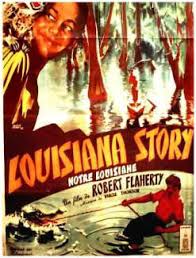
download LS 1

This is a glimpse of how the black and white film was presented to the world. The local papers ran black and white promotional and reporting spreads.

Mommee produce cart


This chapter is very much an amputee without its photographs. As I sit here with my chronic foot problems, in my fifties and in decline in so many ways I feel a kindred relationship with the chapter itself.  The place where the rights to the pictures and the finest instances of those images resides is at the Roy Stryker Papers and Collection in the Ekstrom Archives of the University of Louisville which has now largely been renamed the Standard Oil (New Jersey) Collection .  But the chapter such as it is appears below. A pdf version of a draft of this chapter is available EmergingViewsChapterTwoInsidethelenses.


Here we go:

Chapter Two: Inside the Lenses, Cajun People and Material Culture


Section One of Chapter Two:

THE LOOK OF POST WAR ACADIANA AND THE PHOTOGRAPHIC VISION

Because of approximately  twenty photographic plates needing to appear in sufficient size and quality this chapter has the length and the cost to make it in many measures the bulk of the book itself. The photographs are worth it I believe. However, this can distort the reality that  more of the text is about Louisiana Story than about the SONJ project.  In this chapter there is a good bit of Arnold Eagle in evidence and he operated in both worlds. But before dealing with the operations and goings on based in the Nettles I wish to take the reader a few hundred yards down the street that runs alongside St. Mary Magdalene Church and in front of the Nettles. On the grounds of that fairly impressive church is fairly impressive statue which at a smaller church would truly stand out and draw views but as it is it remains only moderately impressive compared to the lofty tower of a church situated on a high pediment..    


In 1939 on the Feast of St. Therese of Lisieux, Dudley Leblanc donated a marble statue, granite pedestal and concrete base of a state of the Frenchwoman who had been canonized in 1925. Had St.Therese, or Therese Martin,  lived a long lifespan we would have been  seventy six years old in  1939 and only 52 when she was canonized. Today she is a recognized Doctor of the Church. This honor was bestowed by Pope John Paul II. That honor is difficult for non-Catholics whom I would love to have understand this text to grasp. The Catholic Church considers itself to be about 2000 years old and has alway honored the exceptional among the faithful from the Death of St. Stephen. Churches and monuments in the thousands have been dedicated to this vast industry of veneration. How many canonized Saints there are is something that serious people have killed and  argued over. Being a canonized Saint is a big deal, really big deal and there are lots of them.  There are thirty-three Doctors of the Church. These are a very diverse group each of whom represents in some way a  great segment of the vast and complex Catholic heritage.

One of those  thirty-three very exceptional  names has been added since 1939. One would have to say that in terms of Catholic iconography, doctrine and other measures Dudley Leblanc knew how to pick a winner. One could argue he was only caught up in a popular religious movement but that really is not a sufficient explanation. The Cajuns like Dudley Leblanc had a talent for picking the biggest winner imaginable in the Catholic world although for others who choose not to examine religious history in a serious way this all may seem very irrelevant to American history. Nor was this an obvious bet, she was in her twenties when she died. This may seem irreverent to many but to a certain kind of person her face is very beautiful, She had a kind of wit and verve in her writing which was in stark contrast to some other spiritual writers of importance. Dudley Leblanc saw in her a symbol and a stream of thought  worth supporting.

Dudley Leblanc is not known for his speeches or writing or writing on her behalf although he was a very well known speaker and writer. He is known for his donation of an image. Cajun beauty pageants, the HADACOL medicine shows and various other visual expressions were very important parts of his legacy. The blessing of the fleets, the Courires de Mardi Gras, the fais do-do, the tintamarre and many (but not an unlimited list) of other expressions form part the Cajun visual language and system of expression which form a vital part of the culture the Standard Oil Documentaries came to express for and interpret to America. They liked to think and there is quite a bit of evidence that they were pretty good at this sort of thing.


In addition there were and still are many communal activities that defined the community and shaped Cajun life The SONJ photographers did capture some of these events such as the boucherie, the pirogue races and some from the more deliberately exhibition related categories such as  the blessing of the fleet.  Flaherty, as mentioned earlier in this text, keeps the focus tighter than anything that will allow much of this visual language to seep into his film. This text in many ways attempts  to find an understanding of what happens when various visual languages come together and especially when theses specific languages did come together in this particular instance in mid twentieth century America. It is also a story about and a treatment of how these languages and their audiences did not communicate or converge. It is about what can be learned from the way different communities and segments of society competed for ears and eyeballs in an earlier period in the information age.


This chapter leaves out a,most entirely two forces which shaped the production of film and still photographs in this study. More or less the McIlhenny family and the Standard Oil organization are left out of the discussion except  for being addressed indirectly when the Cajuns or Flaherty and Stryker’s documentarians are dealing or being informed by one or more of these other two factors.the major exception is right in this paragraph, just here: Standard oil defined the total concept of the film from the start with a commission for a particular thing. Going through the primary sources on all this is not so simple and even the Calder-Marshall and Rotha biographies   fail to make  the point clearly in a few words. But the rather excellent essay “Step by Step’ by  Eva Orbanz that appears in Filming Robert Flaherty’s  Louisiana Story has a very succinct summary of what needs to be gotten at here.

On april 3, 1944, Roy Stryker, manager of Public Relations for Standard Oil of New Jersey, invited Robert Flaherty to New York. He had something to discuss with him over a bottle of Jameson’s. Would Flaherty be interested in making  a film about the difficulties and dangers of oil production?    An industrial film that would be interesting enough to show in commercial theaters?

Flaherty was interested.   


The commission was not to make a film about the Cajuns or about Louisiana but about the challenges that Standard Oil faced in its pursuit of its basic industrial position. The challenges faced by the oil industry were to be rendered entertaining and meaningful by Flaherty’s artistry. In terms of knowing where the money came from the Cajuns were just along for the ride. But both the fact that Roy Stryker did the asking and the fact that Flaherty was the one asked do frame that business meeting in rather  definite and telling ways. These were not just any two men. They were not strangers and it was not the first time they had been involved in large projects connected to one another.


This is not a book about Pare Lorentz, the FSA,  the collaboration of Helen Van Dongen  and Flaherty on The Land or Roy Stryker’s direction of much of the vast photographic project of the FSA.  It does not have to be a book about the 1930s to recognize that this was in many ways a rebirth with private funding of a massive publicly funded project from before the World War. But anyone who knows anything about the reputation of reborn or resurrected entities knows that the new is usually quite different from the old.  The FSA and New Deal projects did not just simply pause and then start up. A great deal distinguishes the two project and historians of documentary film  have tended to love the FSA — Pare Lorentz era  and nearly ignore this era with the limited exception of Louisiana Story studied and written about with some apology. However just before the work on this book began in the 1990s there were a few scholars who had begun to build on the tiny beachhead of learned discussion of these images. Some of that work was literally going on and coming out  around me as I was starting to put this together.     


The photographs and the film studied here have a history of their own.  The work of Arthur Calder-Marshall on Flaherty’s film and the by contemporary scholars such as James Curtis and Frank de Caro have shown that these same images can be valued as their own historical entities.  I have benefited from the careful and creative analysis which such scholars have provided.  In these pages I seek to understand the photographs as they relate to a social history of cultural group as it is recorded on film.  Perhaps, this comparative and mutually referential method allows more knowledge of all the evidence.  The weaknesses of the method may be exacerbated by the relative brevity of this work.  However, effort to push the frontiers between detailed photographic analysis and a more traditional approach to social history comes from a conscious conviction that this effort will bear fruit in a better historical understanding.


For the purposes of social and cultural history the photograph offers advantages and disadvantages.  Scholars often write and speak of the majority of past persons as “the inarticulate.”  Ironically, these folks spoke, created, built, planted and did numerous other things which expressed their personality in articles of reality.  Their communication, however, becomes either ephemeral, obscure or unintelligible unless someone records it in a clearer more permanent way.  Because this may not happen and because if it does the sources are often ignored, the folk cultures, the masses, the plain folk and the poor of history emerge through the writings of the elite and through statistical evidence.  Both of those sources depersonalize the subject of study and tend to make social history seem less detailed and accurate than diplomatic or political history.  The photograph reminds the historian that his subjects were living beings, existing in the complex and meaning world of personal experience.  The Cajun raconteur Emanuel Mores died as these photographic projects were completed.  His version of the folktale “The Two Ships” captures the situation of all historian s.  Yet it especially applies to this study.  Moras’s comic tale has been recorded as follows:


A cold wave froze the sea and a captain

    shouted to another that a cold wave had

    frozen the ships.  But he did not answer.

    The other shouted the same thing and did

    not get any answer either.


   It made them angry.  They began quarreling.

    The next day the sun came out, the ice melted,

    they were freed, they sailed and the frozen

    voices began to melt.  The ships had left

    the place, but other ships passes there and

    heard the quarrel, saw no one, heard lots of

    noise, but no one in sight.  The frozen words

    were melting.


Leaving aside the comedy of the metaphor and the humor of the poem,  this metaphor seems apt for trying to create a sense of a largely visual dialog now in the twenty-first century based on pieces of communication revived from  a sleep in various forms of preservation over the years.  The historian must take the frozen words and images which he discovers and try to reconstruct the experience of ships which passed.  In the previous chapter the history of the region and people to which the photographers had come was introduced. However, there was no detailed  description of the kinds of realities a photographer or motion picture cameraman can easily capture in their lense. This chapter has three parts. The first part is what you are reading now. The second part is a description of the Cajun hose and a discussion of how the Cajun house relates to the rest of Cajun culture and the Acadian heritage as it is manifest in Acadian material culture. The third and final part of this book works through the SONJ images selected and demonstrates an approach to using these photographs and photography of this sort as an historical source and document. That third part of this chapter is the part of this study which singularly fulfills or should fulfill the promise made repeatedly to take the images seriously as works of history in their own right.     


Looking for the unique images of Acadiana, photographers reached out, like one of the captains in Moras’s story’, to the Cajuns who were living and active to them but are now  frozen in their frames as far our text is concerned. They were trained, skilled and experienced observers often succeeded  captured persisting material manifestations of Cajun cultural that had become rare in the 1940s. In some cases they preserved the information that had some use in the restoration of traditional skills, in other cases they preserved what may have been the only serious portrayals of a given reality on film. They tended toward the distinct, quaint and old fashioned in their choices of subject. That means they tended to photograph places or people who tended in one way or another to be examples of material cultural persistence. The questions a student of Louisiana’s  Cajuns  will have about material cultural persistence cannot resolve themselves here.  But it is possible this chapter will provide a better basis for asking the right questions.

The other interesting set of questions related to analyzing these images is about what may be learned about how the Cajuns photographed related to their subjects. Merely by existing the photographs demonstrate that the Cajuns and the photographers  had substantial interactions. These are not satellite photographs.The photographs were taken on the ground by people who collected other information not contained on the negative. One must also ask how the Cajuns allowed themselves to be frozen in their encounters with photographers.  Finally, how did each party see their encounter with history — the ships to come.


One factor to be considered in understanding the look of Acadiana as the photographers encountered it is to understand the way peoples and cultures interacted with each other and the built or fabricated landscape. Acadiana had an identity as part of the United States as well as many other sources of its cultural identity. So besides Cajun culture in all its rich complexity and American culture in all its richness and complexity there were many other possible adjectives designating a culture which might be applied to  the people, buildings and physical objects which the  photographers tried to capture on film.


Besides Confederate, Francophone and American connections and empathies there are other ways of looking at patterns of people and cultures that in some way typified the region.  The region has a long tradition of harboring those whom some still call Emigres. Literally, this only means emigrants or people moving out of a country. However, in both Britain and the French colonies it acquired a special meaning as referring to the Bourbon nobility who fled from the guillotines that killed the majority of their population during France’s reign of terror which was in many ways brought on by the American Revolution and the French role in it.The pattern begun in those early days had continued  in the centuries before the SONJ projects and has gone on since those projects ended. These left visual cues that the photographers were poorly prepared to discern but would have shaped some of the lives and communities that they filmed or shot. Before Simone Delery’s book Napoleon’s Soldiers in America was published long after the years in question there was little available to alert people to the presence and contribution of the Napoleonic Officer Corps to Acadiana. The boy in Louisiana Story is named  not only Alexander and Ulysses but Napoleon and that name also is  an apt name for a Cajun boy in its own way.  

In certain circles accessible only to the folklorist in Louisiana Emigres is a designation that has come to mean highly elite populations of Francophone background who fled to Louisiana in organized groups to save their lives and settle. The waves of such refugees are: 1. The Bourbon Nobles fleeing the reign of terror, 2. the planter and merchant elite both creole of color and white race  fleeing Haiti after the slave revolt, 3.the Napoleonic Nobility and officer corps fleeing here after his first and second falls, 4. the small but significant group of French speaking Austrian Jews who came here after the fall of the Hapsburg Empire and 5. the Vietnamese specifically who either were themselves or were attached to the Nguyens who are the Royal Clan of Nguyen of the city of Hue and it family of the Kings and Queens of Indochine. Acadiana politics has also always had a somewhat distinctive quality and these layers of people laid on by migration to the basic population groups that existed before  has contributed to a politics with a kind of heritage of relatively right wing politics has been one stream in the complexity of region that produced four term Democrat Governor Edwin Edwards and the first female to hold the office in Governor Kathleen Babineaux Blanco of New Iberia. Both were elected during a time when the Democrats were clearly to the left of the Republicans in what is basically a two party country. At the time of the SONJ photographs however, there had not been a governor from Acadiana since Governor Alexander Mouton the very Acadian Governor of Louisiana and father of the martyred Hero of Mansfield, General Alfred Mouton. The more recent years had seen a great decline in the prestige of the Cajuns and of the French language and although men like Jimmy Domengeaux and Dudley Leblanc were leading a movement to restore French and the Cajun heritage it was more noted for struggle than memorable victories in those years. This ascendance of English had a strong set of visual elements and manifestations. But most of all, to the degree that advertised products were most often Anglo-American or advertised in English, these picture, unable to capture spoken French, actually Anglicize the realities of their subjects’ lives by showing English words.  The photographers struggled to comprehend persistence and change in Acadiana just as scholars struggle today.  Todd Webb, one of the two Stryker photographers whose work most often appears in these pages, wrote to Roy Stryker the following contrast between Harnett Kane’s book and the realities surveyed.  “I was disappointed in La Fourche, where I went last Saturday and Sunday.”  Webb wrote from his hotel room in Baton Rouge, “I had read Harnett Kane’s  “The Bayous of Louisiana” (sic) and he neglected to say that a highway ran along the Bayou and that houses were really quite some distance away.  The people have turned almost completely away from the Bayou and the highway has taken its place.”  Webb would later discover that La Fourche had became famous as “the world’s longest street” and that in other communities the waterway still held ascendancy over graded right of way.  Kane, eager to see distinctiveness survive, had made La Fourche appear as riverine and unique in structure as it had been years ago. according to Webb. Not every scholar would agree about what Webb found. But we see this more clearly if we remember how he may have hoped for many easily obtained photographs of Cajuns in the town using the Bayous  and instead found cars, trucks, bicycles and wagons on the road did most of the work and achieved most of the connections between the Cajuns in this old Bayou Cajun settlement.


Acadiana during the 1940s offered much appeal to the photographers working there.  “Some day this week we are going to Abbeville to see Flaherty.”  Wrote Webb of the man producing Louisiana Story.  Robert Flaherty, recognized as the father of the documentary film, had received critical attention and some financial wealth for previous portrayals of remote cultures and places.  The man who had directed Nanook of the North, Man of Aran and Moana now brought his gifts to a Cajun subject.  His vision of a pristine culture would influence many.  The excitement of working with Flaherty in later days and Webb’s declaration that “Gross Tete and the Teche are both much better…(because they showed more cultural persistence than Bayou La Fourche)” all show that Webb and his boss never saw themselves as dispassionate scientists.  Yet, all parties to this project had ambivalent feelings about the ways this region differed from others in America. The distinctive appealed to them and made them feel successful. But that is not the same thing as them feeling that it should be preserved. However, from what can be remembered from nearly a quarter of a century ago there were more likely to be hostile statements from these generally Yankee aligned photographers when dealing with signs of the Confederacy and the antebellum South than when dealing with the distinctively Acadian. Todd Webb expressed weariness shooting Natchez which was “a crinoline crypt”. Nothing that strongly negative  was associated with his perceptions of Acadiana. But one must remember that a photographer can have all kinds of biases and a very defined agenda and still a shooter of the quality of any of these people will usually be longing most of all for the great picture most of all.  

The fact that there is no story titled Courir de Mardi Gras in the Roy Stryker SONJ collections is one of the most telling facts in the entire survey of what is and is not included in these photographs. The running on Fat Tuesday is certainly a very photogenic ritual of collection of chickens and other ingredients from members of a Cajun Community , beating the bounds around the physical limits of a community and a mixture of charity and intimidation. The whole rather elaborate ritual is  traditionally run by a ridelle under a captain. Men in masks and colorful costumes collect ingredients for a communal feast centered on chicken gumbo. This is done on the day before Lent begins with Ash Wednesday. Why this is not a major feature of the SONJ projects is open to question. But it is significant that it was absent.


The photograph has as complex a set of biases and insights as any other type of evidence.  Both art and science manifest themselves in the activity of photographers.  This paper has benefited from exposure to the correspondence between Roy Stryker and his photographers.  Stryker, while no photographer himself, loved the vision of the camera.  Stryker wrote the artistic and opinionated Webb encouraging words.  “Dear Todd, You are certainly going after Louisiana….” Wrote the office bound Stryker, wistfully, “Looks like the old Farm Security days:  storefronts, gravestones, interesting faces, etc., etc.  It was a nice set of pictures and I congratulate you.  Keep it up.”   The reader should recognize the living eyes which directed the mechanical ones. These men are deeply bound to their New Deal experience and the thing one often senses is that Standard Oil is subsidizing men and a few women whose hearts are invested in the old New Deal concepts. Neither Standard Oil nor the documentarians had a vision that came primarily from Acadiana or the Cajuns.  A photograph like any article of historical evidence is provided by a “witness” and comes through the filter made up of the witness’s interests, prejudices and medium of record.  Photographs provide access to subjects of various types within the context of a single document.  Careful analysis allows a unique view of gender, environment, popular culture and commerce to speak from the complex and holistic mesh of relationships which existed.


This study assumes that photographs have as significant and verifiable a message to convey to professional historians as any other medium. Text has been the dominant source type and should remain so but photographs matter as well.  It is difficult to determine how technical analysis of camera angles, lighting and other aspects of photography clouds the work.  Among the benefits of photographic sources, the greatest asset consists in their ability to speak to the reader’s imagination and intellect without too much introduction from their scholarly chaperone, the researcher.  However, the reader has no guarantee of any ultimate neutral objectivity on the part of the historian who must select the photographs and arrange them in order.Within the photographs, dress, vernacular architecture, transportation, ritual , and occupation serve as points of departure for scholarly inquiry.  The attempt has not been to support an essay on Acadian heritage and Cajun by looking at the breadth of visual imagery within the context provided  by texts and also try especially hard to seek out signs of persistence and assimilation with the  photographs providing key insights into the postwar period. The writer hopes to reveal in these picture and the study as a whole, the history of a people and region by investigating the information in a limited set of photographic documents as they relate to a limited set of questions of an historical rather than an artistic nature.  This study cares as much or more about the backgrounds of Todd Webb and Arnold Eagle, as a New Englander and an Eastern European immigrant respectively, as about their artistic style and is almost ignorant of the many technical questions about cameras, film and lighting which each of them had to answer every day.  A real effort has been made to understand these photographers and their perceptions and biases as well as all the cultural substance of the Cajuns, of Acadiana  and of whatever else they filmed. The human communication and perceptions and not the techniques of photography form the subject of this study.


The reason for mentioning that there was no folder called Courir de Mardi Gras is  because many photographs in this were taken as part of sets and kept as parts of “stories”, a term with a technical specific meaning here related to the ordinary English meaning .  These sets were centered around “stories” such as “The Pirogue Maker,” “River Story,” or “Scenes along a Bayou.”  This study seeks to recreate some of the feel of those stories even where the photographs have gravitated into very disparate sections of the SONJ files.  Perhaps, the final elements of structure to which this study aspires is a movement from environmental mandates on a human nature shared by all persons in all cultures toward those cultural and individual expressions which might never have happened except for unique Cajun experience.  Sometimes, the economy itself is distinctive and nowhere does culture cease to to shape and impact the relationship between Cajuns and their environment.  The section on architecture and the House in chapter one functions as a bridge between discussion of the functional and the sublime. and also between history and material culture studies. But America is a place where many things are hidden that would be obvious in a country where more people understood hidden hidden cultural realities.  


This study is an attempt to integrate sources and methods which are emerging as increasingly important in the study of history and to apply them to a unique set of historical questions. The most arrogant part of this work, and all good writing has an element of arrogance, is the effort to set a high standard of how historians can use photographic evidence. These questions are largely those on the interdisciplinary edge of history, community-studies, anthropology and cultural geography.  The desire by scholars today to recreate a lived experience of the majority of people in a historical period has inspired a wide range of scholarship of history and related subjects  in France and America particularly.


The study of photographs and sets of photographs allows the historian to determine the type of housing, farming and transportation which untied a recent society in a way not available from the descriptions in wills, building contracts standing structure surveys and the documents generated by agribusiness.  Vernacular architecture alone constitutes a part of cultural experience and articulation unknown to those reading social history until fairly recently.  Clearly photographs facilitate the development of a more ready apprehension of a region’s architectural style and landscape function than prose does.  The editors of Perspectives in Vernacular Architecture were somewhat inspiring to this writer in the early days of this project. I understand in researching the next section of this chapter that it brought out the potential of this quality of photographs and that the  Perspectives journal at the time was nearly as photographic in quality as it is textual.  Photographs also allow the historian to make strong prose arguments about the uniqueness of a style or the economic diversity of a farming community while allowing the reader access to evidence which functions as a counterbalance to the narrow focus of the writer.  Clearly, the historian has an obligation to describe individual photographs within the context of the photographer’s career and other factors not related to the function of the image a historical document or even as historical datum.  The wisdom of this approach and the value of the result are very much open to the question, all that is asked is that the study be evaluated on the basis of what it has set out to do.


Section Two of Chapter Two:

ACADIANA’S MATERIAL CULTURE AND THE CAJUN HOUSE

The Stryker photographers’ entire collection did not include much of the relatively few obvious very fine and upscale examples of Cajun architecture which are found near the places they photographed. They certainly did not seek out those which may have lost their distinct visual identity through renovation. Louisiana is a place which has several types of houses within the Creole and Cajun cultural milieu which have a basic modularity. The idea of a modular house in the extreme way in which these houses were modular is that one can start a house with a very modest amount of money and expenditure and live in it have a highly functioning cabin. One can then continue through many stages all the way up to something which can be called a mansion and at all phases have a highly functioning house except for the annoyance directly related to construction of new portions of the building. The system allows for many traits or ideals of the local culture to manifest themselves. There is self sufficiency which does not require a large mortgage, there is attachment to the land as one need not move in order to progress up the scale of financial progress and home value without leaving the same spot. It allowed the family, farm workers (slave or free when both existed) and contract labor to be divided with the home improvements the owners needed in a way which benefitted the builders who had to maintain less permanent labor and the farmer or business owner who might be glad to have work of value to him (or in some cases her) which his employees and dependents could engage in readily when the principal occupation of the establishment was interrupted. This sort of thing happens quite a bit in rural life. Often such an interruption might also involve weather that makes home improvement impossible but there would also be many times when it would be possible to work on the house but not on the normal profit center of the establishment. Thus  in the mindset dsitnctive of the region value could be added even when immediate profits could not be achieved.


After the relative decline of much of the region following both the Civil War and World War One The modular technology common to architecture in the region also had the effect of allowing the owner to disguise the distinct cultural identity of the home by adding what amounted to nondescript or confusing elements to later modules. Thus in time entire groups of houses with  a basic Creole or Acadian identity  were instead sort of odd mainstream American or regional Southern houses.


As stated above, the Stryker photographers’ entire collection  of architectural or architecturally framed images did not include much of the relatively few obvious very fine and upscale examples of Cajun architecture which are found near the places they photographed. The same selective interest also goes for more upscale typically Southern and Creole architecture from the nineteenth century which dots the countryside and clusters in the towns and villages of Acadiana. How such distinctions are made and how various housing types relate to the people living in the towns is a question beyond the scope of this study. But in general the types of houses described above do exist and are not much found in the SONJ photographs.  The interests they followed were not laser focused and narrowly singular either. was in evidence which depicted the economically disadvantaged, the working class, the Acadian, the industrial and the natural —  a house had the best chance of making it on to film if it was a poor or low cost home with a moderate Acadian identity and working class occupants in an industrial or very natural set of environs. Few houses had all those qualities but the trends and tendencies are clearly there. In studying what is on the film there is always a need to remember what is not making it into the lenses. Like all works of human understanding these photographs telescoped reality into a coherent set of themes, concepts and relationships.  To a large degree, the metaphorical ships have left and the words have little context if we do not have someone to tell us they were there. The pictures come from a place and time. WIth the benefit of a broader cultural history that  shows that place and time the photographs have the opportunity to become coherent conversations once again. The historical background provides a kind of map and description such as a good Crime Scene Investigation Unit might compile after a crime has occurred. This at least is a simile and not another metaphor.


During the research for this study a  significant survey of Acadian heritage and pure Cajun houses was undertaken directly by this writer under the direction of Jay Edwards of Louisiana State University, an anthropologist who also directed the Fred Kniffen Laboratory. This project was undertaken in conjunction with his Vernacular Architecture Seminar. The underlying purpose was to get some idea of the prevalence or at least availability of the Cajun House to the photographers in a small area that virtually all of them would have visited more than once. In that project a research was conducted of traditional communities, collections of traditional houses such as exists in Acadian Village in Lafayette. A review of  the Vermilionville living history component of the Jean Lafitte National Park and finally to review folkloristic and historical textual sources and photographs. Unfortunately, the research produced by that last part was lost and the reader will have to rely on the general sense of the sources from which it was drawn as manifest in the bibliography of this text.


After, that research was done a formulaic concept was put forward which allowed for some points in more scientific system as well as an informed judgement  in a more humanist system Using both systems it was arranged for evaluations to be made and credited for  the deviations from the standard to be well understood. This second phase of the project culminated with positing that a classic Cajun house developed which had all or most of a set of easily charted features, including the following:  

  1. A sharply inclined gabled roof.
  2. Construction of cypress walls lined on the inside with a mix of Spanish moss and mud.
  3. The floor is elevated on piers from the ground.
  4. Has galleries in the front and back of the house.
  5. The front and back of the house are on the longer sides of The rectangular structure.
  6. The front gallery runs the full length, or very nearly the full length of the house.
  7. The space above the ceiling is habitable.
  8. The windows have non-louvered shutters
  9. The galleries are beneath the solid wedge of the roof and not beneath an extension of the roof.
  10. There are windows on every side of the house.
  11. The roof is covered with cypress shakes.
  12. The profile includes an acute, an obtuse, and two right angles in its elevation
  13. The walls consist of center-matched or quarter-matched horizontal planks

The third stage of the project was to survey all houses on the road which becomes State St. in Abbeville and record a positive or negative for each characteristic, this survey will extend from the Woodlawn bridge to Henry Louisiana, The other route surveyed will be Hwy. 14-Concorde St.-Charity St. from Kaplan to Erath.  A drive by photographic survey was made first. then an external sampling of measures and more photographs was made of homes scoring at each level range of high medium and  low  However there were entire segments that were not sampled in each category. These samples at all three  levels will provided a little scientific basis for asking how many houses embody enough of these qualities qualities to be a visibly Cajun House..  At least one photograph and the physical location of each house with a score of eight or more positives will be retrieved in this portion of the project. Then a good number of the high scoring sample houses and a few houses in the four to six  points range were entered and thoroughly  examined for construction techniques and the  effects of renovation. The results of all these investigations was preserved and the were recorded and  contrasts between high scoring exteriors and inauthentic construction techniques were noted .


Fourthly, the age, variation, appearance and general feel of the houses with the scores will be contrasted with the model house. it was then evident that the tradition was more varied and vibrant and complex than the model but that the model was nonetheless a very good rubric for having a good investigation and good conversations with owners. Flaws in the set of characteristics and the method as it unfolded were discussed with Doctor Edwards, with owners of the houses and residents and before he dropped out to pursue a related project I discussed these things with the architecture graduate student who was my research partner. Files were developed for  Houses which scored high without seeming Cajun and those scoring low while appearing Cajun will be photographed and discussed.Finally, an effort was made to determine whether certain sets of characteristics appeared together most often and to set up a formula whereby one can analyze the basic frequency of certain characteristics.  

I ended this project with a great deal of confidence that the Cajun House was an important part of the landscape and that it was fair to note that the SONJ photographers had not come to understand the  Cajun House very well.  It seemed that the limits and structural qualities of their project had a great deal to do with why they did see well and missed many opportunities. It was a fair modern American response to ask the question: who decides what a Cajun house is, and what its features distinguish it?


But I was left feeling equally sure that the question could be answered fairly well and that the shallow quality of the architectural awareness I detected in almost every photographer was a real thing to be criticized. That question underlies other questions about Acadiana’s vernacular architecture.  The region is a diverse and complex landscape where the natural, built and near-built environment interact in very close and somewhat subtle ways.  No single simple structural analysis can make sense of all the buildings and builders which have appeared on the scene in this new Acadia.  This chapter discusses a sort of “classic” house.  This typical Cajun house represents a significant number of homes built during those periods of history in which Cajuns developed greatest autonomy and community identity in Louisiana.  This discussion also takes note of the new archaeological evidence for a distinct Acadian architecture prior to the expulsion from Canada’s original Acadia.  The house type defined as Cajun hereis readily recognized locally and has inspired very numerous works of folk art, including paintings, drawings and photographs as well as three dimensional models and toys in a variety of forms.  Furthermore, the house type has commonly served as a symbol for those seeking to promote local “cultural tourism” by outsiders and finally it is a house-form continuously adapted and imitated by Cajuns for their own homes until the time of this writing.


The exact situation in the 1940s was not possible to determine in the time I had but it was possible to see that these photographers and their wealthy patron could have learned a great deal more than they appeared to have actually bothered to learn. The sense this gave me was not that they missed the whole of Acadian architecture but that what they did miss mattered and could be evaluated.


In the environs of Lafayette, Louisiana (the largest city in the prairie region of Acadiana) two collections of historic Acadian or Cajun houses have been established and made open to the public.  The oldest of the two collections is the Acadian Village, operated by the Lafayette Association for Retarded Citizens which was developed in the 1970s.  The six houses appearing in figure “insert info.” vary significantly in age.  The Aurelie Bernard house, formerly of St. Martinville consists of two portions the original built around 1800 and a symmetrical extension sideways added in 1840.  The Thibodeaux house from Breaux Bridge and the Le Blanc house from near Youngsville both date from near the end of the antebellum period.


The fairly broad sampling of prairie Cajun houses at Acadian village constitutes a reasonable representation of what local people see as classic Cajun vernacular architecture.  Many feature predominate in these Acadian Village houses as a group but there is also a gegree of variety in the features of each house.  Significantly, all the Cajun houses at Acadian Village share the following features:


First, all have gabled roofs.

Second, all have an eaveside front.

Third, all have a  basic frontal symmetry with regard to doors and windows.

Fourth, all have a gallery under the eaveside.

Fifth, all are elevated from the ground on piers.

Many other features including the use of cypress in construction appear in all these Acadian Village houses. These houses were not conveniently collected in the 1940s but they were around and people were talking about them.


Those details await further discussion below.  The second collection of houses also serves as a useful reference point from which to evaluate the SONJ photographs and their record of Cajun life.  Vermilionville is a project of the Louisiana Endowment for the Humanities, an affiliate of the National Endowment for the humanities.


The two Cajun or Acadian homes actually collected from the surrounding area share the five features listed above as common to the Acadian Village homes.  They also share cypress construction and other features not listed above with the Acadian Village homes.

One of the homes brought to Vermilionville belonged to Armand Broussard a wealthy Cajun who belonged to the slaveholding planter class.  the house appears distinctly Cajun despite some ornamentation which may have been Anglo-American and Creole in inspiration. In my view of the visual language of the area it seemed to me that the owner was asserting both ethnic identity and a sense wishing to be part of his region and country in which Cajuns were not the dominant ethnic group.  This Broussard home was built in 1790 and its large area and elegant appearance show that the Cajun style was apt for building homes which were as comfortable as most if not all in the surrounding area.  Another home of comparable elegance at Vermilionville is a hipped roof Creole home brought from the Mississippi River Valley and not to be confused with the local architecture.


The above description of these buildings serve merely to demonstrate in verifiable terms a fact which is difficult to support from written sources but which is readily apparent to a perceptive observer.  That fact is that people in Acadiana share a perception of the Cajun or Acadian house.  In fact Cajun people and their neighbors who wish to be more like them have continued to model their homes on this image throughout this century — before and after the SONJ projects.


Important questions arise concerning the interplay between the geographical and historical reality of Cajun houses, the perception of local people that certain features typified a Cajun house and the attitudes of outside researchers and artists towards the local vernacular architecture.  Over the entire history of Cajun houses to the present a complex system of feedback has occurred in which a tradition developed and was understood.  Artists, builders and consumers reacted to the tradition.  The newer homes within a still definable tradition expressed reaction to previous buildings and the impression those buildings had made on the community.  The cycle would continue as these buildings in turn shaped perceptions and were used as models for further building. Thus in short the process of change after establishment in Louisiana might be described as follows:

A= Acadian building tradition as far as an important symbol of their home in what is now Nova Scotia..

e = The effect of environmentally driven adaptations derived from the Caribbean, Louisiana elsewhere. Dating techniques seem to show that the first homes appear to have largely reflected A but quickly became Ae in reaction to the differences in climate and available building materials. and Visual Rhetoric


Section Three of Chapter Two:

( Note to 2016 review group at LSU the images are not currently available to be seen, Reading the text is not entirely pointless in my opinion or I would not be sending this in to be read)

IMAGES OF CAJUN LIFE, WORK AND ENVIRONMENT

The last section of this chapter is a careful examination of some of the images themselves.

it is the heart of this study in which after all the background has been established and before a higher criticism has been applied to the methodologies the photographs are allowed to inform those interested in history. That is they both guide a focus of external evidence and allow for purely visual information not otherwise readily available.

Plate one, photographed by Todd Webb in May 1947, displays the complex rural pattern of cultural and technological development in an assimilating Acadiana.  The levees show both persistence and change in farming and in relations between various cultures and the people who lived those cultures.  Acadiana in Nova Scotia made levees to protect their crops from encroaching swamp and sea water.  The later immigrants from Scotland hired Acadians to design and maintain their hydraulic systems.  In plate one, levees remain a daily part of life, but the water management of rice, not corn or other grains, emerge as the problem.  Here flooded and prepared fields await the airplanes which will plant seed in a broadcast method — strangely combining  new technology with the oldest form of sowing grain.

The farmhouse is of a Southern “shotgun” architecture, which in itself may be a primal expression of Louisiana’s vernacular architecture.  The home is a set of rooms, two rooms wide, going back to the kitchen.  A separate roof covers the porch.  A more traditional Cajun home in contrast would have two storeys , the first alone having a ceiling, and the upper floor would extend over the porch.  The Cajun home traditionally had a steeper roof and rested on cypress blocks at 15 points.  While even the home appearing in plate two, differs from the most typical homes, the Acadian home went through an eighteenth century and possibly two nineteenth century shifts in design and could also expand sideways from its original 15 block base.  Cajun architecture remained significantly adaptable throughout the nineteenth century and has enjoyed a miniscule revival in the last two decades.

The following chapter goes into a more careful and detailed study of Cajun vernacular architecture than is possible in this chapter.  There seems to have been a continuous adaptation to outside forces but there is also a sort of geometrical rhetoric of Cajun houses which is evident during the thirties, forties and even at the time of this writing.  This rhetorical system could preserve forms despite changes in materials and technologies.  The photographers seem to have had a fairly good eye for the “traditional Cajun house” in all its permutations.  The silhouette with its gallery cut away into the eaveside of a gabled house and the eaveside gallery fronting an artery  of the village (bayou or street) is the strongest feature of Cajun vernacular architecture.  This silhouette functions as a sculpted shape against the sky which makes a political statement about community an identity.  A statistical sample taken and anlyzed by this writer indicates that many such houses exist even among newly constructed houses today.  The survival of Cajun vernacular architecture indicates the kind of complexity which exists in the collection of photographs and is confirmed by other evidence.  An important hypothesis for this study is that Cajuns adopted their neighbors’ artifacts and values but also propagated their own values and artifacts to their neighbors.  The evidence gathered for this study indicates that a unique cultural region has endured and does not appear to be in danger of dissappearing soon and even communicates more of its music, foodways and ideas than ever before to the larger society. On the other hand the differences between the larger culture and Acadiana as a society are somewhat less dramatic than in the past.

Why the Acadian home has more often vanished than it has been modified becomes a complex problem.  Architects today admit that, in terms of comfort in the elements and function, the Acadian home outperformed most structures available during its decline.  Apparently, the conformity of farmers who wished to have an American home conspired with the diminishing number of builders who possessed the knowledge to construct an Acadian home.  Carl A. Brasseaux’s discussion of housing in The Founding of the New Acadia and Lauren Post’s discussion in Cajun Sketches offer more highly accessible treatments of these issues.  Apparently the house varied in construction and yet remained within distinct parameters of cultural development.  The photographers did not know a great deal about housing or about the different influences which might be displayed.  Todd Webb, who despised ante-bellum mansions, the French quarter and Southern pride also detected a pride by the Cajuns in their  old cypress homes.

Webb’s impression of the people and their relationship to these houses seems richer in prejudice then perception.

“W.B. has lined up an old house for me which I am

     staring on tomorrow.”  He wrote to Stryker, The way

     they cherish these old houses gives me a pain in

     the ass but I think it will be pretty interesting

     to photograph.  The Live Oaks (sic), festooned

     with moss are fascinating and somehow seem to

     be in line with the decadence that I feel in the

     South.  The cypress tree is a wonder, not only in

     growth but in use.  The wood itself is beautiful

     and almost everlasting and it is almost extinct (sic).

     Another American tragedy of which there are

     many in the South.”

The family in the shotgun home pictured here in plate one in 1947, lived near Abbeville.  These farm people likely spoke French and English, canned foods themselves and bought them canned.  Their furnishings may have included Cajun spindle and calfskin chairs purchased nearby, as well as various store-bought and mass produced products.

Plate one is a composite picture of gradual transformation which reflects the relative independence of the Cajun farmer.  Unlike the urban ethnic working for a non-ethnic, the Cajun farmer could adapt gradually to a changing world.  His family would embrace a new product or folkway because they preferred it, or because it more efficient or at least because the old ways had perished for lack of expertise and supply.  The Acadiana region retained a sufficient base of independent producers to account for their relative autonomy as a culture for 200 years.

Harnett Kane called Acadiana a land of “primarily small men and small affairs,” James H. Dorman has written of the prevalence of “ribbon farms,” and few have failed to mention this diffusion of capital.  The “ribbon farm” serves to highlight the importance of community to a society of small land-holders.  “Ribbon farms” is the term which rural sociologists use to describe farms where farmers live near one another, have some centralized services and work small holdings.  Even today many rural Cajuns work for themselves.  Slavery, sharecropping, salaried work, and accumulated wealth have all changes the region. The industry paying for this project also was already having and would continue to have an effect. The income from oil leases and royalties allowed extended families and nuclear families villages and other units of Cajun culture to make better adjustments to the demands of the era and the problems with the limits of the region than if those oil checks had not come in. In folkloristic terms many oil people from outside the region have commented on how the Cajuns were notable for marrying oil money. Because of legal situation that amount to a great deal on wonders if this book will ever be published if one writes that the oil industry also imposed many costs on the Cajuns that were never mitigated or even recognized. This cost however was very real and still goes on and the legacy lawsuits that have recently been the subject of much controversy are only a small part of that picture. But it is also true that oil provided a much appreciated  and  unique support to the economic struggles and plans of the small landholders of the region. The oil industry  came at just the right time to prevent other crises and  to bolster and support a life of  hard work and the productive capital that the typical small farmer or  (more rarely) landowning trapper already had and continued to maintain. Oil was in itself a kind of economic system recreating the main business climate in the region, in it there were many benefits and opportunities and also some very destructive and unpleasant forces. In that way it was not so different than many other economic systems which had existed at various times in the region.  None of those economic systems ever eroded the base of Cajun autonomous small producers so radically that the tradition of independence withered entirely away.  Cajun racism in the past to the degree that it was distinctive in any way from other racism tended to  focus more on two factors. Those factors were the relatively weak honors an African-American genealogy  would bring to a family and therefore a desire to limit mutual filiation. The second factor was keyed to the fact that Blacks, even free people before and after the war, tended to be employed by wealthier people. Thus free black planters had a very important role. Cajuns had always shared employment within classes  or segments and employed some fellow cajuns continually, But working one’s own capital and means of production and doing this as much as possible within a community with a few elite leaders of significant wealth and with communal facilities  remained a persistent ideal over the centuries and regions. Very little racial conflict or violence ever occurred between Cajuns and Black farmers and ranchers who lived in more or less autonomous communities when the Cajuns were relatively stable and at peace. Men who had beliefs and used language no history department at a major university in the United States would be likely to support would beat  and intimidate white men who were or were not Cajuns and engaged in race baiting of the local colored farming communities. However, in crises there was always a sense among everyone in the region that virtually anything might happen. Some of Longfellow’s idea of a people who love peace above all else is true. That is partly because Cajuns fear more than most people what they may become when pressed too hard. Whether true or not the idea of limitless rage as an ethnic quality is very old and widespread.


Farming and Cattle ranching, war and the learned professions are the most amenable ways to advance in Cajun culture across many times in history.   In recent years, trapping continues but has not enjoyed expansion or been able to offer much steady employment, commercial hunting in banned, and barnyard and cottage industries have declined in recent years.  Only the aquaculture and fisheries enable large numbers of small producers to earn a good living without dependence on the employer.  Those same industries employ many people in the processing and marketing end of the industry, proportionately more Blacks, Anglos and Vietnamese than Cajuns.  Where French language and Cajun customs persist most intensely, where the community is less closely tied to the mainstream labor market, more people enjoy the autonomy traditional to Cajun life.


If the farm in plate one also included stock operations the herd would likely have found its way a few miles up the road to the corrals directly behind the men pictured in plate three.  This stockyard sat on the nearby Richard family property on North Henry Road just outside Abbeville.  The local stock traders watch an auction in progress.  Like much of the local economy, stock auctions were managed by a cooperative.  The auctions in this building occurred in a sort of amphitheater where the cattle could be viewed in small lots when driven in from behind the wall against which the boy is seated.  These men look like other stockmen and farmers in other places.  The lack of accouterments of “cowboy” culture (boots, Stetsons, wide belts, etc.) distinguishes them from groups to the West of Acadiana.  However, this serves as an example of visual images with little evidence of cultural autonomy.  Assimilation seems nearly total.

This picture required the photographer to do very little in terms of composition.  The mix of people, all male and all serious captures enough of the mood sought by the photographer conspicuous to his subjects and yet he does not greatly alter their behavior.

One of the traps a scholar can leap into in this type of study concerns the distinction between Southwestern Louisiana’s economic adaptation and Cajun culture, with the grassy prairies here any European group would have raised cattle.  Nonetheless, stock-raising has formed a vital part of the Cajun economy since first settlement.  In the early days, this mobile property was brought and sold in the bordering lands of Mexico, English West Florida and among the Anglo-Americans settling above Acadiana.  This provided some of the needed money for transportation, resettlement and the development of the lands in the area.  Another form of trade which competed with the cattle drive was the water traffic in furs and foodstuffs which once tied together all of Southwestern Louisiana.  To exclude the physical environment from any model of how behaviors developed would miss a great deal.  Yet the interaction between human culture and the environment becomes highly complex in practice.


The farm near Abbeville and the stockmen both exemplify change and assimilation on the prairie.  The life of Cajuns on the prairies of Southwest Louisiana can not easily  distinguish its ways of sustaining prosperity from countless other plains and prairie cultures.  To the degree that the prairie economy was distinctive, such distinctions (flooding fields for rice, crawfish and catfish) drew upon a wetlands tradition.


The photographer took the picture in plate four not because it was typical but because it fulfilled Stryker’s mission of recording that which soon might pass away.  Without human figures, the photo records the garden and the home as a slice of history.  Empty of children and the other active signs of life the picture speaks, appropriately enough, of a past in which such homes as this had dominated their surroundings.  The intensity of economic production which left little room for such luxuries as a front yard reminds one that Acadiana has never experienced the depopulation of the countryside, by migration to the city, which characterized the rest of the nation since the 1880s.  The land grows ever more populous creating pressures for high profit, labor intensive rural industries.  Journalists, scholars, politicians, economists and sociologists tend toward the urbane.  Fewer intellectuals and writers who become well-known write from the prospective of a resident in a small rural community.  Perhaps this has something to do with those who see poverty whenever they see farms.  If a family owns herds, buildings, boats, and tools and a small spread of land but the immediate descendants of that family become debt-encumbered, college-educated condominium dwellers does that constitute upward social mobility?  In most economic and psychic terms it certainly constitutes a fall in fortunes.  Consumerism and prosperity must be distinguished  by a historian seeking to study those who cherish an economy based on subsistence and cooperation.


This small home has more Cajun features than the shotgun home on the Abbeville rice farm in plate one.  The economic conservative living in the home pictured in plate four practiced a mix of commercial cucumber planting and shrimping.  Such a mixed economy had already declined in Grand Isle, most of this shrimper’s neighbors had abandoned cucumbers to invest themselves completely in the increasingly lucrative seafood industry.  This raises certain ecological questions.  The earlier wetlands economy involved such a variety of small scale operations that the region’s natural balance continued. to produce sufficiently for the population.  Once refrigeration and better transportation made more distant markets accessible, certain aspects of the Cajun economy would benefit unequally.  This change did not obliterate distinctive cultural traditions, it could accelerate assimilation and damage the environment.


One also wonders if the shrimper’s wife lost economic status as production moved into the male dominated offshore world.  Did barnyard animals and subsistence gardening diminish as life and work became more specialized?  The answer seems to be that Cajun women experienced role strain and had to adjust in a much shorter period of time to the transition from a world of family economics, to male providence of nearly all wealth and again to a two career or cooperative economy.  It is unlikely that a significant number of most rural wetlands Cajun women ever divorced themselves from income producing activities or lost power and interest in the world outside the home.


The role of women in the economy of Acadiana is tied partly to the role of the family in the economy.  Acadiana in the twentieth century has increasingly moved towards the separation of family life and economic production which typifies the modern, industrial and post-industrial global economy.  Like countless traditional societies, the Cajuns have been forced to adapt to an increasingly market driven economy in which the accumulation of capital and the development of the new technologies has increasingly led to a specialization and concentration on the production of a few goods and services by members of units other than families.


The success of the local culture in maintaining a large economic base tied to its traditional folk activities is remarkable despite the relative decline of such activities.  The home garden and the small barnyard establishment of chickens, and milk cows have fared less well than traditional male activities discussed in detail below.  However, research would need to be done to ascertain how many families remained vital economic units.  There are still farm families where both spouses cooperate on producing a few staples, women who run small businesses with their relatives from their homes and other signs of persisting involvement by some Cajun women in preserving their families’ economic independence from marketing their labor and developing the capital of others.


The role of women in the culture of Acadiana has yet to become the sole focus of a single monograph.  The economic and social development of the region must include women.Cajun society was still in the early Postwar period  patriarchal to the degree which nearly all Western cultures and many others have recognized men’s authority over their family.  Women certainly expected that during their peak childbearing years wives  focused much of their energy on childbearing and child rearing and that men did not

.

The old woman in plate five had over 100 living descendants and appears in the Stryker collection posed in the same porch and chair beside one of her youngest great grandchildren.  Rural and aged as she was, the photographers must have been as alien to her as she was to them and perhaps they captured this in the way her expression fails to engage the viewer directly.


In the photographs of Acadiana as opposed to other regions, the Stryker photographers have a high incidence of men smiling and relatively expressive of physical affection to their children.  On that basis alone one could not make much of an argument about relationships between family members.  However, it appears that many photographs show men in the region holding their children and smiling among other photographs taken in Acadiana in the earlier part of the twentieth century.  Many also show the serious paternal poses which were typical of the time.  Perhaps Cajun men felt more comfortable expressing physical affection for their children than did some other ethnic groups.


The following picture, plate six simply depicts the pride of a father in his healthy young child.  Cajun culture in prairie and wetlands centered around family life.  Religion, commerce and politics were all shaped by the family.  In politics for example a title of great power before a name was “Cousin,” and in doing business the negotiations between strangers are often preceded by an effort to discover and recognize any familial ties between the parties.  In the pejorative terminology of American mainstream society, nepotism functioned as a central mechanism of Cajun life.  This lifeway allowed the Cajuns to survive.  The keen scientific observer and Spanish governor Antonio de Uloa (much maligned for a passive administration) said of the “Acadianos” in 1766, that they were a “people who live as if they were a single family…; they give each other assistance…as if they were all brothers and sisters, thus making them more desirable as settlers than any other kind of people.”


Despite the remarkable lack of credit and attention given to the people about whom Ulloa wrote it would be difficult to comprehend the draining, dredging, flooding and clearing which the Cajuns had to achieve in order to subsist in what remained a wetlands environment.  Their contribution to the state and the Gulf Coast overshadows that of many better understood groups.


Even in 1992, the folkways of beginning a relationship by seeking to find a kinship tie endures.  Kinship exists in two ways, first there is genetic kinship.  The second type, ritual kinship has been studied in somewhat different forms in the Caribbean, the Philippines and Latin America and will be discussed later in this study.  Third cousins once removed even today may feel significant bonds as “family” which they do not find with non-relatives.  The degree to which they do not find with non-relatives.  The degree to which such values can survive in a society and world which literally worships the individual as the creative source of all that is valuable in life perhaps amazes an observer of twentieth century Cajuns more than anything else.  Families may often be classes by outside “scientists” as codependent, dysfunctional or repressive.  Sometimes they seem appropriately warm and supportive.  However, close extended family ties form a basic element of Cajun culture.


The spirit of extended family loyalties is captures in B.A. Botkin’s A Treasury of Southern Folklore . The details might well represent the perceptions of an entirely candid if effusive observer in a very ordinary situation in Vermilion Parish.  The slightly patronizing tones of the author should not detract from the forceful distinction he made between his and the Cajun’s concept of family.

 “One pitchy black night” writes Irvin S. Cobb

  in the hunting season, five years ago (circa

  1920), we were feeling our way along the bayou

  below Abbeville on our way to the ducking

       grounds.  In a sharp turn our launch went

  hard aground.  The prospect seemed to be that

  we would stay right were we were until morning

  or even later than that….

  There were four of us in the party–three

  outlanders and one native – and inevitably

  the native was a Broussard.  He went aft

  and leaned over the rail and speaking in

  French, he sent his voice out across those

  empty spaces….Promptly out of the void

  came first one answering voice and then

  another and yet a third (The three men freed

  the boat from the mud and refused the narrator’s

  offer to pay)….When navigation had been

  resumed I put a question to the resident:

  “How did you know those chaps were living

  out here in this wilderness?”

  “I didn’t … I took a chance.  I yelled out

  that there was a Broussard in trouble here

  on the mudbank and that if he had any cousins

  around here he’d like them to rally around.

  So they rallied around and rescued us.”


Another form of kinship consists of ritual kinship.  The concept may seem alien to Anglo-Americans, yet it is the nature of relationships between in-laws.  The difference being that, in America another ritual can also bind people in ties of kinship.  Baptism produces a Parrain and a Nanan for the Cajun child.  This relationship has declined in status during the last several decades, yet continues to enjoy significant prestige.  Parrain may translate into “Godfather” but the roles assigned to such figures in Acadiana are far more prestigious and complex than among Anglo-Catholics while less important than in Spanish culture.


Extended family and nuclear family exist within traditional Western European concepts of family.  To this day, a high degree of endogamy (marriage within the overall Cajun culture) and of geographical proximity to one’s relatives combines within a goodly number of family reunions, a high interest in genealogies and a resurgence of regional pride to keep extended family ties alive.  Nonetheless, the educational, economic and legal structures of the United States effectively discourage the intricate mesh of socio-economic collaboration which supported the Cajun extended family for so long.  By the time these photographs were taken, some degree of erosion of extended familial ties was visible.  In the study of kinship, the historian confronts evidence of American forces of assimilation which may in time annihilate Cajun distinctiveness.


Marriage remains the central relationship in Cajun culture.  In the 1940s divorce was nearly unknown and the Alleman’s who appear in plate seven certainly would have defined themselves as life-partners.  Nonetheless, compared to the warm and affectionate pictures of fathers with their children, this image does not reveal great warmth of intimacy.


Arnold Eagle has clearly posed these people and both are looking directly at the camera.  Nonetheless, no evidence exists to suggest that he modified their habitual seating or living arrangement.  In the 1930s collection by Stryker’s F.S,A. Photographers, trappers ‘ camps appear as ruinous, but those did not constitute year-round dwellings.  The Cajun homes if clean, and practical often lack much beauty.  The guns, fireplace, the lamp and the crucifix all serve a practical function (religion would have seemed practical).  The Acadian people’s experience of a demanding environment and unsympathetic government and corporate neighbors as well as limited church activity in the area may have contributed to the strong pragmatic bent of the culture.  A “Down to earth” level of prosperity, safety first farming dwelling and a close relationship with the wilderness characterized the type of lifestyle perceived as sensible.  This did not preclude wage earning, commerce or expensive celebrations but it did preclude spending too much on consumer goods and objets d’art.


Taking a picture of this family and those things which their most casual visitors could see, Eagle uses the bright interior lighting to emphasize the stark simplicity of these people’s lives.  Edbon Alleman’s more central position, in front of the fireplace, and his stern look, crossed legs and hands gripping his rocker as a throne contrast with Mrs. Alleman’s demure gaze, her hands in her lap.  Cajun women have often been seen by outsiders to have forceful and talkative personalities, yet by recent feminist standards it is clear that Mr. Alleman “headed” his home when intrusive outsiders were around.


Cajun families have always possessed guns for hunting and during the French and Indian War, War of 1812 and Civil War they bore their own arms into battle.  The guns may disturb the urban eye of the late twentieth century (they remain ubiquitous among Cajuns).  Most Americans movies and songs made about outsiders in Acadiana such a Southern Comfort, Gator Bait and “The Highway Goes on Forever” portray the Cajuns as extremely violent, no doubt some basis exists for this.  Cajuns have long endured hostility and persecution from powerful outsiders, sometimes these territorial people have added to such conflicts.  Acadians fought the British in Acadia in the late 1750s.  Their descendants opposed outsiders with force between 1850 and 1870.  In more recent times, Cajuns supported and assisted Vietnamese Catholics in their resettlement in Acadiana, but violence punctuated competition over fishing rights.  Vietnamese fisherman were not aware of the orally agreed upon territories of Cajun fishermen.  Overwhelmingly, however, a Cajun home has received les autres with hospitality and coffee, like extended family.


From the marital unit, Cajuns established social, religious and commercial ties to other families.  According to Lauren C. Post, and most other authorities, women controlled many of the chattels which produced cash, especially chicken and milch cows.  They also maintained gardens and spinning wheels well into the first decade of this century.  Men traditionally controlled the land, herds of cattle and hogs which the family brought to market less often but for greater sums.  Adolescent males hunted, fished, did chores and raised their own funds through countless small youth dominated industries (bountying, frogging, etc.).  Cajun youth often provided a significant portion of the meat and fish eaten by the family.  Cajun families swapped woolens and game, cooperated with neighbors in halerie, boucherie, couverage, the planning of the village fais do do, and the normal affairs of business and politics.  Of all the various means for such connections, coffee seems to have been the most common excuse for prolonged interaction.


Here in plate eight, the Allemans entertain in the way one might entertain men who had come to discuss politics or business but whom one knew well.  Notice the relative ease that which these people feel on the porch.  Two men still manifest an awareness of the intrusive camera but one perceives the breezy comfort which the porch both symbolizes and provides.  Eagle has angled this picture in such a way as to capture all three open sides of the porch, the open windows and the open door, the attic vent and the space below the raised house.  by the 1960s, the air conditioner and the television would do much to erode the role of the porch (as throughout the Anglo and African regions of the South), yet,  as late as this writing, Cajun culture is an out-of-doors way of life.  Street dances, festivals, water-sports, hunting, fishing, new technologies in aquaculture and petroleum mining and the other mixes of old and new activities express the connection of the people to the wide and flat openness broken by giant oaks beneath a vast blue or clouded sky.  People did not feel less welcome on the porch.  They only felt cooler in the long, hot and humid months of the summer.


Coffee, in 1945, was not the weak adjunct to hospitality which is found in a jar of freeze-dried granules.  It was a gift.  Acadian coffee remained a source of pride for the people of the region.  Made strong enough that it seemed pure black in a demi-tasse (a very small cup).  Cajuns worked for some time on their coffee, “Ca c’est bon le cafe! ” being a prized compliment.  Most families considered themselves past masters at this art.  The technique of making coffee shows how interaction for centuries with Anglo-American culture (beginning in Nova Scotia) allowed the Cajuns to believe that all Cajuns did certain things better than other peoples.  The Cajuns typically also stereotyped various groups of outsiders based on certain properties. It is very hard to say with certainty how welcome the outsiders with cameras felt in Acadiana. But that will be discussed at some length in another chapter.


Emanuel Moras, the raconteur whose tale appears  earlier in this  chapter, told the following tale:

“There was a fruit peddler who got on

         a steamer to cross the ocean.  The captain

         objected to having him on board because

         he thought the fish would capsize his

         steamer in order to get the fruits, but

         he was assured it would not happen, so

         the peddler was allowed to remain on

         board.  While at sea, the fish got on.

         The captain grabbed the box of oranges

         and threw it overboard when he saw a

         big fish getting on.  The fish swallowed

         the box and a little later came back for

         some more.  This time the captain threw

         the basket of bananas overboard.  The fish

         swallowed it, and returned later.  This time

         they threw the Dago (Italian-American) over-

         The ship reached land safely.  A year later,

         the fisherman caught the fish, cut him open

         without knowing the history of the fish.

         They found the Dago.  He was sitting on a

         box of oranges, selling bananas at the

         same old price, two for a nickel.  He had not

         changed his price.”


Food and drink and economics distinguished the Italian-Americans in Cajun folk imagination and homemade, laboriously prepared and generously shared coffee distinguished the Cajuns in their own minds.


The coffee beans were patiently roasted to “between” medium and dark in a stove-top roaster.  French drip coffee has all but vanished since the sixties, in the 1940s it was made with the kind of concentration evinced by joseph Mouton, a cattle rancher and small-scale meat packer entertained the photographer with a steak dinner and Webb took pictures of most of his daily routine.  The Moutons exemplify a common case in the area, this family held substantial assets in head of cattle, land, equipment and businesses.  Unlike wealthy or substantial persons elsewhere, the Moutons employed little non-family labor.  Their home and dress remain as stark and austere as their neighbors’.  Their manner and porch lack even the simple refinements of the Allemans.


Traditionally, husbands made a family’s very early first pot of coffee.  Wives made the subsequent ones.Mrs. Mouton in plate ten, serves a late morning pot to her husband and one other man in a much more casual way then Mrs. Alleman.  Joseph Mouton would seldom do business at home while Alleman may have been entertaining customers of his pirogue making shop.  Mr. Alleman is pictured in plate  eleven with the tools of his trade and one of his products.  Edbon Alleman’s craft served a vital function in the complex of skills and techniques which allowed the Cajuns to thrive in the wetlands.


Plates twelve through eighteen trace a single material Cajun response to the local environment and the universal human need for transportation.  Arnold Eagle who took these photographs also made a film entitled The Pirogue Maker.  This film shows the grace and skill of the artisan in a way which  the stills do not fully capture. In these images, Arnold Eagle has captured Edbon Alleman’s creation of a pirogue.  The countless shallow channels and lakes which nature has placed in Southwest Louisiana require a flat bottom boat to be conveniently negotiated.  In 1992 many flat-bottom vessels of various sizes are produced and sold in Acadiana.  These modern vessels, fashioned primarily from aluminum, boast speeds and carrying capacity which the traditional pirogue does not.


The Cajun experience included  a full history of exposure to and participation in French maritime culture, numerous voyages during Le Grand Derangement, exposure to and imitation of Micmac birch bark canoes in Nova Scotia and Attakapas dugouts in Louisiana.  Into this rich mix of cultural knowledge came the internal combustion engine and other modernizing technologies.  Cajuns fished, trapped, gathered and farmed in swamps, bayous, marshes, bays and in the open Gulf waters.  The diversity of their needs led to a great deal of variety and creativity in boat design.

Among the other vessels photographed by Stryker’s photographers was the small skiff made to be rowed from a standing position, various v-hulled vessels, the sea going fishing boat known as the Lafitte skiff and the Cajun bateau, which functions as a barge.  Cajun vessels which do not appear in the collection include the compartmentalized water-car or fish car which was towed behind these barges as a series of live wells for bringing his catch to market so that no inland fishery could be truly remote.  The photographs do come at a time when few of the metal boats imitating traditional pirogue and bateau designs had been produced.  Nonetheless it is interesting that these successful innovations eluded the photographers of time.

The simple houseboat, shown in plate 19, allowed some Cajuns to live in whichever part of the wetlands suited their need and inclination at a given time.  The houseboat allows access to vast natural resources without the capital outlay or ecological cost of trying to remove the region from its wild state.  These adaptations not easily modified to accommodate the newer creature comforts disappeared.


The Stryker photographers generally recorded scenes of relaxed domestic life and cheerful faces at work on the houseboat.  The houseboat developed in the Atchafalaya region of Acadiana once the initial attempts at farming the remote islands and cheniers of the swamp had proven unprofitable.  Many swamper families developed the lifestyle of hunter-gatherers and the houseboat allowed the family to stay together instead of remaining at home near a struggling garden and barnyard while the men of the family traveled from one run down camp to another in pursuit of furs, fish, frogs and fowl.


The bayous and channels remain places of work and recreation.  The waters have ceased to serve as homes for families.  During the summers, friends within a town may visit boat-to-boat and from the wharves which form the spine of so many towns.  But the houseboat was an extreme adaptation and its passing into the status of relic and recreational vehicle has real significance as a sign of assimilation.  Determining what it means for a culture  to turn a formerly necessary cultural trait into an aspect of recreation has been a theme in the work of Gaines Foster’s studies of a distinct Southern culture in the United States.  Any keen observer of modern life sees highland games, fencing, track and field, martial arts, competitions, Hawaiian lu’au and surfing realizes that much  of recreation carries over from the past folkways of cultures that attached different significance to these same activities.  In some cases, the activities remain powerful vehicles for transmitting the identity of the culture in which the practice originated, otherwise the activities may simply become absorbed into the subculture of recreation as it exists in a larger and totally alien cultural context.  Many small towns and more “modern” lifestyles could also establsih themselves around water.  Captain Zenon Doucet of the “40 Fathoms” and his crew went after shrimp.  They travelled out into the gulf and carried ice to preserve their catch.  When they returned they sold their catch and lived for a while in the relatively modern town of morgan City, Louisiana.  At times, they would have tenders bring them ice and sell their catch (or more Likely its oldest portion) to the tender to stay out a little longer.  Plates twenty and twenty-one represent a number of photographs in which the Stryker photographers captured some aspect of the shrimping industry.


This lifestyle was much practiced in smaller towns such as Delcambre where these boats are docked.  During hurricanes and storms, the off-season and holidays, shrimpers sometimes worked ashore.  Often they had access to family farms or business where extra help was needed.


The four pictures in plates twenty-two through twenty-five –– a merchant and his son engaging in part time commercial fishing, a fisherman tarring his nets to preserve them in the hot and humid climate, a man shovelling oysters and a man collecting moss to be cured for upholstery — together capture some of the rich diversity of life on the waters and wetlands.  This fabric of work has evolved continuously, the photographers also took pictures of the hoop nets being tarred and of other forms of fishing.  The seafood and fishing industry is not a simple industry in any way.  the earliest recorded example of raising crawfish in artificial ponds is the 1770 account collected in Phillip Pittman’s 1906 study

.  A visitor to the region wrote “The craw-fish abound in this country; they are in every part of the earth…they send to their gardens, where they have a small pond dug for that purpose, and are sure of getting as many as they have occasion for. (34)”  Large scale commercial crawfish production did not develop until the mid twentieth century.  The raising of turtles in the Atchafalaya region and the development of catfish ponds throughout Acadiana has also developed mostly during the twentieth century, both were established when these photographs were taken.  The raising of alligators and redfish have developed in the years since the photographs discussed and the crawfish industry has expanded along with the catfish.  These aquacultural industries have benefitted by individual quick freezing technologies, better grading and packaging technologies and improved communications and transportation.  This industry has continued a long tradition which was much more precarious in the 1940s than it is in the 1990s.

The seafood and fishing industry in Acadiana also includes a complex of extractive freshwater, salt marsh and salt water fisheries.  Each of the species raised as an aquacultural product first became part of the diet through the efforts of extractive fisherman.  The labor and capital invested in the preparation and care of oyster shoals and bed varies from bed to bed.  despite oystering mariculture has never really existed in Acadiana.  The saltwater bays and the Gulf of Mexico have been exploited by extractive fishing alone.  In recent decades the offshore oil production has increased the diversity of employment opportunities in the Gulf.


The freshwater extractive fisheries have long provided the plurality of livelihoods in the Atchafalaya region.  The finest study done of the cultural geography of the Atchfalaya region is Malcom L. Comeaux’s 1972 study Atchafalaya Swamp Life:  Settlement and Folk Occupations.  Comeaux’s study shows the variety and complexity of technologies used to catch fish in the freshwater Atchafalaya Basin.  Comeaux also shows the ways in which the local fisheries fit in with other aspects of the folk economies.  Figure two, taken from Comeaux’s book (page 98), illustrates how these various economic practices fit into the season of the Atchafalaya, how they changed over time and the way in which a single family might be involved in all of the traditional “swamping” activities.


The photographers captured an impressive portion of the richness of the life and work which spread out from the wetlands.  The photographers observed realities such as the collaboration of a father and son and then expressed that reality in their own vocabulary.  The artistry which shows the proud father with his son and their catch as a unit of strength does not come from the people, but rather from the composition and direction of the photographers.  The artist has both father and son facing the camera as one, the fish joining them as a visual baseline and the heads controlled by the heads of the family.  A journalist achieves the same unity by using images, facts and statistics to weave an argument about his or her subject.  here, one rests assured that father and son actually shared and economic interest in the fish, faced customers and suppliers together and functioned under the headship of the father.  The creative and imaginative work of the photographer told “the truth” about what he saw.  Art need not mean “not factual.”  What was the role of imagination and ideals in the somewhat exotic world these people had set out to capture on film?


Notes:


Carl A. Brasseaux, The Founding of the New Acadia; 11 and 31.

My proposal is to begin with a few paragraphs giving a bibliographic and historiographic summary of the literature and research which has dealt with the Cajun house.  These paragraphs will treat the historical and climactic forces which impacted on its design

See Kniffen’ s treatment of the shotgun house in his essay titled “The Study of Folk Architecture: Geographical Perspectives” which appears in the anthology Cultural Diffusion and Landscapes:  Selections by Fred B. Kniffen; edited by H> Jesse Walker and Randall A. Detro.

Refer to the next chapter of this study,and look at  Louisana’s Remarkable  French Vernacular Architecture by Jay Edwardss

Todd Webb to Roy Stryker, May 9, 1947; Box 1, S.C.S.O.N.J. at E.P.A.

See Post especially Cajun Sketches.  Writer also had considerable personal experience in farmhouses during the late 1960s and early 1970s.

In Holtman , See Dorman 90-95.  In Bayous of Louisiana Kane uses this and similar terms often throughout.

The term ribbon farm was first applied by rural sociologists retrospectively studying the manorial and pre-manorial farms of Europe’s past from the vantage point of the nineteenth century.

The original source of this abound.  However, the wirter has excluded Papeles Procedents de Cuba from this bibliography.  For the present see “Allons a la Louisiane”, Brasseaux, Founding of the New Acadia.  See also Post, Cajun Sketches, 39.

See Post, Sketches, 100-103 and 107-109.


Acadiana Profile magazine has done numerous articles on the local economy which indirectly address this set of “women’s issues.”  The local economy today increasingly divides work from the home as is true of much of the world.  Acadiana is rapidly becoming less distinctive regarding these things.

In fact despite the warmth of a few Walker Evans photographs men hugging children is not a common theme in American photography.  The photographs are posed but not therefore insignificant.  The subjects comfort in the situation is significant.

Audiencia de Santo Domingo, Leggio 2585.

Botkin, Southern Folklore, 590.

“Godfather” and “Godmother” the obligations are far more comprehensive than religious ones.

This inspires the comment of everyone writing of Cajuns in Louisiana after 1860.

“Halerie”, hauling wood for buildings; “Boucherie” most festive and ritualized of cooperative events “killing”, butchering and processing and storing a hog or several hogs. “Couverage” roofing and “fais do do” to “make (the babies)sleep” for an outdoor dance for adults, all remain tied to the outdoors.

The social use of the outdoor space in the South generally is a phenomena much remarked upon by northerners before compressed freon and electricity changed the region’s idea of a pleasant summer evening.  Much of cajun life remains tied to the outdoors.

Corinne Saucier’s Folktales, 84.

See Comeaux’s Atchfalaya for discussion of swamping boats and technologies and the function of these in a hunting and gathering lifestyle.  Furthermore this lifestyle was largely commercial and in many ways less subsistence oriented than the more stable life of the smallest prairie farms.

Due to the withdrawal of my colleague Richard Simonton from the project on which we had collaborated and into which I had invested some considerable time, I have decided to ask permission to radically redefine my project in a way which requires little if any scientific and technical expertise,  but which may have some considerable scientific value.

An Election in the Days of Advent and Christmas 2014

Happy Advent! Christmas is approaching and today as the final election between Bill Cassidy and Mary Landrieu takes place both politics and liturgical seasons are on my mind.  There is a lot of Christmas and Advent in this post and also some politics.  This post is mostly written and prepared before the final results are in and I predict Cassidy will win. Landrieu beat him in the primary and I voted for her, I voted for Cassidy in this election and sent him some money after first explaining in a post in a campaign site some of my concerns.  I did not want Cassidy to win in the Primary but I do want him to win now. He should do so because Maness was mostly to his right and Maness voters will vote far more for him than Landrieu. The wonder of Christmas and Advent’s time leading up to it have a place in my thinking about everything including today’s election.  I live my life in the context of these seasons of the Church, life and culture. Notwithstanding the nature of this blog, it might serve me well to devote this post solely to  the election. We all know that we elect people into office in a certain time and place but maybe we do not think religious seasons have much to do with it. Advent and its target — Christmas remind us of the importance of parts of life that do not vary as much as electoral politics. Goals like peace on Earth, Goodwill to mankind, Glory to God, Justice and truth in human affairs and charity to the needy.

Mom with a Christmas tree in a previous year. Today she is scheduled to buy a tree.

Mom with a Christmas tree in a previous year. Today she is scheduled to buy a tree.

There is so much to cover in current events today. It is not a slow news day. Today, Luke Somers whose name sounds like mine and who like me has sometimes made his living with words and photographs was killed. Long in captivity with Al Qaeda in the Arabian Peninsula he was killed during a failed rescue attempt. That story deserves attention and you can learn some facts here. This happened after his family pleaded publicly for his life in a stirring video message.  NASA has returned to real heavy lift rocketry and that is very important in this blog.  The landfall of Typhoon Hagupit in the Philippines affects a country with importance to me, my family and the United States of America.  Beyond all that there is the race itself between Cassidy and Landrieu.  This race may well deserve a book and certainly the overall election cycle could use a lot of analysis. Knowing who voted for whom and why can shape our future.  Racial demographics alone could demand several good blog posts.

The voting booth remains a powerful part of our society.

The voting booth remains a powerful part of our society.


With all of that to do I should probably either ignore the current events of the day or pick a few of them or certainly leave out comments on Advent. But this is another . There are riots and protests sweeping the nation over Brown, Garner and police relations with the Black community. I have dealt with the issues of this election cycle  in previous posts found here, here and here. So here I can maybe afford to take a bit of a different view.

We all have images of what leadership should look like which are not simple portrayals of reality.

We all have images of what leadership should look like which are not simple portrayals of reality.

Last night I was at a large gathering made up of mostly voters and the election was never discussed. Advent was discussed, the Philippines, China, India and many other places. But not electoral politics. It was the Family Missions Company 18th Annual Members and Donors Dinner. I took some pictures and had one taken of me in front of the venue.  I know some people in the group are active in their parties.  But last night dealt with the issues that we all must face in different terms and in a different way. It was more the spiritual than the temporal side of our lives.

Me in a shoy by one of the proprietors on my phone as I walked into the Donors Dinner.

Me in a shot by one of the proprietors on my phone as I walked into the Donors Dinner at Magdalene Place.

In the coming days there will be  more to blog about in the political world. But one notable fact about this election of the next United States Senator from Louisiana is that the election is  being held on December 6. The sixth of December fall square into Advent.  Lord Hylton my sometimes correspondent, wrote a post on Advent in the House of Lords blog and my comments on it can be found here. Lord Hylton serves in the upper house of the British legislature which is Parliament. Our election is for the upper house of our legislature which is Congress. Where is America to find the answers to the struggles it faces? I am fairly sure the Gospel of Jesus Christ must be a big part of the foundation for a useful discussion in this country even if not in every country.  But this idea is increasingly out of sync with our laws and procedures as a society. The Senate ought not be a Church but neither should it be a faith-free institution.

America faces many challenges in this its own country and in the world. It faces huge challenges over time. How will those challenges be met. In the observance of Advent we remember in abbreviated symbols each of the challenges  of the Old Covenant before the coming of Christ. We ought then to be prepared to face our own challenges better and to better celebrate the coming of Jesus Christ. One of the things that emerges in my comment on Lord Hylton’s post is the shift of power and wealth from the Eastern Mediterranean to the West. These issues and facts across history continue to affect us in many ways beyond Advent or even religion. An example of some of those issues can be seen here for those who wish to think about the issues.

But of course most of our lives are sufficiently challenged with current problems we need not look through much of a historical lens to feel that we can understand. we confront these issues in charitable ventures, private enterprises, family and in politics.  It is the same world where all these things are working and aspects of our lives connect. So it is Advent as we elect this Senator. Part of my experience this Advent was attending the Family Missions Company Donors Dinner on the evening of the fifth of December. I have discussed this briefly and could say more.

A picture I took of my table at the Donors Dinner

A picture I took of my table at the Donors Dinner

Today Family Missions had a Swamp Games Celebration. I got a few pics of that but did not participate directly. Like a lot of other things this event is a celebration which may evolve into something more in future years. It has a bouncy castle for children this year and a course laid out with available objects inspired by The experience of my brother Joseph, my brother-in-law Kevin and others in participating in the Warrior Dash this year. It seemed  like a pretty cool event. There are also barbecues and Advent prayers going on.

The course and the racers were visible from most sides of my home. This is across the back fence and some family land.

The course and the racers were visible from most sides of my home. This is across the back fence and some family land.

The home team of my brother, brother -in- law and nephew among others seem to have defended their honor and turf fairly well against all comers in this friendly competition among various parts of the company. We call an election a race and there are similarities between the two things.  How hostile should an election be?  What is the line between political conflict and civil war? This is a big shift in Congress. America’s future is not so clear in various respects. Cassidy will probably win. But whoever wins the Senator will have to face the Lame Duck  Congress in their old job and then a whole new set of challenges in the time after this Christmas.  I hope all my readers who can vote will. But I also hope we will remember that there is more to this time of the year than our politics.

The Church near the Donors Dinner last night.

The Church near the Donors Dinner last night.

We all have struggles ahead of us to keep a good Christmas. They vary from person to person.  But these lifelong concerns matter just as much as the political events of this time and this set of issues. O come Emmanuel! May you all soon have a blessed Christmas and a Happy New Year! But for now may you find life a bit more reflective and worth waiting for than usual. I hope the values of patience and reflection fins some good place in our Senate as well.


Worrying About American Safety at the Olympics

I am concerned this morning about the safety of American athletes in Russia. The Olympics is a great symbolic gathering for sport and international dialog. I feel that there is risk of it becoming a venue for assault on Americans at the last part of these games. It seems the games are poorly attended despite great expense by Russia in providing them. There are two reasons fro this which Russians are likely to be aware of in every hour. One is Islamic terrorism and militancy and the other is the US led denunciation of their domestic policies about sex.

Today is a special day for symbols of a happy kind. Happy Valentine’s Day! I cheer and salute the love, romance, betrothals, special friendships and marriage in the world. I want that to stand alone and so I have made it my thought in a status update below. However, It is also the case that on this Valentine’s Day besides sexy gifts, flowers and for a few the memory of a Bishop and martyr who helped poor girls find dowries to be able to marry — the world is spinning around. We have our customs related to these things and we have a lot of problems of our own with sex in America. Right now there is a lawsuit in my hometown by a student expelled for sexual misconduct. He is suing the school and alleging racial discrimination and the whole thing is a microcosm of all the the tensions and many of the absurdities of our society. Even I can find fault with myself here as I once wrote along list of complaints about schools in which I listed condoms at schools as one sign of too loose of a view of sex for adolescents. I never have opposed kids receiving information about condoms nor having access to them but simply putting them out like a kind of textbook when kids ought to be encouraged to wait. But in the absurdity of our society (others are absurd in other ways) it is easy to say the young man who impregnated two girls (allegedly) should never have been allowed anywhere without condoms. He should also have been expelled from the school earlier but that does not deal with the school’s faults in all of this. The truth is thousands of American instances of sexual dysfunction occur every day. In the Olympic charter and elsewhere it is pretty clear that this is not the venue for attacking the domestic policy of host countries.

So the question emerges whether some part of the security framework in Russia will allow Islamists to penetrate the ring of steel to kill Americans? I think it is not impossible. I think Obama has not made American security and success here his top priority. The next question is what is the threat?

The threat is that in Pakistan we see sophisticated drilling with large numbers of suicide bombers with fake ID cards and models for planning, In Afghanistan experienced fighters have been released from prison, in Iraq masses of suicide bombers are being trained in a way which strains their trainers capacities. That is all the current applicable risk. The conditions are that Islamic secessionist forces in Dagestan and Chechnya are eager to provide a conduit of support and avenue of attack for Islamist assailants against the Olympics. The overall climate is that European and Russian intelligence are more resentful and less eager to cooperate with America than usual. I am not sure President Obama is on our side and does not want to provoke an incident with Russia but whatever he wants this may still happen in a really horrible way. I will breathe easier after the closing ceremonies end peacefully than I ever have for any other Olympics. This is not a small risk.

Reviewing My Mother’s Memoirs

I am not an objective reviewer here. I also do not have the same exact value placed on objectivity which some critics avow. I read my mother’s second volume of her memoirs Our Family’s Book of Acts: To Love and Serve the Lord (Summerise Media Publication, ISBN 978-0-615-45595-2-5195) which is a sequel to Go! You are Sent. I read the book’s 386 or so page in a very brief time of between two and three hours. Of course I lived many of the events, knew many of the characters, edited one of the early exploratory drafts which has then been edited twice at least before the final putting together of the galleys. This is the Asian edition put together by Noah’s Ark Creations in Singapore. I am not sure when this will be available from an American publisher. There is no large distribution plan in Europe or the Western Hemisphere right now and it is really a small edition.

Nonetheless, it is a well-written and compelling story presented nicely in  an attractive volume. I think it deals with many issues, topics and persons of real interest and importance. I would not expect it to be such a fast read for most people — indeed I plan to read it again when I get the chance. However, it really has a nice flow. Discussing life as a Missionary, being a wife and mother, an intense productive and troubled marriage, the Catholic Church, social stresses around the world and the people who make up her family is a challenge for the book of this length. It does not disappoint the reader and does not waste the reader’s time in pointless  searches thought things the reader does not have the time to really grasp or understand.  It is in my opinion a good book and well worth the cost in money and time. 

I will try to  post a comment or an update on this blog post and elsewhere when plans for North American and European distribution are knwon to me. I am hoping that this post has enough detail to be of some value as it is. However, the book is definitely of some value.