Category Archives: Jesus Christ

Monarchy and Royalist Culture in America: Past, Present and Future/ Part One

I wish to outline the subject of monarchy and royalism in the United States of America. It has to be a significant part of the total discussion of the changes I am advocating in this long series of posts advocating an American Revolution. This time returning to mixed government from something which is tyrannical derivation of republican democracy whereas before we returned to mixed government from a corrupt royalist monarchy. In both cases seeking an equilibrium of the three forms of good governance which are monarchy, aristocracy and democracy. However, in this case moving from a republican to a royalist context. In a world where very long but entirely simplistic analysis is common we would need a bit of concise but complex analysis.In these brief posts I have tried to provide some of that.  We had a republican mixed government at the federal level with the President as the republican Monarch, the Senate and the Supreme Court  represent the republican Aristocracy and the House of Representatives  comprising the Democracy. That is the ideal government of many old forms of government. The President was elected by electors variously chosen, the Senators were elected by  the States legislatures. We now live in a dictatorship of the masses which is tyranny modified and complicated but still a majority tyranny at heart. The mixed government equilibrium is lost. I have proposed restoring mixed government this time Revolving into a royalist system.

This is not an easy thing to discuss and in fact is an entirely enticing thing to flee from discussing as rapidly as one possibly can and never look at again.  Yet I feel that I should discuss these issues here. I am afraid some of my dreadful lists may be coming up soon in an effort to address these matters. The changing of a from of government is always difficult and a bit traumatic under any circumstances but is even more difficult if on ie trying to establish a royalist regime like this one in this country. That is because the specifics of this case are altogether very challenging. It is important to make clear that this is not being proposed in abject blindness and disregard as concerns the strong factors related to the frustration of these plans.

We do have some royalist cultural elements so lets list some of them in no particular order:

1. Many of the Mardi Gras traditions of the Gulf Coast

2.The Kingdom of Hawaii and the role of Royal Hawaiian culture

3.The little known and appreciated but not inconsequential Acadian royal tradition.

4. The many ties with the Bourbon monarchy and aristocracy in the Revolution and Louisiana.

5. The heritage of the Napoleonic Empire  and its aristocrats with Louisiana, the Louisiana Purchase and the Confederacy.

6. The British ,French, Spanish, Dutch and Russian colonial heritage of many and varied regions of the USA.

7. Mexico’s failed European based  empire launched under Napoleon and ending in the execution of Emperor Maximilian is tied to our history.

8.Mexico’s Aborignal  American Empire of the Aztecs and the Mayan kingdoms (much less so) have ties towards our land’s populations and history.

9. The Bible and many of our religions which are influential have a strong royalist component and affect people’s thoughts and lives.

This is not nearly an exhaustive list. Also if (and that is nearly inevitable) there are some of these models that you particularly despise and reject for some reason  remember that Hitler’s Third Reich, the French Reign of Terror andmore than  half the failed states you ever heard of were republican systems. Yet surely we do not believe that everyone who founds a republic is going to end up where they were in those republics. Our examples given would be the sort of supermarket from which we could shop for precedents and patterns with the greatest legitimacy.

My posts are being written in a sense of just doing something that cannot be said to make an enormous amount of sense in terms of political logic.  I am doing what seems right more than what seems expedient. That is something many people do, attempt to do or think they are doing. However, when it comes to promoting a royalist revolution in the twenty-first century United States the improbabilities are so great that all other aspects of the quest are overshadowed by the low probability of success.

What  about the very heart of the matter. If there were an Emperor and Supreme President what would that accomplish and what would that be worth? Well first let’s consider the context of our situation. There are other forces out there seeking to create an empire in this area in the near future.

The Premiere of Libya addressed the United nations for the first time in many years after President Obama was elected. He also go the terrorist mastermind who took down the flight over Lockerbie Scotland released at about the same time. His speech did not get very good analysis and it got marginal coverage. Libya’s President Qadhafi attempted to simultaneously adopt the President, proclaim him President-for-Life  and President forever of the United States and to collect over seven trillion dollars in reparations. Obama may not have been ready at that time to support the idea of proclaiming himself African Emperor of the USA or even the moderate step proposed by Libya. The folks at Harvard might not like the way it came across, I do not know.  I am sure many honest people could argue that he had been teasing about the Emperor although Qadhafi did seem to suggest the nonroyalist dictatorship known  to have replaced the Republic of Rome before it adopted some royalist traditions as an Empire. Libya was part of the Roman Empire and the Premiere of Libya seemed eager to bring those facts to light. So all other possibilities should be interpreted in the light of the fact there may be real machinations going on to establish an African Emperor of America.  A primary value in making the Arcadian-Acadian Basileus Emperor is that he would take up that space and answer its calls and threats directly.

I have posted a great deal on royalism and its implications in this blog.  I have posted agreat deal about Acadian and American political, cultural and social traditions as well. Anyone reading this post who is really interested could search the blog and find parts of the subject discussed or ask me a question in the comments and have me direct them to those passages which discuss much of this.

But Obama is getting rid of our nuclear arsenal wholesale, committing us to use Russian capacity to get to space, spending us into oblivion and doing all he can do to raise every suspicion that he will utterly destroy this country. He is part of a deeply sick and disordered social context. We are running quickly out of time.

There are differences between dynasty and dynasty, king and king, regime and regime but any royalist monarch has the effect of joining the interest of an entire society into one personal interest. Part of being a royalist monarch is to be selfish and deprive others of certain kinds of selfishness. Commonly under many different religions and cultures a good king will allow individuals in the realm to accumulate power and wealth in many ways but still to be ruthless in denying them the powers and economic opportunities which are most likely to endanger the realm.

I will go into more details later but the structure of the proposed Royal and Imperial House will be essential to the other aspects of the Empire fitting together properly and the type of monarch here envisioned. However, it will be disturbing to the rest of the society to some substantial degree.  The next post may have to be longer. The point of this first post is simply to show that creating such a regime as I have described more or less right now is not impossible or unthinkable. It would simply have to be done — that is all.

Passover, Holy Week and the World’s Insane Savagery not always Progressing Civilization

“On the First Day of the Feast of Unleavened Bread, the disciples approached Jesus and said, ” Where do you want us to prepare for you to eat Passover?” Matthew  26: 17  NAB. During Easter and Holy Week Christians celebrate Jesus celebrating his national and ancestral holiday of the feast of Passover.  Jesus the Redeemer and Deliverer was celebrating a holiday of Delivery and Redemption when  he entered into the suffering and death of his Paschal mystery. According to the Bible the Hebrew had come into Egypt as wealthy administrators whose zenith was embodied in the man Joseph who struck  a shrewd deal to help Egypt through a crisis and secure his people’s survival. Perhaps ties to Hyksos Semitic elements before or after their dynasty and ties to lands as far away as Babylon and as close as Canaan enabled the early Hebrew clans to play a key role as a small part of the Egyptian society and economy. But things change. “Then a new king, who knew nothing of Joseph, came to power in Egypt, He said to his subjects, look how numerous and powerful the Israelite people are growing, more so than we ourselves! Come, let us deal shrewdly with them to stop their increase, otherwise in time of war they too may join our enemies to fight against us and so leave our country.” Exodus 1: 8-9 NAB.

The Hebrews are enslaved (although neither in the systems we have known relatively recently nor in the system for individual war captives in Egypt) and when that doesn’t do the trick infanticide is commanded to keep them down. Doubtless many Hebrews gave children to any Egyptian who would save them. One of those saved was Moses who became the deliverer of the Passover. There are no real vowels from which English translates his name in the oldest texts.   So we may say his name was Mss. The Pharaohs often had names like Ramses (Rmss) or Thutmose (Ttmss). As a Hebrew  reared as an Egyptian Prince he was doubtless possessed of the name of an egyptian God followed by the “mss” name. He then removed that Pagan first syllable and had a new meaning given to the last two syllables of that name perhaps based on an event or perhaps based on a wall known story of Sargon which was in the Pharaoh’s  Palace Library — and so his name tells a story. Moses’s struggles, spiritual journey and growing sense of Hebrew identity filled a period after he fled Egypt for killing an Egyptian and then returned to seek the deliverance of his people. Why would an atheistic team of scholars and scientists say he appeared to confront Pharoah at that time?  Many such say the story is made up. But I say they are lazy cowards.   

A man learned in all the vast science and wizardry of Egypt that an astute Princeling could learn there he added to it ties with Semite and nomads with old ties to his Hebrew Ancestors. He preayed and sought the help of God for a deliverance for his people. Through consultation and study steadied in prayer he became certain enough that a vast volcanic eruption was coming to the Eastern Mediterranean. The first shifting of plate and upheavals of the Earth came after he had already begun to prophesy to Egypt’s leaders. They found the water reddish and discolored and somewhat poisoned after the prophesied first quake. Hebrews rejoiced at this sign that their unique leader could predict the future. Frogs first, then gnats and then flies were driven from wetlands and wilderness and among the flies were stinging water creatures found in new puddles and flats. Moses preached and life got bad. Moses and his agents kept a sense of pace and theater building the tension and soon the bad water, gasses from fault cracks and rotting bodies and waste of insects led to devastating disease.

The Seventh plague of hail came as the first ashes coated with ice and snow stirred up storms with the early eruptions.  These storms stirred up unprecedented numbers of bugs that swarmed to escape the hostile climate. Then the Locusts descended on a blighted land. Finally the main eruption poured forth and the ejecta cloud darkened the skies for three days. Moses had prevented the Hebrews from being victimized in these terrible ordeals — perhaps sacrificed or eaten and instead had made them feared when he preached and predicted all of this. In the Wealthy Houses many if the Heirs lived in areas of the building nearest the outgassing inlets and as the Hebrews gathered to pray, plan, drill at arms and feast these died in their sleep.

Then the Hebrews moved away from Egypt and found water courses diverted and dams of debris creating dry corridors. The crossed over these and when the Egyptians had second thought s the waters were returning to courses and the armies were cut off surrounded, flooded and washed away by the returning waters.  The Hebrews followed a column of cloud near the coast by day as the cloud of the erupting volcano was visible and of fire at night as it glowed. Exhausted birds flying from lands devastated by the volcano fed them and the ashes fell down with humidity from the sea and caused little plants to produce food in the desert for flocks and people and this went on for a while and was called manna.  With courage and faith they risked it all in a world turned upside down and found themselves free at the end. Unfortunately many seminaries are either illiterate or else see only how fairy tales are similar to these stories.

Jesus was also a real man who really healed the sick. He really fed the hungry and preached and led crowds. He came to Jerusalem knowing he would die horribly with the endless courage that typified him and his life. He came among other things to celebrate the Passover. 

I do appreciate the glories of Egypt and Rome. I am not a romantic idealist purist who hates all trappings of power and pomp. But the great stories at the heart of  Judaism and Christianity are also about human greatness. These are not worthless fools serving a worthy God. This is God drawing near to his people.   

In recent posts I have been putting up a goodly number of more or less political postings.  In fact, the last half-dozen have all been political without an exception. I could have interrupted these to do a personal post on my brother’s wedding but I did not.  Having committed to this political expression I have decided to go on with the process for the immediate future. Everyone has got their discontents and their sense of what are the tolerable limits of their civic and social situation before they must take some kind of drastic action to change that situation or remove themselves from it. I am not arguing that whatever I will do is immediately and inextricably linked to what society as a whole will find to be the right and practical response. In fact, in may ways my own place is one of having lost that basic sense of trust in society which would be at the base and part of the very essence of such an assertion as I disclaim here. But on this holiday as we think of our civilization let us remember that civilization is more than power alone. Besides the unique and great criticisms of Moses and Jesus Egypt and Rome retained much of whatever habitability and decency they did retain because of others who sought more than just power in that sense and were also able people who could wield power.

Human Habitat,  Resources, Sex and Reproduction, Military Culture, Bio-diversity,  Really Understood Moral Hazard, Preservation of Momentum and Continuity of Resources are all themes I would like to address in my blog. I would like to draw near to a plan for reforming our society. However, I want to take a break to ponder God’s mercy in the redemptions we celebrate just now. As we move into SPRING, maybe a new springtime of a genuine and intelligent faith can find its way into our policy.

Happy Passover and Happy Easter.

After an American Revolution: The Royalist Portion of the Empire

This is a separate post from the four-part American Revolution post. It is also being written (at least in part, we shall see what happens)  the week of my brother Joseph Anthony Summers getting married to Brooke Lee Ortego.  I do have some things to discuss about the transition to royalism and the royalist aspect of the Empire and the changes that are necessary.  I choose to do this partly in terms of Twelve Principles and Precepts of the Transition to the Empire. This is all so very extremely distant from the run of American politics and yet it is quite the minimum in terms of understanding a transition from a republican to a royalist system. This is the kind of thing where the big break is to discuss the matter at all. Once one begins to discuss it there is no way to avoid saying many things that must seem ridiculous from the current vantage point. But the transformation would be a real transformation and so one must explain how it ought to work or else really had better not discuss it at all. I am also inconsistent in my use of person and tense here and I am not going to go with single style. This is in a sense incorrect but also suggestive of the context of this blog.

First Principle and Precept: The Emperor shall reign, shall be the Supreme Executive, Special and Extraordinary Commander in Chief and Judiciary of  Last Resort.  He is a minor and indirect player in the making of laws known as Legislation.

Second Principle and Precept: The Emperor shall preside over an a federal Empire which while it is more unitary and less federal than the true nature of the republic is as federal as the republic was often understood to be recently and his sovereignty is that of the federal and direct imperial power and not of the States or constitutional jurisdictions in which a portion of the system of dual sovereignty exists.

Third Principle and Precept: The Emperor shall by right occupy in fullness the Presidential and executive power during times when the First and Executive Vice President is disabled or unnamed but the powers of the Executive Branch as they have been vested in the Presidents of the Republic shall be ordinarily and customarily exercised by First and Executive Vice President  except where the written constitution of the Empire clearly transfers or reserves those rights to the Emperor or where lands, bureaucracies  houses and tribes clearly fall under the special power of the new Empire and were not part of the old Republican Presidency.

Fourth Principle and Precept: The processes of the Founding of the Empire shall in every way count as the Election of the Founding Emperor and the joining while the Constitution endures of the title of Basileus and Emperor. Basileus shall be the senior title and the Acadians shall provide no less than two-thirds majorities in all conclave elections under the Constitution. The Emperor shall also be at least King of the Compact of Louisiana and possibly of some of its Jurisdictions as well. This shall be a title equal in seniority to that of the Emperor and shall produce no less than half as many elector in the Conclave as the Empire itself produces. Further the Empire must accept that some of the Acadians  will not be citizen-subjects of the Empire. These Outside Acadians will number no more than one fifth nor less than one tenth of the Acadian section of the conclave unless the demographics or politics should obviously mean that the se persons had become citizen-subjects of the Empire.

Fifth Principle and Precept: With the exception of the National Parks and existing military bases the ordinary Federal government’s  land ownership shall be that which most yields to the transitions of creating the Empire. The Imperial House, The Peer-Elector Fiefdoms, The Gift Estate and the large transfers to the new Constitutional Jurisdictions will largely consume and exhaust other federal land ownership. Thus the First Executive Vice President will control fewer and less extensive lands as federal although new lands will enter the hands of the Emperor.  The Peer-Electors chosen and choosing will pay something for their lands and these funds will be divided into four equal parts. One part will go to a fund to pay down the national debt, one part will go to the Emperor’s  and Imperial House Trust, one part will go to a Custodial trust of the Fiefdom and Title of the Peer and one part will go the Imperial Combined Aristocratic Trust. The Forty-Nine Fiefdoms will be part of the Direct Imperial Government.

Sixth Principle and Precept: There shall be a handful of Institutions which shall be most especially the Preserve of the Royalist Imperial element of the government and society. A partial but substantial list that includes most of these elements would be:

1. The Imperial House itself.

2. The Office of Liaison to the Ethnos Arkadios.

3. The Empress’s Office of Women’s Affairs

4.The Empress’s Ministry of Protocol.

5. The Mistress of Ceremonies’  Office of Liaisons and Placements

6. The Mistress of Ceremony’s Office of  Ritual Confrontation

7.TThe Imperial Household

8. The Imperial House & Household Bank

9. The Emperor’s Office of Wastes and Ruins

10. The Imperial Office of  Human Habitat Expansion.

11. The Personal, Household and  Direct Imperial Military Institutions.

12. The Imperial Services Agency.

13. The Imperial Wellness Agency.

14. The Imperial Borders Administration.

Seventh Principle and Precept: The funding of the Royalist section shall not be subject in large part to the ordinary legislative process. The Operating Treasury of the approximate dozen major agencies of the Imperial Bureaucracy  would receive certain fixed funds by Constitutional prerogative:

1.  One  half of one percent of all revenues collected by the Federal government during each year would be given to this Operating Treasury.

2. A fourth of any and all taxes collected in the Direct Imperial Government lands would be evenly divided between the Imperial House Trust and the Operating Treasury prior to any other claims upon them.

3. All those passing through the entries to the United States in the Royal Fiat Zone would pay  a fee and all freight would pay an entry tariff to the Imperial Operating Treasury and the Imperial House Trust. A formula for these fees  would be set permanently  in the constitution.   The Emperor would have the right and prerogative to make use of the labor of apprehended illegal aliens and to maintain an office of Liaison with Canada and one with Mexico solely to operate this program in a state of transparency. The EMperor would have no obligation to arrest or detain anyone and  the US Border Patrol would operate on the interior line of the Fiat Zone as on an international border enforcing US laws of immigration. These aliens detained by the Emperor would be paid, fed and housed but paid less than other  American workers for Imperial projects especially in the border’s Royal Fiat Zone. There would be an escalating system of arrests. One week of labor on first arrest, six weeks on second arrest, twelve weeks on third arrest, one year on fourth arrest and five years followed by legal acceptance as permanent resident aliens on fifth arrest.  All aliens would be released with some portion of the profit they had earned when released, a portion equal to half the amount the alien received would go to the Transparency and Resettlement program of either Canada or Mexico or be held in trust until such date as they should agree to set up such an office and program. Labor would be forced but consistent with the health, capacities, skills, willingness and interests of the aliens.  The regular US border beyond this Royal Fiat  zone would operate on separate and parallel rules.   

3. The Emperor and Empress would each have an ex-officio Estate and Manor and the Peer-Electors would each have certain covenants to entertain and   support some aspect of the Household from their estates.  The legal principle regarding these operations should be “The King shall live on his own”.

4. The Imperial Operating Treasury shall receive one tenth of the revenues produced from all foreclosures in the United States but shall at the end of three years of earning conservative interest remit half of these funds to pay off the national debt. This shall be both a tax and a penalty on foreclosing institutions. The Imperial Operating Treasury shall also remit one tenth of these funds to the General Treasury of the Direct Imperial Government.

5. The Imperial Services shall include a Stock Market Assurance Agency. Every share of stock traded in the United States will be charged a one percent SMAA premium. A third of each premium will go into a General Recovery Fund.  Most of the rest will go into accounts attached to the names and credit of various players in a transaction according to rules set out. Each stock exchange in the United States will also pay one half of one mil of its gross gross volume of trade to the SMAA as an annual premium. When a company fall into nearly nill value its shareholders, employees and creditors will  be entered into an SMAA Company Holding Venture. The SMAA will evaluate which of a schedule of options is best from partial making whole of all, to a minimal settlement and dissolution of all interests and to a rehabilitation of the company. The Imperial operating Treasury will receive one percent of all revenues collected by the SMAA as an operating fee.

6. By a set of laws set out in the Constitution the Emperor shall have a right to profit from anything left to waste and ruin in the United States.

7. Every person voting in a national election would pay a nickel to the Emperor each time the voter exercised this right.

8. The Emperor shall have fees and excises associated with titles from which he may derive incomes.

Eighth Principle and Precept: The Imperial Commerce of Agency of the Imperial Services would be set up to pay taxes on activities of the Emperor and House in the free and private sectors of the economy. Both parties may engage in such activities and profit from them but when they do they can sue and be sued through this Agency.

Ninth Principle and Precept: The Emperor and the Imperial House (as well as each Peer-Elector and their House) shall have an official religion or a group of sponsored religions with which he will set the example of that mix of devotion, conflict, adherence and protest which typify these relationships. In the case of an Acadian Basileus the Roman Catholic Church is the Official Church and the Greek Orthodox Church is the most honored other church to which also an excommunicated  Basileus should first seek admittance for himself. However, the Emperor’s religion shall not be imposed upon the Citizen-Subjects of the Empire.

Tenth Principle and Precept:  Those in the Nobility and Aristocracy shall be subject to an Imperial Honor and Protocol Code   which shall govern their standing. In the founding papers it shall be described how the Imperial bureaucracy may discriminate in favor of Aristocrats and Nobles in Good Standing and how they may not so discriminate.  Anyone may buy a lowest rank , such as that of High Squire, for the purposes of attaining some small participation in these privileges. A fee shall be paid to the Ministry of Protocol and  another to the House, a Family Crest shall be certified, a plot of land subject to the new entail law be established, a family trust  and a family charity endowed and one can unless sued to prevent it on solid grounds buy such an elevation. The True Nobility starting at the equivalent of the British Rank of Baron may also be applied for and in a sense purchased but here the Ministry of Protocol must certify that there is some honor to be gained by the Institution and the Purchaser must already be a High Squire at least before applying. No rank above the baronial may be purchased directly under this scheme. Here a Knight’s Hold, a Coat of Arms, a family Shrine and a Personal and Family History would all be required of the purchaser as well as a very secure trust sufficient to provide a modest living at the time of its creation. These trusts will not be subject to seizure by creditors and therefore will require new working out of various laws.

Eleventh Principle and Precept: The House itself will be a domestic regime unto itself under Imperial LAw and with a fairly extensive set of written property and domestic laws. It shall not be subject to other domestic and property laws.

Twelfth Principle and Precept: The First and Executive Vice President would report to the Emperor regularly as prescribed by law and would pay him homage openly at the start of each four-year term or would not be able to hold office.

The Mental Ferment for Men (and Women) who Might Foment an American Revolution: Part Three

We really are facing a dangerous period of opportunity.  Could there be an American Revolution? If so how could it play out and what might its outcome be? I think that we have reached a point where more than few crises will slip out of control unless they are addressed in the relatively near future.  For me as an individual person the idea of seeking and pushing a particular form of constitutional transformation is well justified.  There is enough desperation in my circumstances and history to make me unquiet for a long period of time.

But Revolution is a strong prescription. There are varied levels of the dreaded opportunity our founding fathers called the “State of Nature”.  Remember they did not seek to overthrow the British government or dissolve their own colonies. They simply sought to exclude the British from the governance of the United States and to transform the quasi-state colonies into states. The Constitution they drafted allowed not only for amendments but also for a constitutional convention which would allow for the most low risk possible way to pass through a grave crisis. This would be sort of skirting along the borders of the dreaded state of nature. I think a serious and honest scholar of the period would have to conclude they would have hoped we would achieve many forms of political development we have avoided before undertaking many things we have undertaken. Now we reach the part of this essay which is the most risky and dangerous for the writer. In describing a proposed revolution one should be able to describe some set of relatively large and even shocking changes desired and possible under the new regime which are not possible under this regime. So, either in this section I will discuss what my ideal new America  would be like in terms of almost all its map and in terms of the Congress of the United States and the Electoral College.

I.  The Map and Congress: First Level of Revolutionary Change

However, I will get to those larger and more distinct looking changes much later than this sentence or paragraph.  I will start with those that most closely flow from my last comment. I will focus on the map and Congress. The new House of Representatives  should be made up of 800 seats and representatives exactly. The number of people in a district in a State would be constitutionally set at the variable A (apportionment number). The non states would have 53 seats not apportioned by population: The District of Columbia would have three such seats, a federation of all lands not in Constitutional Jurisdictions (which is what States, Territories and Possessions would be called together) would have two seats. The allotted State legislature representatives of all the Colored Districts in the States would hold an electoral conference every two years and select three of their own members to serve in the House of Representatives and have authority to expedite an election to fill their State legislative Seats. In addition each of the 14 Territories would have two seats serving the Territory as a whole regardless of population and its apportioned seats. Each  of the 17 Possessions would have one seat representing the Possession as a whole and its apportioned seats. Then all military bases of the United States militaries would be made into districts electing representatives. Military people would have two votes in this way– they would keep their home constitutional jurisdiction vote and gain additional representation in the Congress and Electoral College through their base-district votes. Each Territory district which is apportioned by population would serve 1.5 A people, each Possession district apportioned by population would serve   2 A people and each military jurisdiction.There would be 747 seats apportioned by the new council of Censors — as with the States now none ould include parts of more than one Constitutional Jurisdiction.

B. The United States Senate

After the Addition of the State of Puerto Rico there would be no new States added without a Constitutional amendment. There would also be the one additional Senator for each State elected by the State Legislature and serving a longer term.  That would bring the total number of US Senators to 153. These Senators would serve for all purposes of Law, Procedure, Equity and Normal Business. They would be the only ones allowed to vote when the Senate considered such matters. However, there would be a number of additional members  of high office and some elected by the Censors and Tribunes to serve in a Senatorial Constitutional  Assembly entitled to vote on the amendments to the Constitution. The current Congress of the United States numbers a bit under 550 and the new Congress would number a bit under 1000. This would be more in line with our revolutionary heritage. 

C. The New Constitutional Jurisdictions

The cost in lands would not fall on all States equally to create the new  Constitutional Jurisdictions and the Federal Government would be required to provide some lands of its own to the process.

Territories:

1.The Territoryof the Federated Aboriginal American Nations of the North Eastern States

2.The Territoryof the Federated Aboriginal American Nations of the South Eastern States

3.The Territory of the Federated Aboriginal American Nations of the South Western States

4.The Territory of the Federated Aboriginal American Nations of the North Western States.

5.The Territory of the Kingdom of Hawaii

6.The Territory of American Samoa

7.The Territory of Guam

8.The Territory of the Aleut, Inuit and Eskimo Peoples of Alaska

9.The Territory of Creoles of Color of Louisiana

10.The Territory of the Creoles of Color of Puerto Rico

11.The Territoryof the Creoles of Color of the US Virgin Islands

12.The Federated Territory of the Mestizos of the Western Half of Spanish Borderlands

13.The Federated Territory of the Mestizos Eastern Half of the Spanish Borderlands

14. The Small Federal Territory of  token Micronesian, Filipino Other American Imperial Communities

Thus 28 not-by-population districts in the House.   

Possessions:

1.The Negro and African-American Possession in South Carolina

2.The Negro and African American Possession in Mississippi

3.The Negro and African American Possession in Florida

4.The Negro and African American Possession in Alabama

5.The Negro and African American Possession in Georgia

6.The Negro and African American Possession in Louisiana

7.The Negro and African American Possession in Texas

8.The Negro and African American Possession in Virginia

9.The Negro and African American Possession in Arkansas

10.The Negro and African American Possession in Tennessee

11.The Negro and African American Possession in North Carolina

12.The Negro and African American Possession in the US Virgin Islands

13.The Negro and African American Possession in Puerto Rico

14.The Negro and African American Possession of Federated Districts in Kentucky, Maryland and Oklahoma

15.The Negro and African American Possession of Federated Districts in the Union States of 1864

16.The Negro and African American Possession of Federated Districts of the Pacific States and Territories

17.The Negro and African American Possession of Federated States of the Greater South West

Thus 17 not-by-population districts in the House.

D. The Compact Zones

Each constitutional Jurisdiction shall yield a small zone of land to the direct governance of every compact it belongs to — no Compact Zone will be larger than four square miles and shall vary by the size of the Constitutional Jurisdiction.  There shall be major Compacts and minor compacts. Generally, the Major Compacts will receive larger zones.

The Major Compacts:

1.The Thirteen Colonies Compact

2.The Original Constitution Compact

3.The Compact of the Louisiana Purchase

4.The Compact of the Hartford Convention

5.The Compact of the Spanish Borderlands

6.The Compact of the Confederate States of America

7.The Compact of the Union States of the Civil War

8. The Compact of All Jurisdictions West of the Mississippi

9.The Compact of All Jurisdictions East of the Mississippi

10.The Compact of All States

11.The Compact of All Territories

12.The Compact of All Possessions 

Each Major Compact will receive a rebate of half of one percent of all federal taxes collected in every member jurisdiction as well as a half of one percent of all revenues raised by each jurisdiction. The Major Compacts shall also elect an elector for life who will sit and vote with other electors for the President and be seated in the Compact Council. The Compact Councils shall reserve most of the seats in their lower chamber for those elected from the Compact’s Roll of Kindreds. Every family association must belong to at least two Rolls of Kindreds and should contribute one percent of all its revenues to each Roll of Kindreds it belongs to up to four percent. After that if it elects to belong to more it shall simply divide four percent of its revenues equally among all Rolls. The Upper Chamber will be a Council of Nobles.  The Compacts will have the right to petition both the US Congress and their member legislatures. They shall each maintain a cavalry Honor Guard.

The Minor Compacts

The Minor Compacts will be institutions authorized and chartered by the United States Government to co-ordinate a basic set of long lasting concerns. Like the Major Compacts they will have independent constitutional funding but their governance will just be a set of uniquely chartered institutions not fully part of the federal grand plan for the society. I will not attempt to list them all but will give a few examples: the Compact of Louisiana, The Compact of Hawaii  and The Compact of Puerto Rico.

II. The Electoral College: Second Level of Revolutionary Change

A. The Election of the Chief Executive 

Every four years as today a person would be elected to many of the duties and roles of the current President of the United States. Each Jurisdiction would elect as many electors as it has members of its total Congressional caucus as today.   However, there would also be eighty-two Electors for life from the eighty-two Constitutional Jurisdictions and twelve  Electors for life from the Major Compacts.  These would be of less importance than ninety four new electors added to our five hundred because of the expansion of Congress and thus popularly chosen electors. The Electors for Life shall form a council with the only real direct oversight power over the Censors in drawing up the electoral districts. They shall meet to certify these districts on year before each Presidential Election. No one shall be declared President until the full electoral college shall have voted. Popular electors shall be bound as robots on the first vote but free to change their vote if there is no majority in the Electoral College on the First Ballot.

B. Other Elections

Should there be more than a single National Election ( today we have only the single Presidential and Vice Presidential ticket) then in these new elections the Electors for life would also participate as a primary organ of those elections.

In Part Four of this posting I will discuss the most radical outcomes of the proposed American Revolution. Outcomes more likely to be off-putting than any discussed so far in this essay.

In Time of Lent: A Few Thoughts

This Lent has begun for me with yesterday’s Ash Wednesday mass at St. Mary Magdalen Catholic Church in Abbeville. The modified fast and abstinence from meat which the Church still reqires of it adherents where I live combined with the ashes on my forehead and the foreheads of others helped to make the change into this season more palpable and real for me.

I am not going to write much about these things just now. This year has been a rather Lenten year in many ways over the last twelve months. So the sobering feeling is minimized when one was already in a grim mood. The events that made the carnival season a carnival season for me related a great deal to the success of the New Orleans Saints football team. That is not to to say I did not cut and buy king cakes, follow the Mardi Gras events at a distance and remeber previous seasons. But I did less than usual. My usual observances are not among the most extreme or even the large group of moderately active carnival participants. But Lent has come and brings all its associations of spirituality, seafood, a more somber Catholic liturgy and the slipping away of our Southern U.S. winter.  I am really quite ready to think and emote along Lenten lines.

The Crest of the Carmelite Order which operated the Mount Carmel Elementary School I attended.

 As a Catholic Christian my life is marked with moemories of many other Lents. These seasons define my religious identity over time far more than many other more notable and pronounced ceremonies and holidays somehow. 

My brother Simon Peter is confirmed and my sister and Godchild Mary is his sponsor.

 Whether in school, family or parish life — Lent has been important. Not all of my associations and memories are so clearly defined as Catholic experiences as those shown in these three images. But many countless experiences and are so very Catholic.  

My Sophomore Class Award from the Franciscan University of Steubenville


So I head into Lent. That is my only comment really in this post. A definitive transition. One thing I like about my religion and faith is that it provides some transitions.

Personal Identity

This is a brief introduction and a reposting of an old Facebook Note.  The Facebook note is one of series about Jesus and the Gospels which I did and which I began to post here within other notes on Veterans Day. I feel the need to get that whole series on to this blog within a reasonably brief period of time. So this is the continuation of that set and is also about identity as I am aware of my own identity today.  I am very aware of all that I have and have not done and all that I have going for and against me today. I also am thinking of Oprah Winfrey’s retirement and Sarah Palin’s book tour. These are two strong personalities whom people relate to as people and who are doing something to define and redefine themselves in the public eye. So I am using this occasion to post this Facebook note and here it is.  

I am still trying to get to a total of 52 Facebook Notes by my June 15 birthday. A birthday is a very personal kind of celebration and is less shared than almost any other. Only twins and other multis fully share a birthday when one is talking about the kind of birthday Americans of my generation celebrate. I have so many varied memories of this day and so many people have almost no significant memories of that day. Then there are a relatively few people who remember sharing it with me. People who happen to share this date of birth are like earth-like planets around other stars — perhaps similar but so far mostly unrelated. A birthday is in large measure a celebration of identity.

Identity is a complex thing. Certainly it can become complicated to discuss and define it.
I wish to discuss some of it now. I think that my parents, who were much younger as my parents than as any other of my syblings’ parents, lived in a generation that were much aware of seeking after their own identity. The search for Identity is certainly on of the great quests of mythology, scripture, history, fiction and ordinary life. Most of us during adolescence have at least some time and inclination to consider who we are and who we would like to become. I have had more than an average amount of leisure for such questions. Partly because of the family and country I come from but partly because of who I am. I have been robbed, assaulted, threatened, intimidated with cut-off electricity and confinement and tempted with all the blandishments of money. sex and power (in a small degree) but I have always remained me — there has always been a whole lot of me that could not lose itself in this process. I still had the problems and flaws that were my problems before and I still had the strengths and accomplishments that were mine before. Many people are less immune to outside influence than I am. There are again various reasons for that fact being true. I will not be able to go through them exhaustively in this note for sure.

However, I am at a point in my life where I know that identity is not the same subject it was for me in adolescence. Like most people I have figured out a great deal more about who I am now that I am 44 than I knew when I was 17. However, there was a lot in my life that was never going to be identifiable and understandable mostly as a question of identity. But identity is important to me.

I think that one part of my identity is that I am willing to make a little trouble. I am willing to raise a little hell, lower a little heaven and then join the fight on Earth when the huge ruckus stirs up. I am not sure that very many people enjoy peace more than I do not am I claiming that I am an invincible super-fighter. However, I am willing to seek out and engage adversaries, opponents, enemies and others with some alacrity and some frequency. I do this in games and sport, in politics and in varied forms of discussion. I do not mind mixing it up.

When we think of all the great power of stars, galaxies, strings and clusters of galaxies we certainly feel small and relatively insignificant. There is a great deal of truth to that insight but it is not the only relevant insight. We are relevant to ourselves and to those around us certainly. It is our responsibility to take ourselves seriously to some extent. It is even our responsibility to be in our corner and love ourselves to the proper (and not to the improper extent). There may be something very wrong with many of us when we get overheated asserting ourselves as Black, white, gay, straight, men, women, Hispanic, Acadian, Mensan, Jewish, Muslim, German, Italian or Buddhist. But there would certainly be a lot more wrong with never trying to figure out who we are, never trying to be loyal to those associated with us, never trying to present our own moral sensibilities to the world around us.

I am the kind of person who is born with a relatively narrow window of approach to both survival and hope . However, I am no one of the very few such people who against almost all odds really find that niche and manage to make it all work out. Rather I am perhaps one of the near also-rans. I look at the unknown relatively numerous outliers who never have known even as close with the world in which we live as I have had upon occasion. I have a good number of friends who have worked far less at paying jobs, have had more trouble with law enforcement and public health officials and have generaly shown more evidence than I of hanging on the very edge of the body politic and public society. We have all go to define ourselves to some degree by our relationship with others.

I think of the song put out a few years back by (then very young) country singer Jessica Andrew that went approximately like this:

“If I never win a Grammy,
That will be all right….
Sometimes I am clueless and I’m clumsy,
But I have friends who love me.
I know exactly who I am —
I am Rosemary’s granddaughter
the spitting image of my father
and my Mama’s still my biggest fan.”

There is a lot of depth and humanity to such a point of view. It is increasingly less credible and relevant today. While it is certainly true that there have always been very serious problems and evils associated with extended family and webs of well-defined relationships it is also true that such relationship networks are valuable at a huge variety of levels and in a huge variety of ways. They are every bit as certain to be valuable and precious to humanity as they are to be poor centers of absolute power. They are part of the very large and important range of troublesome issues and institutions which pay off handsomely when worked well.

We are reminded each day of the value which modern corporations and entrepreneurs put on their identity in business terms and for business purposes. It is simply impossible to overstate how badly a corporate Board of Directors would like to make a manager feel if that manager or executive allows outsiders to write checks on company accounts for their own benefit. However, I think that the struggle of the individual for recognition of his identity socially and otherwise is also a struggle to preserve that which is really precious.

While I have recently disclosed my interpretation that Peter was already important to the Jesus story even before Jesus approached him directly and almost anyone would admit that Jesus developed close ties to him as an Apostle on a variety of occasions. Nonetheless, the moment of the establishment of Petrine Primacy is a moment tied to identity. Jesus asks the famous series of questions about his own identity. “Who do people say that I am?” and “Who do you say that I am?”

Matthew 16: 13-20

“When Jesus went into the region of Caesarea Philippi he asked his disciples, ” Who do people say that the Son of Man is ?” They replied, ” Some say John th Baptist, others Elijah, still others Jeremiah or one of the prophets. ”
He said to them, “But who do you say that I am?” Simon Peter said in reply ” You are the Messiah, the Son of the Living God.”
“Blessed are you Simon son of Jonah. For flesh and blood has not revealed this to you but my heavenly Father. And so I say to you, you are Peter, and upon this rock I will build my church, and the gates of the netherworld shall not prevail against it.”
(Jesus continues) ” I will give you the keys to the kingdom of heaven. Whatever you bind on Earth shall be bound in heaven; and whatever you loose on earth shall be loosed in heaven.” Then he strictly ordered his disciples to tell no one that he was the Messiah.” {New American Bible, parenthesis mine}.

The faith of Peter which is so fruitful for the Founding of Jesus’s church is tied to Peter’s confession of Jesus’s Identity. Peter had already tied so much of his own identity to the identity of Christ. this confession is fully shared among all of the Apostles and others following him from among the 72 on that occasion. Luke places his account of this event in the ninth chapter of his Gospel shortly after Herod Antipas’s double entendre that Jesus was John the Baptist whom he himself had beheaded. Jesus leads most of his highly committed entourage out of Galilee into the Tetrarchy of Batanea where Philip’s Caesarea was located. This was a central business hub for many interests inside and outside the empire.
Herod Philip’s relationship with his brother Herod Antipas was strained and while I can’t remember what happened to Herod Archelaus when Pilate had already ended all real power and even influence of that Herodian Quarter-king decisively. Batanea had a sizable Jewish minority and some Jewish villages with autonomy but was of the also ancient Lebanese culture.

According to the traditions of my ancient secret society whose interpretations I am disclosing in these end of year notes, Jesus led his disciples on this trip for five reasons. It was typical of him to be extremely efficient and to satisfy several goals with everything he did. Jesus was:
1. Giving Herod Antipas the slip for a while.
2. Bringing the first proclamation of his teaching to Jews in Batanea.
3.Smuggling identifiable good from his two most recent raids on the demon camps which he could currently under with Joanna and Chuza, Herod’s Steward and his wife.
4.Bringing leftover porkfish to be passed out to Batanean Jews and their families.
5. Meeting alone and secretly with the organization he had founded in his first desert raid which were his vassals mostly of the House of David but even including two foreigners and who were different from the church. This group chose and he chose for them a rendezvous outside of Galilee whenever possible.

The context is important because it shows both Jesus’s obvious material strength and success and also his obvious weaknesses compared to this city honoring both Rome and the quarter-king Philip. If a man who was able to build such an important commercial city was in league with the invasion infrastructure the Devil had described to him in detail at Caesarea Maritima and considered his barely Jewish brother Antipas too Jewish and if the resourceful Philip named this city for the Emperors of distant Rome and was himself only a quarter-king then what of a Prince with only a compound and a couple of carpentry shops, what of a Rabbi who had never finished his formal training, what of a Grandee whose wealth was four ovens, six unknown water platforms and a quarter share in six boats? What was a man who had to smuggle his loot to this city to hide even a few bags of mixed gold and silver figurines, insignia, weapons and medals to sell at low prices for secrecy’s sake? If he was dwarfed by the wealth of a quarter-king then who could he be? But in this moment the people still see him as miraculous doing something great and holy. In this moment Peter sees with his enormous practicality all Jesus is asking and yet looking at all Caesarea represents he still proclaims Jesus the Messiah and Son of the Living God. We fail to hear how astonishing it is and to hear Jesus’s confident accepting gratitude.

The Jesus of history was not the holy bum recent centuries have increasingly made him. But after the porkfish were eaten and the fine dinner for a hundred or so disciples at a big house was celebrated he and his followers had a few gifts and unreliable payment deliveries from Joanna to make it to the next big storm. They fished when they could and had the advantages of the bait sites but also shared these opportunities and spent long periods of time in prayer and discussion and preaching. They were warriors hunting and seizing a few times over four or so years and that is vital to understanding everything about them. But they were hunted far more by more than one enemy larger and better armed than they were, living in a manufactured famine and sought out by the needy in large numbers. Few people have ever lived under more strained circumstances all in all. I think most moderns really don’t believe the gospel story and so they do not see how this economic struggle and Jesus’s grace in it shapes so much of the accounts. Yet in his Master’s troubles Peter saw a Messiah and Son of the Living God. Jesus had saved his life and risked his own life for Peter’s already but still many would not have seen things as Peter did.

One of the things that takes shape in these notes is the idea that there has been a line of chiefs among the people who are now Acadians called the Basileus Arkadios and that Joseph Broussard — Beausoleil des Acadiens– was one of these. It is a tradition of my line of the secret society I am revealing that among those Jesus and his Apostles freed from captivity and certain death in the demon camps were a number of girls who were subjects of the Basileus Arkadios of that era. The Arcadians were a somewhat diffused and disorganized people with their days of statehood and wealth without equal (nearby) in a past far more distant than that of David’s reign in Jerusalem. Some Arcadians were then Jews in religion and legitimate line, some were God-fearing Gentiles of whom there were many among the people of Jesus’s time and some were pagans. They lived in there ancestral homes in ancient Arcadia in the North of Greece and in small semi-secret colonies across central Europe and the Middle East it is believed by our esoteric tradition that some of both the God-fearers and the Panist pagans met Jesus and the Apostles around Caesarea and brought him gifts from the king with his declaration of friendship and that some of them also traveled to bring token gifts of wine and bread to his mother at their compound in Nazareth. The gifts given to Jesus were a most rare blank scroll of joined sheets with no writing and a scroll from the Hebrew scripture in Greek as well as two amphorae of fine wine.Jesusit is said sent the scrolls to the Temple in Jerusalem and drank the wine with his gathered disciples local Jews and the emissaries.Some Panist left converted and did not visit the Grottoes of Pan nearby. Others it is said began to copy what they heard and some of it found its way into the lost book “the Sayings of Jesus the Christ” from which many gospel texts are drawn.

Whether or not the story is true it is a valued part of my identity that it is remembered. My identity as an (Anglo-)Acadian is much more precious to me because of the thought of the story. Jesus spoke to many Gentiles but always said his message was (at least chiefly and firstly) for the lost sheep of the House of Israel. On this point there is also an element of the warrior tradition which is relevant and unknown to the public church. The Gospels mention that at the last supper Jesus was told there were two swords and he said that such would be enough. Jesus’s entourage was often lightly armed and sometimes specifically unarmed. they had to sell identifiable captured arms and also to arm freed captives for the journey home. However, the legend is that Jesus had a weapon that was not a sword.

The weapon of Jesus was the mythical Shepherd’s Staff which was frequently carried by a lower ranking disciple attending upon him. The staff was simply shod and round at the bottom but had a concealed tip hidden in the detachable crook. The crook and tip could be joined as an ear planing adze and another adze tip was stored secretly. The whole snapped very tightly together and was wrapped also in a leather cord. This cord was also able to be run through the crook as a bow drill and a drill tip also hidden in it could be attached to one of two dowels joined by a cord which were snapped into the staff and then wrapped in their own cord. These dowels also held blades which allowed for making cuts on timbers in a variety of ways using the cord and the other dowel to manipulate them but ether could be held easily or used as a drill dowel. The whole drill could also be used as a fire drill bow. Jesus could also remove the dowel cord assembly and put it in his belt for close fighting while using the crook and reversed staff as a spear and spear thrower. John’s Gospel has Jesus crucified at Passover but places much of the story on or near the feast of tabernacles. It is in this Gospel that the cleansing of the Temple appears early and Jesus shortly after is approached by those wanting to kill and arrest him and in front of a great crowd retools his living water teaching. He says that he will make living water flow from those who hear him. Jesus actually gave this speech to observing demons and the huge crowd after his only cleansing of the Temple. He was letting them know that he was the one they suspected but did not know whose weapon hit their guards and punctured the heart. John’s distortion of the timeline is also a clue as to the totally extraordinary events of the year that Jesus died. According to some the “We” who rewrote John’s gospel from his original text were disciples who also had been or were Magi. The year when Pilate had begun to encroach each week a little closer to the holy court’s with the insignia of pagan Rome. That and killing the Galileans were signs of all out war and invasion. There is evidence That Jesus and his allies in the Temple maneuvered to have Passover called a month earlier or a few weeks later than the allowable time that year and only part of the usual crowd was there. Jesus entry and defiance in the market was a controlled outpouring of the `frustration before Pilate was ready. Under this theory or tradition Jesus was crucified on the day we would know as April 19 or something that year when there was a partial eclipse predicted by the Magi. I do not know the dates involved in their tradition and can’t find the right eclipses consistently on my search engine. But when one moves in esoteric one meets those who also move in it and the theory when explained properly makes some sense but it is not our theory. These Magi also believe that many unexplainable things happened that day but that he planned his crucifixion to coincide with the eclipse. Such persons would then have Jesus’s birth at about 6 BC rather than 1 AD. That is not the secret society of which I have been speaking rather it is another secret society that believes in Jesus.

It was also this staff’s dowel cord assembly to which Jesus attached the long strings to make the whip with which he cleared most of the Temple Market in front of the mighty Antonia Guard. Meanwhile shouting in Pilate’s establishment’s hearing that even having a market near the Court of the temple was a desecration. He shouted this in a Galilean accent while Pilate thought of how it must be to have killed Galileans offering their sacrifice in the Court of Israel itself. Guards were injured but most humiliating of all He slipped completely away. After that no tradition makes mention with authority of the Shepherd’s staff.

In the first film I ever saw with my ex-wife there is a scene that comes to mind here. In the Rand Haines film “Children of a Lesser God” Marlee Matilin’s character resembles the actress who plays her in being a deaf beauty. The character called Sarah has graduated from the school for the deaf where William Hurt’s Mr Leeds is teaching. He is sexually attracted to her but also wants to teach her to speak. After having rebuffed his attempts to teach her several other times she ridicules the facial expressions of another deaf student when speaking and a bit later says “I never do anything I can’t do well”. The tensions are not resolved there but there is the sum of her reasons. Whatever, the Apostles may have been originally they were suddenly preaching, baking, fishing, raiding, rabbinical students involved with a man with a lifestyle which is perhaps the most unusual lifestyle in history in its final set of combinations. They could not have felt that they were always doing their tasks well. Their belief in the Christhood of Jesus and their embrace of that identity is largely what sustained them through what is quite possibly the most unique apprenticeship in the human record.

As my own birthday approaches I think that we all receive much of our identity from what we have done with and made of our lives. Like Sarah in the movie we spend some of our time in and some out of our comfort zones. I find every physical limitation’s increase with age hard to bear. I had thin eyelashes and eyebrows all my life but now they are already disappearing almost and each wound of youth almost remains. I accept those personal weaknesses as part of my identity. But I also notice them as unpleasant.

I am writing this just before the wedding of some friends. I know that they are reshaping their own identities in the wedding. The two really do become one in so many ways. I have to shower now and get ready for the rehearsal supper. It is part of my identity to try to be presentable when I can. I think that we all understand the importance of identity. To know Jesus Christ’s identity has been a long journey for me and to know my loved ones also. I have rambled aimlessly to an end here. Perhaps I will complete 52 notes to tell you who I am before June 15 or perhaps not. Regardless I will be me and all I do must take that into account.

 
End of  Facebook Note–
 
I hope ye brave, ye few, ye proud — ye readers — will discover more of your own identity and of the identities of those about whom you ought to know more in this wintry season (or summer or otherwise depending on where you live). I hope the identity of Jesus Christ has some meaning for you as well.  

Developing Projects and Policies: The Fine Art of the Now

I like to think of this blog with all its posts as a single grander project which joins together all of it components. Each page post and theme contributes to the totality of the blog in a way which enhances its own significance rather than diminishing it. Sometimes the themes may seem very remote from one another to some people but almost always they are themes which recur quite frequently in my life and writing. This post is pretty complicated in itself. It will combine elements of my interest in Christianity, film, space colonization and  writing. It is a fairly challenging post to read I think  — but I am not about trying to write for the lowest common denominator of talent exercising their minds at the lowest level of effort. That is why I write for ye few, ye proud, ye brave, ye readers.
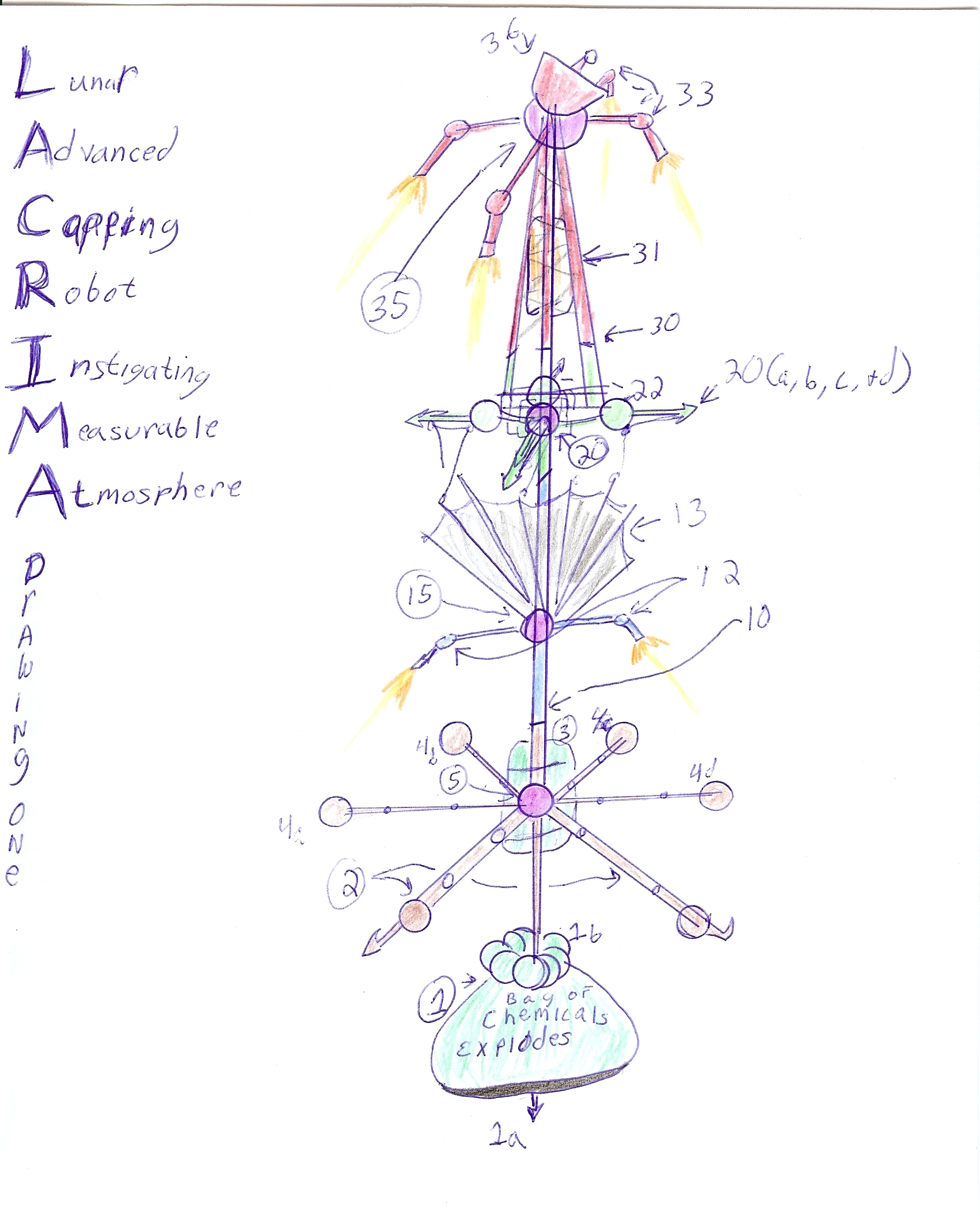
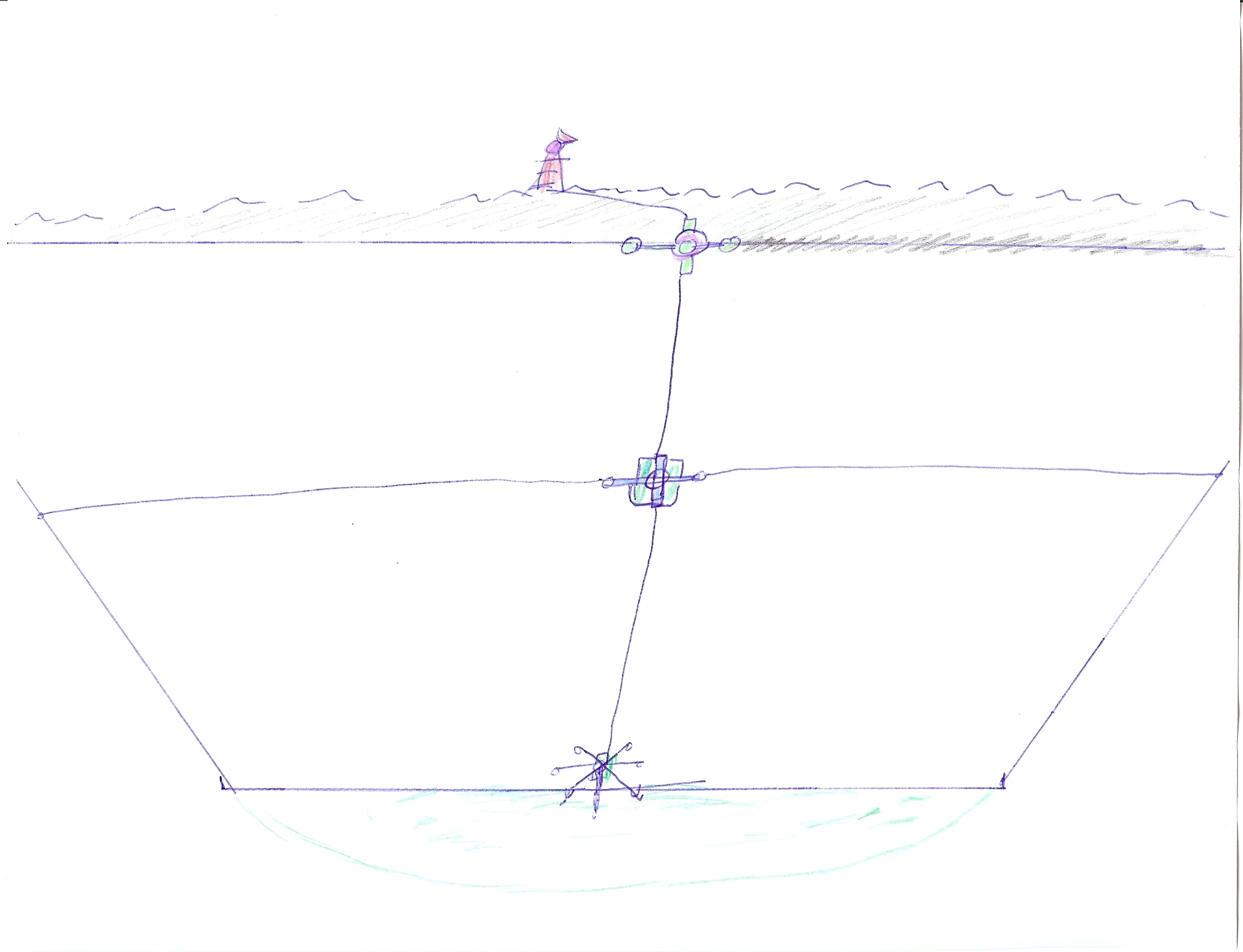
I have been writing and drawing about colonizing craters on the Moon for quite a while. However, now we know that a specific crater on the pools has relatively abundant water and likely neighbors others with water. That means that water and crater like qualities currently coexist. We must now take this combination very seriously in contemplating our next steps in the space colonization enterprise. So I propose we develop robots to cap these wet craters early on and follow up with a short Apollo like visit to install key components and then launch a settlement ship. This small ship’s crew would see themselves as laying the foundations of a permanent human presence on the Moon as well as developing and pursuing their own short-term objectives. Here is small set of crude drawings of the LACRIMA (Lunar Advance Capping Robot Instigating Measurable Atmosphere).

LACRIMA - Lunar Advance Capping Robot Instigating Measurable Atmosphere

The second illustration is of the LACRIMA deployed as it varied stages and components have deployed to undertake various tasks. The drawing depicts operations before the first human short duration landing.

LACRIMA operating as a sort of terrarium developer.


The first human flight would bring an engine and cables for heating and power and would also have a Moon buggy to be left there. This would  be used to connect to solar array robotically deposited in advance outside the polar areas. The mission of the advance human team would be to connect this set of solar arrays to the crater as well as to install the engine, improve the cap and install a good port and elevator in the cap.  The second crew would bring advanced habitation components for the crater. A group would stay a short time and another group would stay on long-term.
There is a constant dialectic of changing steps and retaining long-term objectives in any great project. I am a Christian and I find in both the life Jesus lived among us and in the memory of his life plenty of inspiration  for development and courage as regards worthy objectives.  Here is a Facebook Note I wrote dealing with some of the thoughts I have about the life of Christ.
      
 Saturday, April 25, 2009 at 4:33pm |
I write a lot. I have written a lot. I read a lot. I have read a lot.I have often read aloud in public. I have taught people to read. I have taught people to write. Perhaps I can fill this note with these short declarative first person sentences on this theme. On the other hand, I may go ahead and try to do more. I have not been a very successfull writer compared to the tiny number of people who make huge fortunes from their writing. I have not even been financially successfull compared to the ten thousand or so people in the world who really earn most of their living from writing and live pretty well. I doubt that there are a lot more than that. Notice how much of you local paper comes with a local by-line. Then take that as a generous and very inflated glimpse of how many real writers jobs there are.

In this note I am going to do something that even I think is a bit odd and irregular. That I think is even a bit out-of-place for this type of note. I am going to use as one of my flow-in-flow-out points of reference a hypothetical writing task involving real, living and controversial people. I have in several notes recently revealed a long time secret esoteric interpretation of the New Testament. Now, just suppose it were to be commercially published outside of this little blog in the world of free access with only 499 possible subscribers as I type these words. What would be among the highest and best and most appealing uses for me? Where might it be best released?

Probably if Mel Gibson bought partial rights to the notes here as part of a prequel to Passion of the Christ called Life of the Christ that would be close to the best. Really my preferences would be that specific. Why?

Because he can make a good movie and movies reach lots of people who are hard to reach.
Because he cast real ethnic Jews in many roles and they look right.
Because he used original languages, imperfectly but better than almost anyone else.
Because both he and I might make some money and I could use it.
Because he seemed to interface effectively with a large section of the Christian community.
Because even though he filmed in Malta he got a better feel of the period at least than most.

I often watch media presentations about Jesus that are just plain horrible in my honest opinion. Zeffirelli’s Jesus of Nazareth and the Passion by Gibson stand out as among the best I have seen. Screenwriting is highly collaborative. I have done a good bit of work in newspapers and it is pretty collaborative too but not nearly as much as screenwriting. But all writing is related to a larger world than the page. I think that such a set of relations is often not given enough respect as being very hard to trace and analyze. On the other hand some quite literate critics and some illiterate dismissers also treat the nature of literature’s relationship to the real world as being hard to establish. They simply argue that it has no real significance.

There is no substitute for practice in writing. Jesus reading in the synagogue then preaching. teaching fro long periods of time at a relatively regular feeding of multitudes and training his Apostles and high ranking disciples. In that rhythm were produced stories and words that still compel many of us like no other words. Shakespeare, writing for a play editing when it did not work and then eventually producing one worth copying down and putting in the company chest. Such works have endured. Faulkner earned more money over almost the whole course of his life from screenwriting in Hollywood than from writing novels in Mississippi. Hemingway cranked out war reportage and did many stories in the first person about fishing and traveling. From that routine of work the literary Hemingway emerged. Enduring literature is born from the grind of human interaction, nature and writing more often than not. Writers write. they keep writing and they keep improving in a struggle to realize their dreams on paper and express their real life insights in their dreams.

Northrup Frye, a distinguished literary critic wrote a book about the influence of the Bible on literature and called it “The Great Code”. I was influenced by that book and enjoyed a great deal but its name has no overt connection to the esoteric interpretation of coded frames in the Bible which I have been writing about lately. rather he makes the important point of how scripture is a vital core and framework of understanding for subsequent literature especially English literature.

There is a great deal of the Gospel account which is best understood by the fact that Jesus was a literate story-teller and orator who by distributing wealth on a fairly large-scale while being interesting attracted a significant number of writers to his movement. Probably there were as many as hundred pamphlet like texts about him produced by those who knew him. St. John’s Gospel ends as follows:
“Peter turned and saw the disciple following whom Jesus loved, the one who had also reclined upon his chest during the supper and had said, “Master, who is the one who will betray you?” When Peter saw him, he said to Jesus, “Lord, what about him?’ Jesus said to him, “What if I want him to remain untill I come? What concern is it of yours? You follow me.” So the word spread among the brothers that that disciple would not die. But Jesus had not told him that he would not die, just “What if I want him to remain until I come? (What concern is it of yours?)” ”
“It is this disciple who testifies to these things and has written them, and we know that his testimony is true. There are so many other things that Jesus did, but if these were to be described individually, I do not think the world could contain books that would be written.” John 21: 20-25

In this passage the we who believe and are writing the gospel we have seem to suggest pretty clearly that they have known St. John who knew Jesus and have received an oral tradition from him. They suggest that John also wrote a book which is the basis of the current Gospel of John which they have edited. Finally they make very much the noises that one might make when there are many documents one did not get to include in a history and so one apologizes to the authors of those texts and tries to find an excuse for not included the tidbits and themes that one may have taken great trouble to make available. I am not sure that Mel Gibson could get a real clear feel for that across to his audience but he might do better than some have done. There is a chance that even I would feel the richness of the work outweighed its flaws.

John was an episcopos and an Apostle within the Church but though he is not named with Judas (definitely not Iscariot), Joseph, Simon and James as one of Jesus’s brothers by the people of Nazareth he was also a relative of Jesus and one of Jesus’s purposes in telling Mary that John was her son and she is his mother is to designate John as heir of such privileges within the house of David as he has it in his power to give. This is limited compared to some systems but John is now the man of the house in which his mother is matron which is temporal and not the nascent Christian church. I am aware that the public Christian church has never had a tradition that the holy family adopted anyone but in our esoteric tradition Judas and Simon were cousins whose mother was a descendant of the Maccabees and a fairly prominent one. Their father was a Zealot and a devoted one despite being a Davidian of prominence. He was crucified and while the family was in Egypt and then when they returned the mother and children came to live in a small house that Joseph built on the edge of his struggling compound. She died before Jesus reached adulthood. They were adopted but in a rather more loose and House of David way than other Jews would have used. It was through them that Jesus acquired his first ties ti the Maccabean element in Israel. James and Joseph the other brothers of Jesus were not blood brothers of Simon and Judas. While Catholic prayers seem to emphasize Joseph as not having had sexual relations with anyone it is our esoteric tradition that Joseph was Joseph’s son by levirate marriage to another relative who had lost a husband while they were in Egypt. She raised him as the dead man’s son until her own death and then without parent or siblings he was also adopted. Note that when the people of Nazareth mention his family they are ready to stone Jesus. He had tow near relatives who had met violent deaths and in the ancient world people frankly found it easier to kill people in that class. Modern people do as well but they are not as open about it. Jesus’s family business and household were substantial and although there were many dependents Jesus’s designated heir had more leisure to write books than some living in the relative communism of the early church. To modern ears this sound s hypocritical. But there would have been no church movement without the funds drawn from Jesus’s household at various times and in various ways.

The Gospels also make it as clear as they can that the Herodian dynasty regarded Jesus’s family as a very major threat. They remained more or less continuously at war with them. Herod the Great orders the killing of Bethlehem’s little boys to get Jesus. Herod Antipas is only a quarter-king but as Tetrarch he kills John Jesus’s cousin who is known as the Baptist. When he first hears of the ministry of Jesus he mentions killing John right away and then asks to meet Jesus. Everyone knew Jesus had a better claim dynastically to any Jewish throne anywhere than any Herodian did.

Jesus’s household was clearly not rich. Zealot assaults on cashiered mercenaries at the time of the death of the Holy Innocents in Bethlehem involved members of the House of David and Herodians were killed to in part as revenge for Herod’s atrocity in the most ancient seat of the House of David. This sort of conflict was not only unequal, easily terrifying and cruel it was very expensive for the Davidians. Though he generated a lot of wealth as an adult they were poor when he was born and always had many expensive burdens to bear. Nonetheless, John could afford to write.

Jesus grew up with double entendres and stealth as part of his extended family lore and his way of life. Jesus’s only land based attack is not mentioned in the Bible at all and is perhaps the most gruesome and shocking to modern sensibilities. Jesus recovered from his fasting and prayer, meeting with the Essene emissaries, leading the demon assassins into the lion’s den and he immediately met with Simon the Zealot, a group of unmentioned zealots and relatives and relates his tale of the Devil’s camp. There are pens of captives, huge supplies, torture chambers, guards and time is of the essence. He gets a handful of people to accompany him only one of whom will become an Apostle. He agrees to position them around the camp at night with an emphasis on opening the cages of the captives and setting them on horses and asses kept there with supplies and scattering to the winds. Then they are to take the loot they can killing such guards as they can and bring the loot to a place agreed upon. With about a dozen or so men he assigns all but one to this task.

The only assistant he takes with him is led to a prearranged spot with cages of birds dragging tiny bundles of fire starter on string and a couple of donkeys. The assistant set the fires and released the bird and as they flew over the camp the fire reached the strings and they were burnt through creating tiny bombs. All of this took place at night and so it had a stunning visual effect. The birds were then freed as well by the fire and disappeared. This was timed to occur when the first guard sounded an alarm in the main camp. The men in the larger group would attack at that time. Then the assistant would sling stones dipped in poison at those guards moving near his position. Jesus would be the only many leading an assault on the main cam. The only human assaulting it. Using asses dragging meat and a relationship with the now man-eating lions he led a pride of recently man-eating lions into the camp. The camp had literally a thousand armed men. The other smaller camp was unusually filled with camels and donkeys and packs of booty and unusually lightly guarded had many things not been very unusual the raid on the adjoining camp would have failed but as it happened the camp lost all its prisoners many trade animals and lots of supplies and wealth. A few prisoners were armed by the raiders and died fighting but only one raider died and not on site. When the guards from the main camp arrived they found burning tents dead bodies and little else.

Jesus held back in shadows with a sling and a bag of stones. Whenever a guard drew a bow or a spear effectively against a lion he hit the guard with a stone not caring much if he killed, wounded or stunned. He simply supported the lions letting the blood and food smells of the camp drive them into a frenzy. When groups assembled to attack or defend against a lion he picked a few targets and hit them. He kept this up for a very long time. Then with fires in both camps and the howls of men and the roars of lions he slipped away to meet his men. He never returned to the camp again. He never got a full report on the damage. But when he did return to the meeting place he had enough supplies to begin his public program. The skirmish itself is now lost to all history but there were laid the economic foundations of the Jesus movement.

Jesus then gave the real life speech on which the parable of the talents would be based (see Matthew 25: 14-30). Keeping a double share of the loot himself he divided the rest equally among his followers. Reminding them that he also expected there support within the coming campaign. Further any loot they could not take at that time he agreed to take on an opposite understanding — He would give them back a portion of the value he could realize from the loot upon demand after a reasonable delay. How much was this fortune? It was a significant loss to the fabulously rich demons but it was almost an immeasurable fortune to the struggling House of David. Through his interview with the Devil Jesus knew that the Devil saw three primary men to be eliminated in order to destroy Galilee. One was himself. The other was the most successful fisherman on the Lake — Peter. The last was Jesus’s mortal and hereditary enemy Tetrarch Herod Antipas. Jesus used the fortune in several ways, first he ordered several large loads of wood and supplies through his Household’s carpentry shop and then fabricated the platforms he had already envisioned for dealing with the swine. He used a silent partner to fund his distant cousins James and John to pay off their own debts and then to buy a share of Peter’s business. Thus unknown to any becoming their partner. He paid to have many amphora of fine wine switched with the ablutions water at the wedding of friends having hard times, all of this was wine seized in the raid.

While waiting for the wood to arrive he converted the now empty bird cages to fish cages with hidden compartments and hid a different currency of coin in each of the cages. These coins also helped to anchor the cages by weighing them down. However, there were animals, saddles, weapons and clothes he could not safely use or sell. Through Simon the Zealot he found that Chuza was in trouble with his Lord Herod Antipas for both using court funds to support Zealots and skimming some off for himself. Jesus met with Chuza and Simon and came up with a system where Jesus would send loot to Chuza who had the only institution in Galilee large enough to launder the goods. Jesus would take a fraction of the real value of the loot and allow Chuza to make a cut so long as both the debt incurred by the Zealots and his enemy’s own treasury were also enriched. All three in this set, Joanna, Chuza and Simon would sign off on each transaction. Joanna would bring Jesus and his disciples payment disguised as gifts and then encourage others of women of means to give to his ministry as well(see Luke 8:1-3). This real life experience was the basis of the parable of the wily steward(see Luke 16: 1-15).

Jesus then contracted with foreign merchants so that trade with Galilee would not fail. He ordered lumber, millstones and anything related to bread-making and wineskins. He also bought up most local production of these same items. He traded a brand new millstone in Galilee for anyone who would give him a used stone and a ruined or cracked stone. He traded a new wineskin filled with fine wines from his booty for anyone who would give him two badly used wineskins with any wine in any quantity enough to slosh audibly. He also contracted to build the ovens he would use. He was nearly broke except for a half dozen platforms, a collection of millstones, old wineskins of bad quality, a set of secret ovens and some very part-time help he could demand. With these resources and a handful of new disciples who barely knew him he prepared to face down one of the world’s greatest foes.

The basic schematic of the raids is laid out in my note titled “Easter & War”. As the calming of the storm would indicate, Jesus and his Apostles would cross the seas in a life threatening storm and only then. They would free the captive and drive the swine into the water they would slaughter and butcher the swine bringing only the fish shaped meat pieces to land. Jesus and Peter were seen on one of these platforms in the walking on water. The porkfish were baked on skeletons both of leftover feedings and form the piles of unusable fish fishermen left around. These piles on the shore are mentioned in Jesus’ parable of the net. Jesus always asked people to pass up food to be shared out at his meetings. The normal thing was that a good amount of food was passed up and mixed with the available supply of porkfish. The feedings mentioned in the gospel are manifestations or signs ( and therefore also risky) because the manufactured famine had reached such a point that the people in the crowd had only tiny amounts of food to contribute to the feeding.

Jesus used rituals, parables, acts of charity, instructions and acts of war all overlayed in the same framework of facts. While this gets even more complicated as it passes through layers of writers it was immensely complicated as he lived it. Yet on the other hand this redundant meaning approach made things simple, increased security and aided in his moral teaching ministry. while the phrase “pearls before swine” for example had a history it was used because the bones of the swine tangled in old nets and strings and sunk under water were like white underwater pearls. Some acts of his war are told in parables outside the ordinary form and also repeat technical instructions. Jesus wants his Apostles to find spiritual meaning in the work they do which is largely illegal by most standards. The teaching on scandal is the best example of this style of work.

Imagine the platforms on which Jesus and Peter walked on water as large wooden squares of planks mounted on a heavy timbered cross. The central section over the centermatched cross beams is not platformed. There a ring of pig bladders and skins are inflated and secured under the edge of the platform. A similar rim of inflatables is on the edge of the platform. An odd tube of old nets, sackcloth and trash is weighted down from its open mouth to the lake floor with a small rock. Int hat tube all intestines, pigs trotters, skins, heads and notable pig organs are thrown. Once the butchering is done a millstone is secured around the neck of the tube which is then tied.This is then thrown in and drag the tube down compressing the pig wastes. Later the platform is moved and the place will be the site of several great catches. All of this is done mostly so that Jewish children can eat porkfish and not starve to death while also avoiding scandal.

With that factual scenario in mind listen to the following quote from Matthew 18: 6-9,
“Whoever causes one of these little ones who believes in me to sin, it would be better for him to have a great millstone around his neck and to be drowned in the depths of the sea. Woe to the world because of the things that cause sin! Such things must come but woe to the one through whom they come! If your hand or foot causes you to sin cut it off and throw it away. It is better for you to enter into life maimed or crippled than with two hands or two feet be thrown into eternal fire. And if your eye causes you to sin tear it out and throw it away. It is better for you to enter into life with one eye than with two eyes to be thrown into fiery Gehenna.” An honest and thoughtful reading will show many parallels unlikely to be coincidental.

Not every aspect of Jesus’s life is documented in some close code on the one hand or retelling in recorded parable on the other. For example the Gospels mention that he sent the sick to be examined by priests, that the manufactured mud pastes for eyes, that he encouraged people to give clothes to the poor and that he was involved with both baptism and healing baths. But there is no real evidence for what I propose as a normal Historical Jesus meeting per se. All lepers and sick people would be gathered first. A divider would go from the shore and into the the lake, dividing men and women bathers. All donated clothes gathered by his traveling followers from others would be given to those with the worst clothes. Those worst clothes would be burnt in the fire pits which heated the ovens elsewhere where the porkfish was made. A very unique and kind of crude but sophisticated soap would be given to the bathers. All those who were free of visual uncleanness after bathing and getting new clothes would be released into the crowd and told to confirm their healings with the authorities. Those still not well would receive what salves and bandages were available and be sated separately near Jesus. He would speak for a while and call for gifts of food to be offered to the front. His Apostles and others would mix these foods with porkfish and other goods they had and redistribute the greatly increased food supply to all after Jesus blessed it. Then Jesus would speak again after all had eaten and listened he would bless those in the section of seating for the sick and many would get well ( though obviously here Christians and atheists must see my scenario differently). Then he would encourage people to go to a section in the middle of the crowd to exchange any gifts that they might have brought with those in need. While this was going on he would allow questions from the crowd. After all of that he would usually dine with a prominent local resident for supper. This would be an all day affair requiring the work of dozens of people. He may have had between 12 and 30 of these days.

Jesus and his disciples hit each of a number of camps twice in raids and had a secondary feeding in most cases by moving small pigs to a wild site where they could forage and slaughtering them later. On each raid they freed all captives not killed in the fighting and used captives they armed with captured weapons though more captives were not fighters. The huge herds of swine also were deliberately chosen because as omnivores that helped create the famine by eating any human food available and not just grass. The demons also had a science of using the swine to foul as much drinking and fishing water as possible.Jesus and his disciples all veiled their faces during these raids.

These raids and feedings created the framework around which the rest of his public ministry coalesced. However, as Herod Antipas killed John the Baptist and began to track Jesus it became harder for Joanna to bring her payments. Pilate desecrated the great Temple in Jerusalem killing Galileans during worship and the Temple guard who had killed many armed foreigners did not dare risk an open battle. Then he was spotted walking on water. It is in this crushingly intense historic period of his life ( and not at some later date) that two things begin to happen. Jesus begins to state repeatedly that he will be crucified in Jerusalem and he increasingly supports and defends his reputation as a Messiah and a the Son of God. Son of God is a term rarely used for human kings in the Old Testament when they have a special mission from God but Jesus begins to push even this most lofty of claims to a higher place. He often spends all night alone in prayer. It is here that the Christ emerges whom atheists find it difficult to admire. However, the literary beauty of his teaching reflecting on all his life is still very sharp and sweet. As a verbal artist he is admirable to any one.

I chose the Mel Gibson prequel device partly because I do not wish to deal with the last week in this note. Gibson’s prequel should go to the Last Supper but I will leave off here. What I have to say about the unknown life of Jesus is largely said in covering these earlier months and years. The Gospels are a rich trove of insights even if not always understood as I see them. However, I hope that as long as we have biographies of Christ in various media there will be some I think are artistically worthy of the subject. I also hope that we will always have such biographies.

End of My Facebook Note–
I hope ye brave, ye few, ye proud, ye readers will find some focus and inspiration.