Category Archives: Western civilization

The Olympics, August and Despondency and floods

The flood has grown since this post was named or it might appear in the title. But while it has caused much suffering it was not anticipated like an approaching hurricane. But we do expect problems with rain and floods here.

This afternoon school is cancelled in many parts of the regionwhere I am due to storms and flooding.  I’m not in school as a student nor an employee but I am very aware of its closure. The rain also changes many other things around here. For direct and indirect reasons it has affected my sleep. Texts and calls have been coming in over most of the last twenty odd hours from automated systems warning me of the flood. Such is life. The many problems that I already have are made worse when the little acts that make up my life and struggle are interrupted.  This story continues to evolve around me across editions of this post. Hopefully with no tragedies among the near and dear in my life. But a cousin has needed rescue and nearer kin have needed sandbags. My current haunts in an old family home shared with my aunt are dry.


Many people, including one family very close to me, are more adversely affected than I am so far. But things have a way of letting you know when they are going from bad to worse. They often do. So why do I take time to watch the great successes on the Olympics? Even in the later edition of this post when,  among many other troubles, I have a flood damaged phone and  wound to worry about — I still took time to watch the Olympics. It’s a set of rituals, events and stories compelling to me even in a flood.

I still believe in struggle, effort, training and discipline even when the results are very far from world records and gold medals. There are a lot of other Olympic values that I share. In 2004 I found out during the Olympics that I might well get my papers in time to teach in China and I did. That’s after knowing that I had finally gotten the basic papers. But often the summer Olympics comes at a depressing and disappointing time of year for me as it does again this year. But I still watch and still care. My own less glorious struggle to survive the ordeals of another natural disaster remains connected to the stellar performance of Usain Bolt, Justin Gatlin, Alyson Felix, Van Niecken and many others on the track sprinting today. I watch them in part the way that I will celebrate the Feast of the Assumption of the Blessed Virgin Mary. It’s the National Feast of the Acadian People and it is a Church solemnity. There are layers of meaning.  I connect to the occasion in both Catholic and in Cajun ways.


“The future is not ours to see”, so the song popular in my childhood says.  But it is all too often fairly predictable for many of us. The great success of the U.S. women’s gymnastics team was happily predictable. They looked rightly confident to me. For most of us life doesn’t usually and daily resemble the kinds of unequalled success we have seen this year in the performance of Olympic athletes like Michael Phelps, Katie Ledecki, Simone Niles and a handful of other superstars. Certainly, my life doesn’t much resemble the epic Olympic performance of Michael Phelps whom I have very much enjoyed watching in these Rio games. But in the process of living we all deal with the same sense of being faced with tremendous challenges. I know what it means to push on and so do many other people who will never find a gold medal at the end of their journey. I have been reviewing old correspondence and am aware that I have long lived a life founded in faith. Sometimes, I am very grateful for all the support my faith has received. Other days find me less grateful for the same set of shared experiences.

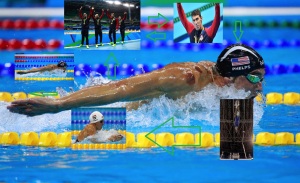
09-08-2016-Swimming-16I have enjoyed the Olympics and hope to keep enjoying them. But on a personal level I relate more to the road racer in women’s cycling who had to cut her own air all the way to the finish line while three competitors drafted and posted their way along to pass her in the last seconds and leave her in a medal void at fourth place. I relate to another part of Team USA which is the water polo team eliminated by a loss to Montenegro in a game they had to win to have a chance to make it out of their pool or group to the single elimination tournament. I relate to the 800 meters American record setter locked behind the dominant African pack of lead runners and kept out of the medals.  America is dominating these games but many American athletes are doing brave deeds and coming up short.
Truly I enjoy the glory of the great stars but I watch more to admire than to identify. I don’t diminish their glory and success but I am not so much made glorious by these events.  However, I am very aware of my own lack of glory and success these days… I am aware of diminishing resources to bring to the fights in which I am engaged.

But like many of you reading this, I hope to keep going on the track I run and the lane I swim in daily life until my strength finally gives out….


Hillary’s History and Politcal Conventions in a Time of Crisis

The conventions have had a bit of time to fade into the background. Both campaigns have been unconventional and both candidates experienced something different about their conventions.  In the DNC there was the contention between  Sanders supporters and the Hillary majority that she might have wished was less than it was. In the RNC,  Donald Trump was operating in a situation where Ted Cruz was booed off stage for not endorsing him and where not a single former President spoke to endorse him. Hillary had President Hubby and President Hussein. Trump did not have  have George War Hero Bush, George Texas Rangers Bush,  or Mitt Romney captain of the very loyal GOP block of moderate Mormons.  But if both sides had memorable conventions the most historic was the Democratic National Convention where a woman we all know very well if we know politics was nominated as the candidate for the Presidency of the United States.  I have no wife, no daughter and largely followed the conventions on both sides alone. I have a lot of female relatives and correspondents. But no matter what their political beliefs I would have to expect that most American women felt some kind of identification with Hillary.  It has been a long road here and she has earned the nomination by dint of creating an unequalled record of engagement in the affairs to which it relates in our time. That does not mean I will vote for her. I have not decided whom to vote for but I do want  recognize that as a student radical,  constituent advocacy attorney, First Lady of Arkansas, First Lady of the United States, United States Senator from New York,     U.S. Secretary of State and Presidential Candidate twice she has paid her dues. She simply cannot be denied that statement — no Democrat has ever had more sweat equity than she has…

She faces a candidate who is running on the plat form of building the Great Wall of the United States and encouraging an immigration policy led by wives for billionaires — although Marla Maples snuck in there somehow…. So we will see.  She is likely to be the next President of the United States of America.  She and her hubby do not make me happy about America’s future but unhappiness is a fairly permanent and pervasive thing for me.  I began my Mon ay with a meeting with the police to reclaim a relatives lost dog who had innocently enough put another relative into medical (really dental care) and then escaped the makeshift tethering the owners had done  as they left for the hospital.  Sunday after the DNC which was yesterday I had a very pleasant dinner with family but there was a potentially serious injury on both the way out and the way home.   Not traffic injuries but unrelated things. My life is full of little problems and medium size problems and big distractions but like most Americans I feel that I have a connection to Presidential politics.  Madame President or President Trump seem the only alternatives likely and Madame President is more likely. I do care and have a few things to say now.

Hillary Clinton has emerged as the first truly serious Presidential nominee by a major party in American history.  Victoria Woodhull’s candidacy in the Equal Rights Party in the nineteenth century was not a joke and has has been followed by many other minor party candidates but none of them had a realistic chance of winning. In addition, Geraldine Ferraro failed spectacularly on her ticket and Sarah Palin first lost with John McCain and then resigned the governorship of Alaska whereas before the national run she had reason to believe that she would be a reasonably successful governor and a fixture in Alaskan and regional politics for years to come.  Both women had some real success and fame after their losing bids, but not enough to say in either case that the run was entirely good for their public and political status. Palin did better in the creation of other opportunities than Feraro. But neither had as much to lose as HRC. Her selfish political reason for running (along with whatever noble and other reasons she has) is that she has done everything else except the VP and the Presidency that would constitute a climb up this ladder. Hillary Rodham Clinton has  a lot of valuable experience and also has a great deal of history to overcome. The Democratic National Convention was her time to try to cement her position leading the charge of the Democrats to regain the White House and also to show she can be an asset on down ballot elections. I think that it is fair to say that it has not gone all that smoothly. Thursday evening was the peak and the key of her efforts to legitimize and secure her position. The precedent had been set by Ivanka Trump introducing her father at the Republican National Convention, Chelsea and her mother would follow suit. But the crucial difference in a daughter introducing her mother was lost on nobody.  The question many were asking was whether a woman’s moment could be an effective reality. I thought that as regards the evening as a whole the jury is still out and may always be out. But Chelsea did a fine job.

Thursday evening Chelsea Clinton looked the best I have ever seen her look on a big stage and she spoke with virtually flawless delivery and presentation as she introduced her mother.  Then there was a video in the hall and a great deal of commentary by people who get paid to comment on most networks.  Bernie Sanders supporters in yellow shorts emblazoned with a dove of peace and the slogan “enough is enough” were much in evidence and some were interviewed.  Almost everyone was respectful of Chelsea and what she had to say.  It was much like Ivanka’s introduction at the Republican National Convention, in that it was hard not to at least wish to allow the speaker in each case a chance to rejoice and be proud of their respective parent.

Hillary Clinton’s acceptance speech was another matter. There were several times when chants of “Feel the Bern” had to be drowned out by her supporters chanting “Hill-a-ry” but that was not like a cheer at the right spot — it still disrupted her delivery. That was despite several points in the speech where she made overtures to Sander and his supporters including directly thanking him and adopting his cause. She also attacked Donald Trump a great deal.


Wednesday, I did watch the Democratic National Convention during most of the nearly two hours that they were broadcast on broadcast networks in what seems like a later version of primetime than I remember primetime being. But actually the speeches by Tim Kaine and President Obama had little trouble keeping my interest. While I was tired and my nerves were frayed from a hard day I was eager to hear what they had to say. Of course, it bears saying that I had a high level of interest when watching Donald Trump and Ivanka as well as Ben Carson and some others who spoke at the Republican National Convention in Cleveland last week. Both conventions have been contentious. Both seem to have achieved unity by their respective Wednesday evening speeches…. the contest between the parties can in fact take place.


I went out to dinner with an old friend on Tuesday evening and so we both missed the Bill Clinton speech. It is a tense time in the country and in the world as all times are but more so.  The country is at its most partisan, the supremacy of these two parties no matter what is more clear than ever in a year like this if there have been any other years like this. Monday July 25, 2016 the Democrats got their convention started. Most people seemed to agree that the highlight of the evening for the party was the speech given by Michelle Obama, the First Lady of these United States.   The news was not all good. there were scandals with the DNC, which has been hacked and has  leaked emails some say show they acted unfairly in favor of Clinton and against Sanders. Those scandals with the DNC are bound to make some people wonder about what was in the Clinton emails lost from her private server when she was in the State Department. Donald Trump has certainly already tried to make the connection. But regardless of what this means for the long history of apparent improprieties among the Clinton network and its two principal actors there were more direct concerns early on. It seemed clear enough that  not all Sanders supporters were in the mood to forgive and forget or to focus their anger on the hackers or any support the hackers may have received from Donald Trump or Russia. That is not likely to change completely even if it turns out that Russia is launching deliberate attacks on the Democratic party. Some evidence suggests there may be a pattern of such attacks.

They were already annoyed and now some of them are really angry. Debbie Wasserman Schultz had not planned to start the convention with her own public resignation from leadership. But her resignation and the hard work, symbolic gestures, speeches and other activities of the Democratic National Convention do seem to have worked to bring the discordant party together.  We must see the struggle as one aided by the supposed sharp contrast between the parties and candidates. However, when that is said one wants to remind everyone of all the candidates have in common although there is no reason to believe that that matters all that much. This is a season of conflict and competition….

Some will rejoice at the tone of the Hillarious  Democrats, peaceful and Kind compared to some in the GOP. But others will wonder if that is realistic.  Trump is not seeking world war or genocide. He is more alarmed than alrmist. The events around the world kept conspiring to make alarm seem reasonable. Japan had is largest mass killing in over half a century without firearms and a saintly old priest was immolated by ISIS in a French church. The Convention seemed tone deaf to some outsiders.  The message of universal tolerance, equal opportunity and average wonderfulness did not jive well with all the headlines. Of course the Democrats are in executive power that has two very different effects which play out across long periods of time.  First, a certain amount of relevance is assured and more is presumed. It’s almost impossible to be as out of touch as a party out of power can be. On the other hand, the portion of the electorate seeking change is likely to want to change such a party into an out of power party. But, in our current situation –and unlike the way many but not all countries work– the roles of the parties are reversed on the legislative side of things. Dems are out there and GOP holds sway. Both sides experience the two effects listed above in a limited and complicated way…

So the country has a complicated set of signals being sent…. But one of these people is going to be President.  Republicans just had their big political convention a few weeks ago at the longest description and it fades from memory. Hillary had her moment and now the Democrats are having their own chance for the Convention to fade in memory. The press is on for the vote. The election matters and I will return to it. But I do want to look at this moment as well.


Racial Violence, Islam, Christianity, America and Me… Part One

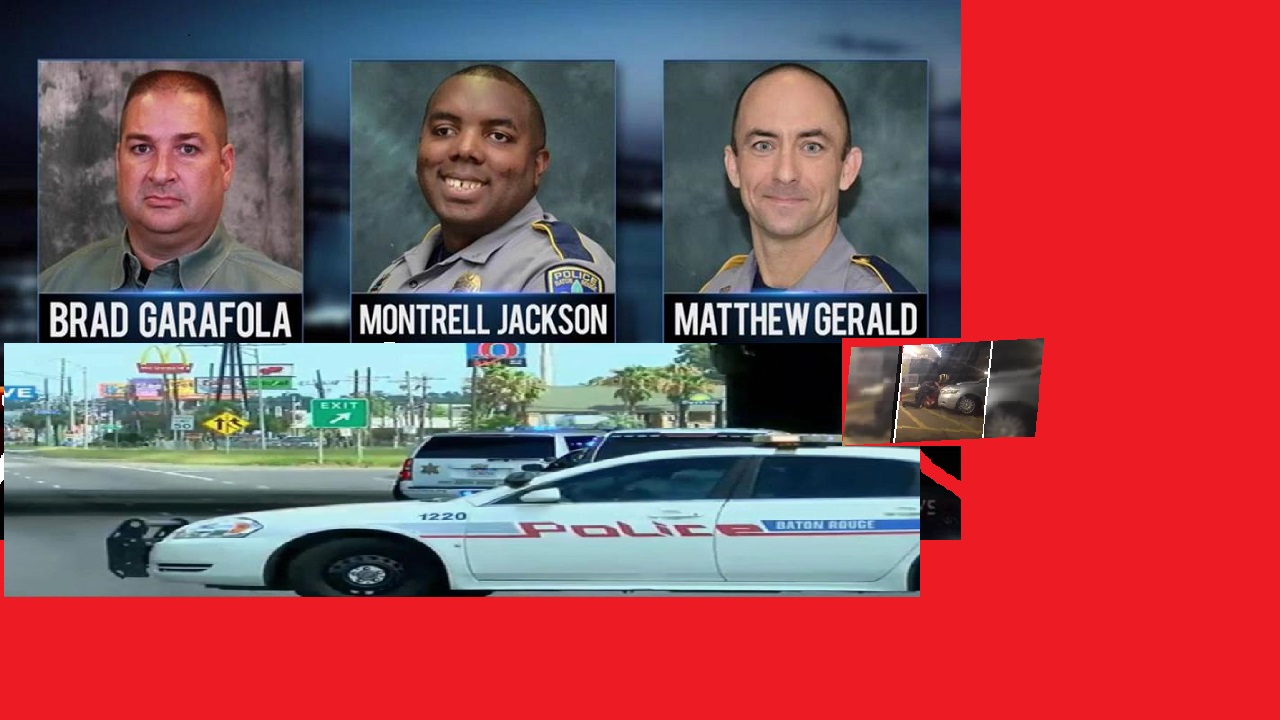
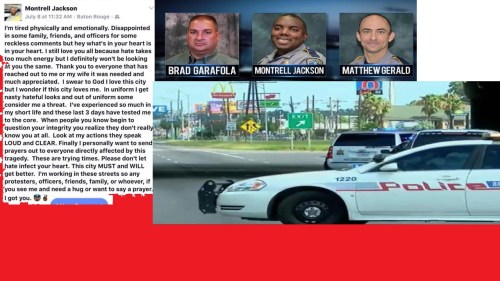
There is a lot to say and so I am using a series to look at our challenges described in the title. This is not a long series of posts it has only two parts. There was an assassination of police officers in Baton Rouge this Sunday. Three officers, two white men named Matthew Gerald and Brad Garafola were killed as was one black man named Montrell Jackson. The basic original report of their tragic death is covered here by the Times-Picayune.  Of the dead, two – Jackson and Gerald- were Baton  Rouge city police and the other one was an East Baton Rouge Parish Sheriff’s deputy. All leave behind families that include children. At least three other officers were wounded. All casualties were from the same two departments. One of the wounded, Nick Tullier, is still struggling for life. The others seem certain to survive.  It makes me sad and angry to think about the loss of life, the breach of peace and public order and the cost to all parts of our civil society arising from these tensions and their many manifestations. I especially realized how emotionally involved I am from video on one of the local television stations which showed me in a distant wide shot asking the panel my question during the forum. I was more agitated than I normally am as far as body language can allow one to communicate agitation, and that was without voice or a close up. But nonetheless I am not devoting this entire post to these events.  I do have emotions about these events that I need to express but I feel the need to express more than those emotions… But frankly, this post is only partly about the police ambush. A small part is about this important story in fact. This blog has some themes to pursue and these sad events occasion my pursing them a bit further. However, this has been more intense of an experience for those who represent the State of Louisiana at the capital city, and that has been covered by the Advocate here.

Baton Rouge cops shot art

In what has been described as a rambling series of YouTube presentations by several reporters and analysts, Gavin Eugene Long claimed to be a former Nation of Islam member, there has be no public affirmation or denial of this claim by  any Nation of Islam leadership that I know of so far. Also on what was basically a You Tube show, however unsuccessful, Long in fact referred to Alton Sterling, the armed black man who ran a long term squatter based DVD business in front of a convenience store and was killed by Baton Rouge police officers on July 5,  this was seen in graphic images and there was at least an element of summary execution in the images that a reasonable prosecutor could pursue as grave police misconduct. Gavin Long operated his own YouTube channel under his new legal name, Cosmo Setepenr which he had adopted in May of 2015. He used the Sterling shooting as an example of oppression, making references to oppression against blacks and police protests.Also relevant to these acts Long called the shootings of five Dallas police officers an act of “justice” in one of his videos. His political analysis led him to declare that  “One hundred percent of revolutions… have been successful through fighting back through bloodshed.” Some portion of the reporting on these matters is well handled by the Los Angeles Times here.  In his You Tube presentations Long said  the act of peaceful protesting was a futile method based on emotion and was easily forgettable. So he claimed association with the Nation of Islam and with more exotic small and less Islamic supposedly Muslim groups. But he also belonged to a number of groups most Islamists would never touch. The individual sovereignty movement is very small but also very diverse, with members varying enormously from one another in every way and it appears that Long was part of that movement. I did receive a degree from  LSU and I had intended to be there in a few weeks as of not so long ago. I reported recently that that would not happen.

Monday, July 18,2016 I attended the Acadiana Press Club Forum Panel Discussion on policing in times of civil unrest. Panelists included David Khey, head of the criminal justice department at the University of Louisiana at Lafayette;  Reginald Thomas, interim chief with the Lafayette Police Department; Marja Broussard, Lafayette NAACP leader and community organizer; and Maj. Art LeBreton, enforcement commander with the Lafayette Parish Sheriff’s Office. Not in attendance as announced was Tracie L. Washington, a New Orleans-based National Lawyers Guild attorney. The discussion also included a number of people from the audience all of whom were concerned about the state of affairs we have been hearing about in Baton Rouge among other things. The mood has been tense in various places across the region since the shooting of the police in our state’s capital on Sunday and remains so to some degree today. But where I am and in many other places it is a subtle tone and feel which is easily missed. The usual  moderator was absent and a young woman from the Advocate organization named Lanie Lee Cook did an excellent job of moderating.She allowed a number of issues to come out including my question about tendencies to unduly nationalize crises and questions about riot gear which later shaped her own article appearing in the Acadiana Advocate.  I met here fro the first time when I helped her bring in the water from her car to go with complimentary snacks. But there was for me a mix of familiar and unfamiliar faces as there always is in these events. Several people were there for this topic who would almost never normally come but still that is not so unusual as people come specifically for each topic as well as those who try to come to most events. The violence in Baton Rouge including protest violence and arrests certainly colored all other discussions about this topic. A pastor and a senatorial candidate from the  African American community certainly brought up black on black violence and how this affects all of our perceptions of the current troubles. But admirable as I find these fora to be they are always limited in scope.

There should be enough material for several blog posts in discussing the Baton Rouge police ambush shooting, the protests and arrests as well as the Alton Sterling shooting that went first in this timeline. The video taken from a witness’s phone showed police struggling with Sterling and shooting him to death. It appears that in both the Sterling shooting and the ambush police responded to reports of an armed man who appeared to be a threat. Gavin Long, Sunday’s shooter was dressed all in black, was a military veteran ( like the Dallas cop killer) and seems to have come all the way from Missouri to kill Baton Rouge law enforcement officials. Rich as that story is, I am only going to deal with it briefly. He was clearly involved in the political realities of his time and clearly was not overly successful, not so different than me or a good number of other people I know in that regard. Just days before his deadly rampage Lafayette General Hospital was launching the formal establishment of the Mayci Breaux Memorial Scholarship founded to honor one of the two women killed at The Grand Theater in Lafayette. That story was reported on my blog here and here.  Also this reminded me that like that shooter, only more so, this killer drove a distance to come to Louisiana and kill our people. Two known high profile incidents do a pattern make. They may also indicate a larger pattern. I can think of a lot of reasons why the choice to attack Louisiana might seem a natural one to some people. Hauser was a man as much an open Christian as Long was a Muslim and then had some nearness left to spare. But his Christianity was of the Hitlerite variety and I will mention Hitler and his views just a bit below. Hitler was a larger supporter of a breed of anti-Semitic, violent and disruptive Islam not so different than the Islamist terror movements of our own day. These two groups often find it easier to converse than Muslim  Sufis and Catholic Charismatics for example. But I believe that for America the Catholic Charismatics and the Sufis would have more to offer as citizens and in productive dialog.

This is the season where one can argue endlessly about the success of various programs and wars and not really agree on where the results stand. In his final Prime Minister’s Question David Cameron dealt convincingly with the progress of the war and yet one knows that there is no doubt that the war on ISIS has a darker side than he describes when hne lists the devastation of their militarized territoties and even claims that their foreign recruits have been cut off by as much as 90%.  Even if those things are true, and it is hard to be sure we know that the region is a mess and the world is made more unstable by the many degree and layers of chaos that are ongoing there.  There is much more to say about that dark side of the Syrian and Iraqi political realities and their consequences elsewhere than we can get to here. There is so much to be said about the recent terrorist attack in Nice that deserves more attention in this post than the Baton Rouge attacks and that event as a whole is more than we can get to here. The Nice attacker was of Tunisian descent but his family seems to have arrived in France even before that early wave of the Arab Spring. He was not directly a part of the huge displacement of people, the refugee crisis and the resulting tensions across the region in Europe and even here in North America which has resulted most of all from the Syrian war. But that is not the only bad outcome. However, it is  quite debatable which outcomes are good and bad fairly quickly.  For me few things could more clear than that we need to fight ISIS and that it has not been an entirely successful fight  — I hope this post contributes something  to understanding what has contributed to the faults in our strategy. The fight with ISIS, the Black Lives Matter excesses, the remnants of Al Qaeda, the Arab Spring, the chaos in Turkey and the tensions related to BRexit cannot all be seen as purely disparate phenomena. In addition,  in September of 2012 in this blog I posted a post  titled “The Current Crisis in US- Islamic Relations…”, you can link to it here but it is reproduced significantly in what follows. In that post I was declaring that the angry Muslim crowds protesting outside US embassies, the killing of Ambassador Christopher Stevens and his four companions at the consulate in Benghazi were all  deeply troublesome events. I reminded readers that from 1776 to 1950 no United States Ambassadors were killed in office.  I speculated given my lack of research resources that perhaps two or three died in transit from posts or even sickened and died after taking some kind of leave but none died in office. Just as with Lincoln no presidents were killed in office before him nor shot but a good percentage were shot or shot and killed after the Kennedy assassination, however I failed to mention that if Andrew Jackson had not had the skills that he had as a sort of action hero co me to life then he might well have been shot on at least one occasion and if he survived that then perhaps on another. This initial shooting of Lincoln after our greatest national crisis also tied to race forms a pattern for future and repeated violence and if one leaves  aside the Indian curse and natural deaths in office that made up a patter until Reagan survived his shooting then one can say it was a creation of a new bloody political discourse when John Wilkes Booth shot the President he perceived as a tyrant. If that is the Case then Ambassador Steven death for which Secretary Clinton bears little penalty might become a very important and seminal historical event because it had been almost thirty years since our singular period of bloody Ambassador service had ended, that is from 1950 to 1988 seven died violently in office. Two in plane crashes ruled accidental and five in armed attacks. The last one killed in an armed attack was in 1979, that was almost forty years ago. It is true that in the last few years no more Ambassadors have been killed. But since on September  11 2012  the whole consulate in Benghazi was gutted and the Ambassador, an IT specialist and two armed men (one of whom was a former US Navy SEAL and the other a State Department Security professional) were killed we can see an escalating patter of violence and worldwide disorder related to the forces that killed them.  Symbols matter from the prompt reality that the within hours of the Libya events  the US flag was torn down in our embassy in Cairo and desecrated and an Islamist flag was raised in its place to the attack in Nice and the shootings of cops by two people who had some ties to Islam in their final views on what to do in America. Other embassies surrounds are erupting and the potential for more killings is very real. Prior to the attacks on the embassy, in fact one day prior on September 10, 2012 I posted the following  paragraph in a note here in this blog:

I am concerned about tomorrow’s anniversary. There have been a lot more shootings in Afghanistan lately of our troops, there have been a lot of ammo dumps opened up to terrorist groups through the so-called Arab Spring. There are new governments with ties to these terror groups. There have been a lot of mass shootings in the USA lately. Our border is very porous with Mexico in which violence is breaking out in new ways daily. In addition the Arab element in Mexico has multiplied many times over in recent decades. Very little has been done to honor the woman who shot the Fort Hood shooter or to punish the Fort Hood shooter. I do not mean to predict that there will be ground based terrorist attacks on our soil this month. Probably there will not be. But if there are they will not be unpredictable.

We find that I was well aware of the general kinds of risks that we would face on the very day that disaster occurred because I was aware. Montrell Jackson was a big armed black man,  sexually vital and successful enough to be a father and financially successful enough to make it in middle class America. he was not less assertive than his killer or less black. But what did he care about: He discusses being tired sending out prayers and hugs working for peace and unity. He has a desire for the civic good to come about as inspired by and separate from the religious good but connected to it. I do not know where this man whose wife had just given birth to a son a few months before worshipped but it is a deeply Christian vision with roots in Augustine and the book of Acts of the Apostles. Labels are not the most important thing and all Islam is not the enemy of all peace in America. But it is true that here the killer found solace in the Nation of Islam and the defending martyr in sentiments with a deeply Christian provenance. Adolph Hitler in his early years of organizing decried the efforts of German missionaries to  make Christians converts among the negroes in Africa. More subtly but clearly enough Macaualay the great British historian indicated a few truths that string together for him into a doctrine. First that Catholic Christianity leads to race mixing more than Protestantism and  secondly that Protestantism produces a superior civilization.  He also believed Catholic Christianity had created the English as a racial entity by mixing the Norse, Celts and Germans but that having happened then it was important that it not happen again. Christians in America do not subscribe generally to such explicit ideas, but they are not irrelevant to us. Christians here do not really understand that Egypt, Turkey and Syria form a real part of the Christian Holy Land and the churches devastated under the years of American influence are deep and sacred parts of our heritage. Almost every comment Christians in the west would make about the racial and ethnic identity of those old Christians is offensive ot most of them even though all the statements are profoundly at odds with other offensive statements from the West.

Montrell Jackson Post

This is not the easiest post to write and not all of them are easy to write anyway. What we have to recognize in my opinion is the real history of the United States as regards Islam. The role of religion in the life of the United States and in geopolitics was probably less open and more minimized during my early childhood than ever at any other time among American children. The Soviet Union was the great Marxist atheist adversary which had reinvented itself and had nothing to do with the thousand year formation of Russia as it struggled to be a Christian nation. The struggle for nationhood and the struggle for Christianity can be separated for discussion but they are deeply linked and in the most complicated ways. We also have to remember that the Slavic peoples we criticize for abusing Muslim territories have an ethnic name of Slav that resembles  slavery in English largely because they were enslaved by Turks and Arabs on a broad scale for centuries.  The numbers are staggering and althoughmany died horribly their genes as much or more than Hellenic and Minoan communities absorbed before account for many of the Europena genetic features in parts of the Arab world which would other wise be far more negroes because of other people enslaved by Arabs and other Muslims then freed over previous centuries.    In this period of history of which Putin is likely more aware than Trump or Clinton most white slaves did not have definably negro masters but certainly thousands of whites did have negro masters and the overall tone that informs the racial dialog in America is in blissful ignorance of these matters.  Almost exactly year before Long shot up Baton Rouge a Muslim shot up a recruiting station in Chatanooga, Tennessee.  Did the internet savvy Long find those memories online when making a decision? The endless bloody chain of events has no end and we must at least understand it — that includes the slavery in America and the COnfederacy but those events have a context as well.  Monuments and flags are coming down across America but what is taking their place?

Today we all know religion has a profound influence on the world, its politics and its power arrangements at least as compared to the secular tone of my childhood as it was portrayed in the news and politics more often than not. I am myself a very openly Christian person and it is not hard for me to connect my  faith to anything else that I might be interested in doing, talking about or writing about in this blog. Sometimes the connection is that what I am doing is not very Christian but there is always a connection. The future of Christianity in America is not assured and not easy to define. It can take many forms and it will face many challenges.  But however much I may disagree with many Americans about what that faith is  meant to be and what its role is — but I think we can not ignore its significance. In the next part of this series, which may or may not be the next post , I will look at how Christianity and Islam offer competing visions of America which affect the violence in our streets.   But for now I will simply conclude by saying that we will not get anywhere I want to go without a lot more painful and uncomfortable discussion of the inter changes between race, religion and violence than we have known so far.

Faith Camp, Bukidnon Youth Conference and the Future

Faith Camp is a one week long camp held for middle school aged students based somewhere in Vermilion Parish. There are currently two such camps held each year. While the kids are the focus it is an event that involves people of all ages. For many who participate in its various aspects it is both an optimistic and fun experience and a deeply spiritual one. The Catholic faith is celebrated in a context which is fairly complete and brings the Gospel of Jesus Christ and the experience of church into the lives of these young people in a complete way.

The last two weeks  before this posting there has been ongoing the 20th year of continuous Faith Camps. This ministry was founded by my sister Susanna whom I saw at Faith Camp last night. At the time she founded she and were regular prayer partners and she was in the area and living at Big Woods during the summer after having started her studies at the Franciscan University of Steubenville. It was a fairly small camp that year but I was deeply impressed with it and shared with her my own memories of a live-in conference  in Bukidnon when she was a child as one of my better memories and so the two things were linked in my mind at the inception although there was not much of a causal link.  Susanna wasalso a small child when the Bukidnon Youth Conference was going on around and near her in various manifestations in Malaybalay, Bukidnon on the southern island of Mindanao in the Republic of the Philippines. I haven’t been back since the 1980s but it was a time which I have always felt had a big influence on the rest of my life and other lives in the family. Many members of my family have played key roles in the success of the camp over the decades. This year a middle school aged child of one of the campers at the second camp was a camper at Faith Camp.


 This year my sister Sarah’s eldest daughter Alyse is the coordinator of Faith Camp as she was last year. This is one of the blog posts that I write that is not primarily driven by the news. It is more driven by  a series of important experiences, recollections  and feelings which resonate in my life. This is one of those posts which combines both some vivid recollection and some fading memories: But the hope one felt at key times continues. The possibility of really putting together a history of those years is a daunting and not a very promising prospect. But the prospect of trying to recapture some of the spirit of those times seems a worthy aspiration as it will help me to convey some thoughts about the current times and some of the times in between now and then. I went from New Zealand to the Philippines with my birth family when I was seventeen and arrived there around Christmas. The bottom right hand picture below is of the Maranatha Youth Group in St. Pius X Church Parish in Titahi Bay which I left behind there on those cool windswept coasts. We passed through Australia on the way there.The top set of damaged images are from my time in the Philippines as is my better picture of myself leading my sisters on the carabao. The bottom right hand corner isa picture of the wall of my Household at the Franciscan University of Steubenville.


 We were in the Philippines for a couple of years (or so I remember without checking) and Simon was born with difficulties associated with Prader-Willi Syndrome. That was also at Christmas and was at the time of my Bukidnon Youth Conference which is the real subject of part at least of this post. Due to Simon’s condition we came back to the United States. While there I completed my Freshman Year at USL — now the University of Louisiana  — in one semester and in the preceding summer worked in some college and youth ministries in the church. Then we all returned to the Philippines and I renewed my ministry for a while and in the summer just after my brother Joseph was born and having overstayed my visa in a tense time in a country on edge and with a gift of a large and dangerous looking tribal sword I flew back alone to the United States.The picctures I took there for various reasons have not much been digitzed and the ones that were have not al made it into part of the cloud I can access. But the memories that I have of the Philippines are indeed plentiful and meaningful. Many of them were pleasant enough. Although the images in the pair below do not show the day to day life there as I justified that life they do show some of the rewards of the experience. Visiting the sick westerners in trouble, prison ministry, speaking to dozens of groups and working with college ministries all filled most of my days. But the Bukidnon Youth Conference was perhaps the  peak of my ministry there.  Being a 52 year old, divorced, childless near indigent was not the future among many possible futures which I saw as most likely in those days. But the journey since has certainly been a complicated on and rich too in color and texture and that sense of richness makes me feel like an expert on almost everything on some days. While that is not fair to much of anything neither or the days entirely fair when I feel that my onIy efforts to communicate come from having little else to do that is fulfilling and that I only ever feel that I  am well qualified to be a sage because I appear not to be qualified for anything else. My life has not been laser focused in a single direction and my time in the Philippines was not either. I like Faith Camp and I liked the Bukidnon Youth Conference in part because they touched many aspects of life from the arts to sport to socializing over dinner. This reminds me of one of my first Facebook notes when I wrote about  some of the extracurricular activities and hobbies that have enriched my life  and divided them into the big three categories of Faith, Science and Sports which I  chose to denominate as easy issues for that early Facebook note. These Easy Issues are not to be confused with the Easy Essays written by Peter Maurin of the Catholic Worker Movement. His essays were easy,  because he easily guided the reader through the complexities of political philosophy to a simple and cohesive approach which would provide the framework fo the movement he and Dorthy Day were founding. In my Facebook the subjects are easy because of my tremendous insights into the very narrow experience I had in each of those fields — I did not concern myself with the larger picture. There was some tongue in cheek in the use of there terms and words but Faith Camp and the Bukidnon Youth Conference were also founded to give young people a real body of experience that they could claim as their own. A small window of controlled positive experience from ehich to see the world.

During those years when ministry was part of my life I did a lot of work preparing to work . One thing  or another or many things must be left out including almost all my regular Catholic  school time but I now note  the religious education I received. Some I received within the context of the schools mentioned. However, I also took a set of remote preparation confirmation classes in the Diocese of Lafayette within the Come Lord Jesus Program and the brief imediate preparation course at a Parish in the Archdiocese of Wellington, New Zealand. I was confirmed by a cardinal. In the Diocese of Lafayette I also completed instruction in and was commissioned for Evangelism as a Lay Evangelist of my native dicoese. This was also where after college I was certified as a catechist. Beyond those things, I completed the Life in the Spirit Seminar, the Cursillo de Cristiandad (en Ingles), a basic Lector’s training, Prayer Group Leaders Training Course, a salvation history micro course and stdied as a journalist the English translation of the Prelature of Bukidnon’s Alagad course which was a successful lay leadership course. I also read and discussed the Documents of the Second Vatican Council many times and in many contexts. Susanna who founded Faith Camp completed here degree in theology while continuing to build up this ministry. The two things have in common that they communicate to the kids from a depp and well laid foundation.

Like a lot of activity among Christians it is designed to provide an opportunity for a personal spiritual experience. The importance of personal spiritual experience in America is more evident than in some countries. One of the reasons for that comes from a man who was not a Christian but had a profound influence on the Christian and other populations of these United States at a critical time — the Revolution. Thomas Paine, one of the great thinkers of the American revolution basically stated that one of the profound problems with revelation as a basis for any law or covenant is that as soon as it is written down or described rather than existing as a perceived miracle or apparition or Messianic epiphany it becomes mere tradition. Three things can be said about that idea that miracles and revelation become traditions:

1. It is somewhat true and worth keeping in mind.
2. If God, the universe, the gods and Divine Wisdom were communicating with humanity they might not excuse people who said “Well, I needed that direct Apparition your Highness — didn’t get it so it’s your fault not mine.”
3.In places and times such as existed in the Charismatic renewal there was a renewal within the person which was seen to confirm the written Word and the received tradition. It is out of that third connection with the renewal of the background music and lifestyle of our family that the Bukidnon Youth Conference (BYC) and twenty years of Faith Camps have come. The Bukidnon Conference was less part of the Charismatic Renewal than was some of my work in those days and the current Faith Camps only remind one of the renewal. But the tradition is there.

St. Augustine is credited with two sayings that mean a lot to me as far as faith goes. One is “Seek not to understand that you may believe. Seek rather to believe that you may understand.” That saying is not perfect and is easily misconstrued but it remains profoundly true and truly profound.The second saying I will allow to explain itself and to be interpreted without me. St Augustine wrote “The best and the worst men in the world live in monasteries.” The idea that these young people come together to find understanding and to explore a fully lay spirituality does not mean that none will later become monks, priests, scientists or theologians some do and those around usually rejoice.  But the experience is of a different focus of informing a growing faith and living for Christ in the world.

That Filipino journey  in which the Bukidnon YouthBconference was born was one  which only temporarily ended just after the conference itself. But after returning with them from my time at USL and in this region I did not stay but went to enroll at the school where Susanna was studying when Faith Camp was founded.  I returned a bit early and went to live that summer with my paternal grandparents in a larger than most two storey house beside a park. That  is where I lived in that intervening summer have lived at other times and is also where I am living  now as I type this but I have only been here for a few months this go round. Then I enrolled as a sophomore at the Franciscan University. The summer after my sophomore year I returned to the Philippines to visit and overstayed my visa yet again by only a few days and flew home alone. I left school in mid semester for complicated reasons including some to do with problems in the Philippines related to those whom I had invited into the region to help me with the Youth Conference and  shortly after leaving school I met my parents returning to Abbeville where I currently reside. All of that was along time ago and I took a break to do some more ministry and other things before enrolling again at USL and finishing my degree there. Thousands of picture taken during those and subsequent years are unavailable to me here and now on this blog. But the family on the bottom left hand of the set below are the son of Abbeville friends and his wife who have been FMC missionaries where we once served for more than a few years now. The picture on the bottom right hand corner shows my brother Simon and my parents at an FMC Donors Dinner. He clearly survived the ordeals surrounding his birth as did we all.


Of the  actual BYC as an event I have no photos to share and never had many photos. Indeed of the conference itself very little documentation was made and far less survives. But there are a few things and here are a pair of snippets of that time. The newsletter Resounding Praise which defined so much of our communication with the rest of the world had a feature on the conference. This gathering so distant in time and space is still near to my memory and sensibility. The sense and vision behind the conference was one of bringing young Catholics and some not sure they were Catholics together to celebrate the gospel and to deal with the real challenges not only of their personal lives but of Islamist and Communist pressures from groups which in several cases were profoundly hostile to their Catholic Christian commitments.  There was also a real openness to finding what could be improved in the generally pro-American, Catholic, free market synthesis that informed the conference. There was not a tone of xenophobia or paranoia but of relatively optimistic participation in the world as it was  for young Catholic Christians. There is something in Faith Camp’s tradition that has always reminded me of that event.


There are bigger events in the world than Faith Camp or the Bukidnon Youth Conference but bigness is not everything. Nonetheless as America approaches it participation with other countries in the Rio Olympic Games I am reminded that the New testament is full of references to Olympic events. Paul wrote of racing, boxing, archery and of the disciplines of training as well as the glories of victory in those ancient games. For those going to the Olympics who are Christians while they should respect the games and the diversity there it can be both a mission and a spiritual experience in Christ.

A few years ago London prepared to see the wedding take place in Westminster Abbey there was a lot of suffering and pain in the world. Truthfully, there is almost always a lot of suffering and pain in the world.  Whatever their role may be in adding to the sum of distress in the world, the British royals do quite a bit to lessen the sum of woe and that was not the less true in a year when they were planning a royal wedding . That  set of outreaches to those in need is an effort that  is well documented. Prince Charles, Camilla Duchess of Cornwall and Prince William (the bridegroom this weekend) all have long supported a variety of charities benefiting humans, animals, ecosystems and cultural groups in distress.Prince Charles has a substantial income as Duke of Cornwall and donates a great deal of the income to charities in such a way that it leverages and is leveraged by other charitable donations. While it may well be that not a direct penny of that family’s efforts and gifts will go to help those hurt by the tornadoes whch ripped through the South last night it is also true that they are part of a philanthropic community around the world in which helping is informally circulated almost everywhere. Two babies (at least) ago the United Kingdom and the British Commonwealth celebrated on the 29th of April 2011 The wedding of Prince William and Catherine Middleton. This expensive and extravagant occasion was also a Christian ritual and gathering and an expression of faith. The scene was truly extraordinary and the elegant venue and the well prepared  liturgy and preaching were all rather impressive even for those who are not so easily impressed.  The sermon of the Anglican Bishop of London is one which I have found to be a worthy sermon to address our times:

“Be who God meant you to be and you will set the world on fire.” So said St Catherine of Siena whose festival day it is today. Marriage is intended to be a way in which man and woman help each other to become what God meant each one to be, their deepest and truest selves.

Many are full of fear for the future of the prospects of our world but the message of the celebrations in this country and far beyond its shores is the right one – this is a joyful day!

It is good that people in every continent are able to share in these celebrations because this is, as every wedding day should be, a day of hope.

In a sense every wedding is a royal wedding with the bride and the groom as king and queen of creation, making a new life together so that life can flow through them into the future.

uture.


The future does flow through families and gathering and weddings and the like. Churches and other communities have an obligation, it seems to me to prepare young people to be conduits of the grace of God and the hope of the future into new generations. They need to be prepared for the task. All married couples, all celibates and many other classes of not mutually exclusive kinds of people have to be educated in that complete humanity. For Faith Camp that is a Catholic Christian experience An I like that best but it also speaks to those not with us in that community. I am not a young optimist and my own view of life can be pretty bleak often enough. But while  I am sorry that when caught up in nearly apocalyptic events I often already have declared myself to have been involved in a number of calamities — sorry but not very repentant. these conferences and other things have not made me boldly cheerful in that sense. But each Faith Camp and its predecessor to my view  have in fact reminded me that how one engages with life may change over the years  but faith filled engagement  and courage remain necessary.  I know that I  was at one time more fully engaged in meeting the world and the changes going on around me with gusto and energy than I am now. I beilieve that some of those now enthused will persevere in doing good but will not have the same zest when they are my age as they do now.  The world is no stranger to my dire assessments and prognostications regarding my own life and future but the truth is I am still in the fight for the same causes and so are some of those who fought with me under that old distant BYC banner. So also is Susanna and her early team.

Faith Camp prayer - 8   But there is a time and a place for looking back on all that has happened in ones life and that place is this blog. The time is spread out over many posts and pages. The truth is that I was not always quite so late middle aged, directionless and chronically despondent as I am now.  There were times when I aspired to other and more things in daily life than a differing serving of a perpetual mix of the routine, the impossible and the trivial. I was working hard at BYC but perhaps nobody got more out of it than I. I rejoice in the legacy I see although nobody else may see it the same way exactly.

The outgrowth of my various involvements and labors over the years are not all that easy to track, however there has been an institution which has grown out of all that activity in one sense or another and which is also dear to my heart for various reasons…  My brother John Paul was the head coordinator longer than anyone else so far I believe. It is also interesting that this year’s head coordinator Alyse Spiehler has a brother who although he only went to the first camp and was abroad on his birthday during the second camp has celebrated his birthday at Faith Camp several years and probably will again. In fact all of my sibling except Simon and my deceased half brother have served ads head coordinators or coordinators although I never have. I did of course at BYC which I consider to be an ancestor of Faith Camp. The family tie is a real one with my family but there are many other family ties as well. This does not make the focus more narrow and our family does not embody any analogous local set of privileges to those that shaped the hosting of the large wedding in London mentioned before. But the family story is part of the Faith Camp story.


That is, with everything else already mentioned and many other things not mentioned here  — the ongoing work of Faith Camp. That is the distant legacy of the BYC. And in some way it is the universal call of the Gospel of Jesus Christ. We are called to be the Body of Christ as Church and to celebrate the mystery of the fullness of life Christ came to offer and assure. All of that is part of the Faith Camp Story.

faith camp week 2, 2016 - 4 faith camp week 2, 2016 - 2 faith camp week 2, 2016 - 1

Remembering Dallas Cops and Asking:What Constitutes A Crisis?

This is  the day after July 7, 2016 it is not clear how famous that day or the July 8, 2016  when the most deadly law enforcement  incident since 9-11  began and ended in Dallas. Much remains unclear and much is likely to remain unclear for some time. These are surely troubling days… and it remains to be seen how famous or infamous these days will be in the history of the United States or even in more narrow histories of the period of the struggles of various parts of American society or in the histories of the Obama administration. The shootings of Philando Castille and Alton Sterling both armed black men one in front of a convenience store in Baton Rouge and one in a traffic stop in Minnesota have been the occasion for a vast amount of upheaval, protest, and perhaps have led to the violence enacted in Dallas.
The Washington Post has tried to react to these three events and to round up reactions to them in a way not so different than what I do tin this blog. Their story draws out the connections for consideration.

 I am reminded in a way that might seem trivial and inappropriate to some of a John Denver song from his later and less glorious years but before he had ceased to really be an important star in his own part of the musical firmament.  I have put these lyrics up on my Facebook timeline before. In fact, they’ve appeared probably three times or so. But every once in a while I have to let John Denver say something about my own life. Except that I am now  writing about my country as well  and writing much more bluntly than the speaker is in the lyrics. But I still relate to the way the song sounded when I first heard it. It is time for Americans to realize that many very serious problems must be addressed in our society. Wr would all like to say that thinngs will work out bu they may not, we would like to say that the crises on our streets and eslewhere almost every day do not define our country but in part they do. the song expresses that well in the personal sphere.

“When you asked, how I’ve been here without you
I’d like to say, I’ve been fine and I do
But we both know the truth is hard to come by
And if I told the truth, that’s not quite true

Some days are diamonds, some days are stones
Sometimes the hard times won’t leave me alone
Sometimes a cold wind blows a chill in my bones
Some days are diamonds, some days are stones

Now the face that I see in my mirror
More and more is a stranger to me
More and more, I can see there’s a danger
In becoming what I never thought I’d be

Some days are diamonds, some days are stones
Sometimes the hard times won’t leave me alone
Sometimes a cold wind blows a chill in my bones
Some days are diamonds, some days are stones”

The song then repeats these refrain lyrics

It is important that we try to see the value of our civic exercises, it is important that we care about the lives of all Americans, it is important that wc recognize the price paid by those who form the thin blue line in times of trouble. It is important that we try to support out President as he negotiates difficult situations near Russia. But there comes a point when one has to admit that there are serious problems in the country and that things are not going along just fine. There comes a point when  the existence of national instability has to be admitted and a national crisis has to be addressed. This is a day when it would be good to be able to write about one tragic situation at a time. This is a day when it would be good to be able to focus on positive things going on in my  personal life. This is a time when it would be good to be able to focus  on th issues without writing anything that might seem paranoid or lend credence to the fears that many Americans have — but that is not the day that I am actually writing about or in which I am actually writing. But there is a great deal on my mind which is not going to be resolved in any kind of post that meets any of those standards. In fact my own personal situation for dealing with anything at all is very poor as well. Let us remember that this killer in Dallas was killed by a bomb he had made, 9-11 involved box cutters taking planes, Timothy McVeigh took down a building with fertilizer and a van,   the current serial killer in San Diego seems to be content to murder homeless people by burning them alive and beating them to death.  But guns do make it possible for the law abiding citizenry to face a country filled with protesters flirting with violent extremists (not only Black Lives Matter but many other groups) and make a realistic plan to continues living their lives.

Originally many highly credible reports were filed that spoke of multiple shooters in a coordinated attack on police.  But the new orthodoxy after Obama and his feds made contact is the traditional lone nut idea. The focus is increasingly only on a suspect who died after  a robot destroyed  a bomb he had made or placed and after he had spoken with negotiators in a  standoff with Dallas police. That man said that  he wanted to kill white people — especially white police officers — and that he was angry about “the recent police shootings”. Conveniently for the great American narrative that all is well this man may have been recorded saying  that he acted alone and that is the narrative put forth by Dallas Police Chief David Brown after the  told reporters Friday that there would be no questions answered about suspects. Early reports can be seen here and here. The original posting of the first article online was,

Four gunmen shoot 11 police officers – killing at least five – and … Daily Mail

While these texts are fluid and are changed to fit the evolving narrative it is clear that there was enormous evidence that this was not a lone nut situation. In addition there is a great deal of interlocking tension in the country. There is a very limited amount of real and effective political discussion about these tensions. Political discussion is not a cure-all by any means  and the country might move into greater crisis with such discussions. But the lack of effective discussion of the forces straining our national consensus and the framework which  allow for our differences — that lack of effective discussion is an important part of our daily reality.

Two civilians it appears were also were injured in the shootings, the office of Dallas’ mayor has said. Most of the injured Dallas police officers have by midday of the Friday on which this post appears  been released from a hospital, Chief Brown told reporters. The officers’ conditions are improving, Brown said. He seemed to be clearly aware of a set of underlying tensions to be dealt with. “All I know is that this must stop — this divisiveness between our police and our citizens,” African American Police Chief and Dallas area native Brown said. “We don’t feel much support most days. Let’s not make today most days. Please, we need your support to be able to protect you from men like these, who carried out this tragic, tragic event.”
Twelve officers were shot it appears and the chaos affected the entire city in one way or another but especially the area around the protests.
I think about what Chief Brown said and am aware of a post that appeared on Facebook which I quote liberally hear from a Facebook friend that I only know slightly in real life:
— Officers killed include one officer with DART, the Dallas Area Rapid Transit agency, which operates buses and commuter rail in the city and surrounding suburbs.
— DART identified the officer killed as Brent Thompson, 43. He joined the transit agency in 2009, and was its first officer killed in the line of duty, DART tweeted.
— Thompson got married two weeks ago to a fellow transit officer, DART police Chief James Spiller told CNN’s “New Day” on Friday.
Witness Ismael Dejesus said he filmed a shooter from his hotel balcony about 50 yards away. He described the gunman as carrying a weapon with a “pretty big magazine.”


In between we had a bad cop that the city fathers eventually fired. It happens. Cops are humans just like the rest of us. But the vast majority are good people, just the like vast majority of people in other occupations. And like other first responders and people in the military, they routinely take risks that the rest of us rarely face in order to keep us safe, and I am grateful for that. When there are episodes like those in Baton Rouge and Minnesota this week, I hold the bad cops responsible as individuals, not as a representative of all cops.

A lot of cops have helped my family and me, not least those men and women who stood out in the wind and rain for hours and hours during Katrina and Gustav. A lot of them have been my friends and neighbors. John and Danny Cummings—the sons of my dear friend Big John, who taught them to call me Uncle Bill (which I like)—have both been cops, and I am proud of them.

A lot of cops have been my colleagues on the faculty at Southeastern Louisiana University, for example, Ronnie Jones, the one-time spokesman of the Louisiana State Police, who was a great teacher and a great cop. In the latter guise, he was on hand a few years ago when a truck started leaking explosive chemicals less than a mile from my house, and emergency workers had to set off a controlled explosion to destroy it.

A lot of our campus cops have been my friends, including Paul Marek, who served as chief of the University Police and whose previous job was as a U.S. Army Colonel and head of Southeastern’s ROTC. And O’Neill DeNoux, who writes brilliant crime novels when he is off duty. And all the others who have defused dangerous situations on campus, been the first responders when faculty, staff, and students have been injured, and in one instance bailed out a shamefaced department head who accidentally locked his keys in his office.

One of my former graduate students is a state cop named Clay Schutz, who has been the driver for every Louisiana governor since Roemer and who still calls me from time to time. In fact, a lot of cops have been my students, including several who retired at the end of their hitch and went into teaching in an effort to get kids into good jobs and keep them off the street. I learned as much from them as they did from me.

That is why I pray for the cops who lost their lives in Louisiana over the last week-and-a-half and those who died in Dallas yesterday. That is why I do not hold all cops to blame when one does the wrong thing. That is why I do not identify cops by race, gender, or anything else except the badge. That is why I, diehard civil libertarian that I am, regard cops as my friends. God bless all those who serve, who uphold the law, who take risks on our behalf, and who in some cases make the ultimate sacrifice. I know who you are, and I thank you.


Clinton’s Campaign: Does She Have Credibility, a Creed and a Contest ?

Will Secretary and Senator and Former First Lady  Hillary Rodham Clinton be the first female President of the United States? It certainly seems likely. Here you can read my first post when she became the presumptive nominee of the Democratic Party.  Since the very first version of this post came out the Washington Post has run an article saying that her credibility is damaged, that article is here and it may or may not represent political reality. But the contention made here in all versions of this post so far is that there appears to be a small chance that she will be indicted, arrested and charged in the email scandal or in any matter to do with Benghazi. By small of course I mean that there is not a large chance. There appears to be a miniscule chance that Bernie Sanders will mount a successful revolt or set up a powerful third party challenge which would derail her path to the presidency. There is more or less no realistic chance that she will be stopped from being elected except by the victory of Donald Trump as the Republican Nominee over her as the Democratic Nominee in the general election. Almost no chance is not the same as no chance. Any number of things could happen including death of physical impairment. But the odds seem to be better than fifty percents that she will be the next POTUS. Few people have ever had more relevant work or official experience when approaching the highest office in the land. To be a Senator is a lot, to be Secretary of State is a lot, to be First Lady is a lot — to be all three is a staggering degree of experience. Of course I physically stagger more easily than some more physically gifted readers and so I go to that adjective and the related adverb more readily than they might. But if one does not stagger one at least must take notice of the degree to which she embodies tremendous experience. Compared to her:

  1. Donald Trump has never held elected office,
  2. he has never lived in the White House,
  3. he has never lived in the executive mansion of a State,
  4. he has never held an office appointed by a President,
  5. he has never led a sustained policy discussion as Clinton did with healthcare,
  6. he has never been officially invited to sit at the table to negotiate  a formal treaty on behalf of the United States.
To safeguard liberty we must be able to adapt to the changing times.

To safeguard liberty we must be able to adapt to the changing times.

On the other hand they do have some lack of experience in common:

  1. Neither on has held a major post in a religious institution,
  2. neither has served in the military,
  3. neither has served in the workaday world of the intelligence community,
  4. neither has lived on our borders or in border towns for any length of time,
  5. neither speaks Spanish of French well, official languages of our neighbors,
  6.  neither has lived and worked as a citizen in the way business people, missionaries, journalists and  volunteers do every day across this world as they forge an American identity abroad.

Ambassador Stevens was an unusually high ranking victim of violence abroad. In the last few days other Americans have lost their lives around the world but a glimpse into the kinds of decisions he faced is also a glimpse into kinds of decisions that Americans who believe in what they are doing abroad face every day.  The following excerpt is from the recent report on the Benghazi incident:

While the end of the fiscal year funding deadline was looming, the Diplomatic Security Agent in charge at the Embassy in Tripoli was, nonetheless,
concerned about Stevens’ trip to Benghazi. Although his first planned trip to Benghazi in the beginning of August 2012 had to be canceled because of security,14 Stevens was adamant, however, about going in September.15 The Diplomatic Security Agent testified:
Previous to this—to his decisions to going up there, there was— we would meet weekly to discuss the security situation in Libya.…[
T]here was a specific meeting regarding what was happening in Benghazi. In that meeting, we reviewed incidents and  probable causes, what’s initiating it. And a lot of discussion was that it was the conflict or the incidents up there were, you know, local population against local population and that that they weren’t specifically targeting Americans … up there. I expressed my concerns about the incidents that did involve us. And the basic response was that they … were anomalies.

We all have images of what leadership should look like which are not simple portrayals of reality.

We all have images of what leadership should look like which are not simple portrayals of reality.

Romney was a missionary in France during anti-American times, Bill Clinton visited Russia as a student in the Cold War years and there are other connections to tat least the same world Chris Stevens lived in that can be found in other political lives outside the military but not in the lives of Hillary Clinton or Donald trump so far as I know. Both have traveled a great deal. both have been at some risk but the proportion of risk to resources has never been equal in my opinion to the baseline many Americans abroad have experienced every day all of my life.

The other thing that they have in common is access to fame, fortune, privilege and the people in power. This is not an even contest between the two of them but neither does it really matter who has had more of such opportunity. These opportunities have defined both of their lives for a long time. One big difference of course is that Trump like all previous American Presidents is a man and Clinton is a woman. I visited that in the post where her candidacy was all but assured but I am not going to deal with it much in this post.

There are issues related to Clinton that have very little to do with the fact that she is a woman. Trump recently said he just knew very little about her religion and she responded by declaring her self emphatically enough to be a Methodist. My own take on some of the discussion of Clinton’s religion has been posted in this blog before and can be seen here. Of course there may be more to say as time goes on.  One fact about the election of the first Clinton to the Presidency is that the result was likely determined by the most credible third party candidate in presidential politics in my lifetime — Ross Perot. He made it more than possible for Bill Clinton to defeat George Bush Senior. Thus Clinton did not face the kind of intense contest he would have otherwise.  This kind of splitting is well established in British politics and may have been fostered in some way or another by the Rhodes Scholar, Bill Clinton as the biggest take home lesson from his time in Oxford. Some may see Trump as Ross Perot on steroids. He is the third party candidate who became the  candidate of a major party and the main obstacle to Clinton’s election. that would still be true even if Romney or someone becomes a real third party candidate somehow. So how does trump match Clinton on matters of faith?

To see Clinton’s faith in political terms this season means to examine Donald Trump’s faith as well. He seems to be a person, like Clinton, about whom one could say a great many contradictory things based on pretty good evidence. That is not necessarily because he is deceptive or a hypocrite but may be because of the place he comes from in his life context. Interestingly enough he has made it clear that he supports Christmas as a national holiday and seeks to preserve it. That was the narrow subject of my original blog post about Clinton’s faith and the faith of other candidates.    Christmas was of course never my only interest in the religious identity of candidates. I love Christmas very much and the Christian observance of it by this country is a tradition I think worth striving for and worth some sacrifice. However, it is interesting that the ugliest rumors and suspicions about Donald Trump involve the ways in which he reminds people of the NSDAP or Nazis and the Third Reich. While many Christians nothing like the Hitlerites have rallied around Christmas, there is also no doubt that the Nazis made Christmas and especially the control of Christmas tree sales and early focus of political activity.  In further clarification, it is interesting to note that the list of candidates in the Democrats poll I posted in that article did include Biden but did not include Sanders. Even more interesting is that Trump does not appear among the six Republican candidates who appear in the poll I posted and reviewed in terms of the religion of the candidates. Huckabee was the leader in the poll and he was of course a Baptist minister who claimed the same hometown as President William Jefferson Clinton — Hope, Arkansas. So where does that leave the discussion of religion as I saw it back in 2014? It is not a perfectly relevant post in every way  then.  But here is the principal quotation from that blog post as it pertains to understanding Clinton’s faith in very general political terms. The first paragraph below deals with how Americans likely to vote Republican were thinking about Republican candidates in 2014 and how that related to Christmas and it observance by the Christians of this nation . However the remaining paragraphs  relate to what Clinton’s religious identity is likely to be. It is perhaps best to look at the text:

There is a lot of shaking out to do if these numbers mean any thing before any Republican can claim the nomination.  But it does indicate perhaps the streams of thought that are shaping the country as regards finding a religious root for values expressed by America’s  “right” in politics.

What then about the left? Where does the other side of American  political energy come down on our connecting with the roots of Christianity.  Unlike the possible GOP nominees, Hillary Clinton has tended to tower over her challengers for the 2016 Democratic nomination. Some people are saying that candidates like Elizabeth Warren are poised to show explosive growth but it would take a lot of growth to challenge  Clinton in the primary.

Joe Lieberman who ran with Al Gore was not a Christian but a Jew who seemed to tolerate a good deal of public Christmas. Mitt Romney belonged to what most scholars consider to be a post-Christian religion but it is one that celebrates Christmas as an American holiday and the birth festival of Jesus Christ. Many presidents have been devout Christians: Washington, Franklin Delano Roosevelt, Eisenhower, Jimmy Carter, Woodrow Wilson, John Kennedy and half a dozen others are clearly men who in my opinion must be seen as Christians entirely. Whatever they did not achieve of the Christian ideal is not because they did not adhere to that faith and religion. Richard Nixon was reared as a Quaker and (though many American Quakers seem pretty much to be Christians) Quakers as a whole are not a Christian faith but one which grew up among Christians.  It is hard to say what Nixon was when he was President. With men like Abraham Lincoln, Thomas Jefferson and  a few others it hard to say where they stood in terms of religious classification and identity.

So that brings me to Clinton. She is a favorite enemy of the Christian Right and other religious people in American politics and she may well deserve it. She has a background which is mostly verifiable: Clinton was reared a Methodist Protestant Christian, belonged to a Senate Prayer Group and has spoken at Prayer Breakfasts.  Her profile may seem different to American atheists than to most other people. Here is an atheist site evaluating Clinton’s background and religious values.  It is hard to know how  she would deal with Christmas.

I have just finished observing the Independence Day  holiday in a minimal sort of way. It is always a time that I like to think about what it means to be an American and posts about those thoughts can be seen here. But although those ideas have been posted here they have more often been shared in other places and my thoughts about America have been posted here on other holidays. Those holiday thoughts on Memorial Day have been  here and on Veterans day have been here. While I have in common with Clinton and Trump that I have not a day of service in the military in my past it seems to be the military holidays that most inspire my patriotism. My observation of the Independence Day holiday was not entirely minimal by every standard and I did post quite a few notes and the lyrics of the National Anthem on my Facebook profile but minimal my observance  certainly was  in some measures. Neither Trump nor Clinton were very visible in my own perusal of our nation’s birthday. But one of them will likely be the American Head of State by next Independence Day. Unlike Christmas these holidays are not specifically Christian. I am a Christian and for me Christian prayer is part of these national holidays. I am not sure how the faith of either major candidate informs  their celebration of these days.  But faith and the most gung ho kinds of patriotism are linked by many as can be seen at links here and here. What else does  America expect from a leader and does Clinton have it?

Clinton has a lot of government experience, but the range is not infinite. One of the big achievements of this week has been the placement of the Juno observatory in position as a satellite of Jupiter. Some of the reason many people around the world are interested in this project can be gleaned here.  Neither Clinton nor Trump seems to be the kind to play an extraordinary role in blazing a pioneering trail into space.  These kinds of brave explorations may shape the future or not but they do not seem to define the vision of either Clinton or Trump.

One question many people have about religion is whether or not someone who prays for help should be President. Perhaps prayer means one cannot do the job. But some contend Clinton had private emails because she did not want to disclose the degree to which she could not do her job. That story can be seen here. It is to be noted that this not entirely clear story comes from a publication as biased in favor of Clinton and against Trump as one can get. But the point is here only that Buzz Aldrin, a rocket scientist, astronaut and space planner is a noted public prayer promoter in his own life and not being known for religious acts makes nobody a scientist.


Fathers Day, Poverty, Harsh Reality & Sports

Last night I watched LeBron James lead the determined Cavaliers against the super professional Steph Curry and the Golden State Warriors. The beloved King James who had seen his jersey burnt in Cleveland when he signed to play in Miami was not quite in the land of ordinary men. He was  crossing over a bit into legend on that moment.  It was Fathers Day and a lot of American Fathers (and other fathers too) are sports fans. It seems likely that for many families in Cleveland this was Fathers Day they are not likely to forget.  Of course for the Curry family and the fans of the Golden State Warriors it was a bitter disappointment. The moment one team and one man and one city flirted with legend was the moment that another story fell short the best regular season in NBA history ended with a hard fought  seven game finals but it did not end with the championship.

Competition is not the only value worth having and really is not the central value of my own life. But it is part of life for all of us and it is part of male identity. This Sunday Americans celebrated Fathers Day. I had an enjoyable time with my father.  I brought him gifts and we enjoyed drinks at the Riverfront restaurant in Abbeville and a beautiful meal that my mother had prepared. During this occasion most of the attention goes to the stories of fathers bringing up children in pretty good situations.  But fathering is done in many parts of the world that are far from ideal. The sense of struggle is almost endless for many people and many of them are fathers too. The Syrian refugees, the destitute in camps, homeless shelters,  and squatting in sites around the world — many of these are fathers as well.  This is one very compelling study about what is happening in the world.  It does not focus on the whole world but on one part of it very specifically, the world of a large group or class of Syrian refugees.  My Dad has spent a lot of time with those who were in trouble. We have lived and he has lived and visited regions where people were involved in the kinds of lingering and sporadic civil wars that were common in the twentieth century, places where mass migrations had strained local resources,  places recently devastated by hurricanes and places under various kinds of social change.

Being with him in some of those times  and places where the trouble and need which attracted us there were prevalent was not always easy. The path of a life in the missions was certainly not one without real challenges. The story of those challenges and the joys that go with them has been a story that has long been a part of my life itself — not just the events of the story but the telling and retelling of that story. Even the journalism I have made a little bit of a living doing from time to time and the fiction that has not yet paid any bills –even that is informed by the really extremely varied story of that life and those years especially spent together often dealing with crises.

Crises shape the community, hardship shapes a community and depression shapes a community.  So does the fear of violence. Americans are subject to a considerable amount of fear of violence and there is not that much agreement about how to deal with it. The cultural hostility to a person achieving any kind of self reliance whatever can be very much manifest in groups of people that inhabit many people and intimidate the family oriented, hardworking and insightful people trying to prevent those neighborhoods from turning to living hells or remaining such. A country like ours that is so dotted with riots and violence and punctuates it life with so many bombings and mass shootings is not necessarily a place that will not be crippled by more emphasis on disarming the citizenry . The Obama administration has often been criticized  here and so have  those around him who want an unarmed lawful citizenry. They are criticized in large part because I believe that they do not know how profound the savagery, disorder and decay is in its effects in destroying the quality of life in this country.  Limiting the arms of besieged American beset with violence, chaos and resistance to public advancement on many sides will certainly increase this sense of a society where it is not safe to try to survive and thrive. Here is a story about these matter in terms of what American guns mean to maintaining a balance of terror. The bad guys will not be disarming much any time soon.

My Dad is a gun owner. He is not a big preacher of the value of an armed citizenry and in many rough places where we lived we could not keep weapons at home. In addition the radical nature of our involvement with those in need  required us to risk a level of vulnerability  — but my dad is, as I have always been, a man who knew and used guns and respected and enjoyed them.


But the arts of shooting and killing like many other things have not been the only part of his life that we have shared. Family, ministry and other values and themes of life have really been much more important without undervaluing those things.  There have also been times visiting tourist sites, wealthy friends and relatives, living in neighborhoods near stable work and hanging out on the beach.


But I think back on my life as life in which the moments victory in dark places and hard times mattered a lot. Compared to opening a new harbor facility, a new factory or a new large piece of permanent public infrastructure a lot of the victories our family shared were kind of fleeting and heard to define. Life the elated Cleveland fans who must go back to the problems that their city faces tomorrow. But Cleveland is building back in many ways over the last twenty years. Form the Rock and Roll Hall of Fame, to the improving Browns, to American Splendor and  the story of King James and his knights of the round ball — Cleveland is a gritty place in a gritty state looking for and finding some real meaning and hope.

I never forget the connection between the Saints winning the Super Bowl and the devastation of Katrina and Rita. Things are far from perfect now but the Super Bowl did help to keep people who stayed in the struggle in the struggle. In America a lot of fathers watch sports and find a little hope in their own struggles from the struggles of sports. That happened to us when the Saints won it all.

Whatever come in the coming year that is difficult and challenging I am sure tha watching the game last nigh after getting back from Dad’s will not be my favorite memory. I am not a huge NBA fan really. But I am also sure that it is a Father’s day even that has some meaning. It is a moment in time that many will treasure  as dads and with their dads.

Mass shooting in Pulse Nightclub

Over fifty killed and another fifty injured in a firefight begun, sustained and led by American Islamic extremist Omar Mateen.  The young Mateen had been interviewed by the FBI several times. The belief is stated that he did not have ties to foreign Islamist extremists but his family is from Afghanistan and NBC News has reported that the father Seddique Mateen openly lobbies for the Taliban. So perhaps a more nuanced statement about his connections abroad should be made. There seems to be a basic agreement in the family that homosexuals deserve to be put to death although the father does not see it as lawful for people to perform that act of execution — leaving it to God.  the CBS link to a relevant story is here and I heard similar reports on other networks. In addition the young man bought weapons very recently.  His ex wife brings up the mental illness idea but one has to question what that means, but he does seem to have been a controlling wife-beater to some degree. The gay bar on the other hand seems to have been entirely unprepared for an Islamist attack of a military terrorist nature.  perhaps that is incorrect but that is how it seems.

The Americans and visitors to America were attacked this morning by a man who called 911 to pledge support and loyalty to the leader of ISIS. This call to emergency services was made in the wee hours of Sunday morning. The bloody ordeal went on until a final firefight with police sometime after five in the morning. Experience has taught me that not all links will be readable over time and I cannot check them all but a pretty good summary of the event should link here.

My first post on this event came shortly after I woke and was on Facebook.  I wrote,

Taking a moment to acknowledge the deaths of dozens of Americans and other people in America killed while celebrating a Saturday night out. The families and friends affected by this and also the wounded are also in my prayers. It would feel good to say that politics has no place here. It would be comforting to say that real issues related to homosexuality, to the obligation of nightlife to have more security now than in the past, to the views of American Muslims, to the policing of districts where clubs are located, to the disputes about guns and even more disagreeable to the electoral implications of these deaths –to hold that these issues didn’t matter. But all that and more matters. 

These are trying times…”

The President of the United States in his initial press conference largely minimized the Islamist nature of this incident. The Press Conference with the White House Press Corps was not his first response however and some of the tweets and actions that came out earlier are mentioned below.  Many issues will emerge over time. The effort to respond reasonably will be opposed on all sides directly and indirectly. A reasonable response in my view would examine honestly all the weakness  this attack reveals. It would deal not only with the many who have lined up to give blood for the victims but the many who are offended by federal bathroom laws, Gay Pride Parades in front of their children and would prefer not to live near a nightclub like the Pulse. Most of those people would not hesitate to condemn this act and take real measures to prevent it.  The gun control debate might include ind reasonably requiring high power assault weapons in a vault near security guards at sites very attractive to known terrorist organizations, might license accountable community militia groups, might acknowledge the fiasco that gun free zones occasion.  A reasonable conversation might   also realize that people call those with deadly records mentally ill in a way that has almost no definable meaning.  But after all the reason was brought to bear then perhaps real restrictions on trading, transporting, storing and using assault weapons could be put in place. When not at the shooting range, at the community armory or in your annually inspected home vault your assault gun might be at risk of seizure and you might risk a fine.  I don’t consider this country a safe place not because I expect to be shot today but because the social fabric is constantly being degraded. Few are interested in the hard work of repairing it. 

Military expressions are often part of Louisiana funerals.

Military expressions are often part of Louisiana funerals.

As the names and stories of the dead emerge the understanding of the events will evolve as well. For me their deaths came on an anniversary of another death.  Here is a link from the television station on Channel Four in Jacksonville which begins to disclose the names — but this is a step in a long journey. I would have discussed these events with that old friend almost exactly my age. His country and mine have changed and continue to change. But that will not lessen the tensions underlying the many faces of this tragedy. President Obama will continue to behave in a way which will evoke a very belated response from a very limited legitimate opposition press as seen in the New York Post story linked here. The journalist cites Obama as saying that ” We”not Islamic terrorism are at fault for the Orlando massacre. Social networks were abuzz but not as much as after some events. I think that the truth is people are unable to write as freely about the incident because it involved a gay nightclub. They may not like the current LGBT agenda and the may not be crazy in love with Gay nightclub scenes on morning television. They do not know how to deal with these realities without mentioning them if they post their sincere outrage at the attack and sincere condolences.  Apparently the club was largely a Hispanic clientele, and had the double empathy issues of current animosity by some towards the LGBT community and by others to the Hispanic community. But fencing things around with so many verbal protocols that one’s critics cannot feel safe to join you in opposing a common enemy seems risky to me.  Remember this man drove a distance to kill people indoors. He was not being forced to deal with any particular assault to his religion directly.


My brother, whom I always called my half-brother  and whom I did not know until I was in graduate school and who had a separate legal set of parents who adopted him was named Paul. He was a homosexual who died of AIDS and was living with me and my family after falling out of whatever support system the LGBT community in San Francisco had to offer. I called a friend and former fraternity brother in the LGBT AIDS assistance community to get help for him and corresponded with several others and with Paul when he first came there to us and nobody helped. However, my experience with programs helping in this country is that they usually have not responded to any request I made but did do many things I did not think worth doing. Those are painful memories for me. That set of memories does not make me an expert on the pain and loss these families are suffering. I tried to help Paul and we were fairly close at the end but he never even admitted to me that he was gay. It just remained a wide open secret between us. My mother gave him up for adoption before I was born. When I met him he was married to a woman from the Middle East and had a stepson named Jameel. I was married in those days as well. Families and sexuality are both complicated things. Death also comes for us all. But the horror of a mass slaying like this goes beyond death.   Nothing can compare to the loss and horror of those personally connected to the tragedy and tragedies like this.. That is true even if like me you do not put a gay bar at the same level as a church or an elementary school. I do not put it at the same level. There is no reason to ask someone like me to make it a shrine. The deaths of their loved ones doubtless make it sacred to the bereaved.  But the public nature of the place is otherwise. The issues of hate crimes, terrorism, murder, national security and civic injury ought to be enough to bother all of us — we do not need to have a belief that the space itself was a sacred one. But it was a privileged space. It was a gathering place for people who are different to do things not everyone will like or approve of them doing. It seems that whether one is opposed to the ambitious LGBT agenda or not one could support the idea of a safe, politically conscious place for adults to gather without disturbing neighborhoods. Many in the building would doubtless want to do all kinds of things in my neighborhood I would not like. But as an American I can still see a need for them to protect their basic civil rights even if we disagree about some of the boundaries, a place to congregate and a place to create a cultural of communication and sexual interchange within boundaries they define for themselves as proper which I do not have to witness. Driving a long way to shoot up a gay bar is more than a hate crime it is a small step in the direction of the extermination of gay people. In scale it is trivial but in type it is a kind of sexual act of genocide. It is of course not trivial to those who had a loved one exterminated.

. The families, friends, first responders and others have been traumatized to varying degrees and the wounded of course intensely injured. The President deserves some credit for trying to strike a tone of human compassion and his response is outlined below. White House Tweets at intervals varying from pauses of a couple of minutes or less to pauses of a few hours included attached materials and video summing up the President’s actions and words. There are other accounts involved and the White House retweeted itself and yet one can map out a response from the following principal tweets.

  1. “In the face of hate and violence, we will love one another. We will not give into fear.” —
  2. “We stand with the people of who have endured a terrible attack on their city.” —
  3. “As Americans, we are united in grief, in outrage, and in resolve to defend our people.” — on

  4. orders U.S. flags flown at half-staff to honor the victims of the attack in Orlando:

  5. Attacks on any American—regardless of race, ethnicity, religion, or sexual orientation—is an attack on all of us.

  6. This is an especially heartbreaking day for all our friends—our fellow Americans—who are LGBT

The policy does not seem to reflect an ongoing series of attacks from Radical Islamists. It would make me feel better to focus only on the facts of the massacre as a massacre but terrorism is always political. Here are some of the political victims I can think of so far as the process is being led by the White House.  From the point of view of Americans who like Obama was fond of saying “cling to their religion and their guns”  this seems to be a chance to expose them to three prongs of pressure. They feel the hostility for Americans from ISIS and the family’s Taliban connections. They feel the hostility from the White House stirring up criticism of all those not fanatic cheerleaders for the LGBT agenda.  They feel what they cannot help but believe will be greater tensions from LGBT leadership who follow Obama’s lead in seeing this as a social hate crime and not part of an Islamist Jihad. For the conservative Muslim who wants a better future as a loyal American — this has to be a bad day. For homosexuals and others who are sexually aligned to the LGBT but while they want to have safe nightclubs do not seek a culture war or value its purported triumphs this is a bad day. For Hispanics who see countless ways this incident pushes out the kinds of connections they have spent a lifetime building with others this is also a bad day.   For those

Today is the first anniversary of a friend’s death. I am inescapably aware of how the United States we grew up in has become a place where Islamists frequently express themselves by killing people gathering places.

We have a responsibility to understand the words we use to shape our live and society. This is a picture of the Declarators committee.

We have a responsibility to understand the words we use to shape our live and society. This is a picture of the Declarators committee.

We must pray, vote, think, write and be  brave. But I make no claim that the path we are on is a promising one. Nor do I believe positive change is a foregone conclusion. The promise of America has been made simplistic and almost ridiculous in my view but it does have a promise and we can come to understand it. We can face the fact that crises like these play far too large of a role in shaping any national dialog we do have.  I just published a post about national conversation and this is the link to it here. I will also mention its title:  https://franksummers3ba.com/2016/06/09/presidential-politics-and-the-current-american-mindset/

I have some empathy with those who  wish to keep political comments for the future although I do not do so here.  I end with a quote from a politically active Facebook friend younger than myself, named Rick Fisher:

I am a conservative republican. I believe a person who is gay has a right to go to a nightclub without fear of being shot, just like everyone else. I believe a person who is Muslim has every right to be in this country, to live and work here just like everyone else. And I believe there is nothing wrong with expressing sympathy and sorrow first for the families of those who lost a live one due to an act of such extreme hatred I cannot comprehend.

Like everyone else I have several thoughts about the horrific tragedy that occurred last night in Orlando. Those thoughts will be shared in due time. But not today. Today we pray for the fillies of the deceased, and for the well-being and recovery of those who survived a battlefield they rightfully didn’t expect to enter.

So where do I get the incentive to do this analysis as I slide into the silent dark perhaps? I get it from the commitments I have made over the years.  From those who sought out my advice and published my stuff. From those of you I do not know who still read these posts. I also get it from inside as well. I do not know if I will return to this subject directly but sadly it is a subject  that is tied to many others across this blog.


Presidential Politics and the Current American Mindset

So will the US ban all Muslims from entering the country for a time? Will it seek to get along better with North Korea and not so well with the UK? Will it deport tens of millions of aliens to Mexico by relative force across the country? Do those visions fairly represent Donald Trump?

Will it lie, deny, distort and obfuscate as long and as much as can be imagined when challenged on any wrongdoing in the White House? Will it sing the official praises of those who who sell human body part of members of our species deliberately dismembered? Will it find ways to blame working class white men and unidentified big businesses for larger and larger parts of the country’s problems no matter what the evidence may be? Is that a fair vision of a potential Clinton presidency?

This blog post does not attempt to answer any of those questions.  This post does assert that while I am doing other things I am still committed to the political commentary in this blog. It is a little different than the commentary any where else. It is very much my own.  Some of that commentary begins just now.

We all have images of what leadership should look like which are not simple portrayals of reality.

We all have images of what leadership should look like which are not simple portrayals of reality.

It looks like there will be a race for the White House between Hillary Clinton and Donald Trump. There may be surprises or a third significant candidate but it appears that those two will lead the charge for the major parties in this country. This post is a chance to simply link together a few thoughts and references for this blog which began during the presidency of Barack Hussein Obama. I still have a few more posts in my series Emerging Views but this post is about the developing presidential election and what all of that will mean for this blog and other aspects of life, culture and politics. While this blog is obviously a particularly small voice in the world of news and information it is not clear that America has the kinds of voices today which Time and Newsweek represented in the 1980s and 1990s. Those were far from perfect times and those two famous weeklies were far from perfect media outlets.  Perceptions of bias and the wrong kinds of selectivity were often stated and were justified.  But these news and culture magazines did seem to capture a sense of where American political energy and interest were in a way which no handful of media outlets do today. Rush Limbaugh, the ABC, NBC,Fox, CBS, Yahoo and Google News programs taken together cover a lot waterfront. I am not sure they bring together a sense of the country as those two magazines and handful of their peers once did. I wonder where and how this great debate and discussion will play out.

To safeguard liberty we must be able to adapt to the changing times.

To safeguard liberty we must be able to adapt to the changing times.

Before there were blogs forming a blogosphere there were letters to the editor in journals and magazines and I had quite a few published. That includes on published in Time. I recently wrote two long letters to Time although they really do not publish much in that way. Here they are reproduced nearly in entirety. The first discusses the state of political discussion in America from a particular point of view.


 Nancy Gibbs and Colleagues

Time Editorial Staff
225 Liberty Street
New York, New York 10281-1008
Ms. Gibbs (not to insult those who actually read this),
I am responding in part to the cover of the May 23 issue on Rana Forohaar’s careful rendering of her book into a lead article on capitalism. There is some alarming material in the article in the sense that it raises concerns that pose a threat to all of us. But the tone is perhaps other than alarmist. The cover was sort of evocative of covers that have appeared over times past with a contemporary take and for whatever mix of nostalgic and critical reasons I liked the cover and its kind of conversational approach to saving the U.S. economy. I also saw much of the same use of concepts of gate-keeping, source identification, making comparisons between varied crises and challenges for perspective and all these little traits reminded me of Time over the decades. But this time my reading was influenced by another experience that I will only mention and leave to any reader’s imagination as to how it influenced my reading of Time. The experience involved an interaction with an institution In some ways not at all like Time, yet both have played a role in the great and American intellectual commons which is distinct from a world or civilization based heritage or any regional or sectional intellectual ferment. That institution is one of the officials in the particular sport of television. I published a review in the Historical Journal of Film, Radio and Television in the early nineties and since I have no plethora of academic publications that is yet another reason for me to be more interested in the NIelsen process than most. Thus I found it stimulating.  
Just about the time your issue was hitting stands and libraries I had a chance to participate in the Nielsen ratings. It gave me the opportunity to think a bit more clearly about the ways in which all that we know as mass communication is changing and about how our society is changing. I deal a good bit with issues of social change and and communications and I do it in my blog, Facebook profiles and other places which are possessed of much longer comments on these events than you have time to read from an over the portal source. A look at my Twitter feed and profile would quickly tell you two things: I do have some influential followers although the number is small and I just added Time to those I am following as I started typing this email. It is not that I never viewed your tweets — I just don’t remember to add people and institutions to my list.  My Linked In profile which should be available herealso show some other connections. The relatively long and bizarre path through life depicted there is not a fiction, doubtless there are some errors and some of longstanding.But every thing in it is at least close to the truth or has simply evaded my limited attentions as an editor of the profile.
Time has bigger fish to fry than my little corner of the media world. Your recent issue of May 23 seeks to address Capitalism, feminism with Megan Kelly, mental health with Kristen Bell, Jodie Foster discussing the meaning of her movie and how Sadiq Khan hopes to combat extremism. You do this in a way which is fairly coherent, clever and informative and makes someone like me want to write you a letter even though no letters to the editor appeared in the issue about which I write. But it is clear is it not that there are forces almost of the type found in YA literature which challenge Time’s capacity to marshal an argument, stage a debate and aid in the creation and dissolution of any consensus in these United States. Much of this is blamed on Culture Wars by some who keep up with news from the eighties and nineties. However, this year it is notable that energies channeled into supporting Hillary Clinton, Donald trump and Bernie Sanders all find focus in places near your offices in New York City. They really do not seem to be cultures at war. More like a single culture not able to deal well with the people who make up the culture. I on the other hand am one of the real outsiders compared to New York and D.C., Jackson’s demise as a face on currency in favor of a Broadway promotion of Hamilton will hurt tourism associated with the Battle of New Orleans and I will feel it more than most  — although being too disadvantaged to feel it much.   I did live in New York for a year as a child and in a vague and general way I am part of the numerous constellations of enclaves the best of New York journalism used to seek to stay in touch with but I think finds it more difficult to do these days. I believe Time  is bringing to bear a great number of important questions and people are reading Time and yet I am not sure the influence on a national dialog is very great.  The recent past was not perfect but there was a conversation going on about its imperfections when your mentors were young. But the costs are not trivial, I care about fur trappers, cowboys, loggers, oilmen and stevedores. Most of all farmers and fishermen have made up large parts of my life and I consider myself an ardent environmentalist. Likely any relationship with New York journalism would experience plenty of frictions from that area of tension alone.   
The magazine you lead is really defined in part by a set of relationships with Newsweek, Life, Business Week, National Review, U.S. News and World Report and a handful of journals just as much as it is defined by its relationships with readers, advertisers, interviewed talent and newsmakers. It is easy to see that  Life andNewsweek are relatively defunct, National Review is less than it was under the leadership of the late William F. Buckley and the others are struggling at least as much as Time to find their way forward in the current era and into the future.  
I am fifty-one years old and had a letter to the editor appear in Time in the days when voice mail was means of communication that was in vogue. That was sometime around 1993 and I was more optimistic, less bitter and more hopeful of a positive future for myself and the people, communities and values I care about in an emerging American society. I think the tone was perhaps more strident and angry than the tone of this email but I was less alienated. This year is a special year for many observers of and participants in American culture, with its communication focused at actual vocal human beings in attendance at the excited and seemingly burgeoning rallies for Trump and Sanders and the coverage of those events. This makes this political season a year about a different kind of dialog. But this is not coming out of nowhere,Black Lives Matter, Occupy, pro and anti Confederate Flag rallies, Hispanic identity rallies, anti-immigration rallies, the rallies at the Papal visit and with the Pope near the border all form a compelling national dialog. In addition David Duke’s endorsement of Donald Trump reaffirmed that the pure blogosphere ( in which Duke is a player) can make a difference at least for a moment in the news cycle. My own blog is right here. Or you can drag and paste https://franksummers3ba.com/ into your browser. Isn’t it also time to admit that many of the mass shootings are acompanied by political statements which are fairly serious, reasoned attempts by Muslims, White Supremacists, East Asian Americans, military veterans, African Americans and the victims of bullying. They feel alienated and that there is no real recourse in our major social and political process. The  focus on guns and mental illness to the exclusion of everything else these people are expressing is perhaps a real sign of profound bankruptcy as regards our national conversation. I myself would like radical change and I outline it in my blog.  But how change is achieved matters almost as much as what changes one seeks.

 One of the mysterious casualties of Hurricane Katrina and a host of other troubles was the loss of a daily New Orleans newspaper in the Times Picayune. The Advocate from Baton Rouge seeks to make up the slack, but I do not think this will be without some dire consequences down the road.The decline of newspapers has been discussed all my life. I worked for or with and have been published in a variety of papers that there is only  a small chance anyone in the initial review of this letter will know. Among these newspapers are the Abbeville Meridional (principal voice of Vermilion Parish, Louisiana since the 1850s), Gannett’s Daily AdvertiserThe Vermilion ( student paper for UL now then USL)and Bonnes Nouvelles ( the Vermilion Parish edition of a  chain owned by connected members of the Dardeau family). 

My Facebook friends list has the publishers and journalist of many Catholic and also of many regional outlets. The  list also includes the principal editor of the Queer Times and a number of space related blogs. Yet I cannot help but wonder if I am more alienated from the center you represent than ever before. Would it be to risky for Time to interact with me given perhaps some position or other in my blog?  The question is not purely rhetorical. I admit I would still love to have a byline in Time. I do not pretend that I am the only and best qualified person wanting to publish in your pages. I think your recent issue did a credible job. I enjoyed it although less perfectly than in the past and did not read every word. But I do wonder is Time very committed to a sort of national conversation? Committed in the way so many others are to so many other things? If not, then who is?   

— 

Frank W. Summers, III
Frank “Beau” Summers

The next letter I wrote to Time was related to an article I had read in their pages related to the  South China Sea and the brewing tensions there.  It is less to the point of this post than the first but it is not irrelevant:


Timelords (is that the correct form of address?),

 
Fiery Cross Reef is vital to Chinese military interests. There artificial island should be expanded with a more naturalistic artificial coastline. We need a very civilized rival somewhere in the world to justify maintaining our investment in traditional military assets. We need traditional military assets to have a long term future. The Philippines and the United States have a vital interest and real claims in the region are indeed held by several powers as described in the article.
 
The total story is a complex one. But where are the calls for the kinds of dispute resolution which the vast and costly international legal system and the United Nations could possibly actually resolve?
 
There are not yet any real bad guys in this story. It may turn out in the long run that a real belligerence must arise in this region. I wish that were less likely than it is… However, if the United Nations, the various systems of mediation and other institutions are worth anything then many people should be calling for them to be fully used here.
 
I also believe artificial islands must become major priorities for many of the world’s great powers. Learning to address the issues related to such projects ought to be both an American and a global priority.
 
Sincerely,
 
Frank Summers
Foreign Expert
People’s Republic of China
2004 to 2005
Students & in English Corner meeting on Campus SDIBT Yantai.

Students & in English Corner meeting on Campus SDIBT Yantai.

America has a lot on its plate right now. It is not mostly China which challenges us in the world. Our policies from Syria, to Iraq, to Israel, to Afghanistan and on to Europe are at least subject to serious question. This blog has been questioning policies throughout the Obama presidency. It has also been the place to put forward some policy proposals — many of them radical which may be up for discussion or may be ignored but are not being deleted from this site.  It has also made many correct predictions and some dire predictions about the possibilities of the Obama Presidency that may not turn out to be the case. While that was always hoped for by me and others around it nonetheless does undermine the credibility of the blog if things do not get significantly worse than they are before January.  My own life in these years has arguably been more and more ineffective with a few bright spots and counter trends not disproving that general direction. But while I  have problems and many others do as well I am not sure mine are the problems that resonate with the electorate per se. At least they are not likely be determinative of the outcome of the election. Yes I need better opportunity and more money but not in the same way as some other people whose needs better represent more voters.

America has many challenges to face and this blog is full of my thoughts bout meeting those challenges. but so far there is little evidence that this blog will be a major factor in shaping the key discussions of these matters at the heart of our political discussion.  I myself am more than a little weary and the worse for wear.  But I began this blog to express a point of view and influence the American mindset and I will continue to try to do that.

The earliest post on this blog was provided by Word Press but I could have deleted it. I am not sure if I edited it at all it appears here. 

It is reproduced here:

Hello world!

Welcome to WordPress.com. This is your first post. Edit or delete it and start blogging!

My next blog post was a kind of manifesto lifted from a series of Facebook notes just a few months earlier in its release on Facebook. You can read it here if so inclined. The idea of a very personal blog with a political view is quite manifest but not so much presidential politics. In fact specific politics as the term is often  are not much in evidence in that post.

The next post, which appears here, lays out some geopolitical ideas, visions and policies. It takes tongue in cheek a limitless ambition and scope as part of the nature of this blog.  I had nothing much to say about presidential politics in the manifesto.

The first post dealing with presidential politics in this blog links here. It was a reposting from a now long neglected or abandoned user blog I had on Politco.

I reproduce the long introductory segment of it here below. I cannot say that none of my views have changed or evolved but many have not:

I feel a certain amount of sympathy for Barack Obama. I choose to start with that line because I consider myself to be one of the people most opposed to Barack Obama within the spectrum of legitimate politics. However, I don’t think that there is any doubt that we have reached the point where Conservatism can be looked at as something which has merited the term “crisis”. America is in a crisis and I believe that it will prove to be a very grave crisis. However, conservatism is in a far greater crisis. For argument’s sake let us say that the terms right and left, Democrat and Republican describe a real political dynamic which matters in this country. I would argue that on the right in this country we have lots of politicians who use the label“conservative” but actually we have a collection of Libertarians, Tax Avoiders,  Moderate Neo-Fascists , Ultra-Reformed  Protestant Theocrats, and Anglophile Antiquarians who collectively squeeze a weak and demoralized conservative group of Americans who hardly matter at all.  Some of these five never discussed groups would be Conservatives if there really was a Conservative Movement for them to be part of , on the other hand many fundamentally despise Conservatism.I voted for George Bush the first time and almost certainly would have voted for him the second time if I could have made it to Beijing’s American Embassy in time to vote. However, I missed that election. I voted for McCain-Palin in the most recent election. I also voted for Mary Landrieu a Democrat this year. Through my life I have voted for a collection of Democrats, Republicans and Independents.  My sympathy for Barack Obama comes into play in this regard. Like Obama (and a lot of other people)  I have had to make the best choices I could at any given time. By the time I was old enough to vote I had forged a lot of bonds and relationships which included fundamentalists, communists in other countries, resentful Moslems, white supremacists, black radicals and lots of other people who don’t fall into the neat safe categories that President mills like mid century Yale Law normally produce in quantity.  If I were to have made a run at the US Presidency there would be people some folks would like as little as I like Rev. Wright and David Ayres. Despite all that colorful background I have lots of self-respect and more oddly yet, I think of myself as an authentic American Conservative. Arguably, I am one of the only American conservatives who could be optimistic about the Obama example. Because if such an oddly positioned person of such a background as Barack Obama can be President of the United States then maybe I could at least get elected parish assessor, city dog-catcher, county councilman, water-district representative or something else somewhere in the land of the free and the home of the brave. Somehow I don’t think Obama’s election signifies anything nearly that hopeful for someone like me.  I am able to accept that there is not likely to be a government paycheck in my future. That is unless you include the kinds of fellowships and part-time job checks form school boards and universities which I have gotten in the past. I don’t hate liberalism but I know that Liberals are more likely to take a political interest in those with odd and quirky backgrounds than conservatives are. I am able to say that I have won a few elections. I won a seat on Dorm Council in College, I was elected as Outstanding Graduate in my department , college and university for that particular commencement exercise at a different school. Then In China  a few years ago I organized elections among my student for various class and subgroup offices. Then there are a couple of elections where I was elected to post that I can’t discuss here by groups that like their privacy.  None of those races seem very much related to the Presidency or even a governorship however. In most of these races my political philosophy was not a central aspect of what people were electing me for or voting against. Many people hold office for other reasons than political philosophy. People vote for friends, members of their race or class, to keep seniority in a legislature or because they are personally opposed to the candidates opposition. But in  the big leagues there are always some questions of political philosophy that become important. I would argue that Conservatism is usually not on the menu.I think that a coherent expression of American Conservative political philosophy would require at least one very long book. If someone hasn’t read any of the books which have helped to from my opinions then an article or two would not make the great sweep of ideas stand clear. Here I am going to do something very different. I am going to propose ten unthinkable planks in a platform in an aggressive conservative movement. I don’t think that conservative means passive. Some of these would even require constitutional amendments. I believe that these planks would probably unpopular and are largely undemanded but that is because Conservatism is largely dead. I think that passing something along these lines would be essential to setting our country on a good conservative path. I believe struggling for something like this would be essential for rebuilding a conservative movement.

What is the mindset or set of mindsets which will shape American destiny in the coming election cycle?  Where are we headed as country?  This blog will still be involved in tracking these questions and any answers that it can find.

Emerging Views: Chapter Fourteen; A relatively Humble Standard

Standard Oil paid for the projects discussed in this book. This last numbered chapter in this book is about them and Humble Oil who worked closely with Louisiana Story. Hopefully it sets in context other references from across the text.  It is not long enough to do much more.   This chapter is out of sequence on my blog. The thirteenth numbered chapter will have to follow in time. But this is a chapter about the oil industry as well as about funding these pictures.   It is a chapter which is only a hint at the breadth of a topic that goes far beyond the book as a whole in many ways.

The Gulf of Mexico's oil reserves remain vital to our country's future.

The Gulf of Mexico’s oil reserves remain vital to our country’s future.

But despite controversy and complexity the relationships described in this chapter were never all good or all bad. Here a few topics are discussed  within the context of what might have meaning for this text and its readers.  Much more work could be done in a different book.

Here is the pdf form:EmergingViewsChapterFourteenARelativelyHumbleStandard

Here is the text itself such as it currently is:

Chapter Fourteen: A relatively Humble Standard


The title of this chapter plays with the meaning of the two capitalized names when one is used as an adjective and the other as a noun. Thus this chapter is about Standard Oil and Humble Oil and how in the years between 1943 and 1953 they created a norm for these projects which was tied into their overall management style and philosophy.  In contrast to their philosophical approach as it has appeared to other writers and to this writer at other times, this was humble standard of operating procedure. To a great degree oil was trying to fit into America’s energy coast (and yes was hoping to transform it — but–) they saw and others saw the operation of the energy sector in the region as one important set of activities among many. They aspired to lead as has been stated before,  but the leadership had a different flavor and texture than other times and places have sometimes been asked to consume. It was easier on the palate.


There is evidence of this in their dealings with Flaherty himself. Flaherty had known great triumphs and Nanook is still at least the equal of Louisiana Story by almost every measure. But he had known a variety of pressured manipulated projects where his work was compromised. Murnau had squeezed him out of directing their supposed collaboration, Tabu. The story one sees on screen was largely written by him and some of the locations and casting may be due to him as well as many other aspects of the fim. But great as the film is in its own right it was Murnau’s as a director and it is more accurate to give Flaherty half a dozen other credits on the film and not to list him as director. That was only his greatest and not his only disappointment in terms of feeling taken advantage of by those with whom he worked. Compared to much of his life’s work this was a his widow Frances later asserted — a princely commission. Princes are not often equated with humility but in fact the royalist ideal is of a gentler and more deft touch in rule than is typical of the tyrant or the dictator. Not to overstate the case this is a story about oil companies which behaved themselves. During the time and in the place which this text describes….


In Chapter Twelve it was remarked that Dudley Leblanc’s thirty-fourth birthday party was an occasion for him to receive a kind of tribute from people from a variety of industries but not the petroleum industry.  It is also true that we have discussed how the Broussard Brothers became a very successful firm and remains so today but its growth as a major named focus in the oil industry on the Attakapas Prairie has been a fairly slow process. The firm was located mostly in Chalmette at first and then has gradually assumed more prominence in the region. Only in recent years has it bought the prominent and fairly stately office building in a leafy neighborhood where it now holds sway.Chris Crusta Flying Services was operated by Danny Babin of the Gueydan area and by Chris Crusta of Abbeville. Both were pilots with distinguished military careers however, the firm which provided crop dusting services across the Parish  for many years also helped to launch the business career of one of the leading figures in the oilfield in Vermilion Parish and the Prairies.  Revis Sirmon was a French speaking native of the region whose family farmed rice and who married a Cajun girl, name Lorraine Breaux,  many of his closest friends were Cajuns. Yet Revis Sirmon was a distinctly non Cajun person with his own set of folklore and religious experiences shaping his life.  His close relationship with the wealthy rice-milling  Godchaux family was a relationship with a white Creole family. Possibly there both not being Cajun entirely formed a common part of their identity in the intensely Cajun region. Revis Sirmon flew fifty combat missions in Europe in World War II and loved to fly. However, after a few years of of the risks of agricultural aviation and with two small children to worry about leaving orphaned he was ready to spend more time on the ground. He went into the oilfield fluids business called the mud business with the backing of Frank Godchaux III. Revis Sirmon’s memoirs, Eternal Pilot, a book co-written with Joseph Chaillot  do a good job of charting his life in Acadiana and the tensions between Cajun identity and residence in Acadiana. They also provide a useful glimpse of his rise in the local oilfield world and its ties to world commerce and it also is true that the book like so much else describes many people whom I knew well although it also leaves out a great deal and a great number of people whom I know were involved in the events described.    But whatever angle on takes in viewing these things it is different than the take of a book like this one, the scholar has to bring something to the research as it is not the book’s purpose to address any or all of these questions directly.  Revis Sirmon was encouraged by the ethnically prominent Charles Broussard of the Flying J. Ranch to ask Edwin Edwards (who has always identified as Cajun) to appoint him to the Mineral Board, while in that position he raised the royalty payments made to the State for mineral leases. However, as an active commercial oilman he was disqualified from future service after seven fairly distinguished years on the board when new ethics rules defined his operations as a conflict of interest. He resigned rather than before the newly propounded rules would have formally disqualified him. My maternal grandfather was in business with Revis Sirmon in a company called Riptide Investors and in developing a port known as Freshwater City. However, almost all of this oilfield story is outside the scope of this book. Almost all but not quite all. It was in 1953, the very end of this period that the pilot known as the Scatterbrain Kid founded his mud company. This was just one more sign of the growing importance of the oilfield and related industries in the immediate region where Louisiana Story had been filmed.  


Humble Oil and Standard Oil lend their names to the chapter and especially the capitalization of the words Humble and Standard in its title. They have since merged but at the time of the focus of this study from 1943 to 1953 they were both relatively autonomous and certainly legally independent corporations and each had a distinct and significant role that they played in the production of these photographic projects and the film Louisiana Story. The two companies had national and global connections and so forth but both came from distinct regions in the United States outside of louisiana where they retained significant rootedness.  It is not easy to minimize the importance of the oil industry and of Standard Oil of New Jersey and Humble Oil in the production of these projects more than has been done here without leaving aside  a very significant part of the story indeed. The truth is that cramming what is left of the essential parts of that story into one chapter is not an entirely satisfying solution either.  But it is the solution which is achievable in this case.


GAS RECYCLING PLANT IS ASKED IN ERATH FIELD

Preliminary plans for the erection of a gas recycling plant estimated to cost $2,000,000 in the Erath oil field in Vermilion Parish though the unitization of approximately 3300 acres included in the productive area were discussed at a public hearing held here Monday by Conservation Commissioner Jos. L. McHugh and other members of the committee.


The notice which appears here set in perspective the money spent on Louisiana Story and on the larger photography project. Here there are two points and set of line from which to measure. One is to compare the cost of the film to what Flaherty had spent on other films and also to what Hollywood spent on a feature film. The other set of measures is that established by what the oil and gas industry were spending on other expenditures in the region.  That will come back into this chapter and has already appeared in the comments made in Abbeville and Vermilion Parish which appeared in Chapter Eleven of this text. The same little article lends us more insight.


The public hearing was adjourned Tuesday afternoon and will open until the presentation of additional information, it was announced by E. L. Gladney, Jr., attorney for the commission. Other members of the commission attending the hearing were H. N. Bell, director of the minerals division; John J. Huner, state geologist; and Percy Irwin Chief Petroleum Engineer.


We see the importance the newspaper attributes to this commission in giving details of various kinds including names. We see that there is an attorney, a director, a geologist and a petroleum engineer. We also  see that the Conservation Commission is a very well established and multifaceted bureaucracy.  Additionally the lack of even one distinctly Cajun name or any of the phrases that might be used if the people involved had close ties to large numbers of readers. Such a thing is not entirely determinative of their identity and connections to the place but it does indicate such a level of connections or the lack thereof. This reminds us that the local readership were informed participants but did not necessarily have a shared identity with the oil industry.


The operators owning about 85 percent of the leases located within the productive limits of the Erath field and who are seeking the orders from the commission to unitize the field include the Phillips Petroleum Company, the Texas Company, The Humble Oil and Refining Company and the Tidewater Associated Oil Company.

“We believe that the Erath field constitutes one of the greatest and most valuable reserves of gas-distillate and gas-condensates now known to exist in the entire mid-continent area,” declared Dan DeBaillon, Lafayette, attorney who represented the operators. “We can state frankly, with the firmest of convictions, that waste of a large percentage of these valuable resources is eminent, and inescapable, if this field be either unoperated. Wisely planned development and intelligent operation of this field as a unit, as distinguished from development and operation on a wasteful basis, will result in the recoveries of millions of barrels of distillate and condensate not otherwise recoverable and at the same time, billions of “cubic feet “of gas can be saved by returning the gas to the productive formations. This returned gas, by, helping to maintain the reservoir pressure, will itself greatly increase the ultimate recoveries of distillate and condensate and also will itself, as gas, have a value in dollars and cents estimated in terms of millions of dollars.


Here we see that Humble Oil which would interact closely with Standard Oil in pursuing the making of Louisiana Story was accustomed to interaction with other oil companies in unitization hearings, in other interactions with the Conservation Committee and in a variety of other circumstances. While they had a special relationship with Standard Oil the industry itself was to some degree a cohesive community which could pursue its community interests in ways not so disimilar from the way that the Cajuns and the documentarians also formed communitiescapable of pursuing community interests.


The article goes on at some length and its detail in some places is at least some real and fairly compelling evidence that the readers of the Meridional had a fairly sophisticated understanding of the oil industry at the start of the SONJ projects. It also shows the Vermilion Parish definitively had relationships with Humble Oil.


The oil industry was remaking the realities of the life in Acadiana during the years between 1943 and 1953. One of the purposes of this chapter will be to understand through the lense of the work done on Louisiana Story and the rest of the SONJ projects how the oil industry operates and what its culture was  as regard interacting with the people, local culture and the environment of Acadiana. Without going into great detail we will seek to understand as well to what degree the portrayal of the oil interests is a valid one — mostly in the film but also briefly revisiting their portrayal in the photographic projects. There are various levels of distrust for that portrayal which are possible and in this study we will at least be honest about what level of mistrust is at the foundation of our study. This is a book largely about perception and understanding. Here we take a further step back and ask ourselves how we ought to perceive  both the role of the oil company and industry that funded these projects and the wa way that historians, scholars in general and others have perceived those involvements up to now.


One real factor to remember in the midst of documenting and analyzing these projects and the people and places that they chose to document is that  Standard Oil was footing the bill. The relationship between Humble Oil and Standard oil was a complicated one and a complete understanding of that relationship is beyond the scope of this text. However one of the objectives of this chapter will be to create a basic framework of understanding for that relationship in its most basic configuration without much appreciation for  the nuances and  complexities of the full reality even where those different and varied complexities may have shaped and impacted the experiences of the production and organization of the SONJ photography project and the Flaherty unit that created Louisiana Story.


I was honored to sit with Mr. Sirmon for a year (2008) and gather his stories, organize them, and ghost write this book for him (as acknowledged in the Introduction). I will be glad to answer any questions I can about it … Joseph Chaillot ( josephchaillot@gmail.com


At this writing there are over 125 years of  ExxonMobil history and one can fairly trace the evolution of the company to many stories including that of Humble Oil as well as that of Mobil. But the main story is surely still that of Standard Oil which has evolved and developed  from a New Jersey based and largely regional distributor and  marketer of kerosene in the U.S. to the iconic symbol of an industry which is only overshadowed by state firms in a few countries and is the  largest publicly traded petroleum and petrochemical joint stock corporation in the world. The company in 1943 and in 1953 was closer to today’s firm than to its origins. The biggest difference is perhaps hidden behind a similarity is that while ESSO and EssoMarine were prominent brands that had the kind of currency still true of the company’s dealings with the larger world today as today they operate in most of the world’s countries and are readily identified familiar brand names: Exxon, Esso and Mobil. There was another name that really mattered in those days and was essential to the life of the firm and which is not so important today.


That name was Rockefeller.


Rockefeller Wildlife Refuge, located in eastern Cameron and western Vermilion Parishes, is owned and maintained by the State of Louisiana. When deeded to the state the refuge encompassed approximately 86,000 acres, but beach erosion has taken a heavy toll, and the most recent surveys indicate only 76,042 acres remaining. This area borders the Gulf of Mexico for 26.5 miles and extends inland toward the Grand Chenier ridge, a stranded beach ridge, six miles from the Gulf.

When the Rockefeller Foundation officially granted the property to the state, they spelled out in the Deed of Donation exactly how the property was to be used. The U.S. Fish and Wildlife Service makes periodic inspections of refuge activities and has reversionary rights over the refuge if the state fails to meet its obligations pertaining to the Deed of Donation, as amended.

The major terms of the original agreement stipulated 1) the property must be maintained as a wildlife refuge, 2) boundaries must be posted, 3) enforcement agents must protect the area from trespassers and poachers, 4) no public taking of fish or animals is allowed, 5) refuge staff must study and manage the property for wildlife, and 6) mineral revenues must be used on the refuge first (surplus may go toward education or public health). In 1983 the Deed of Donation was amended with a Memorandum of Agreement (MOA) between the Department of the Interior and the Louisiana Department of Wildlife and Fisheries. The MOA allows for regulated sport fishing and commercial trapping when compatible with the primary purpose of the refuge as a wildlife sanctuary. The MOA also allows surplus revenues to be used for land acquisition for wildlife management purposes. A 1987 MOA between the same two agencies ceased yielding surplus revenues for education or public health.

Planners had the foresight to realize that mineral revenues would cease at some point in time, and steps were taken to ensure that the refuge would be financially capable of operation and maintenance indefinitely. Act 321 of the 1972 legislature created the Rockefeller Wildlife Refuge Trust and Protection Fund (Trust Fund). One fourth of funds derived from royalties, rentals, or otherwise from Rockefeller mineral leases were to be deposited in the Trust Fund until a principal of $5 million was reached. Act 342 in 1978 raised the Trust Fund goal to $10 million. Act 807 in 1980 increased the Trust Fund goal to $20 million, and also established the Rockefeller Scholarship Fund for Louisiana wildlife students from 5% of interest from the Trust Fund. Act 63 of 1982 raised the Trust Fund goal to $30 million, and Act 707 of 1989 reduced additions to the Trust Fund from 25% to 5% of mineral revenues. Senate Bill 662 of 1989 established an annual donation of $150,000 to the Fur and Alligator Advisory Council, and Act 832 of 1995 raised the Trust Fund cap to $50 million.

Rockefeller Wildlife Refuge is one of the most biologically diverse wildlife areas in the nation. Located at the terminus of the vast Mississippi Flyway, south Louisiana winters about 4 million waterfowl annually. Historically, Rockefeller wintered as many as 400,000-plus waterfowl annually, but severe declines in the continental duck population due to drought and poor habitat quality on the breeding grounds have altered Louisiana’s wintering population. More recent surveys indicate a wintering waterfowl population on Rockefeller Wildlife Refuge reaching 160,000. In addition to ducks, geese, and coots, numerous shorebirds and wading birds either migrate through or overwinter in Louisiana’s coastal marshes. Neotropical migrant passerines also use the shrubs and trees on levees and other “upland” areas of the refuge as a rest stop on their trans-Gulf journeys to and from Central and South America. Although Canada geese no longer migrate to the refuge from breeding areas in the north as they once did, a resident flock of giant Canada geese was established in the early 1960s.

Common resident animals include mottled ducks, nutria, muskrat, rails, raccoon, mink, otter, opossum, white-tailed deer, and alligators. An abundant fisheries population provides recreational opportunities to fishermen seeking shrimp, redfish, speckled trout, black drum, and largemouth bass, among others. No hunting is allowed on the refuge, but some regulated trapping is allowed for furbearers that could potentially damage the marsh if their populations are not controlled.

The refuge is a flat, treeless area with highly organic soils which are capable of producing immense quantities of waterfowl foods in the form of annual emergents and submerged aquatics. Since 1954 Rockefeller Refuge has been a test site for various marsh management strategies, including levees, weirs, and several types of water control structures utilized to enhance marsh health and waterfowl food production.

The style of this text has been a bit less orthodox and strict in adhering to the manner in which some other standards of text have been put together by competent people seeking to establish a norm. Standard Oil was becoming a leading company in offshore exploration and was involved with others in that field and in deep drilling. But there world’s largest refinery in Baton Rouge was leading the way to providing the   petrochemical building blocks that would lead to thousands of consumer goods. An would usher in many of the most unique qualities of the emerging era an era of the very start of a process which would distinguish previous worldwide international commerce from what is called globalization. Standard Oil itself was a mature and venerable institution. In the 2007 film There Will Be Blood American and international viewers were reminded, if they had not already known, that  the oil industry has been around for a while.  This film was loosely based on the 1926 novel OIL! By Upton Sinclair. That novel dealt with many of the issues explored by people involved in these events — and yet it is a profoundly different story. But regional texture, capitalism, a rough and dangerous industry, powerful personalities and socialism are all themes common both to this book and its subjects as well as to Sinclair’s novel and its subjects.  

Standard Oil may not have been the name of the concern but in the Rockefeller dominated era and even today the company that became Exxon was well aware of its heritage going back to the same year the Abbeville  based history of the Vigilante Committees of the Attakapas was written by a French historian living among these people that year was 1859 when the remembered exploring entrepreneurs  

Colonel Edwin Drake and Uncle Billy Smith drilled the first successful oil well in Titusville, Pennsylvania. The colonel’s discovery triggered an oil boom that in many ways resembled the gold rush of a decade earlier. The internal combustion engine was a long way into the future.as the icon of  oil consumption. However it was also in 1859 that Jean Joseph Étienne Lenoir created the first commercially successful internal combustion engine.  As the oil industry prepared to lead its way in creating this region’s future few felt it was in any way a fledgling enterprise.

Lionel Leblanc and Robert Flaherty’s  parent’s generation were in some cases unborn, were in diapers or in the case of a few late to procreate were when in 1870 Rockefeller and his associates formed the Standard Oil Company (Ohio), with combined facilities constituting the largest refining capacity of any single firm in the world at that time and seemingly exceeding any comparable entity consisting of consortia or government entities. In America 79 years is a fairly long time compared to most other continents. The idea that they were leading America to a new future does not mean that they were themselves perceived as new. The  name Standard is chosen to signify high, uniform quality and the name Rockefeller .was iconic as a symbol of wealth and prestige. It would be foolish and would distort the story to pretend that Flaherty, Stryker or the Cajuns did not have a healthy respect for all things Standard Oil.

In 1882 the SONJ entity which has its name or initials stamped on so many documents in this project came to be.  It was in that year that it touched another great American icon when

Standard Oil lubricated the invention of the man who also revolutionized the film industry by revolutionizing a system related to film itself. Standard Oil  contributed to Thomas Edison’s first central generating system by providing lubricants from its new chemical divisions.. Besides SONJ  in this year, Standard Oil Trust formed to include the Standard Oil Company of New York (Socony) and in those years SONJ was referred to usually as the Standard Oil Company of New Jersey and shortened to two words rather than four letters –Jersey Standard. .

In 1885 the company became associated with New York City, where documentary film and photography had its main American nest from 1920 to 1953 at the very shortest duration. That year the Standard Oil Trust relocated its corporate headquarters to 26 Broadway, New York City. The nine-story office building became a landmark which would have been known to the majority of the scene and history conscious film and camera people involved in this set of projects long before they worked for Standard Oil.

In 1911, following a landmark U.S. Supreme Court decision, that reshaped a lot of the United States in its view of itself in economic terms Standard Oil was broken up into 34 unrelated companies, including Jersey Standard, the SONJ which funded this photographic venture.  The year also marks the first time Jersey Standard’s sales of kerosene are surpassed by gasoline, conjectures about a photographic bias against horses which seems evident if in fact it exists would be related to the fact that by the 1940s the company depended largely on a  product that in the early days had often been discarded as a waste product.  In 1911 many buggies could carry a kerosene lantern and be good customers. Auto racing became part of the Standard Oil legacy through Mobil products in the decades between 1911 and 1943.

In 1919 the company that actually furnished the drillers for Louisiana Story became a real part of the Standard Oil family and tradition when SONJ or

Jersey Standard acquired a 50 percent interest in Humble Oil & Refining Company of Texas. In that same year Humble Oil , led by its pioneering Chief Geologist Wallace Pratt, developed the full commercial employment of  micropaleontology in oil exploration.This study of microscopic fossils contained in cuttings and core samples from drilling was an aid in finding oil which tied the Oil industry more to local universities in various region and made the science and technology of the industry a bit more compelling. It laid the foundation for the kind of postwar industrial leadership sought in this set of projects.

Just about the time these projects were getting cranked up and closer to the subject of this text in 1942, the world’s first fluid catalytic cracker went into onstream operation at Louisiana Standard’s Baton Rouge refinery. The process, was developed by four SONJ scientists known as the “four horsemen,” and became the worldwide industry standard for producing gasoline. Fortune magazine when it covered the story described it as “the most revolutionary chemical-engineering achievement of the last 50 years.” In the fifties SONJ would found more cultural and educational programs and more automobile related products as centerpieces of its overall vision. Those fascination with shaping culture through the Esso Education Foundation after 1955 and the increased interest in playing a dominant role in serving the needs of automobiles after the development of Uniflo in 1952 doubtless affected these projects, though this text does not provide a close analysis of how that played out.


This chapter simply provides a bit of history to serve as a background to other observations made throughout the text. It is very far from exhaustive and does not disclose a great deal of highly compelling close analysis of Standard’s role here. But it is the place to make a few assertions if there is indeed any such place.


  1. Standard Oil and its competitors and friends funded education, built things and employed people. But Cajun technology in building, dredging, design and drainage was seldom incorporated except by a few who struggled hard to do so. Lack of respect for the accumulated knowledge of regional conditions had a powerful negative set of impacts on the region from the Cajun point of view.
  2. Standard Oil and the Rockefellers with deeply Baptist Protestant heritage may well be responsible for the lack of Catholicism in Louisiana Story simply because of their enormous general reputation. Likewise, the other desires and needs of that family and coporation likely transmitted themselves across the project with little direct efforts from those at the top of the power structures involved. All evidence for this is general in nature at this point and may exist in specific form or may not.
  3. Cajun inventions continued to proliferate in navigation, crawfish farming seafood processing and elsewhere across the region, horseracing and breeding of the Cajun quarter horse continued to produce ethnic excellence. There is a sense among many that Cajun leadership in this industry and the cultural accommodations that could have produced better relationships never fully materialized.
  4. Both Huey Long and Dudley Leblanc were at different times Public Service Commissioners and as such dealt with the oil and gas industry. The importance of this industry to all sides of the political spectrum over a much larger period than is central to this text can scarcely be disputed. Longism was of course more influential and successful than whatever Leblancism may be said to be. On the other hand, Huey was killed by the husband of one of Dudley Leblanc’s Evangeline girls Yvonne Pavy for suggesting that she had Negro blood. Weis’s family disputes that claim  and he was in many respects one of the finest and most gifted citizens of Louisiana in his time. But it is highly credible that the dictator was killed for insulting the genealogy in question by a man who considered himself and his family superior specimens to Long himself. Dudley Leblanc, diminished over time but died in peace and as a fairly old man. The oil industry although soaked by Huey in many ways was more associated with Huey and the Long Machine than with Dudley Leblanc.
  5. These projects coincided with the last great push of Dudley Leblanc in politics. Had he been closer to the oil industry and less close to four or five other industries it is quite possible that his fortunes would have continued to rise and the period would have been a different one than it was.

In conclusion to this chapter, Standard oil is not at the heart of this text about a project it made possible. But in many ways it chose to take a back seat, to hide behind the scenery and many other metaphors. They influenced many things but determined very few. There chapter is the last numbered chapter before the conclusion and their role is the least thoroughly studied of the communities whose interactions define this text.