Category Archives: Crater Cap Colonies

Waiting on Water on the Moon

Well it has been a few days and we have not heard anything from NASA about how much water they did or did not discover with the LCROSS mission. Certainly some of that early morning data seemed compatible with just about anything one could be tempted to think. Given that most of us did not record the transmissions as I can assure you that I did not. We had no blazing tower of ejecta that all the telescopes could photograph well. NASA_launches_rocket_72f4
Assuming the conspiracy theorists are not right and that the reason there were no good pictures is not because nothing happened. Likewise believing that the money was used on this mission and not all diverted to something horrible then here are a few facts I picked up on:

1. There was a sodium flash at the time of impact.

2. There was a drop off in the degree of luminosity and and a drop in some other things indicating reflectivity after the impact.

3.The  shepherding spacecraft traveled well through the ejecta cloud.

4.The Chandraayan discovered hydration cycle must be considered good data until shown otherwise.

All of this data is compatible with water which will create vapor features which obscure reflective particles, will suspend and dissolve sodium and hold it in relative stability and would in my opinion tend to diminish the chance of unpredictable particles exceeding the limits of tolerance of the shepherding spacecraft. Of course there was so little data in that first press conference that it could be compatible with a set of crystalline salt rocks and metals reacting in some mutually destructive way or almost anything else.

That is why we all want to know who are into this sort of thing. Hey NASA what did you find?

For what I was thinking before they hit the Moon go to the post from that time:

https://franksummers3ba.wordpress.com/2009/10/09/lcross-we-slam-the-moon-looking-for-water/

I think that this is a very important moment in our history whether we can perceive that or not. I hope they find water but most of all I hope they provide good and ample data.

LCROSS: We Slam the Moon looking for Water

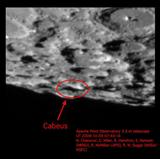
Tomorrow, on my clock here in Louisiana NASA will slam a school bus sized part of a space craft into the Cabeus crater on the Moon’s South Pole. A second shepherding spacecraft equipped with many sensors and transmitters will navigate through the particles, gasses and vapors and whatever may have been thrown up by the impactor. The principal purpose of this exercise is to prospect for water.

If the impact reveals an ample near ice cap in the shadows and just below the surface then many other factors will suggest to many people and companies that the Moon can become a hub for a space industry. If there is water rich subsoil that does not amount to the large quantities in an icy pole but is nontheless significant it means outposts and colonies on the Moon can be started with great care and skill and hoping for the best according to optimistic space boosters. If there is very little water then developing the Moon in any way will be a very costly and daunting task by most definitions and analyses of the situation. Of course the spot could be an anomaly and not represent much that is typical of anything but almost everyone will presume that this is not true.

The LCROSS will be a vital step in coming to know what the resources on the Moon are and how they are distributed. We know there is abundant water ice on the Martian poles. We know there is water in many other places in the solar system. However if it does not exist on the Moon it will be much harder for us to develop a real space policy than if it does not have water in greater than the small amounts we have already detected across most of the surface of the Moon.

The more water we find the more chance there is also for me to see the Crater Cap Colony Concept I have pushed for come to some kind of fruition in my lifetime. It will not cause anything to happen but will certainly help if LCROSS kicks up lots of water.  For some basic data on the LCROSS as it has been intended from the start go to:

http://www.nasa.gov/home/hqnews/2009/jun/HQ_09-143_LCROSS_Launch_Success.html

This will interact with my own colonial ideas in complicated ways. But a water train shuttle or pipeline from the poles to feed the colonies would certainly be a vastly superior goal than hauling the water in from the Earth.

Crater cap fishCCCC mining concept

We may hit dry spots that are not typical or there may be malfunctions we do not detect. However, it would be great to find a great deal of ice and water. That is what I will be hoping until the report comes in to us all.

What about that water on the Moon?

Today NASA held a press conference revealing that by combining calibration sightings of a comet watcher called Deep Impact and the data aquired by the Moon Mineralogy Mapper riding a hundred kilometer orbit over the moon on the Chandrayan India based lunar mission. I watched the press conference on TV and am basing this note on what I remember from that conference without using any more sources. Somewhere on the site www.nasa.gov one can doubltless get the most up to date data. Probably some of it will correct errors in my summary below.

A Frank Summary of Moon Water Issue

1. The general surface of the Moon remains drier than any Earthly desert.

2. There is water difuse and spread over the whole surface of the moon in rough terms. There is is a chaotic and broad pattern of water distribution.

3. There is a broad distribution of hydroxyl as well which is a different combination of hydrogen and water.

4. There is evidence in ejecta that hydroxyl and possibly subsurface deposits of water have been thrown up by impacts.

5. There is an average of between one liter and one gallon of water in every ton of typical surface regolith.

6. There may still be water in permanent shade, water in subterranean deposits of ice and remnants of meteoric or comet borne material that was not part of this surface distribution.

7. We now have a baseline above zero for water on the moon. It is much less than Martian conditions and very austere but it can be combined with other elements of water located.  Together with other sources it increases the chances of successful futute lunar crater colonies above the worst case scenario.