Category Archives: 1

Emerging Views: Bibliographies and Sources

My 52 years celebrations...

My 52 years celebrations…photo by JTS on my phone camera

O

Yesterday was my birthday. It was a special day and I enjoyed celebrating it with family members who could come. I will add some pictures of the event to this post. This series of posts is sort of finished. Sort of not finished too. My personal life has been pretty hectic lately and there is a lot of national news. But despite all of that — I am returning to the series on my book about Cajuns and an era of film and photography.

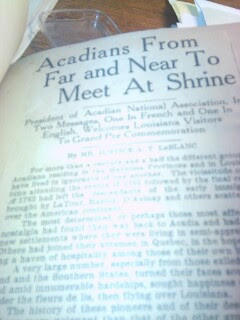
Press from Acadian Museum Corinne Broussard Scrapbook

Press from Acadian Museum Corinne Broussard Scrapbook at the Acadian Museum. I found this while preparing the current  draft, but it is not really a source.


The accumulation of sources for this text has been a long labor. It gets no simpler at the end than it was at the beginning. The search has led to materials not really in this book. But this post covers the experience and the body of knowledge.

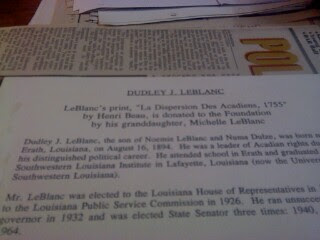
Dudleytrip 1CB2

press from Corinne Broussard Scrapbook — Acadian Museum


Today is a blazing hot June day in Acadiana and there is a heat advisory tomorrow when I  will be doing some yard work. I had my oil changed, got a haircut, recharged my phone minutes, handled some correspondence,  and myriad other things that are more pressing in many ways than putting out these final posts about the book that has been appearing as a series of posts on this blog. I also had an important meeting this afternoon, something happened which I will always remember. I am not disclosing it yet in case it does not become  an operational reality.


The Acadian Miracle by Dudley Leblanc is fifty years old this year.

The Acadian Miracle by Dudley Leblanc is fifty years old this year.

This is more imperfect in its own right than  any of the chapters posted before. It is also not highly readable. But scanning it would make the reader feel more secure that there is some research behind the book. The truth is this is the roughest draft because the text of the Bibliography is as it was almost a quarter of a century ago. There is a lot that is not included.  For those who read the Emerging Views all the way up until now I said there would be another post or two for the appendices. Thus is one of those posts leaving a post or two if I combine or do not combine the appendix on the functionality of the Cajun House with the Appendix on the Hellenic origins of the Cajuns.

This is a glimpse of how the black and white film was presented to the world. The local papers ran black and white promotional and reporting spreads.

This is a glimpse of how the black and white film was presented to the world. The local papers ran black and white promotional and reporting spreads.

EmergingVIewsBibliography


Some links:

  1.  The most Primary Source of all for this project. The archives and collections linked here.
  2. The same placed linked partly here and here is a source.
  3. This place can be a significant source although I did not derive much from it directly, that is happenstance.
  4. This place also has some tangential and duplicate source material and some related published texts.

Mass shooting in Pulse Nightclub

Over fifty killed and another fifty injured in a firefight begun, sustained and led by American Islamic extremist Omar Mateen.  The young Mateen had been interviewed by the FBI several times. The belief is stated that he did not have ties to foreign Islamist extremists but his family is from Afghanistan and NBC News has reported that the father Seddique Mateen openly lobbies for the Taliban. So perhaps a more nuanced statement about his connections abroad should be made. There seems to be a basic agreement in the family that homosexuals deserve to be put to death although the father does not see it as lawful for people to perform that act of execution — leaving it to God.  the CBS link to a relevant story is here and I heard similar reports on other networks. In addition the young man bought weapons very recently.  His ex wife brings up the mental illness idea but one has to question what that means, but he does seem to have been a controlling wife-beater to some degree. The gay bar on the other hand seems to have been entirely unprepared for an Islamist attack of a military terrorist nature.  perhaps that is incorrect but that is how it seems.

The Americans and visitors to America were attacked this morning by a man who called 911 to pledge support and loyalty to the leader of ISIS. This call to emergency services was made in the wee hours of Sunday morning. The bloody ordeal went on until a final firefight with police sometime after five in the morning. Experience has taught me that not all links will be readable over time and I cannot check them all but a pretty good summary of the event should link here.

My first post on this event came shortly after I woke and was on Facebook.  I wrote,

Taking a moment to acknowledge the deaths of dozens of Americans and other people in America killed while celebrating a Saturday night out. The families and friends affected by this and also the wounded are also in my prayers. It would feel good to say that politics has no place here. It would be comforting to say that real issues related to homosexuality, to the obligation of nightlife to have more security now than in the past, to the views of American Muslims, to the policing of districts where clubs are located, to the disputes about guns and even more disagreeable to the electoral implications of these deaths –to hold that these issues didn’t matter. But all that and more matters. 

These are trying times…”

The President of the United States in his initial press conference largely minimized the Islamist nature of this incident. The Press Conference with the White House Press Corps was not his first response however and some of the tweets and actions that came out earlier are mentioned below.  Many issues will emerge over time. The effort to respond reasonably will be opposed on all sides directly and indirectly. A reasonable response in my view would examine honestly all the weakness  this attack reveals. It would deal not only with the many who have lined up to give blood for the victims but the many who are offended by federal bathroom laws, Gay Pride Parades in front of their children and would prefer not to live near a nightclub like the Pulse. Most of those people would not hesitate to condemn this act and take real measures to prevent it.  The gun control debate might include ind reasonably requiring high power assault weapons in a vault near security guards at sites very attractive to known terrorist organizations, might license accountable community militia groups, might acknowledge the fiasco that gun free zones occasion.  A reasonable conversation might   also realize that people call those with deadly records mentally ill in a way that has almost no definable meaning.  But after all the reason was brought to bear then perhaps real restrictions on trading, transporting, storing and using assault weapons could be put in place. When not at the shooting range, at the community armory or in your annually inspected home vault your assault gun might be at risk of seizure and you might risk a fine.  I don’t consider this country a safe place not because I expect to be shot today but because the social fabric is constantly being degraded. Few are interested in the hard work of repairing it. 

Military expressions are often part of Louisiana funerals.

Military expressions are often part of Louisiana funerals.

As the names and stories of the dead emerge the understanding of the events will evolve as well. For me their deaths came on an anniversary of another death.  Here is a link from the television station on Channel Four in Jacksonville which begins to disclose the names — but this is a step in a long journey. I would have discussed these events with that old friend almost exactly my age. His country and mine have changed and continue to change. But that will not lessen the tensions underlying the many faces of this tragedy. President Obama will continue to behave in a way which will evoke a very belated response from a very limited legitimate opposition press as seen in the New York Post story linked here. The journalist cites Obama as saying that ” We”not Islamic terrorism are at fault for the Orlando massacre. Social networks were abuzz but not as much as after some events. I think that the truth is people are unable to write as freely about the incident because it involved a gay nightclub. They may not like the current LGBT agenda and the may not be crazy in love with Gay nightclub scenes on morning television. They do not know how to deal with these realities without mentioning them if they post their sincere outrage at the attack and sincere condolences.  Apparently the club was largely a Hispanic clientele, and had the double empathy issues of current animosity by some towards the LGBT community and by others to the Hispanic community. But fencing things around with so many verbal protocols that one’s critics cannot feel safe to join you in opposing a common enemy seems risky to me.  Remember this man drove a distance to kill people indoors. He was not being forced to deal with any particular assault to his religion directly.


My brother, whom I always called my half-brother  and whom I did not know until I was in graduate school and who had a separate legal set of parents who adopted him was named Paul. He was a homosexual who died of AIDS and was living with me and my family after falling out of whatever support system the LGBT community in San Francisco had to offer. I called a friend and former fraternity brother in the LGBT AIDS assistance community to get help for him and corresponded with several others and with Paul when he first came there to us and nobody helped. However, my experience with programs helping in this country is that they usually have not responded to any request I made but did do many things I did not think worth doing. Those are painful memories for me. That set of memories does not make me an expert on the pain and loss these families are suffering. I tried to help Paul and we were fairly close at the end but he never even admitted to me that he was gay. It just remained a wide open secret between us. My mother gave him up for adoption before I was born. When I met him he was married to a woman from the Middle East and had a stepson named Jameel. I was married in those days as well. Families and sexuality are both complicated things. Death also comes for us all. But the horror of a mass slaying like this goes beyond death.   Nothing can compare to the loss and horror of those personally connected to the tragedy and tragedies like this.. That is true even if like me you do not put a gay bar at the same level as a church or an elementary school. I do not put it at the same level. There is no reason to ask someone like me to make it a shrine. The deaths of their loved ones doubtless make it sacred to the bereaved.  But the public nature of the place is otherwise. The issues of hate crimes, terrorism, murder, national security and civic injury ought to be enough to bother all of us — we do not need to have a belief that the space itself was a sacred one. But it was a privileged space. It was a gathering place for people who are different to do things not everyone will like or approve of them doing. It seems that whether one is opposed to the ambitious LGBT agenda or not one could support the idea of a safe, politically conscious place for adults to gather without disturbing neighborhoods. Many in the building would doubtless want to do all kinds of things in my neighborhood I would not like. But as an American I can still see a need for them to protect their basic civil rights even if we disagree about some of the boundaries, a place to congregate and a place to create a cultural of communication and sexual interchange within boundaries they define for themselves as proper which I do not have to witness. Driving a long way to shoot up a gay bar is more than a hate crime it is a small step in the direction of the extermination of gay people. In scale it is trivial but in type it is a kind of sexual act of genocide. It is of course not trivial to those who had a loved one exterminated.

. The families, friends, first responders and others have been traumatized to varying degrees and the wounded of course intensely injured. The President deserves some credit for trying to strike a tone of human compassion and his response is outlined below. White House Tweets at intervals varying from pauses of a couple of minutes or less to pauses of a few hours included attached materials and video summing up the President’s actions and words. There are other accounts involved and the White House retweeted itself and yet one can map out a response from the following principal tweets.

  1. “In the face of hate and violence, we will love one another. We will not give into fear.” —
  2. “We stand with the people of who have endured a terrible attack on their city.” —
  3. “As Americans, we are united in grief, in outrage, and in resolve to defend our people.” — on

  4. orders U.S. flags flown at half-staff to honor the victims of the attack in Orlando:

  5. Attacks on any American—regardless of race, ethnicity, religion, or sexual orientation—is an attack on all of us.

  6. This is an especially heartbreaking day for all our friends—our fellow Americans—who are LGBT

The policy does not seem to reflect an ongoing series of attacks from Radical Islamists. It would make me feel better to focus only on the facts of the massacre as a massacre but terrorism is always political. Here are some of the political victims I can think of so far as the process is being led by the White House.  From the point of view of Americans who like Obama was fond of saying “cling to their religion and their guns”  this seems to be a chance to expose them to three prongs of pressure. They feel the hostility for Americans from ISIS and the family’s Taliban connections. They feel the hostility from the White House stirring up criticism of all those not fanatic cheerleaders for the LGBT agenda.  They feel what they cannot help but believe will be greater tensions from LGBT leadership who follow Obama’s lead in seeing this as a social hate crime and not part of an Islamist Jihad. For the conservative Muslim who wants a better future as a loyal American — this has to be a bad day. For homosexuals and others who are sexually aligned to the LGBT but while they want to have safe nightclubs do not seek a culture war or value its purported triumphs this is a bad day. For Hispanics who see countless ways this incident pushes out the kinds of connections they have spent a lifetime building with others this is also a bad day.   For those

Today is the first anniversary of a friend’s death. I am inescapably aware of how the United States we grew up in has become a place where Islamists frequently express themselves by killing people gathering places.

We have a responsibility to understand the words we use to shape our live and society. This is a picture of the Declarators committee.

We have a responsibility to understand the words we use to shape our live and society. This is a picture of the Declarators committee.

We must pray, vote, think, write and be  brave. But I make no claim that the path we are on is a promising one. Nor do I believe positive change is a foregone conclusion. The promise of America has been made simplistic and almost ridiculous in my view but it does have a promise and we can come to understand it. We can face the fact that crises like these play far too large of a role in shaping any national dialog we do have.  I just published a post about national conversation and this is the link to it here. I will also mention its title:  https://franksummers3ba.com/2016/06/09/presidential-politics-and-the-current-american-mindset/

I have some empathy with those who  wish to keep political comments for the future although I do not do so here.  I end with a quote from a politically active Facebook friend younger than myself, named Rick Fisher:

I am a conservative republican. I believe a person who is gay has a right to go to a nightclub without fear of being shot, just like everyone else. I believe a person who is Muslim has every right to be in this country, to live and work here just like everyone else. And I believe there is nothing wrong with expressing sympathy and sorrow first for the families of those who lost a live one due to an act of such extreme hatred I cannot comprehend.

Like everyone else I have several thoughts about the horrific tragedy that occurred last night in Orlando. Those thoughts will be shared in due time. But not today. Today we pray for the fillies of the deceased, and for the well-being and recovery of those who survived a battlefield they rightfully didn’t expect to enter.

So where do I get the incentive to do this analysis as I slide into the silent dark perhaps? I get it from the commitments I have made over the years.  From those who sought out my advice and published my stuff. From those of you I do not know who still read these posts. I also get it from inside as well. I do not know if I will return to this subject directly but sadly it is a subject  that is tied to many others across this blog.


1953 in Acadiana and the years since: Conclusion to Emerging Views

This is the conclusion of Emerging Views. It is not a numbered chapter nor is it the last post in the series. Whether it deserves the name Conclusion or not the reader can judge. It deals with what happened  in the past at the end of the period and what life has been like in the region since as well.


The appendices which follow are appendices and some readers who have read everything up to and including this and do not read the appendices may justly claim to have read the book as it appeared in the blog. Chapter Thirteen on the McIlhenny family will appear later and out of context perhaps or may be the least in this series.

A flotilla of shrimp boats adapted for skimming oil.

A flotilla of shrimp boats adapted for skimming oil.

The story told here is not one that has a very clear ending. But the text does end evan as the legacy of film and documentary photography, oil exploration, Cajun culture and other themes in the text live on. As living traditions they continue to create stories.

There is still a new morning every twenty four hours in Cajun country.

There is still a new morning every twenty four hours in Cajun country.


Here is the pdf: EmergingViewsLouisianaStorytheSONJPhotosandAcadianaConclusion

Here is the text itself:


1953 in Acadiana and the years since: Conclusion to Emerging Views


This chapter opens with a picture of an oiled pelican from the current century but it could start with a picture of Zachary Richard. Perhaps that would be a more positive tone than I really want to set.  Film and photography are a particularly important part of the struggle for preserving the culture, language and identity of the Cajun people. In 2016, as I was on the waiting list for admission to  Louisiana State University’s Doctoral Program in History, Zachary Richard was named Humanist of the Year by the Louisiana Endowment for the Humanities. And his work as a musician, poet and songwriter have been enormously impressive. However, he has always been connected with and aware of the camera and its role in communication, in communicating environmental concerns and  making people aware of any aspect of cultural development and structure. Film and photography form a set of focal points in many of our lives.


This book seeks to set out something about a number of communities which are not equal or similar in every way and in fact are dissimilar in many ways. The Acadians of Louisiana also known as Cajuns are  the most important to the text. The Documentarians also known as documentarists are a second community. The Flaherty crew are a more intense community within this community. The Standard-Humble Oil people form another community and that exists with the nebulous but very real oil and gas industry or Oilpatch or Oilfield as sometimes referred to when those words are capitalized. The McIlhenny family under various names and guises and with various annexes is another community in the text. But while all of these groups are important to the text the documentarians work on film is the central occasion and instance of this text existing at all. It is an ethnohistory but in the end it is just as much a book of film and photographic history.  I have found the text compelling even as this sentence is typed in a draft. I hope it may one day appear as a polished book.


In a text like this where photography is such a substantial part of the story that fact is made more clear. The images of life and the portrayal of life in Acadiana during the nineteen forties and to a small extent in the early 1950s do tell us something about the subjects they seek to portray and also about those who created the images. The image at the start of this conclusory chapter  shows a pelican in severe distress after being  coated in oil after what many have established as America’s greatest environmental disaster resulting from a single event. The BP -Transocean disaster on the Macondo Deep Water Horizon drilling rig.   Deep drilling is interesting because at the  time when the Flaherty crew were making Louisiana Story in rural Iberia Parish elsewhere in the Parish other new was being made.


World’s Deepest Oil Well

Brought In At Weeks Island


The world’s deepest oil well was brought in as a producer this week on Weeks Island by the Shell Oil Company, it was learned today.

The Well Smith State No. 3 is the fourth producer brought in by the company on Weeks Island. A fourth well is the Myles Salt Company well.

The well was completed March 27 at a depth of  13,867 13,868 feet officials said….   


The article goes on to tell of other deep wells in the area and how much they are producing.  The oil industry was certainly very much on the minds of the people in the region as Louisiana Story was being made. That leaves aside the promise of offshore drilling which was in many ways an outgrowth of Louisiana wetlands drilling. The oil industry did offer a future. The local Cajun community already discussed problems with canal planning and spills but there was a need and a desire to work with the industry. In times where Angels of the Basin and the struggle related to the BP spill and the legacy lawsuits and so many matters come readily to mind Cajuns still want to work with the industry. Even the ones who are most critical. Only a few would would like to see them go before the resource is fully exploited. The struggles and tensions between the marsh and the drilling rig continue.


One cannot watch the blowout scene in Louisiana Story without thinking of these events. The perception of events from the more distant past is shaped by images from the more recent past.

My own work on this project began in 1991 and I was not the only person in the area thinking about these topics at that time. Here is an excerpt of other work being done more or less at the same time. Almost no real coordination or communication occurred regarding these things. But the notice following this paragraph appeared in the Abbeville paper when I was researching and writing early drafts of this topic at LSU while earning my Masters degree. In Abbeville the memory of Louisiana Story has endured. It also is featured prominently in Angels of the Basin which is a film which deals with such current  crises and coastal erosion and such a recent event as Hurricane Katrina. So there are many reasons why not only film and photography but this film and these photographs have remained highly relevant to current discussions of film and photography.  The struggle for a full understanding of Cajun life and identity today must address these images. There is no way to ignore the role in shaping the image and identity of a people and a place without greatly limiting the understanding of how that place and people moved into the world of mass communications through film and photography.


In 1991 Abbeville added a new feature to its local architecture as the Abbey Players acquired their current theater building and set it up for business. It was also the year that I began graduate study in history. It was not long after that that Louisiana Story found its way into my research and their theater in different ways.


Abbeville Meridional June 5 1992


PATRONS NIGHT COORDINATION— Abbeville Fortnightly Club coordinators have teamed up with the Abbey Players to coordinate  several  wonderful patrons nights for the summer production of “At the Picture Show on Magdalen Square”, a musical to begin here next week.   Patrons Nights will be June 17 and 18 and a jazz brunch on June 21 Fortnightly members Susie Bertrand and Tracy Russo met with Abbey Players Deborah Atchetee and Marie Vaughan Regular performances begin June 19 Tickets are available at The Apple Tree in Abbeville, Raccoon Records and Video in Lafayette


Take a nostalgic trip back to Abbeville in the 1940s and come to the Abbey Players for their original musical  “ At the Picture Show on Magdalen Square” it written and directed  by F. Wade Russo, an Abbevillian now living in New York. Patrons’ Nights are on Friday June 17th, Saturday June 18th, and a Jazz Brunch noon on Sunday, June 19th.. For information call 893-2442. Regular performances begin June 19th for a limited run, with’ performances every Wednesday through Sunday through July 4th. Tickets are available at The Apple Tree in Abbeville, Raccoon Records in Lafayette and Verna’s Hallmark in New Iberia. The Abbey Players in happy to announce that, starting now, there will be reserved seating for all shows (Patron’s night excluded). Get your tickets early for this limited run musical. See you at “The Picture Show”.(Staff photo by Angie Heart)


The truth is that the writer F. Wade Russo has had the kind of stellar career at places like Juliard and the Boston Conservatory. He had left behind life in Acadiana and was proud of his Sicilian heritage in Cajun Country. Nonetheless, he celebrates his  heritage in the region as well. In addition he certainly had many Cajun friends growing up and the established Sicilian community in Vermilion Parish has many ties by blood and marriage to the Acadian ethnic community. But still, the Cajun connection to the work is a complicated one at least.  My own connection to this community is not without complications and it is in fact a complicated community. Brasseaux’s book Acadiana cites the judgement of other scholars and the direct evidence presented in his book to show the great cultural complexity of the place and its peoples.  Only a small glimpse of that aspect of Acadiana’s identity and essence has been presented here. It also deserves to be said that Louisiana Story is not like Evangeline it does not have the same towering respect and also pervasive influence that poem has had in the culture. But Wade Russo’s musical revue was certainly a sign that the movie had become part of the local cultural scene in many ways. Some of the material taken from the 1992 press related to the production will show how it lived again in the popular consciousness:


Abbey Players Theatre will open its doors this evening for the first production of the original musical ‘At the Picture Show on Magdalen Square.’ In honor of the special occasion, Abbeville Mayor Brady Broussard has proclaimed Friday, June 19. as ‘At the Picture Show on Magdalen Square’ Day here. Written and directed by Abbeville native (Staff photo {of Russo included here} by Angie Hebert) Wade Russo. the musical is based on the premier of the 1940’s movie, ‘The Louisiana Story’ — but with a local twist. The entire cast features local talent. Shown performing ‘Riders in the Sky’ are (left to right) Davlon Rost, Jack Smith and Wayne Hebert. See page 1B for more information and photos.


To have a day proclaimed for it is far more than is typical for events in the Parish or this small city. The interest in the return of the successful Russo to his native roots is likely one of the  reasons Abbeville got behind this celebration. The article continues:


. To read these names brings back precious memories of the gala premiere of the ‘Louisiana Story* at Frank’s Theatre and the good old days. Residents and businesses are remembered in scenes throughout the production; including the late Donald Frederick who lost his life when the Japanese attacked Pearl Harbor. Abbeville paid respect to Frederick by naming a boulevard in his honor As the musical says, from the church on the square to the Audrey Hotel and the smell of the syrup mill, Abbeville is where our hearts belong Members of the harmonic cast include Davlon Rost, Jack Smith, Wayne Hebert, Clay Chauvin, Paul Landry, Julien Couvillion, Evona Quails, Dave Pierce, Brown Pierce, Laura Meade, Jenny Meade, Ray Meade, Lisa Nunez, Leslie Campisi, Lauren Orellana, Tiffany Babineaux, Mandy Hebert, John Cramer, Gerald Landry, Shannon Redwing, Ellis Byers III, Casey Pierce, Alexander Evangeline, (Staff photo by Angie Heberf) Abbeville Mayor Brady Broussard presents Wade Russo with key to the city Kim Stagg, Sarah Ortego, Devin Orellana, Margaret Collier, Allison Tine, Jenissa Allen, Rochelle Collier, and Shawn Carter. Coordinated by Musical Supervisor Ronney Mayard, the orchestra consists of Madeline Dehart and Deidre Dartez, flutists, Christy Simon and Jennifer Mula, clarinets; Jerry Dehart, trumpet, Tim LeBlanc, drums; Julian Couvillion, strings; and F Wade Russo, piano. The cast is scheduled to give 12 more magnificent performances at the theatre. The final performance will be held at Abbeville High School on July 4th. Underwritten by First Commercial Bank, tickets for the musical production are available at The Apple Tree in Abbeville, Raccoon Records and Video in Lafayette and Verna’s Hallmark in New Iberia For more information contact the Abbey Players


The cohesion of the community goes back to the way the film was dealt with by the paper and others at the time and does not seem to have diminished.  The names in this list are left in place partly so that the reader can remember seeing some family names earlier in the text and also be fairly sure of not having seen others. The original production in 1992 was about as big a dramatic and musical experience as Abbeville has ever seen. Few can equal or surpass it in a town that does have a good bit of music and drama.


Eight years later after the rather extensive support that the original production of the Wade Russo work had received Abbeville celebrated the sesquicentennial of its founding ( that’s right 1850 after saying it is rooted in the 1840’s but the founding was based on act act late in the total process of founding — its incorporation — most of the work was done in the 1840s). Mayor Brady Broussard chose Russo’s musical revue as the centerpiece of the celebration and it was largely billed as a celebration of life in Abbeville in the 1940s. That may be fair enough but I think we have seen that the premiere was by no means a typical day and the issues and interests it brought to the fore were by no mens limited to Abbeville.  Louisiana Story has remained however part of the consciousness of this city and a mayor named broussard could appreciate that reality.


The years go on piling on new images and new perspectives that come into the world because of or merely at the same time as other images. The films being shown to the audiences that either do or do not go to theaters and movie houses to see these feature films  change. Many of them hardly have any life as true film and some none at all. Mostly they are streams and patterns of digital information created in processes which imitate the filmmaking processes and ventures of previous decades. The result is also intentionally filmic. But whatever their function they owe little to cellulose many may still come to be printed on this medium in the end but they are not crafted in the old rituals of silver, sweat, light and cellulose which defined this art and expression so intensely for a   few generations.


Like F. Wade Russo moving beyond his roots, the film industry has left film and the demands it made on men like Flaherty and Leacock and Webb somewhere in the past. It may be a past that is respected and valued but it is not the present. For me the use of film was a klarge part of my daily life for many years and now has been entirely replaced by the manipulation of the digital component of images.


When I went to China I had a film camera which my sister Mary had given me and it saw a lot of use there. Some of the pictures I took and others I composed but had executed by third persons appeared in the second most popular periodical reporting mostly on Vermilion Parish. Bonnes Nouvelles, where I had written quite a bit, carried this article about my experience there and photographs connected readers and neighbors back home to those days spent in a far away land. It was not the first time I had appeared in the local newspaper.


I took a lot of pictures and yet not as many as I probably should have. The camera required a special film to allow it to take pictures in three various formats including a broad panoramic view. One can compare that to the increasing universality of the digital experience. I relied mostly on my chief contact and handler in the Board of Foreign Experts, Special Exchanges Office at the Shandong Institute of Business and Technology to procure the rare film. So even in the recent past film made it mark on lives such as mine and the experience of Flaherty and the documentarians in Acadiana was also shaped by any number of experiences based directly on real and tangible facts about film. Some film was ruined, some was delivered late, some was defective. These instances were kept at a minimum. Film management was the reason why. Daily rushes are one thing but today one can see the image on replay right away. There is less need for the kind of structure in community and functional team which existed in the lives of those photographers and filmmakers.

Today the kind of work they did could be done with less obtrusive organization because of the  ability to avoid the problems associated with film itself. This may allow all sort of records to be kept edited and erased which would be nice to have on a research project such as this has been. But it also lessens the chance of organizations which can be kept accountable in the same way. These people expected to be judged by history and while I applaud much of the work they did I also criticize it and find fault. That sense of doing work that endures in a group that is committed and documented is likely changing. Media companies abound in entertainment but the cohesion of the old studios is largely gone. That trend is likely to be more pronounced in work such as this.  Nothing stays the same and what lessons may be gained here are not lessons for those doing exactly this work because this exact work will never be done again.


Cajuns have always traveled and so did Acadians and so did the folk of Poitou — not everyone all the time but navigation has long been a major theme. Most traveled short distances and most cattle drives were short but the skills of travel formed part of the culture as did the tendency. Cajuns and their ancestors have also welcomed those who travelled to see, study and document them in various capacities for centuries. My trip to China was reported in a newspaper in which I had written quite a few stories very much about this particular region and its communities — especially the Cajuns. The  Daily Iberian reported while Flaherty was making his film in their parish that they boasted 3,006 veterans of World War II and many of them had traveled.  The same paper had a regular column called the Talk of the Teche reported 4,100 visitors had signed in during one month at the Acadian House named for Gabriel at the Evangeline Park in St. Martinville. This was in March in 1947 and was reported in April  and showed the fruit of Dudley Leblanc’s earlier work as a legislator was ongoing at the time.


All of this was part of the fabric of a region and is captured to some degree in the work of the documentarians. But to a remarkable degree it is ignored. China was very much on the mind of newspaper readers in the region and on the mind of those families who still had sons and some daughters serving in Asia. Some of those who read my article and spoke to me about it when it was published after my stay in China had served in  the Korean War as young men, more of them had served in the Vietnam War — almost none were alive and able to speak to me who had been in the  Pacific during the  World War or in the region when the documentarians were here. But my grandfather who commanded a ship in the Pacific in World War II and died when I was studying at LSU for my Master of Arts in History discussed this work with me a great deal and saw now disjuncture between the life in rural Acadiana and the interest he had in world affairs. I was living with my family who were involved in a Catholic lay mission company working around the world when the China article came out.  We all were used to reporting and being reported upon within the context of the larger world. Looking back at supply lines to Louisbourg, ships between France and Acadie, Acadie and New England and the role of trade to New Orleans from the first settlement of the lands around what is now Abbeville each form an additional set of reminders that Barsam has misinterpreted this culture as it appears in this Louisiana Story quite a bit. In no way do Joseph Carl Boudreaux, Lionel Leblanc and Evelyn Bienvenue represent one of the most primitive cultures in the world. Nor is isolation a primary shaper of this culture as has been proposed by many poorly informed and ill advised observers over the centuries. A different value system and a different way of life have sustained themselves here for centuries and among these people for earlier centuries. That value system and way of life have in turn sustained these families, individuals and communities.


Travel is a part of the culture and cultural exchange is a part of the culture and there is no period of Cajun history when this is not evident. In the years that Flaherty was making his film Cajuns and others in the region were entertaining oil executives. Pan Am Airlines executives and others in the region in hopes of forging ties to the whole world and they did so without wishing to give up who they were. This kind of exchange was still part of the picture when the musical revue remembered the film in 1992. This is evident in some more press from the Abbeville Meridional that year.


Today’s VISITORS FROM NEAR AND FAR Some 40 Girl Scouts from states throughout the nation toured the area as part of their two-week Cajun Days/Cajun Ways National Wider Opportunity program. The group enjoyed a tour of downtown Abbeville and the Vermilion Courthouse (left) by the Volunteer Tour Guide Committee while girls from Vermilion Parish enjoyed a week of Day Camp at Camp Steen in Abbeville. Second grade students Philana Jackson, Megan Trahan, M Dartez and Leslie Zaunbrecher (top photo) play with the balloon yoyos they made while campers Kathiryn Listi, Megan Pearson and Kattie Marceaux (bottom photo) relax in their camp chairs. Thie chairs were cut by Theodore Bares of Erath. Girl Scouts from throughout nation tour city of Abbeville California’ Iowa’ Florida’ New York’ That’s just a few of the many states represented with 40 Girl Scouts from throughout the United States came into Abbeville Tuesday These girls were selected from over 250 applicants to attend the two-week Cajun Days/Cajun Ways National Wider Opportunity sponsored by Bayou Girl Scout Council The history and culture of the Acadiana area will be sampled and experienced by the scouts through demonstrations, tours, and hands-on experiences ….


The article will continue below but it is worth pondering just a bit the methodology of pedagogy. The idea that teaching a living culture is worth presenting to the nation as a whole is present here. The idea of learning across many resources, of girls being important, of all this being newsworthy.  This is not an enormous event but it still is a significant event nonetheless.  Significant for historians and ethnologists in what it can reveal with a little pause for careful analysis.  The same text continues below.


They met with other Vermilion Parish Scouts at Camp Steen for a Day Camp training session Then on Monday morning the 40 scouts met each other for the first time as thev converged at the Academy of Sacred Heart in Grand Coteau which would be their home for two weeks. From that location they travelled daily to such sights as Vermilionville, Eunice Liberty Theater, the State Capitol in Baton Rouge, Nature trails and refuges in Cameron Parish, an Alligator Farm, an Atchafalaya Basin tour, the New Iberia cane fields and Tabasco tours, and a weekend in New Orleans They arrived in Abbeville Tuesday afternoon and visited the Girl Scout Day Camp which was in progress at Camp Steen They departed from camp and arrived at the historic marker at St Mary Magdalen Church for a walking tour of downtown historic Abbeville led by the Volunteer Tour Guide Committee The hour and a half long tour brought them through St. Mary Magdalen Church, around the square, both North and South Concord Streets and to the Courthouse while enjoying a narrative of the early days of Abbeville.  Organization of the tour committee was under the supervision of Nilta Russo who greeted the group upon arrival Ruth Broussard conducted a most interesting tour of St Mary Magdalen Church explaining the stained glass windows, irons and other features. Guiding the girls through Magdalen Square was done by Francis Dixon. Interesting stones of yesteryear were related by Bee Bee McClellan and Rosemary Sandoz while strolling North and South Concord Streets An information tour of the Vermilion Parish Courthouse was given concerning the paintings of Harry Worthman that are located on the first floor The scouts enjoyed pizza while watching slides of the local scouts recent trip to Our Cabana Girl Scout World Center in Mexico Then everyone joined in for a dance session and “Freeze Party” The evening culminated with a preview of the new Abbey Players production “Picture Show on Magdalen Square” by Wade Russo The scouts enjoyed the dress rehearsal and the historical enlightenment the evening offered Bayou Girl Scout Council, which sponsored the event, serves girls in the parishes of Acadia, Allen, Beauregard, Calcasieu, Cameron, Evangeline, Iberia, Jefferson Davis, Lafayette, St Landry. St Martin, St Mary, and Vermilion The organization is a United Way member agency.


The inclusion of girl scouts in this audience that saw a local interpretation of this film shows the values that still define the community were represented in diverse and varied ways. It also shows that people cared about the preservation of enduring values. In addition it shows that Louisiana Story had remained part of the memory of the local cultural tradition.


In 1992 while working on the first drafts of the first version of this text I had already some kind of reputation in Vermilion Parish for both scholarship and being associated with film and movies. This has been mentioned before but now it is spelled out a bit more specifically. On June 28, 1988, in the year that came forty years after the release of Louisiana Story on an ordinary day which was a Tuesday, The Abbeville Meridional  featured a photograph on the upper left hand corner of its eighth page that was captioned. I was already married and in fact had worked on the film just after coming back from my honeymoon. During that Honeymoon among other things Michelle and I spent some time at the Shrine of the Confederacy at Jefferson Davis’s home at Beauvoir Mississippi. But the moviemakers had cleared out long before this article appeared. Our wedding had gotten significant ink in the same paper but beyond that I had not had many article length pieces appear which discussed me or my life. Neither had I been absent from photographs with briefer captions or notices of some achievement or other. If Lionel Leblanc was a well known trapper. I perhaps was well known too. In addition, a few  years before I had held several positions at the paper and my byline had appeared there a good number of times. But enough of that and on to the first connection with film which really is associated with my name in the Cajun community.


“BEAU IS BAD — Beau Summers of Abbeville cradles his M-16  automatic weapon between takes on the motion picture “The Blob” here in January. Shoot-to-kill orders on photographers were never given by producers intent on squelching photos such as this of guarded special effects (the white bio/chem costumes), but it came close. (Meridional photo by Bernard Chaillot).


It was a time in my life when things were somewhat different than they are today….   The facts of human life are such that there are many side both to every real and actual person and also to every substantial reputation. My reputation would appear under quite different representation just the following year.not the dangerous near outlaw of the screen and set but rather the promising and relatively young graduate who could still hope for a bright future.


Summers Top Graduate at USL

LAFAYETTE — Frank W. “Beau” Summers III of Abbeville has been named winner of this year’s Outstanding Graduating Senior Award, given by the USL Alumni Association. Summers was announced as winner of the award at the university’s May 14 commencement exercises in the Cajundome. He was selected from nine ‘ nominees from USL’s various academic colleges, on the basis of leadership, scholarship and service. Summers graduated with a • degree in English, and earned a cumulative grade point average of 3.661 on a 4.0 scale. He is the son of Mr. and Mrs. Frank W. Summers II of Abbeville, and the grandson of Frank W. Summers, retired Chief Justice of the Louisiana Supreme Court, and Mr. and Mrs. Cecil B. Gremillion of Abbeville. He is married to the former Michelle Denise Broussard, daughter of Mr. and Mrs. Eddie J. Broussard of Abbeville. “I believe that we live in a world community,” he says. “My devotion to my campus, hometown and my country have always been an integral part of my commitment to the needs of humanity as a whole. My upbringing as the child of missionary parents has given me a sense of fraternity with all people.” He entered USL with 18 hours of advanced placement credit, 16 in Spanish, and has been on the Dean’s List each semester of his enrollment and was elected to Outstanding Young Men of America.


Reputation in the local papers, the chats of the most respected raconteurs and in other places means more in a place like a small Acadian town than it does in many other places. The South has at times had a kindred spirit in that regard. But reputation alone, honor alone and all such related values alone are not enough. Cajun culture teaches people to aspire to a very strong basis in substance for anything that raises itself above that substance. The fictional LaTour family added the income from oil to their trapper’s income and secured the life they were living into a better future. My own journey in life has been defined by my failure to achieve the kinds of security in some ways which both Lionel and Dudley Leblanc achieved in differing degrees.

In producing a work like this one can hope of course to lay a foundation of a more secure future for one’s own life but the odds of such success only grow longer with the passing of the years. This is one of the more mixed and digressing chapters in a text not distinguished by laser like focus. I end this work mostly as one reflecting on the completion of a major project.

When any writer sits down or leans on an elbow at a computer, sheet of parchment, papyrus or paper or anything else  to write a story, fictional or historical it seems to me that a writer expresses some real  faith in humanity.  The truth is that as America and the entire world continue to evolve it is necessary and desirable that Acadiana continue to evolve as well. The challenges of all humans are no less real and no less shared than challenges specific to the many groups of humans that share this planet. To tell the story of this particular group of people does not diminish the need for Cajuns to address the challenges which they face along with all other people and simply as people without distinctions deriving from their unique ethnic identity. I am deeply ensconced in and conversant with Acadian/Cajun culture. I write with faith in their aspirations and in my own heritage I write with faith in those who read and study history.  One hopes that it is not a blind faith but producing this text has certainly been an act of faith.


Faith that members of the human species remain literate, curious, prosperous and sympathetic enough to give a damn about a narrative that does not immediately determine their own survival. Of course one may hope that either social pressure from the popularity of the book among a reader’s friends or real pressures on students assigned to read the text may help its popularity and boost its readership. Nonetheless most writers realize that the odds are long against their  book achieving either of those two particularly desirable ebenefits.  Sometimes that faith seems misplaced,  when one examines the circumstances in which one is writing and all the urgencies of any year including 2016 it may seem unlikely that one’s words will find their way to the last (or at least the current) descendants of Thucydides, the latter votives of Clio who will really find in themselves the energy to address a vision of the past and find in it some direction and insight as regards the present and the future.  Anyone who has read this up to now can see that in part it is a family history in any number of  ways, it is thereby equally prone to deeper insight and also more likely to be subject to  accumulating misinformation.  The book is more than one story and more than an interweaving of multiple stories. But a story of documentarians, Standard Oil, Cajuns and the McIlhenny family between the years of 1943 and 1953 is at the center of this text and that story is about as  accurate as I can make it.  The story begins in a time when Aa great war was ending and America’s role in the world was changing, people of various sorts were faced with the nearly eternal realization that the world would change and yet people were much as they had always been, the social context was modified by the war’s massive boost to industrialization and a kind of early information explosion that we overlook at times because the one before it was more striking compared to the days before the printing press, telegraph and photograph had been integrated well before the war. We also overlook it because the information explosion in more recent times has been substantially bigger. This final narrative section that is not labeled an appendix ends with the present not because the present is a logical and inescapable climax and fulfillment to the processes of the early postwar era but because it is when I am writing.


Acadian history as I have known it, petroleum history and film history as subjects similar enough to my topic to matter may one or the other or all three  well be over within a generation or two. That is not mere baseless conjecture but in all three cases one can readily enough see signs that could portend the end of Cajuns and Acadians, the end of the oil and gas industry and the end of anything that could be called the film industry. I personally hope that none of these cessations will transpire and most of all that Acadians and Cajuns will be around for a long time to come. But perhaps history is most itself when it is written to preserve a story with as much depth, reality and fullness as possible  in every way that the historian can  preserve it.  


If this  relationship with readers is one in which a great deal is invested in an uncertain outcome then that is perhaps as it should be. The winners and losers of actual wars often will both read the histories of those wars but in all the small cultural struggles which occur across a society and across lifetime’s and generations there is involved in these times a struggle for relevance and readership.  In the minds of many writers there is a sense that simply in being read at all there is a dimension of victory. For those in an intense and broad struggle of ideas that are not very compatible being read seems to indicate that the writers side has won through, because the writer feels, his or her opponents are by and large through with  reading the sort of things the writer is producing.


Cajuns and other people in Acadiana were not extremely and broadly concerned about the SONJ documentary projects. That is one of the most definitive  realities that cannot be escaped as one researches the response to the documentarians and to Flaherty’s somewhat autonomous film crew within the Stryker SONJ organization. These creative and observant outsiders were the objects of gossip and newsgathering but they were not major objects of either. Largely, this is a story of a people caught up in a period defined by the end of a war they did not believe was going to lead to any certain and enduring peace.  As a whole the regional press was very concerned with rebuilding Germany and Japan, with the threat of Communism and with what would happen to the economy, The press also reported on the progress of the oil and gas industry in the region and the country, Movies also commanded some attention. But reporting on the SONJ projects as such was limited.  Neither do I allow my own intense interest in these activities to distort the portrayal of the larger response to what was being done and thus to distort the story more than I can help it. The documentarians on the other hand show little sense that they had sold out their integrity and point of view to big oil. They seem to me to be aware that they are creating serious work in a documentary tradition that would stand alone before the judgement of history.  Whatever greatness we believe the documentary tradition to have, we remain condemned by their words and efforts if we do not consider these projects to have been part of that tradition.


It is not worthwhile to simplify a comparison of Donald Frederick who died and Whitney Leblanc who lived in two different wars. But the era does seems to be different. Acadiana seems to have joined a more individualistic America than when it named a street for Donald Frederick after Pearl Harbor. In 1953 Whitney Adam Leblanc of Iberia Parish was involved in one of the most bloody and violent encounters in U.S. Military history. Nobody was making a movie about his experience  or carefully documenting his days in pitched battle in still photographs. He endured a great deal in battle and afterwards his records were confused or misfiled and the consequences of that battlefield confusion stayed with him later on. By the time the Battle of Pork Chop Hill was over his family had more or less lost track of him for a while. It may not be much more than a coincidence but there is an individualism within a broad national context that seems to describe and define Whitney Allen Leblanc’s wartime homecoming. Years later after some deliberate restorations of ethnic and regional institutions had been made his son Roger would help to restore his war record to good order. In 1953 he was somehow more than a little bit alone in that vast and terrible conflict. The Battle of Pork Chop Hill would be portrayed in a movies that focussed only on the last few days of what was actually the longest battle in the Korean War. That movie lay in the future, the film and the lasting name of the battle came from the shape of the hill on a contour map most soldiers never saw. But those who were there fighting related to the name because it was a place where men did not merely die but were reduced to chops of flesh lying about unburied on display. Surely an incident like that ought to define this year, but graphic and significant as the Korean War may have been for the Cajuns who fought in the war or lost loved ones in it  it has little to do with this study except to mention that it had so little influence on the regional experience of daily life as a whole. There seems in many ways to be little connection between the year at war as the troops lived it and the experience of being or observing Cajuns in 1953 we are mostly considering those experiences at the end of this text. We consider a year marked not by great violence and risk but by a sense of being caught between the past and the future.


Robert J. Flaherty and his wife Frances had lived in the small town of Abbeville more often than not while working on the film. They had been the center of a community that included quite a few people. Frances Flaherty has perhaps been shorted more than anyone else for her likely contribution to the film. But the Boudreaux family were also very much a family unit that completed the environment. A great journey had been made in a short time from the first meeting between Robert Flaherty and Roy Stryker on April 1944 when they met in New York,  shared a bottle of Irish whiskey and discussed the project.  He and Frances had discussed the project thereafter and he had signed the contract in December of that same year. Louisiana Story had begun.   


The SONJ photography project supervised by Roy Stryker ended completely somewhere else and the occasion was not much noticed in Acadiana. The previous decade had carried the world from the greatness, horror and weighty contests of the Second World War to something else. The something else was a period of emerging American prosperity. It was a period of urbanization. For the first time the US Census of 1950 showed that more residents of Louisiana lived in cities than outside of them.  The period  of this study began when the Louisiana Maneuvers were the largest training drill in U.S. Army history. By 1953  despite the heroic action of some Cajuns and some of their neighbors in the Korean War and the pervasive influence of the Cold War with the Soviet Union on society Louisiana had the character of a region long at peace in the eyes of many people. Compared to the wars on their own soil and the mass mobilizations of World War II the role of the military in the state was greatly reduced. For Cajuns the early 1950s were a time of uncertainty. The region itself was changing. Dwight D. Eisenhower was the new President of the United States and although few could imagine all it might mean people were starting to talk of a system of highways that would change rural America like never before. The Mississippi River Gulf Outlet was promoted in the 1950s was to help rectify the limits of the Industrial Canal and other features of New Orleans shipping to help it compete with the rest of the world in a changing era of navigation, bigger ships need different kinds of canals. By 1953 many rural Cajuns had already noticed problems with natural drainage disruptions on a smaller scale as oil companies  changed waterways to allow deeper draft vessels to work in many location and then abandoned the canals as improvements without any real plan or inventory. A few were already concerned about the effects of  some plans to correct Louisiana’s  deep draft deficiency by permitting deep-draft vessels to access the Industrial Canal inner harbor in a new feature. But the kind of very distinctive rural and wetlands Cajuns who most discussed these things tended to have a fading influence and little voice to speak of in those years. In addition Cajuns had built many miles of levees and canals for centuries and were hopeful that the emerging national power would make good choices. There was no organized Cajun resistance to the authorization for the MRGO was formally provided by the United States Congress in the Rivers and Harbors Act of 1956. The world had begun to rely on fewer people per ton to crew a ship or a boat, produce an acre of crops and local militia duty in small boats and infantry units was more or less fading into the past. Chris Park in his book Sacred Worlds: An Introduction to Geography and Religion states that Roman Catholic religious affiliation has been in decline among Cajuns since 1945. He also the extremely important role that Roman Catholicism played in maintaining a distinct identity for French Louisiana throughout its history within the largely Protestant and Anglicized United States of America.


The forces that would make the coming years had not yet fully matured but for those most aware of the limits of the new era there was no doubt that powerful forces were reshaping America. It was a time of anxiety about the nuclear war.The Soviet Union had by then detonated a nuclear weapon and begun building more and the Cold War had begun in earnest. In 1953 Julius and Ethel Rosenberg were first United States Citizens who were both civilians and executed for treason by their government. The world clearly faced new dangers that were unfamiliar to the long and complex heritage  with which they associated themselves.    Mostly the Cajuns were at peace and in prosperity as they lived out their lives. For them, as for most Americans the Korean War was a far away thing following a terrible war with Japan and hopefully part of avoiding an even more terrible war with China and Russia. For Whitney Adam Leblanc of Iberia Parish and some other Cajun soldiers it was a struggle nightmarish violence in which they fought two actions known together as the Battle of Pork Chop Hill in 1953. For them the year was spectacularly violent. But there would be nobody to meet Whitney Leblanc at the bus stop when he got home. The Korean war was a war mostly of individual Cajuns and individual Cajun families in the smaller sense of the word. These people felt at once very Cajun and very American but the two identities had little connection in this experience. For the purposes of this book the Korean War is fairly or unfairly largely ignored. It has often been largely ignored in recountings of the period as it was perceived by Americans at home. One cannot help but note that the war was fought far from any Cajun or Acadian homeland, neither the enemies nor the allies spoke much French and the nature of the struggle was poorly understood across many sectors of American society. The contrast between the experience of being involved in the fighting and being left behind was even greater than is normal in the long history of war.


It is hard to say how much the Louisiana Story and the SONJ photographs were viewed, discussed and remembered but clearly they were already objects of nostalgia. Already the vision of their world before the growth of the oil industry was seeming like something  tied to a distant past. The world that children learned about in school and the world that was reported in the media was most a world that seemed likely to share values that were continuous with those of their past. Increasingly there was a specialization of cultural functions within the community. People who identified themselves as Cajuns were more than ready to support those who preserved cultural expressions and traditions to some extent. However, the sense of continuity of communal interdependence which relied on culturally distinct institutions was in decline. Language, religion, the basic components of the economy and many other  aspects of life were in  a real sense changing in the face of a world that was less amenable to preserving their distinct identity than ever before. This has not been and will not now become a comparative history text. However, other rural communities and other minority groups were becoming aware of a rapidly changing world as well. Louisiana Story had been released again as Cajun  the year before this final year of the SONJ project and the tone of its distribution was less respectful than previously. the Stryker project for Standard Oil was ending and it was not much noticed. America was moving into the period that was recognizably the 1950s and in many Cajun towns and villages there was a strong effort to go with the flow of the new American consensus. Cajuns were generally proud to be Americans and were also wondering as individuals and in groups of different sizes and types exactly how American they were welcome to be.  Some Cajuns were fighting in Korea under the American flag and a few had already returned from action in that war. Those who had known or cared a great deal about Flaherty and were interested in movies noted that Flaherty had been credited as one of the directors on a final Academy Award winning Documentary about Michelangelo called Titan. That laurel earned in 1950 would be one of his last, by 1953 had been dead for more than a year. He had died in Vermont and Louisiana seemed to be just one of many places where he had spent some time.


Film editor Helen Van Dongen was still alive when I began writing this thesis and I had begun the process of contacting her but never did. Since that time she has published a diary of her experience on the project and that diary has formed a valuable counterpoint and compliment to other points of view and observations throughout this book. She seems to have gone from Flaherty’s company to restore the long and complex relationship with Joris Ivers after Louisiana Story.  She was certainly at least relatively young and vigorous in 1953 Forty-four years old  and near the end of a career in film that had begun back in her native Netherlands when she was in her teens.  Born overseas in Amsterdam, Netherlands she did one last film after Louisiana Story. A film to commemorate the  Universal Declaration of Human rights was a work she produced edited and directed. She married a pro-Soviet US Journalist named Kenneth Durant and all three of them were in Vermont when Robert J. Flaherty died. It is hard to be sure what she was thinking about her stay in Cajun country in 1953. But she was in another part of rural America. She had edited Flaherty’s work The Land produced or commissioned by Pare Lorentz and so with her time in Cajun country and her long final stay in Vermont her commitment to rural American life was really very substantial. Her life was also deeply shaped by the experience of the Cold War in her marriage to her husband. But one has to presume that she left Louisiana and the Cajun mostly in the realm of memory. Not interviewing her is one of those missed opportunities for which there can be no substitute.


Richard Leacock  the photographer on the film was also not interviewed during the first years of work on this thesis and that is another lost opportunity. He was still of coherent mind and sufficiently vigorous when this work was begun. In fact he was still making films when this work became dormant in 1993. But he did speak of Louisiana Story on the record and as his career in film continued to develop we know that he continued to think about making that film. In fact he spoke about the film for a project that asks some of the same questions this project asks and he stated that he never worked with anyone who was “nearly like” Flaherty.  However neither the Cajuns nor the oil industry seemed to draw him in at a personal or professional level to any great degree.  At least that is how things would have seemed to people paying close attention in 1953. Over time things would have seemed much different. It would not be possible to draw a line from Louisiana Story to his later life but we know he thought about the film and discussed it. We also know some other things about his later years.But the French language and Francophone world that had been part of his life in Cajun country would have it day later in life. He spent his final decades in France. There is very little doubt that his Cajun connections through the film gave him an extra entree into French life and society.   


Ned McIlhenny’s legacy of a fascinating life, studying alligators traveling and developing the Jungle Gardens for naturalist and tourism interests all continue. His involvement with his family and with Tabasco sauce are his greatest legacies and those charged with preserving his legacy do not spend much time and energy on enshrining his contribution to the film he made with Flaherty. He got a credit in a life with many other perhaps more impressive credits. It was to be one of his last projects however and he scarcely survived the premiere of the film. His family and company would continue to be a big part of the local scene and environment. One of the many mysteries related to the life of a man whose life is well documented is exactly how much he had to do with the introduction of the nutria to Louisiana. The nutria is in many to rural Acadiana as the boll weevil was to the former Confederacy after the Civil War. The nutria damaged the levees with its dens  and that could be vastly dangerous to everyone and very costly to rice farmers especially,. The indigenous muskrat did not do this. In addition it competed with the muskrat for habitat and deprived trappers of a pelt bearing animal that could continuously produce a valuable commodity and which contributed more than the nutria to the health of the ecosystem. The nutria was one of several invasive species that damaged the country Cajuns had long labored to bring into a kind of maturity and development many of them felt that most of America would never understand. So for this and many other reasons he was always an ambiguous figure for the Cajun who lived all around him. There was reason to like or dislike him but no way to trivialize his influence in the region. His involvement in Louisiana Story was only one of the things he did which kept getting him mentioned in conversations among Cajuns throughout his life.    

But by 1953 he was gone. He had been a man who could deal with the Cajuns and the oil industry as an independent outsider who dealt with both communities often enough but did not depend on either one of these influential local institutions for his primary identity and financial support.


Beyond Louisiana Story the Standard Oil photographers who were shutting down had documented a great deal of life in Cajun Country. Roy Stryker was still going on as an almost entirely unique figure in America’s twentieth century experience. He would do several more projects before his career ended. He had acknowledged that Flaherty would be entirely autonomous and would have all direct influence that anybody exercised over his little unit of Helen Van Dongen, Richard Leacock, the actors and a few locals hired for different tasks.  But this was not “entirely autonomous” in the ordinary English definition of the words. He still felt that he was the overarching authority for what Standard Oil was doing on film. In a real sense this text takes his point of view seriously and uses his project as the larger matrix for the studies and discussions that appear in this text. Photographer  Arnold Eagle was apparently charged by Roy Stryker with keeping an eye on the Louisiana Story group. In a sense he was Stryker’s man there and he doubled for and complimented Richard Leacock’s work in still photography on the film. He would remain in that field of endeavor his whole life more or less.A radical leftists by American standards with ties to other Eastern European Jews on the Left who were part of New York City’ political and social milieu . In 1953 he seems to have been getting established back in that city and environment and leaving Cajun Country somewhere in his memory. Eagle would become a Professor of Photography at the New School for Social Research in 1955 and would die shortly after this thesis was begun the first time. Like many others on the left he had little incentive to emphasize the years he had spent in the employ of Standard Oil.       


Todd Webb was one of the photographers whose work moved me the most and he too was alive in the first years of this project and not in the renewed project of 2016. I never interviewed him, He had been a photographer for the U.S, Navy in World War II  and after the SONJ project he would distinguish himself with many more photographs and photographic endeavors. Many of them have received recognition but the time spent in the SONJ project and specifically his Acadiana photographs in that period have not received that much recognition. In many ways Todd Webb seemed conflicted about his work in the South for SONJ. The Cajun Country episode in that part of his work was not the focus of his most obvious discontent but he seems to have moved on and not spent much time reminiscing about his work on the photographic project.


Louisiana Story had been filmed just as real and substantial oil exploration in the Gulf of Mexico was getting started in 1953 the offshore oil industry was a real industry and was employing people on rigs in the water and also in all the jobs and industries it took to keep them there. the leases from small landholder and larger ones would continue but the Gulf itself would become the more important asset to develop and none of it had to be leased from Cajun families that resembled the fictional La Tour family in Flaherty’s film. Cajuns would find their way forward in the world but the pattern laid out in the film would not be as important as some might have thought it would be. By 1953 there were many more signs of the future being one in which a variety of forces would create new population groups, new economic patterns and a great deal of social change. That sense of change was tied to the emerging forces of social change promoting a major set of adjustments in race relations. To a remarkable degree the Standard Oil of New Jersey Photographic Project and the film were both projects which had far less to do with racial questions than did many other major film and photography projects that were in some way similar.


Thurgood Marshall and whatever lawyers, scholars and political operatives participated with him in the early Civil Rights Era before the Civil Rights Era did not have the kind of visibility that the movement headed by Martin Luther King Junior would have. However, in Vermilion Parish there would be a great deal of discussion among people who watched the law with the eyes of an established white majority in the rural south. Here the sense of constitutional change and the complex demands of federalism was somewhat heightened. The eyes of many of the better informed Cajuns were turned to cases working their way through the US Supreme Court. The sense of a more interconnected and yet less institutionally diverse American society was not so much palpably present as it was expected and felt to be everywhere approaching.   Leander Perez was not a Cajun but his 1962 excommunication by New Orleans Archbishop Rummel was still a good number of years away. But it was a confrontation that among many others was in the wind.  Like Pork Chop Hill Brown Versus the Board of Education was one of the biggest things happening in 1953 and it had a  kind of well known invisibility. American seemed to have become a place where the great contest that many were involved in nonetheless did not define daily experience. Abbeville would have its connection to a New Orleans born churchman who was much more influential in internal Church discussions of race relations than Archbishop Rummel but the name of Tracy had not entered our story in 1953.


The Civil Rights Era as we really know it to have been played out was still in the future. Segregated schools and facilities were spread across Cajun country,  but the complicated history of race relations in the region was clearly moving into a new phase of experience. Whatever unique qualities the racial protocols and structures of South Louisiana may have preserved were not likely to thrive in the more nationalized American society that everyone saw emerging. That growing nationalizing pressure also had  the effect of increasing the sense of Southern and Neo-Confederate identity.  The memories of the abuses of the Reconstruction era had not died away. Generally there was a fear of integrating forces greater than any hopes of a better opportunity for social progress and ethnic restoration for the Creoles of Color with whom the Cajun community maintained some kind of relationship. The first inklings of the tensions to come were being felt in many sectors of the community and the region in 1953.  


African-Americans were experiencing the continuous change sense of change with more optimism as the U.S. Supreme Court  heard the case of Brown Versus The Board of Education twice that year and prepared to outlaw racial segregation in the states on the grounds of the equal protection clause and other guarantees of the United States Constitution. For anyone  French Louisiana in general who had a sense of this was a strange time because the U.S. Supreme Court had in 1896 used its authority to destroy the traditional privileges of those of mixed race communities who had long known special opportunity and privileged  status in their larger cultural context.  There were in rural Acadiana many instances of resistance to the uniform application of all the minutiae of the current Jim Crow regime.  There were nonetheless many segregationists, white supremacists and adherents of other points of view who feared the interference of the United States government in every school district. The decision of the U.S. Supreme Court would not be handed down until 1954. But 1953 saw the Court deciding a case people knew was important. The United States government opposed segregation because it alienated the colored peoples of the world. This was very specific proof that the Cold War was a force for  a new level of political conformity.


My grandfather Frank W. Summers  had put his private law practice which he had resumed after the war into the hands of law partner Sam Leblanc and was serving as a judge in the Louisiana Fifteenth Judicial District in 1953. He would return to private practice before leaving it behind forever when he was elected to the Louisiana Supreme Court in 1960. Just before his death I would discuss an earlier version of this thesis with him and he would give me his opinions about the period of time as well as about some of the characters who made their way into the story.

One of the factors he remembered was that this was a period when Thurgood Marshall and not Martin Luther King Jr. seemed to be man destined to be remembered as the head of the movement for African-Americans to achieve greater rights and more civic and social equality. Marshall was perceived as a man with a sophisticated racial consciousness, an understanding of the theory of federalism and who really valued the constitutional process. For some like my grandfather Marshall inspired a certain cautious optimism for those who were involved in trying to understand the nature of Louisiana’s legal and constitutional future which would largely be the matrix of Cajun ethnic and communal status. Something slow, careful, enduring and well conceived was within their view of what one might hope would form the next stage in race relations. From the standards  of men such as this the real Civil Rights Era led by King and others on the streets and using direct action was a profoundly different kind of movement. One of the other lenses of this period through which my grandfather and others in Vermilion parish would look back was the life, work and friendship of Bishop Tracy.This pastor of St. Mary Magdalene Church in Abbeville while he was Auxiliary Bishop of the Diocese of Lafayette would attend the Vatican council and would speak forcefully in favor of clear language supporting racial equality. This was a future bound to harm white residents of Acadiana and other regions and bound to sweep aside a constitutional sensibility. The split between the lives they could assure for their own families and the ideas they had in their heads about what law and government ought to be about was strained and many feared that the future would bring changes they could not manage very well. Abbeville and Vermilion Parish and Acadiana were not centers of strong opposition to all change in the state of racial affairs. But neither were they universal desgregationisists. They looked out at a complicated reality with anxiety in a year marked by anxiety.


It is tempting and might even be right to diverge here and see how the careers of Robert Leblanc, who would become a Brigadier General in less than a decade from 1953, was going. He was to be Postmaster general for a region as well as another kind of general. He was dealing with all sorts of aspects of racial tension and ethnic identity but there is no place here to discuss such things in depth.   Looking at Bobby Charles Guidry soon to come of age as a precocious musician by local standards is tempting as well. Revis Sirmon and my maternal grandfather Cecil Gremillion were forging a deeper friendship as military flyers who would connect the immediate region to the oil industry. The Broussard Brother might be described as seeking a path for a long journey home in the same large industrial context. But beyond a brief mention these are not the stories that define the era. This was really a time when history and the future were very big concerns even as a boom  had people working on the present more rapidly than normal

This connection to Plessy versus Ferguson was known but the complexities of connections to Old Louisiana culture were poorly understood. For those Cajuns who were culturally informed a great deal of education in history and social studies could validly be classified as shoddy and lazy anti-Cajun propaganda.  The facts of Governor Mouton as an Acadian Governor, the role of Acadians in the colonial struggle, the role of Acadians and the Acadian region in the formation of the first Constitution of the State of Louisiana,  the law of 1847 that authorized education in French and English were all among the facts that were not being learned. The preservation of the French Civil Code in law and the rest of their larger Francophone heritage were ignored in what had to seem a hodge podge of absurdly biased communication. The real nature and circumstances of the Louisiana Purchase  seemed to be deliberately distorted and that in itself distorted the rest of their history in the state and region which constituted their part of American life and history.  At this time in the early 1950s cultural deprivation theory was a model used across America to explain poor educational attainment in minority communities across the United States (Crawford) and bilingualism was linked to poor proficiency in English this all added to the perceptions behind the English Education Act of 1915.  In addition this tended to increase the divide between the most and least privileged members of the ethnic community. Acadian or Cajun identity was under a new set of strains related to the larger societies changing and more suspicious attitudes to communities that preserved another language. There was a diminishing sense of social space in the emerging American consensus.


The final chapter of this text brings into focus the limits of a journey across very few years in a restricted region. The area  of Acadian influence in Louisiana from 1943 to 1953 is not a negligible scope of study but neither is it vast. Seen through the work of Robert J. Flaherty and Roy Emerson Stryker the Cajuns and Cajun country had fallen under the eyes of the father of documentary film and the indirect observation of the man who as his archivists put it “had supervised the great photographic documentary efforts of the 20th century.”


In 1949 year Virgil Thompson’s score  had become the first film score to win the Pulitzer Prize in Music and in that same year “HADACOL Boogie” commissioned by Dudley Leblanc had climbed to number nine on the general charts in the country. Bill Nettles and the Dixieland Blue Boys never had a bigger hit before or after that hit. In the next few years HADACOL became  the second largest advertiser in the country only behind Coca-Cola, But this little flash of Vermilion Parish imperialism had not endured.  In 1953 HADACOL had played out and was disgraced with the disappearance of that great brand it seemed that the likelihood of Dudley Leblanc achieving any further political greatness was gone. Millions of dollars in disputed claims were being contested. He had known problems with the FDA  before HADACOL but this was very different. This was the kind of trouble people could see from differing points of view in Cajun Country.The new health claims were vague, but he couldn’t do anything about the testimonies consumers gave. Without specific diseases,  In the years from 1948 to Leblanc liquidating his equity in the company Hadacol had grown to be a company in which a small percentage of those using the potion were either Cajuns or very conversant with Cajun culture. The drug had never been a very specific modern medicine curing a specific malady but in the year before he abandoned it the drug became a cure-all for whatever people hoped it would cure. those investigating the business were soon aware that no matter what was wrong, the medicine made people feel better -and that was all that mattered to the growing crowds at the increasingly elaborate shows.. LeBlanc instigated rumors that Hadacol was good for sexual potency, a tip that was slyly alluded to in the medicine shows. in the later years Leblanc had a whole set of incentives to involve medical doctors in the HADACOL movement as much as possible.. To enlist doctors for endorsements of the controversial mixture he still believed in LeBlanc made plans similar to to other promotions he had sued with consumers, He offered free samples and a payment for each patient a doctor could include the research he believed could vindicate his product. Hadacol was said in ads to to be recommended by doctors and it seems that some doctors did find a limited utility for the elixir but would not risk the dangers of being associated with such a disreputable product. So in the struggle for public medical branch to everything else going on there was only one doctor named, this single supposed doctor was Dr. L.A. Willey, who later turned out to be a Californian convicted of practicing medicine without a license. Dudley Leblanc’s political career might have peaked and HADACOL might have faded away but Cajun unity and Acadian restoration were still challenges into which he would pour a great deal of energy and in which he would be effective. the various Cajun regions photographed by the SONJ photographers would find in Dudley Leblanc a new voice and force for unity,


So with Louisiana Story now released under the title Cajun and seeming to have a different tone in its marketing and distribution and with Leblanc in political decline there were many other areas of the cultural fabric that people turned more attention to in the years ahead. The music that Virgil Thompson had heard when he composed his score would be a focus of some attention among opinion leaders.  People were talking about the work Alan Lomax and others had done and there were people organizing new venues and connections in the Cajun music scene but it was not easy to see a path forward and the home and the dancehall were still the venues people had available.  Frances Parkinson Keyes was just really conceiving the idea of her novel Blue Camelia. Lyle Saxon had died in 1949 without ever fully addressing the Cajun experience and contribution to the state. Dr. Harry Oster, a thirty year old academic who would become a prominent American folklorist and musicologist and was the child of Russian-Polish Jews, who had emigrated to Cambridge, Massachusetts. He had already become involved in Folklore while doing his university studies  and had been involved in both business and the military before earning his doctorate in 1953.  In a couple of years he would begin teaching Louisiana State University and would become one of the founders of the Louisiana Folklore Society.  He and the society would do a great deal to help unify a  group of Cajun musicians seeking to cope with the new era into which their people and all Americans were moving.


French Immersion Education, CODOFIL, the Cajun French Music Association and many other institutions and groups such as the Action Cadien founded by 2016 Humanist of the year Zachary Richard to promote the restoration of French Immersion Education were a long ways off in the rapidly changing and fast-paced time scale of the Twentieth Century.  In these early years of the1950s and  continuing on into the 1960s, South Louisiana like the rest of the nation and much of the world was profoundly affected by the emergence of rock and roll, the proliferation of car radios, the availability of television, the increase of international air travel and the rise of a new kind of multinational corporation like Standard Oil that was tied to America or some other country and was powerful and ambitious but was also distinct from the old colonial corporations which Europeans had used to administer much of the world. Cajuns noticed these changes in many aspects of their lives and experience. One example of this kind of change was that as the Cajun French Music Association has stated in discussing the era “the sons and daughters of Cajun musicians followed the musical lead of fellow Louisiana musicians Jerry Lee Lewis and Anton “Fats” Domino to produce what was called swamp pop. Country music and swamp pop were tempting alternatives and Cajun music was again strained “to water the roots so that the tree would not die.”  This year of 1953 was 11 years before Cajun musicians would really join the national folk and roots music scene with an historic appearance in a musical event in Newport, Rhode Island with John Baez, Bob Dylan and Peter, Paul and Mary. In 1953 there was plenty of reason for widespread and profound concern about preserving  Acadian musical culture.


The University of Southwestern Louisiana would change its athletic nickname to the Ragin’ Cajuns in 1964 and that also had not happened yet. The Cajuns of 1953 were a people still looking out at a new national consensus and wondering  what their regional and ethnic responses to the new situation might be. The Baby Boom was an optimistic and positive reality in the eyes of most Cajuns. But the fact that so many Americans had small children in 1953 when their parents faced a changing world increased the sense that the world could and would exchange for America because all these new people would not have known the world that existed before 1943.  Historians and other scholars as well as journalists and just well informed people have commented on the anxieties of the Cold War. The fear of nuclear annihilation was certainly a feature of daily life for Americans and people across the world. However other anxieties were clearly abundant. In America, the Soviet Union, Britain, France, China and many other places lives were affected by the new and emerging world order after World War II through the lens of the nation states in which these people lived. The major powers in the world and certainly the United States were under significant pressure to change and conform to a new set of demands. The Cajuns in many ways had fully entered into an identity as an American community for the first time since the Civil War in the huge changes, trials and opportunities of the Second  World War and now there were to be many questions about what kind of America was emerging from that same experience. Clearly it was not to be an instance of joining the same society that had existed in 1940. In many ways the changes that had occurred had more risk and more opportunity for the Cajuns than for almost any other of their anxious Cold War fellow American citizens.  


But it is nonetheless wrong to see this as a period primarily of anxiety and resentment. Cajuns were in general optimistic about the future of America. There was an increasing transition between calling those outside the community Americans and calling themselves Americans. This was a hugely significant transition and can be traced to more or less this very time in the history of the community for many rural families. So this was a complex time.


The complexity is hidden in the lack of significant events that marked the lives of most Cajuns who did not serve in the Korean War. Acadian history is not uneventful and this period contrasts with many others as not being so starkly distinguished by conflict and upheaval as many other periods in history.  There is no Grand Derangement, no War of American Independence, no War of  1812, no Civil War, no Reconstruction and the great turmoil of the Civil Rights Era  in the Deep South had not yet begun. It is pardonable and perhaps even  reasonable that many people would look at this era and see it as a peaceful, prosperous and optimistic time. Many people both within and outside the Cajun community more or less take that view of the 1950s as a happy, prosperous and optimistic time.Just after our period of 1953, in 1957 came the turmoil of hurricane Audrey, a terror to great to describe here. J.C. Boudreaux lost his first house to a hurricane in that storm and would lose another in hurricane Rita which came the same season as the more famous Katrina which was featured in Angels of the Basin. Robert Leblanc the Brigadier General whose life is a part of the framework of this story was at the forefront in fighting the horrors and devastation of the storm with the largely Cajun units he commanded in the National Guard.  But aside from hurricane Audrey many Cajuns take a positive view of the fifties and among those who take that view there is usually a fairly positive view of the oil and gas industry. It is not the intention of this text to see the region as merely an oil producing region. Many other forms of economic activity and employment survived. But for many Cajuns oil and gas related activity provided the main chance for a good future and survival in the present era.


My own view as it appears in this thesis can be summarized as being a more nuanced view. I simply refuse to reduce the elements of the era into a simple statement of what the realities might be if they were conveniently organized for the benefit of scholars. It makes easier lesson plans, textbooks and lecture formats if a period is either optimistic or anxious. It makes for simpler and clearer political history if this is a time of ascending or declining cultural identity. What I believe to be the case that for Cajuns in 1953 America was in a period of fairly rapid transformation which had both threatening and promising possibilities.
I was not born until 1964. Therefore for me all of this period is in fact history outside of my personal set of recollections. But anyone my age cannot help but feel that this is a world much closer to the one we all know.   This story ends not with some great conflict or transformation. It simply stops as the world is going on for a pople still caught up in change, still living between the past and the future. So having spent the first part of this conclusory chapter telling how the legacy endured in specific forms I truly end in 1953 remembering what it was like or may have been like at the point when the SONJ projects ended.

Presidential Politics and the Current American Mindset

So will the US ban all Muslims from entering the country for a time? Will it seek to get along better with North Korea and not so well with the UK? Will it deport tens of millions of aliens to Mexico by relative force across the country? Do those visions fairly represent Donald Trump?

Will it lie, deny, distort and obfuscate as long and as much as can be imagined when challenged on any wrongdoing in the White House? Will it sing the official praises of those who who sell human body part of members of our species deliberately dismembered? Will it find ways to blame working class white men and unidentified big businesses for larger and larger parts of the country’s problems no matter what the evidence may be? Is that a fair vision of a potential Clinton presidency?

This blog post does not attempt to answer any of those questions.  This post does assert that while I am doing other things I am still committed to the political commentary in this blog. It is a little different than the commentary any where else. It is very much my own.  Some of that commentary begins just now.

We all have images of what leadership should look like which are not simple portrayals of reality.

We all have images of what leadership should look like which are not simple portrayals of reality.

It looks like there will be a race for the White House between Hillary Clinton and Donald Trump. There may be surprises or a third significant candidate but it appears that those two will lead the charge for the major parties in this country. This post is a chance to simply link together a few thoughts and references for this blog which began during the presidency of Barack Hussein Obama. I still have a few more posts in my series Emerging Views but this post is about the developing presidential election and what all of that will mean for this blog and other aspects of life, culture and politics. While this blog is obviously a particularly small voice in the world of news and information it is not clear that America has the kinds of voices today which Time and Newsweek represented in the 1980s and 1990s. Those were far from perfect times and those two famous weeklies were far from perfect media outlets.  Perceptions of bias and the wrong kinds of selectivity were often stated and were justified.  But these news and culture magazines did seem to capture a sense of where American political energy and interest were in a way which no handful of media outlets do today. Rush Limbaugh, the ABC, NBC,Fox, CBS, Yahoo and Google News programs taken together cover a lot waterfront. I am not sure they bring together a sense of the country as those two magazines and handful of their peers once did. I wonder where and how this great debate and discussion will play out.

To safeguard liberty we must be able to adapt to the changing times.

To safeguard liberty we must be able to adapt to the changing times.

Before there were blogs forming a blogosphere there were letters to the editor in journals and magazines and I had quite a few published. That includes on published in Time. I recently wrote two long letters to Time although they really do not publish much in that way. Here they are reproduced nearly in entirety. The first discusses the state of political discussion in America from a particular point of view.


 Nancy Gibbs and Colleagues

Time Editorial Staff
225 Liberty Street
New York, New York 10281-1008
Ms. Gibbs (not to insult those who actually read this),
I am responding in part to the cover of the May 23 issue on Rana Forohaar’s careful rendering of her book into a lead article on capitalism. There is some alarming material in the article in the sense that it raises concerns that pose a threat to all of us. But the tone is perhaps other than alarmist. The cover was sort of evocative of covers that have appeared over times past with a contemporary take and for whatever mix of nostalgic and critical reasons I liked the cover and its kind of conversational approach to saving the U.S. economy. I also saw much of the same use of concepts of gate-keeping, source identification, making comparisons between varied crises and challenges for perspective and all these little traits reminded me of Time over the decades. But this time my reading was influenced by another experience that I will only mention and leave to any reader’s imagination as to how it influenced my reading of Time. The experience involved an interaction with an institution In some ways not at all like Time, yet both have played a role in the great and American intellectual commons which is distinct from a world or civilization based heritage or any regional or sectional intellectual ferment. That institution is one of the officials in the particular sport of television. I published a review in the Historical Journal of Film, Radio and Television in the early nineties and since I have no plethora of academic publications that is yet another reason for me to be more interested in the NIelsen process than most. Thus I found it stimulating.  
Just about the time your issue was hitting stands and libraries I had a chance to participate in the Nielsen ratings. It gave me the opportunity to think a bit more clearly about the ways in which all that we know as mass communication is changing and about how our society is changing. I deal a good bit with issues of social change and and communications and I do it in my blog, Facebook profiles and other places which are possessed of much longer comments on these events than you have time to read from an over the portal source. A look at my Twitter feed and profile would quickly tell you two things: I do have some influential followers although the number is small and I just added Time to those I am following as I started typing this email. It is not that I never viewed your tweets — I just don’t remember to add people and institutions to my list.  My Linked In profile which should be available herealso show some other connections. The relatively long and bizarre path through life depicted there is not a fiction, doubtless there are some errors and some of longstanding.But every thing in it is at least close to the truth or has simply evaded my limited attentions as an editor of the profile.
Time has bigger fish to fry than my little corner of the media world. Your recent issue of May 23 seeks to address Capitalism, feminism with Megan Kelly, mental health with Kristen Bell, Jodie Foster discussing the meaning of her movie and how Sadiq Khan hopes to combat extremism. You do this in a way which is fairly coherent, clever and informative and makes someone like me want to write you a letter even though no letters to the editor appeared in the issue about which I write. But it is clear is it not that there are forces almost of the type found in YA literature which challenge Time’s capacity to marshal an argument, stage a debate and aid in the creation and dissolution of any consensus in these United States. Much of this is blamed on Culture Wars by some who keep up with news from the eighties and nineties. However, this year it is notable that energies channeled into supporting Hillary Clinton, Donald trump and Bernie Sanders all find focus in places near your offices in New York City. They really do not seem to be cultures at war. More like a single culture not able to deal well with the people who make up the culture. I on the other hand am one of the real outsiders compared to New York and D.C., Jackson’s demise as a face on currency in favor of a Broadway promotion of Hamilton will hurt tourism associated with the Battle of New Orleans and I will feel it more than most  — although being too disadvantaged to feel it much.   I did live in New York for a year as a child and in a vague and general way I am part of the numerous constellations of enclaves the best of New York journalism used to seek to stay in touch with but I think finds it more difficult to do these days. I believe Time  is bringing to bear a great number of important questions and people are reading Time and yet I am not sure the influence on a national dialog is very great.  The recent past was not perfect but there was a conversation going on about its imperfections when your mentors were young. But the costs are not trivial, I care about fur trappers, cowboys, loggers, oilmen and stevedores. Most of all farmers and fishermen have made up large parts of my life and I consider myself an ardent environmentalist. Likely any relationship with New York journalism would experience plenty of frictions from that area of tension alone.   
The magazine you lead is really defined in part by a set of relationships with Newsweek, Life, Business Week, National Review, U.S. News and World Report and a handful of journals just as much as it is defined by its relationships with readers, advertisers, interviewed talent and newsmakers. It is easy to see that  Life andNewsweek are relatively defunct, National Review is less than it was under the leadership of the late William F. Buckley and the others are struggling at least as much as Time to find their way forward in the current era and into the future.  
I am fifty-one years old and had a letter to the editor appear in Time in the days when voice mail was means of communication that was in vogue. That was sometime around 1993 and I was more optimistic, less bitter and more hopeful of a positive future for myself and the people, communities and values I care about in an emerging American society. I think the tone was perhaps more strident and angry than the tone of this email but I was less alienated. This year is a special year for many observers of and participants in American culture, with its communication focused at actual vocal human beings in attendance at the excited and seemingly burgeoning rallies for Trump and Sanders and the coverage of those events. This makes this political season a year about a different kind of dialog. But this is not coming out of nowhere,Black Lives Matter, Occupy, pro and anti Confederate Flag rallies, Hispanic identity rallies, anti-immigration rallies, the rallies at the Papal visit and with the Pope near the border all form a compelling national dialog. In addition David Duke’s endorsement of Donald Trump reaffirmed that the pure blogosphere ( in which Duke is a player) can make a difference at least for a moment in the news cycle. My own blog is right here. Or you can drag and paste https://franksummers3ba.com/ into your browser. Isn’t it also time to admit that many of the mass shootings are acompanied by political statements which are fairly serious, reasoned attempts by Muslims, White Supremacists, East Asian Americans, military veterans, African Americans and the victims of bullying. They feel alienated and that there is no real recourse in our major social and political process. The  focus on guns and mental illness to the exclusion of everything else these people are expressing is perhaps a real sign of profound bankruptcy as regards our national conversation. I myself would like radical change and I outline it in my blog.  But how change is achieved matters almost as much as what changes one seeks.

 One of the mysterious casualties of Hurricane Katrina and a host of other troubles was the loss of a daily New Orleans newspaper in the Times Picayune. The Advocate from Baton Rouge seeks to make up the slack, but I do not think this will be without some dire consequences down the road.The decline of newspapers has been discussed all my life. I worked for or with and have been published in a variety of papers that there is only  a small chance anyone in the initial review of this letter will know. Among these newspapers are the Abbeville Meridional (principal voice of Vermilion Parish, Louisiana since the 1850s), Gannett’s Daily AdvertiserThe Vermilion ( student paper for UL now then USL)and Bonnes Nouvelles ( the Vermilion Parish edition of a  chain owned by connected members of the Dardeau family). 

My Facebook friends list has the publishers and journalist of many Catholic and also of many regional outlets. The  list also includes the principal editor of the Queer Times and a number of space related blogs. Yet I cannot help but wonder if I am more alienated from the center you represent than ever before. Would it be to risky for Time to interact with me given perhaps some position or other in my blog?  The question is not purely rhetorical. I admit I would still love to have a byline in Time. I do not pretend that I am the only and best qualified person wanting to publish in your pages. I think your recent issue did a credible job. I enjoyed it although less perfectly than in the past and did not read every word. But I do wonder is Time very committed to a sort of national conversation? Committed in the way so many others are to so many other things? If not, then who is?   

— 

Frank W. Summers, III
Frank “Beau” Summers

The next letter I wrote to Time was related to an article I had read in their pages related to the  South China Sea and the brewing tensions there.  It is less to the point of this post than the first but it is not irrelevant:


Timelords (is that the correct form of address?),

 
Fiery Cross Reef is vital to Chinese military interests. There artificial island should be expanded with a more naturalistic artificial coastline. We need a very civilized rival somewhere in the world to justify maintaining our investment in traditional military assets. We need traditional military assets to have a long term future. The Philippines and the United States have a vital interest and real claims in the region are indeed held by several powers as described in the article.
 
The total story is a complex one. But where are the calls for the kinds of dispute resolution which the vast and costly international legal system and the United Nations could possibly actually resolve?
 
There are not yet any real bad guys in this story. It may turn out in the long run that a real belligerence must arise in this region. I wish that were less likely than it is… However, if the United Nations, the various systems of mediation and other institutions are worth anything then many people should be calling for them to be fully used here.
 
I also believe artificial islands must become major priorities for many of the world’s great powers. Learning to address the issues related to such projects ought to be both an American and a global priority.
 
Sincerely,
 
Frank Summers
Foreign Expert
People’s Republic of China
2004 to 2005
Students & in English Corner meeting on Campus SDIBT Yantai.

Students & in English Corner meeting on Campus SDIBT Yantai.

America has a lot on its plate right now. It is not mostly China which challenges us in the world. Our policies from Syria, to Iraq, to Israel, to Afghanistan and on to Europe are at least subject to serious question. This blog has been questioning policies throughout the Obama presidency. It has also been the place to put forward some policy proposals — many of them radical which may be up for discussion or may be ignored but are not being deleted from this site.  It has also made many correct predictions and some dire predictions about the possibilities of the Obama Presidency that may not turn out to be the case. While that was always hoped for by me and others around it nonetheless does undermine the credibility of the blog if things do not get significantly worse than they are before January.  My own life in these years has arguably been more and more ineffective with a few bright spots and counter trends not disproving that general direction. But while I  have problems and many others do as well I am not sure mine are the problems that resonate with the electorate per se. At least they are not likely be determinative of the outcome of the election. Yes I need better opportunity and more money but not in the same way as some other people whose needs better represent more voters.

America has many challenges to face and this blog is full of my thoughts bout meeting those challenges. but so far there is little evidence that this blog will be a major factor in shaping the key discussions of these matters at the heart of our political discussion.  I myself am more than a little weary and the worse for wear.  But I began this blog to express a point of view and influence the American mindset and I will continue to try to do that.

The earliest post on this blog was provided by Word Press but I could have deleted it. I am not sure if I edited it at all it appears here. 

It is reproduced here:

Hello world!

Welcome to WordPress.com. This is your first post. Edit or delete it and start blogging!

My next blog post was a kind of manifesto lifted from a series of Facebook notes just a few months earlier in its release on Facebook. You can read it here if so inclined. The idea of a very personal blog with a political view is quite manifest but not so much presidential politics. In fact specific politics as the term is often  are not much in evidence in that post.

The next post, which appears here, lays out some geopolitical ideas, visions and policies. It takes tongue in cheek a limitless ambition and scope as part of the nature of this blog.  I had nothing much to say about presidential politics in the manifesto.

The first post dealing with presidential politics in this blog links here. It was a reposting from a now long neglected or abandoned user blog I had on Politco.

I reproduce the long introductory segment of it here below. I cannot say that none of my views have changed or evolved but many have not:

I feel a certain amount of sympathy for Barack Obama. I choose to start with that line because I consider myself to be one of the people most opposed to Barack Obama within the spectrum of legitimate politics. However, I don’t think that there is any doubt that we have reached the point where Conservatism can be looked at as something which has merited the term “crisis”. America is in a crisis and I believe that it will prove to be a very grave crisis. However, conservatism is in a far greater crisis. For argument’s sake let us say that the terms right and left, Democrat and Republican describe a real political dynamic which matters in this country. I would argue that on the right in this country we have lots of politicians who use the label“conservative” but actually we have a collection of Libertarians, Tax Avoiders,  Moderate Neo-Fascists , Ultra-Reformed  Protestant Theocrats, and Anglophile Antiquarians who collectively squeeze a weak and demoralized conservative group of Americans who hardly matter at all.  Some of these five never discussed groups would be Conservatives if there really was a Conservative Movement for them to be part of , on the other hand many fundamentally despise Conservatism.I voted for George Bush the first time and almost certainly would have voted for him the second time if I could have made it to Beijing’s American Embassy in time to vote. However, I missed that election. I voted for McCain-Palin in the most recent election. I also voted for Mary Landrieu a Democrat this year. Through my life I have voted for a collection of Democrats, Republicans and Independents.  My sympathy for Barack Obama comes into play in this regard. Like Obama (and a lot of other people)  I have had to make the best choices I could at any given time. By the time I was old enough to vote I had forged a lot of bonds and relationships which included fundamentalists, communists in other countries, resentful Moslems, white supremacists, black radicals and lots of other people who don’t fall into the neat safe categories that President mills like mid century Yale Law normally produce in quantity.  If I were to have made a run at the US Presidency there would be people some folks would like as little as I like Rev. Wright and David Ayres. Despite all that colorful background I have lots of self-respect and more oddly yet, I think of myself as an authentic American Conservative. Arguably, I am one of the only American conservatives who could be optimistic about the Obama example. Because if such an oddly positioned person of such a background as Barack Obama can be President of the United States then maybe I could at least get elected parish assessor, city dog-catcher, county councilman, water-district representative or something else somewhere in the land of the free and the home of the brave. Somehow I don’t think Obama’s election signifies anything nearly that hopeful for someone like me.  I am able to accept that there is not likely to be a government paycheck in my future. That is unless you include the kinds of fellowships and part-time job checks form school boards and universities which I have gotten in the past. I don’t hate liberalism but I know that Liberals are more likely to take a political interest in those with odd and quirky backgrounds than conservatives are. I am able to say that I have won a few elections. I won a seat on Dorm Council in College, I was elected as Outstanding Graduate in my department , college and university for that particular commencement exercise at a different school. Then In China  a few years ago I organized elections among my student for various class and subgroup offices. Then there are a couple of elections where I was elected to post that I can’t discuss here by groups that like their privacy.  None of those races seem very much related to the Presidency or even a governorship however. In most of these races my political philosophy was not a central aspect of what people were electing me for or voting against. Many people hold office for other reasons than political philosophy. People vote for friends, members of their race or class, to keep seniority in a legislature or because they are personally opposed to the candidates opposition. But in  the big leagues there are always some questions of political philosophy that become important. I would argue that Conservatism is usually not on the menu.I think that a coherent expression of American Conservative political philosophy would require at least one very long book. If someone hasn’t read any of the books which have helped to from my opinions then an article or two would not make the great sweep of ideas stand clear. Here I am going to do something very different. I am going to propose ten unthinkable planks in a platform in an aggressive conservative movement. I don’t think that conservative means passive. Some of these would even require constitutional amendments. I believe that these planks would probably unpopular and are largely undemanded but that is because Conservatism is largely dead. I think that passing something along these lines would be essential to setting our country on a good conservative path. I believe struggling for something like this would be essential for rebuilding a conservative movement.

What is the mindset or set of mindsets which will shape American destiny in the coming election cycle?  Where are we headed as country?  This blog will still be involved in tracking these questions and any answers that it can find.

Emerging Views: Chapter Fourteen; A relatively Humble Standard

Standard Oil paid for the projects discussed in this book. This last numbered chapter in this book is about them and Humble Oil who worked closely with Louisiana Story. Hopefully it sets in context other references from across the text.  It is not long enough to do much more.   This chapter is out of sequence on my blog. The thirteenth numbered chapter will have to follow in time. But this is a chapter about the oil industry as well as about funding these pictures.   It is a chapter which is only a hint at the breadth of a topic that goes far beyond the book as a whole in many ways.

The Gulf of Mexico's oil reserves remain vital to our country's future.

The Gulf of Mexico’s oil reserves remain vital to our country’s future.

But despite controversy and complexity the relationships described in this chapter were never all good or all bad. Here a few topics are discussed  within the context of what might have meaning for this text and its readers.  Much more work could be done in a different book.

Here is the pdf form:EmergingViewsChapterFourteenARelativelyHumbleStandard

Here is the text itself such as it currently is:

Chapter Fourteen: A relatively Humble Standard


The title of this chapter plays with the meaning of the two capitalized names when one is used as an adjective and the other as a noun. Thus this chapter is about Standard Oil and Humble Oil and how in the years between 1943 and 1953 they created a norm for these projects which was tied into their overall management style and philosophy.  In contrast to their philosophical approach as it has appeared to other writers and to this writer at other times, this was humble standard of operating procedure. To a great degree oil was trying to fit into America’s energy coast (and yes was hoping to transform it — but–) they saw and others saw the operation of the energy sector in the region as one important set of activities among many. They aspired to lead as has been stated before,  but the leadership had a different flavor and texture than other times and places have sometimes been asked to consume. It was easier on the palate.


There is evidence of this in their dealings with Flaherty himself. Flaherty had known great triumphs and Nanook is still at least the equal of Louisiana Story by almost every measure. But he had known a variety of pressured manipulated projects where his work was compromised. Murnau had squeezed him out of directing their supposed collaboration, Tabu. The story one sees on screen was largely written by him and some of the locations and casting may be due to him as well as many other aspects of the fim. But great as the film is in its own right it was Murnau’s as a director and it is more accurate to give Flaherty half a dozen other credits on the film and not to list him as director. That was only his greatest and not his only disappointment in terms of feeling taken advantage of by those with whom he worked. Compared to much of his life’s work this was a his widow Frances later asserted — a princely commission. Princes are not often equated with humility but in fact the royalist ideal is of a gentler and more deft touch in rule than is typical of the tyrant or the dictator. Not to overstate the case this is a story about oil companies which behaved themselves. During the time and in the place which this text describes….


In Chapter Twelve it was remarked that Dudley Leblanc’s thirty-fourth birthday party was an occasion for him to receive a kind of tribute from people from a variety of industries but not the petroleum industry.  It is also true that we have discussed how the Broussard Brothers became a very successful firm and remains so today but its growth as a major named focus in the oil industry on the Attakapas Prairie has been a fairly slow process. The firm was located mostly in Chalmette at first and then has gradually assumed more prominence in the region. Only in recent years has it bought the prominent and fairly stately office building in a leafy neighborhood where it now holds sway.Chris Crusta Flying Services was operated by Danny Babin of the Gueydan area and by Chris Crusta of Abbeville. Both were pilots with distinguished military careers however, the firm which provided crop dusting services across the Parish  for many years also helped to launch the business career of one of the leading figures in the oilfield in Vermilion Parish and the Prairies.  Revis Sirmon was a French speaking native of the region whose family farmed rice and who married a Cajun girl, name Lorraine Breaux,  many of his closest friends were Cajuns. Yet Revis Sirmon was a distinctly non Cajun person with his own set of folklore and religious experiences shaping his life.  His close relationship with the wealthy rice-milling  Godchaux family was a relationship with a white Creole family. Possibly there both not being Cajun entirely formed a common part of their identity in the intensely Cajun region. Revis Sirmon flew fifty combat missions in Europe in World War II and loved to fly. However, after a few years of of the risks of agricultural aviation and with two small children to worry about leaving orphaned he was ready to spend more time on the ground. He went into the oilfield fluids business called the mud business with the backing of Frank Godchaux III. Revis Sirmon’s memoirs, Eternal Pilot, a book co-written with Joseph Chaillot  do a good job of charting his life in Acadiana and the tensions between Cajun identity and residence in Acadiana. They also provide a useful glimpse of his rise in the local oilfield world and its ties to world commerce and it also is true that the book like so much else describes many people whom I knew well although it also leaves out a great deal and a great number of people whom I know were involved in the events described.    But whatever angle on takes in viewing these things it is different than the take of a book like this one, the scholar has to bring something to the research as it is not the book’s purpose to address any or all of these questions directly.  Revis Sirmon was encouraged by the ethnically prominent Charles Broussard of the Flying J. Ranch to ask Edwin Edwards (who has always identified as Cajun) to appoint him to the Mineral Board, while in that position he raised the royalty payments made to the State for mineral leases. However, as an active commercial oilman he was disqualified from future service after seven fairly distinguished years on the board when new ethics rules defined his operations as a conflict of interest. He resigned rather than before the newly propounded rules would have formally disqualified him. My maternal grandfather was in business with Revis Sirmon in a company called Riptide Investors and in developing a port known as Freshwater City. However, almost all of this oilfield story is outside the scope of this book. Almost all but not quite all. It was in 1953, the very end of this period that the pilot known as the Scatterbrain Kid founded his mud company. This was just one more sign of the growing importance of the oilfield and related industries in the immediate region where Louisiana Story had been filmed.  


Humble Oil and Standard Oil lend their names to the chapter and especially the capitalization of the words Humble and Standard in its title. They have since merged but at the time of the focus of this study from 1943 to 1953 they were both relatively autonomous and certainly legally independent corporations and each had a distinct and significant role that they played in the production of these photographic projects and the film Louisiana Story. The two companies had national and global connections and so forth but both came from distinct regions in the United States outside of louisiana where they retained significant rootedness.  It is not easy to minimize the importance of the oil industry and of Standard Oil of New Jersey and Humble Oil in the production of these projects more than has been done here without leaving aside  a very significant part of the story indeed. The truth is that cramming what is left of the essential parts of that story into one chapter is not an entirely satisfying solution either.  But it is the solution which is achievable in this case.


GAS RECYCLING PLANT IS ASKED IN ERATH FIELD

Preliminary plans for the erection of a gas recycling plant estimated to cost $2,000,000 in the Erath oil field in Vermilion Parish though the unitization of approximately 3300 acres included in the productive area were discussed at a public hearing held here Monday by Conservation Commissioner Jos. L. McHugh and other members of the committee.


The notice which appears here set in perspective the money spent on Louisiana Story and on the larger photography project. Here there are two points and set of line from which to measure. One is to compare the cost of the film to what Flaherty had spent on other films and also to what Hollywood spent on a feature film. The other set of measures is that established by what the oil and gas industry were spending on other expenditures in the region.  That will come back into this chapter and has already appeared in the comments made in Abbeville and Vermilion Parish which appeared in Chapter Eleven of this text. The same little article lends us more insight.


The public hearing was adjourned Tuesday afternoon and will open until the presentation of additional information, it was announced by E. L. Gladney, Jr., attorney for the commission. Other members of the commission attending the hearing were H. N. Bell, director of the minerals division; John J. Huner, state geologist; and Percy Irwin Chief Petroleum Engineer.


We see the importance the newspaper attributes to this commission in giving details of various kinds including names. We see that there is an attorney, a director, a geologist and a petroleum engineer. We also  see that the Conservation Commission is a very well established and multifaceted bureaucracy.  Additionally the lack of even one distinctly Cajun name or any of the phrases that might be used if the people involved had close ties to large numbers of readers. Such a thing is not entirely determinative of their identity and connections to the place but it does indicate such a level of connections or the lack thereof. This reminds us that the local readership were informed participants but did not necessarily have a shared identity with the oil industry.


The operators owning about 85 percent of the leases located within the productive limits of the Erath field and who are seeking the orders from the commission to unitize the field include the Phillips Petroleum Company, the Texas Company, The Humble Oil and Refining Company and the Tidewater Associated Oil Company.

“We believe that the Erath field constitutes one of the greatest and most valuable reserves of gas-distillate and gas-condensates now known to exist in the entire mid-continent area,” declared Dan DeBaillon, Lafayette, attorney who represented the operators. “We can state frankly, with the firmest of convictions, that waste of a large percentage of these valuable resources is eminent, and inescapable, if this field be either unoperated. Wisely planned development and intelligent operation of this field as a unit, as distinguished from development and operation on a wasteful basis, will result in the recoveries of millions of barrels of distillate and condensate not otherwise recoverable and at the same time, billions of “cubic feet “of gas can be saved by returning the gas to the productive formations. This returned gas, by, helping to maintain the reservoir pressure, will itself greatly increase the ultimate recoveries of distillate and condensate and also will itself, as gas, have a value in dollars and cents estimated in terms of millions of dollars.


Here we see that Humble Oil which would interact closely with Standard Oil in pursuing the making of Louisiana Story was accustomed to interaction with other oil companies in unitization hearings, in other interactions with the Conservation Committee and in a variety of other circumstances. While they had a special relationship with Standard Oil the industry itself was to some degree a cohesive community which could pursue its community interests in ways not so disimilar from the way that the Cajuns and the documentarians also formed communitiescapable of pursuing community interests.


The article goes on at some length and its detail in some places is at least some real and fairly compelling evidence that the readers of the Meridional had a fairly sophisticated understanding of the oil industry at the start of the SONJ projects. It also shows the Vermilion Parish definitively had relationships with Humble Oil.


The oil industry was remaking the realities of the life in Acadiana during the years between 1943 and 1953. One of the purposes of this chapter will be to understand through the lense of the work done on Louisiana Story and the rest of the SONJ projects how the oil industry operates and what its culture was  as regard interacting with the people, local culture and the environment of Acadiana. Without going into great detail we will seek to understand as well to what degree the portrayal of the oil interests is a valid one — mostly in the film but also briefly revisiting their portrayal in the photographic projects. There are various levels of distrust for that portrayal which are possible and in this study we will at least be honest about what level of mistrust is at the foundation of our study. This is a book largely about perception and understanding. Here we take a further step back and ask ourselves how we ought to perceive  both the role of the oil company and industry that funded these projects and the wa way that historians, scholars in general and others have perceived those involvements up to now.


One real factor to remember in the midst of documenting and analyzing these projects and the people and places that they chose to document is that  Standard Oil was footing the bill. The relationship between Humble Oil and Standard oil was a complicated one and a complete understanding of that relationship is beyond the scope of this text. However one of the objectives of this chapter will be to create a basic framework of understanding for that relationship in its most basic configuration without much appreciation for  the nuances and  complexities of the full reality even where those different and varied complexities may have shaped and impacted the experiences of the production and organization of the SONJ photography project and the Flaherty unit that created Louisiana Story.


I was honored to sit with Mr. Sirmon for a year (2008) and gather his stories, organize them, and ghost write this book for him (as acknowledged in the Introduction). I will be glad to answer any questions I can about it … Joseph Chaillot ( josephchaillot@gmail.com


At this writing there are over 125 years of  ExxonMobil history and one can fairly trace the evolution of the company to many stories including that of Humble Oil as well as that of Mobil. But the main story is surely still that of Standard Oil which has evolved and developed  from a New Jersey based and largely regional distributor and  marketer of kerosene in the U.S. to the iconic symbol of an industry which is only overshadowed by state firms in a few countries and is the  largest publicly traded petroleum and petrochemical joint stock corporation in the world. The company in 1943 and in 1953 was closer to today’s firm than to its origins. The biggest difference is perhaps hidden behind a similarity is that while ESSO and EssoMarine were prominent brands that had the kind of currency still true of the company’s dealings with the larger world today as today they operate in most of the world’s countries and are readily identified familiar brand names: Exxon, Esso and Mobil. There was another name that really mattered in those days and was essential to the life of the firm and which is not so important today.


That name was Rockefeller.


Rockefeller Wildlife Refuge, located in eastern Cameron and western Vermilion Parishes, is owned and maintained by the State of Louisiana. When deeded to the state the refuge encompassed approximately 86,000 acres, but beach erosion has taken a heavy toll, and the most recent surveys indicate only 76,042 acres remaining. This area borders the Gulf of Mexico for 26.5 miles and extends inland toward the Grand Chenier ridge, a stranded beach ridge, six miles from the Gulf.

When the Rockefeller Foundation officially granted the property to the state, they spelled out in the Deed of Donation exactly how the property was to be used. The U.S. Fish and Wildlife Service makes periodic inspections of refuge activities and has reversionary rights over the refuge if the state fails to meet its obligations pertaining to the Deed of Donation, as amended.

The major terms of the original agreement stipulated 1) the property must be maintained as a wildlife refuge, 2) boundaries must be posted, 3) enforcement agents must protect the area from trespassers and poachers, 4) no public taking of fish or animals is allowed, 5) refuge staff must study and manage the property for wildlife, and 6) mineral revenues must be used on the refuge first (surplus may go toward education or public health). In 1983 the Deed of Donation was amended with a Memorandum of Agreement (MOA) between the Department of the Interior and the Louisiana Department of Wildlife and Fisheries. The MOA allows for regulated sport fishing and commercial trapping when compatible with the primary purpose of the refuge as a wildlife sanctuary. The MOA also allows surplus revenues to be used for land acquisition for wildlife management purposes. A 1987 MOA between the same two agencies ceased yielding surplus revenues for education or public health.

Planners had the foresight to realize that mineral revenues would cease at some point in time, and steps were taken to ensure that the refuge would be financially capable of operation and maintenance indefinitely. Act 321 of the 1972 legislature created the Rockefeller Wildlife Refuge Trust and Protection Fund (Trust Fund). One fourth of funds derived from royalties, rentals, or otherwise from Rockefeller mineral leases were to be deposited in the Trust Fund until a principal of $5 million was reached. Act 342 in 1978 raised the Trust Fund goal to $10 million. Act 807 in 1980 increased the Trust Fund goal to $20 million, and also established the Rockefeller Scholarship Fund for Louisiana wildlife students from 5% of interest from the Trust Fund. Act 63 of 1982 raised the Trust Fund goal to $30 million, and Act 707 of 1989 reduced additions to the Trust Fund from 25% to 5% of mineral revenues. Senate Bill 662 of 1989 established an annual donation of $150,000 to the Fur and Alligator Advisory Council, and Act 832 of 1995 raised the Trust Fund cap to $50 million.

Rockefeller Wildlife Refuge is one of the most biologically diverse wildlife areas in the nation. Located at the terminus of the vast Mississippi Flyway, south Louisiana winters about 4 million waterfowl annually. Historically, Rockefeller wintered as many as 400,000-plus waterfowl annually, but severe declines in the continental duck population due to drought and poor habitat quality on the breeding grounds have altered Louisiana’s wintering population. More recent surveys indicate a wintering waterfowl population on Rockefeller Wildlife Refuge reaching 160,000. In addition to ducks, geese, and coots, numerous shorebirds and wading birds either migrate through or overwinter in Louisiana’s coastal marshes. Neotropical migrant passerines also use the shrubs and trees on levees and other “upland” areas of the refuge as a rest stop on their trans-Gulf journeys to and from Central and South America. Although Canada geese no longer migrate to the refuge from breeding areas in the north as they once did, a resident flock of giant Canada geese was established in the early 1960s.

Common resident animals include mottled ducks, nutria, muskrat, rails, raccoon, mink, otter, opossum, white-tailed deer, and alligators. An abundant fisheries population provides recreational opportunities to fishermen seeking shrimp, redfish, speckled trout, black drum, and largemouth bass, among others. No hunting is allowed on the refuge, but some regulated trapping is allowed for furbearers that could potentially damage the marsh if their populations are not controlled.

The refuge is a flat, treeless area with highly organic soils which are capable of producing immense quantities of waterfowl foods in the form of annual emergents and submerged aquatics. Since 1954 Rockefeller Refuge has been a test site for various marsh management strategies, including levees, weirs, and several types of water control structures utilized to enhance marsh health and waterfowl food production.

The style of this text has been a bit less orthodox and strict in adhering to the manner in which some other standards of text have been put together by competent people seeking to establish a norm. Standard Oil was becoming a leading company in offshore exploration and was involved with others in that field and in deep drilling. But there world’s largest refinery in Baton Rouge was leading the way to providing the   petrochemical building blocks that would lead to thousands of consumer goods. An would usher in many of the most unique qualities of the emerging era an era of the very start of a process which would distinguish previous worldwide international commerce from what is called globalization. Standard Oil itself was a mature and venerable institution. In the 2007 film There Will Be Blood American and international viewers were reminded, if they had not already known, that  the oil industry has been around for a while.  This film was loosely based on the 1926 novel OIL! By Upton Sinclair. That novel dealt with many of the issues explored by people involved in these events — and yet it is a profoundly different story. But regional texture, capitalism, a rough and dangerous industry, powerful personalities and socialism are all themes common both to this book and its subjects as well as to Sinclair’s novel and its subjects.  

Standard Oil may not have been the name of the concern but in the Rockefeller dominated era and even today the company that became Exxon was well aware of its heritage going back to the same year the Abbeville  based history of the Vigilante Committees of the Attakapas was written by a French historian living among these people that year was 1859 when the remembered exploring entrepreneurs  

Colonel Edwin Drake and Uncle Billy Smith drilled the first successful oil well in Titusville, Pennsylvania. The colonel’s discovery triggered an oil boom that in many ways resembled the gold rush of a decade earlier. The internal combustion engine was a long way into the future.as the icon of  oil consumption. However it was also in 1859 that Jean Joseph Étienne Lenoir created the first commercially successful internal combustion engine.  As the oil industry prepared to lead its way in creating this region’s future few felt it was in any way a fledgling enterprise.

Lionel Leblanc and Robert Flaherty’s  parent’s generation were in some cases unborn, were in diapers or in the case of a few late to procreate were when in 1870 Rockefeller and his associates formed the Standard Oil Company (Ohio), with combined facilities constituting the largest refining capacity of any single firm in the world at that time and seemingly exceeding any comparable entity consisting of consortia or government entities. In America 79 years is a fairly long time compared to most other continents. The idea that they were leading America to a new future does not mean that they were themselves perceived as new. The  name Standard is chosen to signify high, uniform quality and the name Rockefeller .was iconic as a symbol of wealth and prestige. It would be foolish and would distort the story to pretend that Flaherty, Stryker or the Cajuns did not have a healthy respect for all things Standard Oil.

In 1882 the SONJ entity which has its name or initials stamped on so many documents in this project came to be.  It was in that year that it touched another great American icon when

Standard Oil lubricated the invention of the man who also revolutionized the film industry by revolutionizing a system related to film itself. Standard Oil  contributed to Thomas Edison’s first central generating system by providing lubricants from its new chemical divisions.. Besides SONJ  in this year, Standard Oil Trust formed to include the Standard Oil Company of New York (Socony) and in those years SONJ was referred to usually as the Standard Oil Company of New Jersey and shortened to two words rather than four letters –Jersey Standard. .

In 1885 the company became associated with New York City, where documentary film and photography had its main American nest from 1920 to 1953 at the very shortest duration. That year the Standard Oil Trust relocated its corporate headquarters to 26 Broadway, New York City. The nine-story office building became a landmark which would have been known to the majority of the scene and history conscious film and camera people involved in this set of projects long before they worked for Standard Oil.

In 1911, following a landmark U.S. Supreme Court decision, that reshaped a lot of the United States in its view of itself in economic terms Standard Oil was broken up into 34 unrelated companies, including Jersey Standard, the SONJ which funded this photographic venture.  The year also marks the first time Jersey Standard’s sales of kerosene are surpassed by gasoline, conjectures about a photographic bias against horses which seems evident if in fact it exists would be related to the fact that by the 1940s the company depended largely on a  product that in the early days had often been discarded as a waste product.  In 1911 many buggies could carry a kerosene lantern and be good customers. Auto racing became part of the Standard Oil legacy through Mobil products in the decades between 1911 and 1943.

In 1919 the company that actually furnished the drillers for Louisiana Story became a real part of the Standard Oil family and tradition when SONJ or

Jersey Standard acquired a 50 percent interest in Humble Oil & Refining Company of Texas. In that same year Humble Oil , led by its pioneering Chief Geologist Wallace Pratt, developed the full commercial employment of  micropaleontology in oil exploration.This study of microscopic fossils contained in cuttings and core samples from drilling was an aid in finding oil which tied the Oil industry more to local universities in various region and made the science and technology of the industry a bit more compelling. It laid the foundation for the kind of postwar industrial leadership sought in this set of projects.

Just about the time these projects were getting cranked up and closer to the subject of this text in 1942, the world’s first fluid catalytic cracker went into onstream operation at Louisiana Standard’s Baton Rouge refinery. The process, was developed by four SONJ scientists known as the “four horsemen,” and became the worldwide industry standard for producing gasoline. Fortune magazine when it covered the story described it as “the most revolutionary chemical-engineering achievement of the last 50 years.” In the fifties SONJ would found more cultural and educational programs and more automobile related products as centerpieces of its overall vision. Those fascination with shaping culture through the Esso Education Foundation after 1955 and the increased interest in playing a dominant role in serving the needs of automobiles after the development of Uniflo in 1952 doubtless affected these projects, though this text does not provide a close analysis of how that played out.


This chapter simply provides a bit of history to serve as a background to other observations made throughout the text. It is very far from exhaustive and does not disclose a great deal of highly compelling close analysis of Standard’s role here. But it is the place to make a few assertions if there is indeed any such place.


  1. Standard Oil and its competitors and friends funded education, built things and employed people. But Cajun technology in building, dredging, design and drainage was seldom incorporated except by a few who struggled hard to do so. Lack of respect for the accumulated knowledge of regional conditions had a powerful negative set of impacts on the region from the Cajun point of view.
  2. Standard Oil and the Rockefellers with deeply Baptist Protestant heritage may well be responsible for the lack of Catholicism in Louisiana Story simply because of their enormous general reputation. Likewise, the other desires and needs of that family and coporation likely transmitted themselves across the project with little direct efforts from those at the top of the power structures involved. All evidence for this is general in nature at this point and may exist in specific form or may not.
  3. Cajun inventions continued to proliferate in navigation, crawfish farming seafood processing and elsewhere across the region, horseracing and breeding of the Cajun quarter horse continued to produce ethnic excellence. There is a sense among many that Cajun leadership in this industry and the cultural accommodations that could have produced better relationships never fully materialized.
  4. Both Huey Long and Dudley Leblanc were at different times Public Service Commissioners and as such dealt with the oil and gas industry. The importance of this industry to all sides of the political spectrum over a much larger period than is central to this text can scarcely be disputed. Longism was of course more influential and successful than whatever Leblancism may be said to be. On the other hand, Huey was killed by the husband of one of Dudley Leblanc’s Evangeline girls Yvonne Pavy for suggesting that she had Negro blood. Weis’s family disputes that claim  and he was in many respects one of the finest and most gifted citizens of Louisiana in his time. But it is highly credible that the dictator was killed for insulting the genealogy in question by a man who considered himself and his family superior specimens to Long himself. Dudley Leblanc, diminished over time but died in peace and as a fairly old man. The oil industry although soaked by Huey in many ways was more associated with Huey and the Long Machine than with Dudley Leblanc.
  5. These projects coincided with the last great push of Dudley Leblanc in politics. Had he been closer to the oil industry and less close to four or five other industries it is quite possible that his fortunes would have continued to rise and the period would have been a different one than it was.

In conclusion to this chapter, Standard oil is not at the heart of this text about a project it made possible. But in many ways it chose to take a back seat, to hide behind the scenery and many other metaphors. They influenced many things but determined very few. There chapter is the last numbered chapter before the conclusion and their role is the least thoroughly studied of the communities whose interactions define this text.


Interrupting the Series for a note on Presidential politics

This is a historic day and I am interrupting my pattern of posting lately to comment on the news of the Presidential race which I have not been doing much. Hillary Clinton may well be the Democratic Presidential nominee. Bernie Sanders still seems to disagree and he may be right but the occasion deserves to interrupt my series of posts — much as I hate to do so. Especially as the last post is the most popular I have had in a while. Even more so because Dudley Leblanc is a politician I have a great desire to write about.


Well according to most People-in-the-know, Hillary Clinton is the first presumptive nominee of a major political party in the United States who is also a woman. That is a milestone. If we had a female head of state we all know that means something new as opposed to the old days when mane ran everything. We will join the Buzz Lightyear company of Catherine the Great’s Russia, Elizabeth I’s England, Cleopatra’s Egypt, Deborah’s loose Hebrew Confederacy, Theodosia’s Empire and other avant guard and sci-fi periods of human endeavor so new and newfangled we can hardly imagine them. Empress Qi-xi’s (Pinyin varies four ways including Cici) China. I think it could be seriously said that America is truly overdue for a woman head of state and government. I have no mastered the Census bureau data but my observation leads me to believe that there are quite a few women in this country.

Early December 2014? Whenever this is it is Clinton's race to lose at that moment.

Early December 2014?
Whenever this is it is Clinton’s race to lose at that moment.

However, if she is elected and perhaps before I will be critiquing American feminism which she represents as I never have before — so long as I have health and access to a computer. To some degree I have given things a pass in my small opposition voice which I will no longer give a pass to if Hillary is head of State and government. I voted for McCain-Palin and have voted for several women for many offices who came from both major parties. At one time I kept track of my voting record and found that I voted more often for women when there was a man and a woman in the same race than I did for the man or men in the race. Hillary Clinton is not anyone I have ever trusted, felt great empathy with or been very supportive of in any way I can remember. But I can at least recognize this moment of achievement even if there are some other points of view about whether she has secured the nomination –there really are such arguments to be made (it is not a fantasy and in fact this year comes closer to what I consider a real election than any other I can remember taken all in all).

The voting booth remains a powerful part of our society.

The voting booth remains a powerful part of our society.

Clinton looks more presidential than she ever did before. I believe that is something real and it matters. To some apparently horrible people like me she has always seemed bitter, pinched and truculent. Worst and most sexist of all we did not like that about her. An unforgivably, while we were disliking that tone she was a woman. Now she seems more open and gracious.

The link below reminds anyone reading of what I was thinking about in political terms on this date a few years ago… Its name bears showing too.

https://franksummers3ba.com/2010/06/07/bp-oil-spill-politics/

Emerging Views: Chapter Eleven The Movie at the Dixie as it Was

This posting of this chapter raises a few issues for me. Not the least of these issues is that Chapters Thirteen and Fourteen are still not ready to be posted and chapter fourteen will be ready before Chapter Thirteen. So my little serialization system is about to experience some more strain than it already has. Secondly it is time to post a few more bits of accompanying information for those who are not  reading this right now but may in one of the unpredictable future upswings in readership which this blog occasionally enjoys. Below is a map to more or less remind or inform people of what the Acaidana region is.


More or less what Acadian means to those who do not know...

More or less what Acadiana means to those who do not know…

But this post brings up more than this  map relates to — at least directly. Here below is one of my grandmother’s pictures of a period before the film premiere and painted long after the film premiere. But it does address issues of cultural relevance and give a little more context to the discussion.


My great grandmother painted glimpses of Cajun life -- this is one of those.

My great grandmother painted glimpses of Cajun life — this is one of those.

So we come to a chapter that shows how the local community responded to the premiere of Louisiana Story. I hope that it is informative and entertaining to at least some reader and a bit more to an even smaller set of people.

This is a glimpse of how the black and white film was presented to the world. The local papers ran black and white promotional and reporting spreads.

This is a glimpse of how the black and white film was presented to the world. The local papers ran black and white promotional and reporting spreads.


Here is a pdf version of the text: EmergingViewsChapterElevenTheMovieattheDixieasitWas (1)

Here is the text itself:

Chapter Eleven:

The Movie at the Dixie as it Was


The previous chapter tried to see the premiere of Louisiana Story in the context of history and in the relevance it has to our own times. In doing so a few liberties were taken with the normal conventions for an historical narrative. There was no premiere at the Frank’s. The premiere was held at the Dixie which in time became the Frank’s Theater. It was not held in 1948 which is the official date of release but early in 1949. The two chapters are meant to illustrate also the problems with what I call folkloristic evidence. There is no doubt that people not old enough to be there who do have a memory — in the folklorisitic sense — of the film remember it being at the Frank’s in 1948. There are some who have better data and some worse. But such memories are not rendered entirely worthless. The building known as the Frank’s today is indeed the spot and 1948 is the place to find the film on most lists arranged by year.   This chapter seeks to look at the premiere of the film as it was viewed and understood at the time, also to provide a kind of plain and straightforward narrative history of the film as it was perceived although not in great detail nor exhaustively. It does not seek to apologize for the fact that it has been perceived through an evolving lens. It only seeks to balance that view with one more restricted to the known responses of people to the film at the time. It especially looks at the response of local journalists and the interviews they did with local people whose own words about the film have not appeared much in this text so far. This work of history is obviously more personal than most works of academic history and the people and places make up a framework of the writer’s life. In addition, the time and delays involved in the production of the text give it a certain quality of intimacy that may not be ideal but cannot be avoided. My own experience with the Abbeville Meridional newspaper is very extensive — I have been featured in it, read it and been employed by it on far too many occasions to discuss here. That is for the reader to bear in mind.  Clearly, I think that a great deal of academic objectivity is brought to all the varied sources relied upon by this text and to the questions raised in pursuing its arguments and narrative. But the reader will have to evaluate that for him or herself.


The masthead under which the coverage appeared was different than than of today but similar and familiar as well. Today’s masthead states that the paper is “The Voice of Vermilion Parish, The Most Cajun Place on Earth”. In those days it merely said: “ABBEVILLE MERIDIONALOLDEST CONTINUOUS BUSINESS IN VERMILION PARISH ABBEVILLE, LOUISIANA, SATURDAY, FEBRUARY 19, 1949 LEADING NEWSPAPER OF VERMILION PARISH SINOE 1856 NO; 8 “


There were two articles on the front page in that issue but deeper inside was an extravagant full page pictorial spread that told readers it would be at the Dixie Theater from the next day, Sunday, February 20, 1949 to the following Thursday. The newspaper also had a regular advertisement for its films which showed too mainstream films playing as a double feature on Friday and Saturday which were its biggest money making days. That same advertisement did however give the “Southern Premiere” of Louisiana Story bigger billing than either of the other two films. But in addition to being extravagant for such a spread in this particular paper it has the following telling lines on the side among others:|

Showing In The South A GEM! Abbeville has been chosen as the “Premiere City for this great film, LOUISIANA STORY, because it was filmed here and stars Vermilion Parish people. It’s- film is the everyday story your friends and your relatives.


The pictorial spread shows review snippets from the New York Times, Life Magazine and other sources. The celebration of the film as everyday life is very telling. It is not clear if the writer of those lines had seen the film but it has some significance in any case. It was a Saturday issue and in Louisiana to be classified as a daily one need only publish five papers a week. That is what the Meridional has done for a while including at the time of this writing. Today there is no Saturday or Monday issue but in those days the Saturday issue came out regularly and this was one of those issues. There were at least two articles about the film on the first page and may have been a mention elsewhere that has escaped my research.

The first and more background oriented article begins; with a montage of photographs described as follows:

Filmed entirely in the marshes of Vermilion, Iberia and Lafayette parishes, “Louisiana Story” has as its stars Joseph Boudreaux of Cameron parish and Lionel LeBlanc of Abbeville. Scenes reproduced from the picture show Mr. LeBlanc, above, looking into the sky, Joseph talking with Frank Hardy, an oil worker, left, and fondling his pet raccoon, top left.

This little detail is significant because photo essays are expensive and time-consuming  for small community papers and this would not be the last to be placed in the paper related to this film. This article goes on:

Louisiana Story’s Lionel LeBlanc — Abbeville’s own movie star, came to our office Tuesday, sat down in our chair and told us how much he enjoyed making “Louisiana Story”. “It’s too bad we didn’t meet 20 years ago,” he quoted Producer-Director Robert Flaherty as telling him, “because we could have done great things together.” LeBlanc, who is now 65 years old and .’almost* past the times when he could spend days and days bogging through the marsh country, says that, despite his age, he didn’t find the filming of the story, too rigorous a job “Times have changed since I first went into the marshes. Then it ‘was work to kill an alligator, but now my four sons, all of whom are trappers, can drive their boats with ‘motor paddles’ right up to where the ‘gator is,” the Louisiana Story actor remembers. “Then all they have to do is shoot him and drag him into the boat.”


The personal tone is typical perhaps of Southern rural newspapers and even small American newspapers but it is especially true of the Cajun rural community press.  The story about how much harder life was when he was young than it is for the pampered trappers of the modern era is also an old Cajun tradition which resonates no doubt among cowboys, loggers and lobstermen of other American rural ethnicities. The article continues to let the reader get to know more about this man lifted to the movie screens which Cajuns generally liked and admired.


LeBlanc killed his last alligator 10 years ago. He now handles E. A. Mcllhenny’s trapping ranch • and has been doing that work for 20 years. It was through Mr. Mcllhenny that Mr. LeBlanc was discovered by the film producer. He reports that Mr. Flaherty asked the fur ranch owner where he could find a man who knew the marshes and who looked like and was a fur trapper,  Abbeville’s star, whose home is on Maude Avenue, remembers one bad experience during the filming of the movie.


In the days of the film Abbeville had racial segregation of housing. Today Maude Avenue is made up of some white families, some Vietnamese families and is largely an African- American (with the distinct cultural mix that still exists to a fading degree among African Americans in Acadiana) middle class neighborhood. In those days it was a neighborhood of the prosperous white working class. Nothing fancy but a good place to live from which a daughter or son might contend for a place in what economically based social strata existed in the parish not as an equal but above a few other neighborhoods in a town which did note such things.  After this implied bit of social introduction and orientation as to who Lionel Leblanc is in the community, the Meridional gives a brief passage a chance to relate the worlds of trapping and movie-making as they coexist in this new moment of history. Here it is worth repeating the last half of the last sentence.


… Abbeville’s star, whose home is on Maude Avenue, remembers one bad experience during the filming of the movie.

He and a crew of others went out into the marshes on a “marsh buggy” which bogged down. LeBlanc and the crew had to walk several miles to get out of the swamp. Mr. LeBlanc smiles as he remembers that the producer, who is about 65, wanted to make the trip with them. With his knowledge of the danger in the swamp and the weaknesses of all man-made attempts to tame the swamps, he adds that “Mr. Flaherty might not have gotten out because you have to know how to ‘walk the marshes’ “.


Walking the marshes is no joke. Harnett T. Kane has a passage in his influential book in these projects about walking what I was raised to call Flotant  and there so many risks they literally could fill a chapter very neatly.  The marshes and swamps are beautiful and abundant but they offer more risks than a stranger can usually even properly imagine. Flaherty of course was no ordinary stranger but a man who had put new lands into the world’s maps.  Yet the trapper, who clearly liked Flaherty just fine knows the man was not ready for that environment in the time of preparation allowed in a shooting schedule. Trappers walk the marsh — almost nobody else does. Native Americans rarely did and more as proof of manliness under grave risk than as a livelihood. Hunters, fishermen, ranchers and oilmen may boast of having done so a few times now and then and they do so usually with a lot of bravado in the telling. But for the true trapper it is a matter of daily life and daily bread. The Meridional knows that many of the parish’s young people of greater advantages would in many cases dream of being movie stars and they have catered to such interests in varied ways over decades. Therefore, they explore what the unlikely local hero of the glamorous industry has to say about life on film.


When asked if he intended continuing in the movies, Mr. LeBlanc said, an emphatic “no”. He says that he will continue to trap however, in this, however, he also is a bit discouraged. “Trapping isn’t as good now as it was. This season I have seen many go into the marshes and come out with their expenses on their backs.” But, at 65, he has the right to ‘hibernate’ at his home on Maude Avenue, and bask in his glory. There aren’t many who can become full-fledged movie stars after spending 64 years in the marshes of Louisiana.


There is a whole fabric of social cues in this brief article which cannot be spelled out without making too much of them but which the reader may be able to speculate upon after reading this text. The next article on the front page serves as an interesting framework and foundation for better understanding an earlier chapter about “Cajun Works”. Remember that the film industry has become rooted in this small place of small enterprises and the newspaper coverage shows that this work was begun as people took every advantage they could of the possible opportunities to make the moviemakers feel connected and welcome in this place. The next article is about the premiere itself.  It is reproduced in full below as it appeared.


Throngs Are Expected For Southern Premiere


The first premiere in the history of Abbeville will be held Sunday when “Louisiana Story,” a film depicting the encroachment of modern industry over trie fur trapper in his native marshes, opens here. State officials, representatives from nearby towns, stars of the film, representatives of the state press and a contingent from Life magazine


Robert Flaherty, producer and director, with his staff, will arrive by plane Friday and will remain through Sunday. Invitations have been extended to Governor Earl K. Long, the directors of various state departments, Mayor Delesseps Morrison, the mayors of Lafayette, New Iberia, and Crowley and to others. The film, which has been awarded several prizes for its excellence, was produced by Robert Flaherty under a grant from a major oil company. The veteran producer spent 14 months making it and maintained his headquarters at the Mettles home in Abbeville.


He picked the stars from the surrounding territory, Lionel LeBlanc, who lives on Maude avenue and is employed by E. A. Mcllhenny, was selected to play the part of the father in the film. Joseph Boudreaux, a native of Cameron parish, was cast in the roll of the son. It is around him and his experiences with the members of the oil company crew that is the basis for the story. But the film is more than the story of the boy and the oil country —it is the story of the adventure and the intrigue of bayou swamps, the marshes. The film was shot in the natural surrounding and depicts the marshes as they are. The ‘characters in the film are real, too. They are the trappers who have lived for generations on the bayous and have learned their ways of trapping the muskrat and mink from their fathers and grandfathers. Even the oil company men are taken from real life, many of  them being brought Abbeville from the different locations at which they are now working. Joseph Boudreaux, Lionel Le Blanc, Mrs. Evelyn Bienvenu, and Frank Hardy are coming for the premiere. The Chamber of Commerce and Civic organisations, along with the Abbeville Women’s Club, are planning to entertain Mr. Flaherty and the out-of-town visitors.. ,


The occasion is clearly anticipated as a major event in the small town. It is also true that not everyone is presumed to have been very closely following the production of the film prior to that point. Had the film been well covered in the Meridional prior to this front page coverage? The local paper certainly gives some indication of how the film crew were received.


Flaherty had received favorable press in the newspaper back in the 1930’s for Elephant Boy made in India and the admiring reviewer also lauded the earlier Man of Aran  when he praised this film. All of this preceded his coming to Abbeville or having any plans to do so for that matter. On Saturday July 12, 1947 the following piece appeared in the Meridional as reproduced below:


Film Production Unit Shoot 250,000 Feet Near Abbeville

Shooting schedules of “Louisiana Boy”,  a feature motion picture with a southwestern Louisiana background, were completed this week and the company of Robert Flaherty Productions from New York’ were preparing to head north again to complete technical finishing afj the 250,-000 feet of film made here. Flaherty, discoverer of Sabu; the Indian youngster who rose to stardom in “Elephant Boy” and other films, stated that he had spent approximately three months looking for a native Acadian’ boy to use as a star in the production, finally finding J. C. Boudreaux of Cameron, Louisiana on a lucky hunch by Mrs. Flaherty. Other native characters were found to fill supporting roles. Including Lionel. LeBlanc of Abbeville, well known trapper and fisherman of Vermilion Parish, where most of the scenes were laid. The film depicts the life of a ‘youngster of the Louisiana , marshes, and the change brought when the barge derricks of “oil survey crews begin to probe into the remote fastnesses of the swamp. The film shows many scenes of the lonely grandeur of the marshlands, and records the sounds of its amphibious Wildlife. Flaherty said that title ‘Louisiana Boy” was purely a working title, and that the film would probably appear under another name when released sometime in November 1947.


There may have been a bit more coverage of the filming process but not so very much more. The film was not as big of an event as the premiere. Some films had been made in part in the region but a film premiere was unheard of and  was received with a very warm welcome. The Saturday, February  26, 1949 running mostly in ENglish had a full page pictorial coverage of the premiere. It ran under the banner:

SATURDAY FEBRUARY 26, 1949 THE ABBEVILLE MERIDIONAL as usual and then in French  Vien ici ~~ mon Petit Salo-pri . The words loosely indicate that a call had come out to display Acadian heritage and that the people had responded. The chief manifestation was the much photographed buggy parade. The central brief article in this pictorial was  as is reproduced below:

They ‘hooked ole Dobbin to the shay’ last week and came to Abbeville to stage the now famous “Buggy Parade*’ to the Dixie Theater for the Southern Premiere of the movie “Louisiana Story.” Mr. and Mrs. Ulysse Hebert came in from Maurice in their buggy to lead the parade. They followed behind Police Officer Howard Guidry and Happy Flats the hillbilly singer, and a member of his band. Representatives from Life Magazine, from Time Magazine, from Harper’s Brothers Publishing company, and many local photographers started taking pictures and they couldn’t stop. When the buggies were unloaded and the crowd had filed into the theater, there had been more pictures taken in Abbeville than in any other one day in History. Uncle Nick Broussard of Erath, who traveled “many a mile in a buggy, arrived just in time to join the parade as it was going into it’s last lap. Co-chairmen of the parade were Corbette LeBlanc and Ernest Trahan of Maurice.

The future Buggy parades of Church Point may have owed something to this precedent and the totality of the event was clearly in the realm that has earned Cajuns a reputation for exuberant celebration among many Americans. However, to a Cajun there are other aspects to this story than mere exhilaration and the coming together in this way seems suitable to the event.  Nonetheless, it was clearly a big event that would long be remembered in the town.


What could be gleaned from the local press about the way the film itself was remembered and appreciated as a final complete work viewed and remembered? Here again it is useful to work through the limited text that exists in its complete totality. The March 5. 1949 article incorrectly names Frances Parkinson Keyes as Evelyn and has a few other problems typical of the overworked and understaffed quality of small papers. For while big city papers may have more pressure they also have more resources and so careless errors are ferreted out that a local rural writer carries into eternity on every piece even when they are not added in by other careless errors. The errors are as much the result of cares in many cases as they are of carelessness.


LOUISIANA STORY—A REVIEW Premiere Film Uses New Technique To Tell Story Of State Marshes

By Gene Yoes, Jr.

“Louisiana Story”, the great documentary film about the marshes ‘ of Louisiana and of Vermilion parish has come and gone. Behind it, it leaves some who did not appreciate the picture But the vast majority of those who saw the stirring film acclaim it as magnificent “Louisiana Story” is the recital of ‘ the life of an Acadian fur trapper’s  son—told through the all-seeing eyes of a camera It is a true to life story, a story that is happening every day in the marshes at our back door It shows the fur trapper’s son, played by young Boudreaux, as a child of nature almost untouched by the synthetic mechanized world we live in.


But, as the story develops, we see this child’s playground, the marshes, invaded by an oil exploration crew. We see the ordinary calm of his life, at first, disturbed, later altered, by the man-made machinery.’ Then, the oil company leaves. Left behind is a child who feels empty because of its departure!, but a child who very easily slips back into his normal, everyday way of life. Two of the most magnificent sequences in the film were presented without the use of words—a technique that is new, and many times as powerful as the shopworn phrases of Hollywood. After the oil well had “blown out” with dangerous underground gas and. water, the crew was waiting! for orders to move to another location The child, in his desire to keep his newly found friends from leaving, poured the contents of his evil-spirit-chasing-salt into the well to remove the “hex” that was causing the well to “blow out”. This dramatically demonstrated the change in the child, his acceptance  of this new mode of life. In the other sequence, the child was fondling his new rifle that his father had bought in the city. His pet raccoon, which he thought had been devoured by the alligator, returned. The child dropped his new rifle, and went to his coon. “Told” without the use of dialogue, this sequence powerfully shows the child as he rejects the mechanized world, the artificial world created by machinery, and returns to his native environment, to his native way of living. Some have said that the film gives a “bad impression” of this area of Louisiana, that it presents this area as a large swamp. But, we think that they may have missed the point of the story. At the beginning of the film, it is implicitly stated that the movie was made in one particular locale, Bayou Petit Anse.


It is true that the people of the Northern part of the United States may believe that all of Louisiana is a swamp. “Louisiana Story” will not change their opinion—no amount of films or stories can change them. But, after seeing this film, we are sure that the occupant of a penthouse on the richest ground in New York would gladly exchange his property for the property of John La-tour or any property in the marshes of Louisiana that are capable of spouting black, liquid gold. Robert Flaherty’s product was not an ordinary film—it was not’ made with the flourish that is typical of Hollywood films. For its locale, the producer picked the area around Bayou Petite Anse in Vermilion parish. For its star, Flaherty picked native Acadians—Lionel LeBlanc of Abbeville, Joseph Carl Boudreaux of Little Pecan Island.


The cost of the film was less than one-fourth that of a Hollywood production—but the film has been acclaimed as great by the New York Times, New York Post, New York Mirror, Harper’s Magazine, the Brooklyn Eagle, the New York Herald-Tribune, Life and Star. And the comments of many of those who saw the film here—Miss Evelyn Parkinson Keyes, (noted author), W. B. Cotten, Jr., (Baton Rouge), F. A. Godchaux, Sr., Mr. and Mrs. W. B. MacMillan, Mr. and Mrs. Matt Vernon (Daily Iberian), President and Mrs. Joel Fletcher of Southwestem Louisiana Institute, and many others echoed those reviews.


Boudreaux’s family had moved for Cameron to Little Pecan Island while he was making the film. He used the thousands of dollars he earned to buy the family a set of propane powered appliances.  Later he would continue to hunt alligators but would not be in films other than Louisiana Story; The Reverse Angle as himself.  Beyond that, one who has read up to this point should not need much explanation to follow this review. An opinion can be formed of how Southern, Cajun and rural American identity are interrelated in the minds of various people.


One of the questions in a book like this is whether a book mostly without presidents, armies and stacks of dead bodies deserves really to be an academic history at all. For this book aspires to a serious record of this film and these photographs and the people about whom they were made. But the fact of the lives of the actors does raise a question, if history is to really cover such apparently ordinary lives can it be history in the same way that a history of commanders in World War II is American history? The trivial details set in the Battle for Gettysburg are one thing, but should history take cognizance of the trivial details of daily life? That is the question which led me to show in earlier chapters all the ways I believe Cajun significance has been unfairly diminished in our history. If they deserve (or we deserve) real historical recognition then it will consist largely of ordinary people and events being described in stories of special significance. Not every story can be significant history and have those words mean much. But where the significant stories are Cajun the ordinary will usually predominate as a mode of experience.


The ordinary is a trait of Cajun and Acadian culture more than of most places. There is an extraordinary ordinariness about life among these people in some ways. Even those to whom they are very exotic note this as well. In that ordinary life things that are real and useful are seldom wasted. The premiere had much to offer the people of the region in terms of support for memory and recollection. A March 12, 1949 issue of the Meridional had this something still to say. It is reproduced in full on the following page


BUGGY PARADE’ FILM HAS FIRST SHOWING

On Monday night at the home of Mr. and Mrs. Lionel LeBIanc, a film of the “Boggy Parade” was presented by Charles Nunes. The movie was made during the pre-premiere festivities of the “Louisiana Story” which had its Southern premiere here three weeks ago. Lionel leBlanc, a native of Abbeville, played one of the leading roles in the movie. He was chosen to play in the film because of his knowledge of the Southeast marshes. The “Buggy Parade” movie was made by Mr. Nunes from the sidewalk awning of the Audrey Hotel and from in front of the Dixie theater where “Louisiana 8tory” was shown. Attending the showing were Mr. Nunez, Mr. and Mrs. LeBIanc, Mr. and Mrs. Minos LeBIanc, Mr. and Mrs. .Gene-Yoes, as well as several children.


We will return before the last words of the conclusion to other written responses to this film among the Cajun people and the people of Abbeville. But in this brief chapter the bulk of the Meridional’s published response to the events related to the entire series of events related to the SONJ cinematic invasion has been reproduced. The photographs are not here and add a great deal. The struggle of different Americans to correctly perceive and understand one another is illustrated in these relatively few words. Not the only local paper to discuss these events the Meridional still deserves a chapter of its own. They give us the record not necessarily of the premiere at the Dixie as it was in any absolute sense as perhaps this chapter title might suggest — but at least how the film’s premiere was perceived in town and in the Parish as a whole at the time.


In segregating this particular source here I both show respect and a kind of mistrust. Community journalism has very real limits and shortcomings. I choose to expose the reader to this voice after having said some other things. Likewise differences in my perspective and those in these articles are more clearly and I  think fairly illustrated when the words are joined into a single compelling voice for whatever perspective the local newspaper represents.


Emerging Views: Chapter Ten, The Premiere at the Frank’s and the Years that Followed

This is one of the posts which is very different from the way things would be if this were and actual book.  If this were a proper book with an actual promotions budget which most readers had bought in advance or at least borrowed from a library that had bought it then I could let this chapter stand without mentioning the next chapter. But in this case I know that only a few readers are reading this text directly from the site at this time. A good portion of those few readers are reading as the texts appear in these blog posts. So it may be that some are relative experts on the local scene. If you are don’t get discouraged by possible inacuracies or near inaccuracies in this chapter’s account of the premiere of Louisiana Story.  The next chapter is a near companion piece and the two together make one more or less complete telling of the  story of the  long remembered premiere.

new courthouse clock going up in Abbeville... at the time of my last post...

new courthouse clock going up in Abbeville…
at the time of my last post…

The town has a life, a memory and a folklore, this book is in a sense a part of that as well. In the conclusion there will be more mention of yet another view of the premiere that has become part of our heritage and reality.  But in terms of this event, these two chapters should make things right in themselves.


The St. Mary Magdalene Catholic Church Where I was baptized, made my First Communion and was wed.

The St. Mary Magdalene Catholic Church Where I was baptized, made my First Communion and was wed.

I am typing this post at the Vermilion Parish Library Main Branch, also the Abbeville Branch which stands at the site of the Old Palms hospital. I wrote and article and took pictures and collected pictures for Bonnes Nouvelles describing both the library and the Palms and how these two histories come together.  In that story there were multiple points of view and multiple perspectives.that is the way history and time works its way out in our world. The Premiere discussed here was in a sense celebrated as a key event in Abbeville’s sesquicentennial.  That telling is the one highlighted in the conclusion.


Me in front of a Christmas lights nativity scene shot by one of the proprietors on my phone as I walked into the Donors Dinner.

Me in front of a Christmas lights nativity scene shot by one of the proprietors on my phone as I walked into the Donors Dinner.

But as I type this today, I simply urge the experts to accept what this chapter has to say but wait until the next chapter has been absorbed to come to a full judgement.


Palms Hotel & Hospital owned by great-grands, later grandmother &sibs

Palms Hotel & Hospital owned by great-grands, later grandmother &sibs


Here is the  Chapter in a pdf format: EmergingVIewsChapterTen


Here is the text itself:

Chapter Ten:

The Premiere at the Frank’s and the Years that Followed


While most people who arrived at the premiere of Louisiana Story either walked from nearby or arrived in automobiles one is impressed by the horses and buggies hitched and posted around the Frank’s Theater in the images of the premiere. There is something about a horse and buggy being driven to a movie premiere that is in itself noteworthy. Movies and automobiles seem to come together on to the world stage and we expect them to stay together.  In addition, there are no horses in Louisiana Story. Furthermore it was funded and largely produced by Standard Oil which depended on selling fuel for automobiles for much of its income. Horses as most readers will grasp consume very little gasoline. So the buggies at the premiere are worth a comment or two and there will be a few comments here about them.


However, the cars not in this picture were also part of this scene. Postwar Acadiana was everywhere changing even as it continued to be a place either backward or culturally conservative depending on one’s point of view. Or from this writer’s point of view a little bit of both. The world of the fictional Latour family was being affected by all sorts of change and some of it was of a more global nature and some of it was profoundly local.


Some might think that the life of a trapper remained much the same as long as the person remained a trapper but that is not necessarily the case. Trapping continues in Acadiana today. The same Nunez family that provided pelts and alligator skins for the film operates just such a business today. I spoke with them and took the photograph below in working on this  draft of this text.  There is no hitching post notable in front of the fur trading post in 2016. But there are places where horses could be hitched. Many alligator skins are farmed today, many come from the broad expanses of the Atchafalaya Swamp and then some do come from the harvest of alligators during the carefully managed hunting season. Alligator hunters discuss the decline of nutria  populations in Vermilion Parish and the impact that has on alligators. But in 1948 nutria pelts were the up and coming source of revenue for trappers in the region. Trapping was a more mainstream and less controversial part of life in those days. Today we live in a world where trappers and fur traders are more defensive about their way of life than was the case in those days.


The world depicted in the somewhat arranged swamp and marsh scenes in Louisiana Story had been changing in the years since the first camera had taken the first pre-production shots for the film had been taken. In the January 23, 1947 issue of the Jeff Davis Parish News there was coverage of a report to the Kiwanis Club. Earl Atwood of Lake Arthur was an employee United States Department of the Interior in its Department of Fish and WIldlife. The man was speaking about the growing importance of the species called coypu and nutria variously. In the 1945 to 1946 season the nutria pelt on the coypu held the sixth place in the number of pelts taken in Louisiana went to the more or less invasive species at 8,784 pelts in the trapping season. But according to Atwood the following season had led to an improvement in the rank of the number of pelts taken to fifth place and the market allowed those pelts to take fourth place in total money value for a species of fur-bearing animal. The nutria (as it is almost always called in Louisiana) had some impact on plague of invasive water hyacinths. Those were promising results for trappers oilmen and anyone else struggling to keep rural waterways open in those days.


In the January 18, 1945 issue of the Jeff Davis Parish News there had been reporting of the shutting down of camps which provided German prisoners of war as local farm labor to area farmers.  Four hundred hostile soldiers in that camp had then been returned to Camp Polk. The same process occurred elsewhere in Acadiana and Southwest Louisiana. The fabric of rural life no longer featured these exotic features. America’s own veterans returned to seek out a path forward in this as in many other parts of rural America. The oil industry would play a large role in forming the economic structure of rural Acadiana and its fringes from the very moment the war ended. Abbeville was a little East of Jeff Davis Parish and Iberia Parish was East of Abbeville But trapping farming and the oil industry were affected by these same very specific factors that got little national attention. People cared a good bit about  nutria and hyacinths and German POW farm labor. By 1948 the nutria had abated the worst of the hyacinth crisis despite it continuing negative effects to this day. By 1948 POWs were gone and for all practical purposes all the troops were home who would be coming home. Abbeville where the film would premiere was a postwar town in the definable postwar era locally and nationally.  


The postwar era if defined in almost any way that one might define it would not end in 1953. The year 1953 is chosen as the end of the period which is the direct focus of this study because it is the last year in which the Standard Oil of New Jersey documentary projects were working in Postwar Acadiana. Actually the date may be imperfect even for that standard but it is suggested by many of the most important and highly accessible sources. When this narrative arrives at the end of the year 1953 we just more or less magically stop without apology. But the postwar reality which had begun to take shape in 1945 was in full swing in 1948 when the film Robert Flaherty had made was exhibited at the Frank’s Theater in Abbeville.  The idea of a postwar era involves two smaller ideas forming a single complete idea. The idea is first that the war has ended and that is pretty well established in the case of World War Two to a higher and more certain degree than is the case with most wars. The second part of the realization of a postwar reality is the realization that the society, community, region and people being described as postwar entities are not merely the same as they were before the war. Rather they are somehow at least significantly transformed by having passed through the war. Louisiana Story was and is, I believe, a truly  postwar film. That reality is essential to all that it is. It has a great deal to say about a new stage for the oil industry and for the Cajun people and for the region after the end of the Second World War.  The transformations that had occurred during the war years were at a worldwide, a national and at smaller scales. Some of the transformations were directly related to the war, some were indirectly related and some were coincidental. But all of these transformations came together to create a single reality. That reality is what we have been describing as Postwar Acadiana.     


The house on Main Street had settled back into its existence as something other than a place to make movies. Robert and Frances Flaherty had completed their last real collaboration on the full and complete work of making a movie. His filmography was not yet complete but the last film would be an editing and reworking of an existing film far more than anything else. Louisiana Story had really brought their lives as married filmmakers to a close.  They had been busy promoting the film before its premiere and after the last edit and would continue in that mode for a while. Their agent and principal publicist for Flaherty productions always felt they were not getting enough money for the film in various deals they made with exhibitors and distributors. The Flahertys had been paid all along, they did not have to share any of the current and future proceeds with Standard Oil and they had been able to keep a film unit together under their command for a reasonably long time. People do and don’t become very rich for real reasons, in some ways it is not so different than having a talent for sports or music. The Flaherty’s had lived well, had made a movie that they were proud of, had built a further basis for their legacy, had unique ties to a major industry. It is really not surprising that they were not in the mood or of the mind to drive hard bargains for the money to be paid by exhibitors and distributors.


In the few years since the surrender of Japan on the ship in the waters joining the vast and far off Pacific Ocean life had changed on the Gulf Coast of the United States of America.  Abbeville, Acadiana and the rest of America had decisively and clearly moved from the wartime to the postwar American experience. While things were not yet as they would be in 1953 they were well on their way to that exact configuration of American life and society. The good and the bad of a really postwar way of life was making itself felt. The Louisiana Maneuvers which had trained so many men and some women for service in the U.S. Military during the Big One had involved an element of involvement by several colleges and universities in Louisiana. The funding and resources that came into the region at that time helped to remake Southwestern Louisiana Institute which was in Lafayette, Louisiana and now exists there as the University of Louisiana at Lafayette. Abbeville is its own Parish Seat in Vermilion. New Iberia and Lafayette are each larger cities that have their own Parishes: Iberia and Lafayette respectively. Lafayette is to the North of Abbeville and New Iberia is to the East. At the time of Flaherty’s residence the cities had about an equal influence over the town and Avery Island where they and their SONJ photography visitors traveled most often was almost in New Iberia. But Lafayette was on the way to being the much greater influence and that is true now although New Iberia remains a very important  neighboring seat of a neighboring parish.The postwar years brought back many men and a good number of women who had seen much of the world, achieved new skills and made more connections than they would have otherwises and all these factors contributed to dramatically accelerating the pace of life in south Louisiana. The oil business that SONJ was trying to promote and document was indeed growing rapidly, Lafayette which had already had SLI  was emerging as a significant medical and financial center. Students and returned military service personnel would be among those attending the premiere of Louisiana Story.


Mr. Joel Lafayette Fletcher the former Dean of the College of Agriculture at SLI, became the president of this institution of higher learning in 1941 just before the years at the center of our study at the onset of U.S.becoming fully engaged in World War II after the bombing of Pearl Harbor. Not ignoring the draft it is also true that a huge number of people rushed off to volunteer out of reasons not so different than those which caused recruiting to reach new heights  after the attacks of September 11, 2001. SLI had not had any really substantial military component to its institutions and so enrollment dropped both at very high rates and very suddenly. Fletcher had faced the prospect of presiding over the collapse of an institution starting with huge reductions in the number of faculty. Fletcher took action and with his academic vice president, Dr. Joseph Riehl, went to the nation’s capital and negotiated all that was necessary for the Navy to locate its V-12 and V-5 officer training programs at SLI. Among the results of all this change was the coming of recruits who were also athletes  as All-Americans from many colleges transferred to SLI in Lafayette, Louisiana. As the SONJ film and photography projects were getting underway SLI won the first Oil Bowl in 1943 with these players. During the war years and early postwar years this same institution organized a College of Engineering. Some of it had a military component and a great deal of it would be about preparing engineer for the oil industry and is service sectors even when the engineers were not petroleum engineers as many would eventually be. When World War II ended the school was associated with the Oil Bowl, had served as a major part of the war effort and was ready to provide engineers for the oil industry The school realized a further advance because of the war when it  purchased 108 units of veterans housing, buildings that became known as “Vet Village”. The tradition of military roles for schools that were not particularly military was well established in Acadiana. St. Charles College in Grand Coteau in St. Landry Parish was the first Jesuit College in the Southern United States. This school which combined a preparatory academy of high standards and an abbreviated University level curriculum was a key institution for the Cajun elite and others of means in the region during its tenure. It was where future Confederate General Alfred Mouton had studied before attending the US Military Academy at West Point, where future Louisiana Speaker of the House and District Judge Estilette studied before continuing on at Yale.  It had been a site for an army student company and a military radio course during World War Two. However St. Charles had closed after a fire in the early 1920s and one more connection to the golden era of Cajun Americanism in the late 1830s and the 1840s was lost. By the time World War II came around a period of real marginalization had preceded the changes brought about by that conflict. The fictional Latours really represented that marginalization in a strong way but one that people could identify with fairly well. Their feelings about the portrayal and the realities it represented might be complex but almost nobody doubted that the  oil industry offered the best chance forward for a culture and ethnic community that was not thriving economically to the degree it once had and which was showing other signs of strain. .


War of course is never off of the radar screen of the entire planet. The military cullture and the warlike conditions of the war years that had ended in 1945 and wrapped up in 1946 really had left a period of peace which was notable and profound in the Acadiana region. But there were seeds of the next war blooming and not all were oblivious to them. Yet it was already possible to guess that the next war would be huge and bloody but contained in the quiet and sense of restraint created by the unique Cold War conditions that were emerging. .  Korea was to be the next place where many men and some women would serve under their country’s arms and some would die for these United States of America. Korea had been  ruled by the Japanese Empire from 1910 and was one of the last foreign possessions rested from that dying and remade Empire in the 1945 and 1946 period when so much was happening around the world that defined the closing act on the real and bloody drama that was World War II. As part of that grand finale of struggle at a date later than many Americans would guess once this period faded into the past, that is in August 1945, the Soviet Union joined in on the great Pacific theater of the war as allowed by the defeat of Germany in  its very belligerent form as the Third Reich and  declared war on Japan. This Communist ally to the United States who was already becoming a potential adversary in Europe undertook these efforts with the understanding of the United States and by specific agreement with the United States occupied Korea north of the 38th parallel. After the first and only recorded events of atomic warfare and all else that was involved the  U.S. forces subsequently occupied the south and integrated a rule of the region tied to the rebuilding of the Philippines and most of all Japan which had surrendered. By 1948 when Louisiana Story premiered at the Frank’s, two separate governments had been set up on opposite sides of the agreed line. According to what all parties saw as the state of international law both the  government of the Soviet client state and the American client state believed the border dividing the country could not be permanent. Each of these countries claimed to be the legitimate government of Korea as a whole — with some willingness to consider accommodations of the other government’s claims and forms to some degree.. Cajuns like other American military personnel were already serving in a region offering signs of future conflict and a serious war at that. The Chinese Civil War was yet another strain in this growing symphony of tension and brewing violence likely to bring in the United States. But despite all of that this was a period of peace and hope in which the oil industry a path into the future and a new order distinctly different from the period before the Second World War or the period of that war. Louisiana Story was a good film for that sense of the likely trend of local events.


Postwar Acadiana was increasingly going to be an oil industry dominated Acadiana. Louisiana Story told a tale which many could relate to very well.  It may not have been the story of very many lives directly in the sense that a tiny percentage of Cajuns or Acadiana residents were trappers and not such a large percentage were landowners who signed oil leases. Yet nonetheless the film was very relatable and relevant in that it showed the oil industry bringing in the promise of a new prosperity. That was in itself a hugely important theme of everyday life and daily conversations.    When the film was exhibited it was not terribly hard to connect with local audiences. Horses and buggies and antique wagons nearly filled the town center as people chose to participate and show support for the event and the film that occasioned it. Cajuns were known for being the inhabitants of a part of the country where people kept their old buggies and related gear long after they had begun to rely on automobiles for daily transportation.


One of the realities of life in the Acadiana of the 1940s was that it was a society in which the horse which is absent from the film Louisiana Story still played an important role. The horse was still truly useful for working cattle and is still of some use in that regard. However, it had even more usefulness in other areas of life which focussed on ritual and recreation. Horses of course do not burn petroleum based fuels and that may explain why although they are not absent from the SONJ documentary projects they are very little represented there.


The role of Cajun quarter horse racing in shaping the cultural landscape is among the greatest realities in recreational life of the 1940s and fifties. The roots of these events and the impact they had on the larger world of quarter horse racing also revealed a number of realities within the evolving culture of Acadiana which addressed a set of circumstances that were in themselves due to change. The horse was a mode of transit on and between farms especially for young people when the family automobile and tractors were engaged in the business of farming. The word Cajun had by force of varied circumstances come to have multiple meanings even in the Acadiana region itself and some people grew up especially as white creoles with no blood ties or marital ties to the ethnic community and no grounding in its folklore or associations who believed that they were Cajuns because they spoke French and lived in Louisiana’s Acadiana region and were Catholics this was emphasized by the influence of the outside world calling all such people Cajuns in many newspaper and other media outlets. In addition the Cajuns did have many countless ties to the White Creoles in the community’s vicinity and were not eager to be too earnest in excluding them. The larger world began to associate many of the most rural and poorest people with being Cajun and very often those people were not at all Cajuns. In fact though poor and very rural Cajuns did exist they might or might not differ sharply from those held up as examples of the group by the incredibly misguided flounderings around of the mainstream consciousness. The Cajuns did really do a lot of ritual horseback riding and bring to the  to the areas near the community many racing events and venues. So did some of their neighbors. But among other things the Cajun horseracing world was a form of employment for the most needy young boys and men and a handful of girls as well.


Much like trapping , jockeying offered a life at the edges of a society that was not all that likely to offer many opportunities. Some people made a really “excellent living” at trapping to use the term Helen Van Dongen used to describe Lionel Leblanc who portrayed the trapper Latour. Such people like Leblanc usually had a whole series of enterprises besides trapping to engage their energies and fill their hours or as in the case of Leblanc had a single job or regular position which allowed them to trap as well. A few became fur buyers and brokers and of those a few got rich rich. The abundance of the nutria, the rising market for furs in a world recovering from the austerity of war and many other factors contributed to the sense of hope that trappers had for prosperity. Into all this mix the oil industry in real life as in the film Louisiana Story offered a few new chances for a good livelihood.  Even a new canal or a an improved waterway in the vast marshes could make the lives of some number of trappers substantially easier. It was also noted fairly early on that the alligator benefitted from the rise of the nutria population. The alligators also controlled what was already coming to be recognized as the real risks and dangers associated with a large nutria population. While the muskrat built a kind of artificial island nest and was a small animal the nutria was much bigger and burrowed into natural and man-made levees which joined with emerging oil activity to disrupt water and drainage patterns. This whole set of pressures on the marsh seemed to be creating more understanding of fur trapping and alligator hunting — both of which were often done by the same people as in the film. The sense of the way that these pressures would join with other emerging pressures to really challenge the fur trapping industry was not yet very manifest to everyone involved in the newly emerging economic situation in the marsh. People who might attend a premiere of a film in Abbeville were interested in fur trapping and felt as much connected to it almost as to the oil industry. Both industries were relevant to their daily lives.


The horse racing, breeding, cattle working and other industries of the Cajuns and of Acadian were significant. Throroughbreds get more attention for many reasons but in the world of quarter horses many prizes and titles were associated with this very unique section of a very rural environment. The world of major thoroughbred racing has continued to feel the impact of Acadian’s jockeys in recent decades as such greats as Calvin Borel, Shane Sellers , Randy Romero and Kent Desormeaux have created an almost incredible record in that more international, national and glamorous sport. All had deep roots in the races dominated by quarterhorse contests which have for generations filled the rural areas of Acadiana. Today these tracks may be in decline (although how seriously is hard to say) but in 1948 they were very much a going concern. Horses then which appeared outside the premiere in 1948 were very much a symbol of the Cajuns and Acadiana. Of course horses have been symbols of many peoples and countries. In fact that is probably why unlike the Russian bear, the English Lion, the American Eagle and so forth they do not stick. They are real and powerful symbols and images and realities for many peoples and so they do not come to be associated with one people. If there is an animal that now must recognizably is associated with Cajuns it is the lowly crawfish. A distant second would be the alligator.  But the horse has always been very important and even now continues to be relatively important. The traditional length for a rural race in Acadiana is four arpents (quatres arpents). The arpent is 64 yards. The original yards would have been slightly different from the yards in the American system of measure and on real estate transactions this all led to confusion. However, in the racing world the standard American yard had been completely adopted by 1948. The riding of horses also at the heart of much of traditional identity.


The jockeys that made their livings and rose to some sort of prosperity in the late nineteenth and early twentieth century were often the most malnourished young boys whose families were perhaps genetically small but also did not have enough to eat. They started off earning enough to get a few meals for themselves and their families and perhaps some would gain enough weight to be disqualified from greatness. The rare combination of malnutrition, genetic smallness and coming to manhood without getting big but while growing in reputation, skill and business savvy laid the foundation for a successful jockey of the era between the 1860s and 1948. But the great rewards of the recent batch of professionals did not exist. Likewise Cajun rodeo cowboys were around and could supplement an income with skills used in ranching and the life of the old vacherie.  However, this life was not built on the shadows which haunted the jockey culture but neither were Cajun cowboys extremely successful in the world of rodeo. There were plenty who were somewhat successful and there were a handful who were very successful but there was not kind of institutional dominance which united the Jim Boudreaux, Kenny and Jim Bergeron and Ernest Theriot with others in creating a kind of dynastic tradition atop the sport.


In addition the equivalent of the smallest bush races was more like the informal rodeos after a local cattle drive or roundup. That kind of activity fed and defined the local culture and had a lot to do with shaping local life and values but it did not make as good a basis for a larger connection with society as a whole. It made for a world where the skills of the cowboy were tied to the business of raising beef and breeding horses almost entirely.     


The buggies that appeared at the Frank’s were part of a dying breed. 1955 is a year that folklorisitically and generally speaking one could say and people did say (as confirmed by the Buggy Festival materials online) that almost all regular use of buggies as transportation in Cajun towns effectively ended. In 1961 Church Point Louisiana, which preserved a mounted Courire  with mounted Mardi Gras riders when changing torts law made it more rare also chartered and organized a Buggy Festival where  antique buggies were preserved and paraded.  The horse played many roles in  Acadiana. Horse breeding accomplishments have been significant. Lynn Richard’s book A History of Cajun Quarter Horse Racing has done a decent job of documenting the achievements of these local breeders, trainers and jockeys and the fans who supported them in achieving national, regional and even international excellence. The stock used for racing bled its way into the farms and ranches of the region. The sense of communal economy was both real and promoted in this culture. Acadiana does not manufacture cars and trucks.  All the dealerships, mechanics and roads in the region will not allow it to participate in the car based economy in the way that it could participate in the  horse industry.


The new Postwar era of increasingly worldwide oil and petroleum was a set of opportunities that Cajuns wished to participate in as much as they could. However, it was also a period of many risks. The Cajun rancher could control the herd of horses and make their future and current plans adapt to current conditions. Like many other aspects of life the role of the small town and the common man in the coming years seemed likely to be more passive.  But Louisiana Story told a true story of  trappers given a new security by the newly confident industry.  This was set around fictional events but it was the experience of many.


The troubles over lands and navigable marshes, old rights and state laws in the larger swamps would all have new aspects as the oil industry advanced. But those disputes were like the Korean War — one can see the  pieces in place but the troubles are not yet in full swing. Coastal erosion and the role of abandoned canals, cuts and the depredations of the nutria which allowed hurricanes to wreak vast damage. These things would be mostly whispers after Audrey would come in a couple of years and Hurricane Rita was far off. The BP oil spill and the discussions which followed were still a long way from center of most people’s thoughts.

The days would come when trappers, coastal ranchers, shrimpers like those pictured above going out to fight the BP spill with specialized gear and others among the Cajuns and their neighbors would have to consider whether the promise of abundance offered in  Louisiana Story was a  fair promise. There would be times of trouble and many problems would not be resolved. Yet when the film premiered at the Frank’s it offered a happy ending that people could relate to easily enough. People wanted to be optimistic about the role of petroleum in the future and they were.   
 

Emerging Views: Chapter Nine Cajun Works and Works in Acadiana

This next chapter in Emerging views deals with all the photographic projects but focuses on the film made in Abbeville, rural Vermilion and rural Iberia Parishes. It deals with many of the aspects of the work which was being done and how that work tied into Acadiana experience before and after that film, Louisiana Story was made.  Here is a link of some use to those who might like to make a movie in Abbeville today.

But the work of sustaining a living community, of building a region and a set of local traditions, of continuing to enhance a regional and ethnic aesthetic — this work continues without ever stopping… It references the past and reaches for the future.

As I was on the way to the place where I am typing this post I took this set of photographs. In many ways a new public clock is a symbol and expression of a community tradition.

As I was on the way to the place where I am typing this post I took this set of photographs. In many ways a new public clock is a symbol and expression of a community tradition.

Today as I was coming to the Library to drop off some books and scholarly journals as a donation and to  dive right in to the public access internet in my current internet deprived state — as i was doing that I saw that at this moment and at no other they were putting up a traditional looking new clock where there has never been one in my memory. That is the way life and the life of a community evolve. New things occur which speak to us of a whole set of previous experiences and of future hopes and aspirations as well as of the current events going on…

14-556_3204 IMG_20160526_084947_802-2 Continue reading

Emerging Views: Chapter Eight: Louisiana in the Story

In each of these posts I include a few words before the post itself. But the words are few and the posts have not included any images that were not part of the chapters. But today there are many reasons why in my daily life in May of 2016. I am thinking of American perceptions of Louisiana and of the Cajuns and of Acadiana. All of those are different things. I think of how challenging it would be to teach High School history to people from Louisiana and as a Louisianan knowing the standardized test reward distortions of the truth. I think that is more so for Cajuns than others in the state.

I am happy to reflect on Zachary Richard receiving the Louisiana Endowment for the Humanities this year. That is some part of embracing the truth — but it is a little and a little late for me and for many others.

Zachary Richard Acadian humanist rightly honored

Zachary Richard Acadian humanist rightly honored

I also attended the Acadiana Press Club Forum  Yesterday at the Daily Advertiser and was well aware of how much good work is done by many in community organizations, environmental groups, the media, the DOTD and elsewhere across our to improve the quality of our infrastructure and to have an infrastructure that is responsive to environmental and cultural realities.

Toby Takes Charge: DOTD set out state of I-49 Connector plans

Toby Takes Charge: DOTD set out state of I-49 Connector plans

Nonetheless, a lot of sad realities in running the I-49 Connector through the Evangeline Throughway were evident to the people assembled. One has the real sense of a society that is out of touch with this place and its needs and potential. That was the case in the period treated in this text as well. One could see in the meeting that the people of this region remain a treasure even when one has become as down in the mouth about the state of things as I have.

Young but experienced reporter from Abbeville was on the job...  Not sure who she is with these days, I have known her since she was an infant...

Young but experienced reporter from Abbeville was on the job…
Not sure who she is with these days, I have known her since she was an infant…

So the struggle for Louisiana’s past, present and future continues since the days described in this text to the present day.  Here is a pdf version of the text: ChapterEightTheLouisianaintheStory

Here is the text itself:


Chapter Eight:

The Louisiana in the Story


The Confederacy had long ago faded into obscurity as the main focus of attention in American politics in 1943. The fact that a Cajun had led the Louisiana Secession Committee when only a few states had seceded was not on that any students of American history as a whole could be expected to know. However, Cajuns participated in being part of the rural South which was subject to perceptions rooted in their defeat in the Civil War and was also affected by conditions largely created in that war. The South was made out as backward by influential men  like H.L. Mencken and the Cajuns were a more remote and backward part than usual of the rural South. Not everything in that point of view is wrong. Nonetheless,  this is not fair or entirely true. This chapter seeks (not in all ways that could be shown but in a few ways that can be shown here) to show that the range of significance of Cajuns in American life has been deeply askew and is profoundly unsatisfactory. This chapter does not do much directly to rehabilitate Louisiana as a whole as being worthy of more study and teaching. The reason is that in general  this text is devoted to Acadiana and not Louisiana. There will be the odd spillover but this chapter is mostly to show that the Cajuns deserved and deserve serious attention in the way America sees itself.


Writing this text as a Cajun myself and as someone of English descent and many  other identities produces no simple single point of view. Points of view change over time and the points of view which are espoused by the most numerous and most influential portion of historians also changes. A reminder of that is present in Parkman’s massive tome. This example of changing points of view also happens to be relevant to our understanding of the Cajuns and how they came to be who they are and were in 1943.


Hence it happened that the English were for a
time almost as anxious to keep the Acadians in
Acadia as they were forty years later to get them out
of it; nor had the Acadians themselves any inclina-
tion to leave their homes. But the French authori-
ties needed them at Isle Royale, and made every
effort to draw them thither. By the fourteenth article
of the Treaty of Utrecht such of them as might
choose to leave Acadia were free to do so within the
space of a year, carrying with them their personal
effects; while a letter of Queen Anne, addressed to
Nicholson, then governor of Acadia, permitted the
emigrants to sell their lands and houses.

The missionary F^lix Pain had reported, as we
have seen, that they were, in general, disposed to
remain where they were; on which Costebelle, who
now commanded at Louisbourg, sent two officers. La
Ronde Denys and Pensens, with instructions to set
the priests at work to persuade their flocks to move.^
La Ronde Denys and his colleague repaired to
Annapolis, where they promised the inhabitants
vessels for their removal, provisions for a year, and
freedom from all taxation for ten years. Then, hav-
ing been well prepared in advance, the heads of
families were formed in a circle, and in presence of
the English governor, the two French officers, and
the priests Justinien, Bonaventure, and Gaulin, they
all signed, chiefly with crosses, a paper to the effect
that they would live and die subjects of the King of
France.* A few embarked at once for Isle Royale
in the vessel “Marie- Joseph,” and the rest were to
follow within the year.


The exiled Acadians had dealings with the Duke of Nivernais as was shown in the cite from Dudley Leblanc’s book The Acadian Miracle and its attendant source. He was the means of the rescue of those held in Liverpool while he was also negotiating the Treaty of Paris. Thomas Jefferson: Who would preside over the United States as the Louisiana Purchase was negotiated knew the Duke of Nivernais. He was appointed Ambassador to France on March 10, 1785; Presented his credentials to the French Court and was accepted republican credentials and all on: May 17, 1785. The termination of the mission was  September 26, 1789. The Duke of Nivernais meanwhile did not stay forever in England. He did leave London, where he had freed the Liverpool Acadians and negotiated the Treaty of Paris (10 February 1763). From 1787 to 1789 he was a member of the Council of State and dealt with Ambassadors such as Thomas Jefferson. Nivernais was not unsympathetic to Lafayette, Washington and even the more radical Jefferson as is evident from the fact that in time this Duke  chose not to emigrate during the Revolution. He paid for these principles with a great deal of personal loss including the loss of almost  all his money and his liberty too when  he was imprisoned in 1793. While happy endings are few in the Great Upheaval, the Duke of Nivernais at least escaped the guillotine and regained his liberty after the fall of Robespierre. His role and future had he lived longer are not entirely clear but it is clear that he was free and poor when he  died in Paris on 25 February 1798.


Thus there is at most one degree of separation between the most influential leader of the intellectual struggle for American independence and the Acadians.  The irrefutable fact is that he knew Nivernais before the Louisiana Purchase.  The question of whether he knew much before authoring the Declaration is one we will touch on just briefly in this text. It is well known that  Thomas Jefferson was a Francophile. It is known that he took a broad interest in all sorts of people and that among the peoples of the world he most often took a superior interest in Americans on the East Coast of North America, the British, the French and the Hellenes. It might do to include the Romans as well. But the Acadians were the people who most embodied the quality of being French, Americans and part of the British Empire. If he knew them a bit better he might have known that they also embodied some qualities of the Hellenes. He was a man who stayed informed about affairs of his time. Yet our history is written and taught as though he had no awareness of the Acadians. There would seem to be a possibility that he had some sympathy for what had happened to a people who had been scattered throughout the thirteen colonies and whose homes and lives, liberties and pursuits of happiness had been so horribly and almost utterly abrogated. One could examine two passages of the Declaration with that in mind especially.


He has endeavoured to prevent the population of these States; for that purpose obstructing the Laws for Naturalization of Foreigners; refusing to pass others to encourage their migrations hither, and raising the conditions of new Appropriations of Lands.


For abolishing the free System of English Laws in a neighbouring Province, establishing therein an Arbitrary government, and enlarging its Boundaries so as to render it at once an example and fit instrument for introducing the same absolute rule into these Colonies:


The first of the two passages cited above is of special significance when one considers what his words were later as President when the Acadians were living in Louisiana and he was the President of the United States of America. The Treaty of the Louisiana Purchase is very specific about the naturalization of the same foreigners he might have been writing about  as well as their fellow citizens in Louisiana. Read the words carefully to see what they have to say about Franco-American relations and empathies which were specifically relevant to the people becoming the Cajuns.


Art: III

The inhabitants of the ceded territory shall be incorporated in the Union of the United States and admitted as soon as possible according to the principles of the federal Constitution to the enjoyment of all these rights, advantages and immunities of citizens of the United States, and in the meantime they shall be maintained and protected in the free enjoyment of their liberty, property and the Religion which they profess.

It also stand to be stated here that the Louisiana Purchase was an incredibly important event in American history. The transformation of the country by that single act from a coastal to a truly continental power has such vast effects that they can scarcely be overstated in considering anything that follows in the story of the Union. The Cajuns were at the very least living in the  lands of the Louisiana Purchase.


The Acadian struggle is in fact extremely important in one respect.  If the British wronged the Acadians it was a colossal wrong and if the Americans operated in sympathy with them that act of sympathy offsets much of what was less than morally perfect in the Revolution and the War of Independence. The British always from the first moment had an enormous set of incentives to distort and alter the record of events to minimize the importance of the Acadian expulsion in shaping the climate of the times in which they lost much of their American Empire. They have always been devoted to marshalling the intellectual resources behind their military and political maneuverings and interests. They have been extremely successful in doing so. The undermining of the American sense of moral entitlement among revolutionary historians has often been rather extreme. There are exceptions of course but the exceptions only show how clear the trend has been.


To remain anything like the country the Founders hoped for the truth about the Acadians needed to become part of our national history and it never has been. I know that there is very little exploration of how the Acadians might play a role in that period because there is no evidence in most historical inquiries and surveys related to the period. The French call the War of 1812 the Second War of American Independence more often than not.  That has been resisted by Americans but mostly in service to the interest of the Court of St. James.


The Acadian or Cajun role in that war and antecedents and subsequent events related to it has quite a bit of relevance to their relationship with the State of Louisiana for which the film Louisiana Story is named and  in which Harnett Kane wrote the book which most of any single publish source likely formed the perspectives specific to South Louisiana and the Cajuns as they formed their agenda and created their artistic reportage on the region and the people in the postwar era.  


If the Acadians were an autonomous people with a chief recognized in France from at least 800 A.D. and if the British consistently failed to recognize a status that was clearly legally theirs then the Cajuns were entitled to take extraordinary member in their own right against the British. Once they had been dispossessed, had families divided in a manner unusual even among the most despised people of the world and lost about half of the population of their province to the brutalities of exile — once all that had happened there was virtually nothing they could have done which in the view of many would amount to anything worth reckoning at all in the balance if it could harm the British Empire and its principals.  Perhaps one thing they did in that struggle was to influence the Americans in their revolution and War of Independence.


Perhaps they rejoiced as much as almost anyone when the words of the Declaration appeared which removed from their tormentors a piece of land larger than Acadie (although it would take a war won largely with French help to win it).   Read those fairly familiar words from the eyes of those who had lost so very much.

We, therefore, the Representatives of the united States of America, in General Congress, Assembled, appealing to the Supreme Judge of the world for the rectitude of our intentions, do, in the Name, and by Authority of the good People of these Colonies, solemnly publish and declare, That these United Colonies are, and of Right ought to be Free and Independent States; that they are Absolved from all Allegiance to the British Crown, and that all political connection between them and the State of Great Britain, is and ought to be totally dissolved; and that as Free and Independent States, they have full Power to levy War, conclude Peace, contract Alliances, establish Commerce, and to do all other Acts and Things which Independent States may of right do. And for the support of this Declaration, with a firm reliance on the protection of divine Providence, we mutually pledge to each other our Lives, our Fortunes and our sacred Honor.


The other thing which they may have done falls across the line of history into the realm of folklore once again. Perhaps they took the arguably very small act of setting up a relationship with Jean Lafitte and the Baratarian Association specifically to provide for the defense of their interests in the region and of their own lives and liberties from the depredations of the British.  The person who would have been most in charge of this activity would have been Gils Robin. The memories of this period persist across Acadiana.


There is a Jean Louis Robin Canal and a Jean Louis Robin Lake to this day in South Eastern Louisiana. In the aftermath of hurricane Katrina  journalist Ken Wells did a book published in 2008 about the family still building their own boats and navigating the waters of that region. Today they are only partly Cajun culturally and genealogically  and have become part of another cultural fabric beside the homes of their Cajun ancestors. But in his book they remember the ties between the outlying Cajuns of that region  the pirates and privateers of the Barataria Association. Folkloristically, the story would be more or less that the brothers Gils, Martin and Jean Robin would have moved to the region shortly after the Acadians had settled in the Lafourche region relatively nearby. Their small community would have ties to  Attakakpas and Oppelousas Prairies of  Louisiana in the West as well as with Lafourche. Martin Robin who was a godfather to one of the Lafitte children was the grandchild of one of these brothers. Jean Lafitte also had a number of titles he sometimes used that are capable of being given Cajun interpretation unique to it Helllenic Centre Ouest Languedoc vernacular.  But the words have other possible explanations. In addition to the role Lafitte played in the Battle of New Orleans which was crucial in terms of artillery and supply and guides to the waters of the area Cajun units also fought in the area. Future Governor Henry Schuyler Thibodaux was a Lieutenant who saw action there. In addition Cajun or Acadian units served in several parts of the encounter. The service record was perhaps mixed in that battle but while some Acadians may have been farmed out to the other units and deployed some real expertise in throwing up defenses along the wetlands it does seem to be likely that the plurality of Acadians served on the ill-fated West Bank line under David Morgan.  Morgan had put his troops in a more or less indefensible position to support Patterson, the artillerist not from Lafitte’s group. The bad position was exacerbated by the Kentucky riflemen in the unit who were sick exhausted and without Lafitte and others from Louisiana would have been unarmed for all practical purposes. At the moment of the attack all witness blamed the break in the line on the lack of courage not of the Cajuns but the troops from Kentucky. However, a court of inquiry found them also without fault because the position was so ill conceived and because the overall glory of the event was enough to overshadow the failures. Nonetheless men  very likely to biased in favor of the Kentuckians over the men from South Louisiana thought they broke first.  


The most fierce fighters on the American side on that day may well have been the Free Blacks. I did write earlier that no North American Colored officers existed before the Confederates of the Louisiana Native Guard. However, anyone who knows the battle well will remember Major Savary and Lieutenant Listeau were officers of color who fought in the battle. However, it seems very likely that their commissions like many titles of the era were carried over from other service. They held commissions as Spanish troops in Santo Domingo and the US recognized those commissions. This was intended to be temporary. Dominique Youx the Lafitte artillerist who played the most significant role of direct fighting by any Baratarian is of uncertain  (certainly not Cajun) ancestry and became a respectable citizen of Louisiana when others went to galveston for  the chance to continue a disreputable way of life.  He likely had some colored ranking people in his unit but they were not formally commissioned, that leaves Listeau and Savary as exceptions to my statement about the Louisiana Native Guard. The Spanish had a few knowingly and  officially commissioned colored officers in the Caribbean but not in their North American forces. Nonetheless, the victory at New Orleans was the greatest in American history at that time by many measures and Cajuns were there.


The First Battle of Baton Rouge taking West Florida for Spain and weakening the British position against the infant USA was a small but significant battle.  The Cajuns were there. A Cajun General led the action that mattered the most in last major Confederate victory. They had always been citizens with a secure treaty footing since Louisiana entered the union.   Yet the perceptions that abounded in 1943 and still abound today had them as less than a footnote to most of American history and a footnote or two to some of it.


An earlier chapter has already discussed Cajun alienation. The next chapter will deal with Cajun backwardness and poverty to the degree and extent that it did exist in  as honest and direct terms as can be captured in a chapter of a text like this. J.C. Boudreaux’s selection for Louisiana story is mentioned and discussed at some length by Richard Leacock in his correspondence with his wife Happy. He mentions they chose Boudreaux in part because he was dark enough to meet their ideal of a Cajun boy. They also liked his version of the Cajun accent. Physical morphology is very relevant to Cajun identity. In fact there is a sense of a vision of beauty and so forth specific to the ethnicity. But within that context there are many types and the fact is they chose a darker and curlier Cajun than many. Boudreaux’s looks are plenty Cajun but so are some family’s whose faces show a lot of intermarriage with the Norsemen of medieval Normandy.


The point of all this is not really pillory American historians, the British, the documentarians are anyone else. However, it is too show that in my opinion the Cajuns had already been pushed aside, their role in America stolen from them by one force or another and all of this determined what the documentarians would see when they came to postwar Acadiana          


In the study of history there has been a long and in fact continuous struggle over the proper viewpoint  for the historical discipline itself.  Herodotus set forth his motivations and objectives in writing his history and that has been the custom of many historians since that time. It can be argued that it has been an unimportant part of the process to define and redefine this sense of the scholar’s objectives and values since the start of the historical tradition. When this is done it is traditionally done in the introduction and not in the eighth chapter. That tradition also goes back to the very early days of history as a kind of profession or avocation.  


THE FIRST BOOK OF THE HISTORIES, CALLED CLIO

This is the Showing forth of the Inquiry of Herodotus of Halicarnassos, to the end that neither the deeds of men may be forgotten by lapse of time, nor the works great and marvellous, which have been produced some by Hellenes and some by Barbarians, may lose their renown; and especially that the causes may be remembered for which these waged war with one another.


In understanding the history of these documentaries and of postwar Acadiana it is interesting to try to understand their own historical understanding and objectives. It is not possible to fully address this subject without addressing the sense that the documentarians had about Cajun history and what that understanding they had could, should and would mean for the subjects about which this text is written. What is most obvious is that they did not schedule a formal interview with Dudley Leblanc who had published The True Story of the Acadians. They almost certainly did not completely read the text as a group and if some read it or scanned it that was not much reported. Really any sane person knowing most of the facts of their operation would have to take this lack of contact with Dudley Leblanc as very significant. However, when the only historical method employed is to write about what is reported in diaries and letters then one does not inquire into what is omitted and why The history of  the documentarians in the 1930s and into new incarnation under Standard Oil in the 1940s  has often been written without this reverse angle which independently examines the sources which  they were examining. Here the reverse angle is the principal one. The story of the documentarians is secondary in this text to the story of the Cajuns. But it is an important secondary story which is told from a more critical point of view because of the responsible and relatively complete treatment of their subjects in this endeavor.


The Cajuns were of course subject to the same limits of time and resources available to be devoted to the education of the documentarians as anyone else they chose to document. The average inhabitant of the region had no knowledge of their work at all. The documentarians of the era were, as we have already seen, influenced very significantly by the book by Harnett Kane published in 1943. The relationship with Kane and his perceptions were a more favorable than fair representation of the views of Cajuns which had come to characterize the view of the relationship between Cajuns and the State of Louisiana. it also shows a good bit of the view of Cajuns within the State of Louisiana.  


The name of the film is not Cajun although it was released again under that name. The name of the film is Louisiana Story. The original screenplay was called The Christmas Tree. That references the oil industry which was paying for the production but the final product is named after the state. So in this chapter we want to discuss the idea of Cajuns and Acadiana as recorded over the 1943 period and what the period indicated as to the underlying relationship between the people  and culture they recorded. This has been addressed briefly in the other chapters but will be addressed more carefully here.


There is an observed principle in politics that is formulated by some unknown wag as as “if you are not at the table then you are on the table”. in the recording and teaching of American history Cajuns have not been at the table. In addition there was no lack of reasons for them to be misrepresented. The problems were not new in 1943 and have not disappeared since then. Because this book aspires to set out a more comprehensive view of the efforts of various Americans to understand one another than is usually attempted it demands a review of the historical context at many points and this chapter is one of those points.


What is clear about this process of waiting a history is that it remains a humanist far more than a scientific undertaking.  Science has yet to be subjected in my opinion to the fullest and highest form of criticism. It needs and deserves to be evaluated in terms of its general assumptions and the assumptions of specific people and institutions among others criteria. However, in the humanities one expects the writer and scholar to know  the work in a field, to tell the truth about the fact covered and to do some work which adds to the reliable record. Not very many serious people pretend that the context of the times, the needs of society and the grand mentality of the scholar do not affect the final work.


In reaching for the  Louisiana context discussed here there are quite a few things to consider. The chapter which in many ways forms the center of this book focuses mostly on the SONJ photographers and the images they recorded. This is in large part a function of the way that an archive of underutilized images can tell a great deal about a place and a people and how other places and people recorded in the great SONJ project could by inference be more fully evaluated using other images from the collection. The other chapters tend to pay more attention to Louisiana Story and that is in large part because Louisiana Story  and that is not only because the film forms a single and very substantial work to evaluate.  It is because of that surely. But it is also because there is a very definite intended audience and viewership use which forms a sort of fixed point by which and through which the film can be evaluated for the purpose of this film.

The truth is that there was a great deal of the identity of Louisiana which was not favorable to the state as a whole in terms of how it was perceived in America. But the perceptions shared by all were unduly unfavorable to the Cajuns by almost any standard.  The perceptions were largely reinforced by the work done by the documentarians and the legacy of holding down the Cajuns while offering them something in return was continued more than anything else by these visitors from New England. That is not the whole story but it is the story of this chapter.  


************* Appendix to the Chapter********************


TREATY BETWEEN THE UNITED STATES OF AMERICA AND THE FRENCH REPUBLIC

The President of the United States of America and the First Consul of the French Republic in the name of the French People desiring to remove all Source of misunderstanding relative to objects of discussion mentioned in the Second and fifth articles of the Convention of the 8th Vendémiaire an 9 (30 September 1800) relative to the rights claimed by the United States in virtue of the Treaty concluded at Madrid the 27 of October 1795, between His Catholic Majesty & the Said United States, & willing to Strengthen the union and friendship which at the time of the Said Convention was happily reestablished between the two nations have respectively named their Plenipotentiaries to wit The President of the United States, by and with the advice and consent of the Senate of the Said States; Robert R. Livingston Minister Plenipotentiary of the United States and James Monroe Minister Plenipotentiary and Envoy extraordinary of the Said States near the Government of the French Republic; And the First Consul in the name of the French people, Citizen Francis Barbé Marbois Minister of the public treasury who after having respectively exchanged their full powers have agreed to the following Articles.

Article I

Whereas by the Article the third of the Treaty concluded at St Ildefonso the 9th Vendémiaire an 9 (1st October) 1800 between the First Consul of the French Republic and his Catholic Majesty it was agreed as follows.

“His Catholic Majesty promises and engages on his part to cede to the French Republic six months after the full and entire execution of the conditions and Stipulations herein relative to his Royal Highness the Duke of Parma, the Colony or Province of Louisiana with the Same extent that it now has in the hand of Spain, & that it had when France possessed it; and Such as it Should be after the Treaties subsequently entered into between Spain and other States.”

And whereas in pursuance of the Treaty and particularly of the third article the French Republic has an incontestible title to the domain and to the possession of the said Territory–The First Consul of the French Republic desiring to give to the United States a strong proof of his friendship doth hereby cede to the United States in the name of the French Republic for ever and in full Sovereignty the said territory with all its rights and appurtenances as fully and in the Same manner as they have been acquired by the French Republic in virtue of the above mentioned Treaty concluded with his Catholic Majesty.

Art: II

In the cession made by the preceeding article are included the adjacent Islands belonging to Louisiana all public lots and Squares, vacant lands and all public buildings, fortifications, barracks and other edifices which are not private property.–The Archives, papers & documents relative to the domain and Sovereignty of Louisiana and its dependances will be left in the possession of the Commissaries of the United States, and copies will be afterwards given in due form to the Magistrates and Municipal officers of such of the said papers and documents as may be necessary to them.

Art: III

The inhabitants of the ceded territory shall be incorporated in the Union of the United States and admitted as soon as possible according to the principles of the federal Constitution to the enjoyment of all these rights, advantages and immunities of citizens of the United States, and in the mean time they shall be maintained and protected in the free enjoyment of their liberty, property and the Religion which they profess.

Art: IV

There Shall be Sent by the Government of France a Commissary to Louisiana to the end that he do every act necessary as well to receive from the Officers of his Catholic Majesty the Said country and its dependances in the name of the French Republic if it has not been already done as to transmit it in the name of the French Republic to the Commissary or agent of the United States.

Art: V

Immediately after the ratification of the present Treaty by the President of the United States and in case that of the first Consul’s shall have been previously obtained, the commissary of the French Republic shall remit all military posts of New Orleans and other parts of the ceded territory to the Commissary or Commissaries named by the President to take possession–the troops whether of France or Spain who may be there shall cease to occupy any military post from the time of taking possession and shall be embarked as soon as possible in the course of three months after the ratification of this treaty.

Art: VI

The United States promise to execute Such treaties and articles as may have been agreed between Spain and the tribes and nations of Indians until by mutual consent of the United States and the said tribes or nations other Suitable articles Shall have been agreed upon.

Art: VII

As it is reciprocally advantageous to the commerce of France and the United States to encourage the communication of both nations for a limited time in the country ceded by the present treaty until general arrangements relative to commerce of both nations may be agreed on; it has been agreed between the contracting parties that the French Ships coming directly from France or any of her colonies loaded only with the produce and manufactures of France or her Said Colonies; and the Ships of Spain coming directly from Spain or any of her colonies loaded only with the produce or manufactures of Spain or her Colonies shall be admitted during the Space of twelve years in the Port of New-Orleans and in all other legal ports-of-entry within the ceded territory in the Same manner as the Ships of the United States coming directly from France or Spain or any of their Colonies without being Subject to any other or greater duty on merchandize or other or greater tonnage than that paid by the citizens of the United States.

During that Space of time above mentioned no other nation Shall have a right to the Same privileges in the Ports of the ceded territory–the twelve years Shall commence three months after the exchange of ratifications if it Shall take place in France or three months after it Shall have been notified at Paris to the French Government if it Shall take place in the United States; It is however well understood that the object of the above article is to favour the manufactures, Commerce, freight and navigation of France and of Spain So far as relates to the importations that the French and Spanish Shall make into the Said Ports of the United States without in any Sort affecting the regulations that the United States may make concerning the exportation of the produce and merchandize of the United States, or any right they may have to make Such regulations.

Art: VIII

In future and for ever after the expiration of the twelve years, the Ships of France shall be treated upon the footing of the most favoured nations in the ports above mentioned.

Art: IX

The particular Convention Signed this day by the respective Ministers, having for its object to provide for the payment of debts due to the Citizens of the United States by the French Republic prior to the 30th Sept. 1800 (8th Vendémiaire an 9) is approved and to have its execution in the Same manner as if it had been inserted in this present treaty, and it Shall be ratified in the same form and in the Same time So that the one Shall not be ratified distinct from the other.

Another particular Convention Signed at the Same date as the present treaty relative to a definitive rule between the contracting parties is in the like manner approved and will be ratified in the Same form, and in the Same time and jointly.

Art: X

The present treaty Shall be ratified in good and due form and the ratifications Shall be exchanged in the Space of Six months after the date of the Signature by the Ministers Plenipotentiary or Sooner if possible.

In faith whereof the respective Plenipotentiaries have Signed these articles in the French and English languages; declaring nevertheless that the present Treaty was originally agreed to in the French language; and have thereunto affixed their Seals.

Done at Paris the tenth day of Floreal in the eleventh year of the French Republic; and the 30th of April 1803.

Robt R Livingston [seal]

Jas. Monroe [seal]

Barbé Marbois [seal]